
I no longer have any PhD funding. That means I’ve zero income from what is effectively my day job. A Pistachio Frappuccino® from Starbucks costs $7.35USD plus sales tax A subscription to my Substack costs $8USD. Because I’m a Canadian that’s $11CAD to me. If I got 200 paying subscribers, I could actually afford to like live comfortably for the first time half a decade (phd income levels are precarious at best)! Basically for the price of buying me a coffee a month you can be a shockingly large part of how I stop doing SW and get out of poverty. Please Consider subscribing!
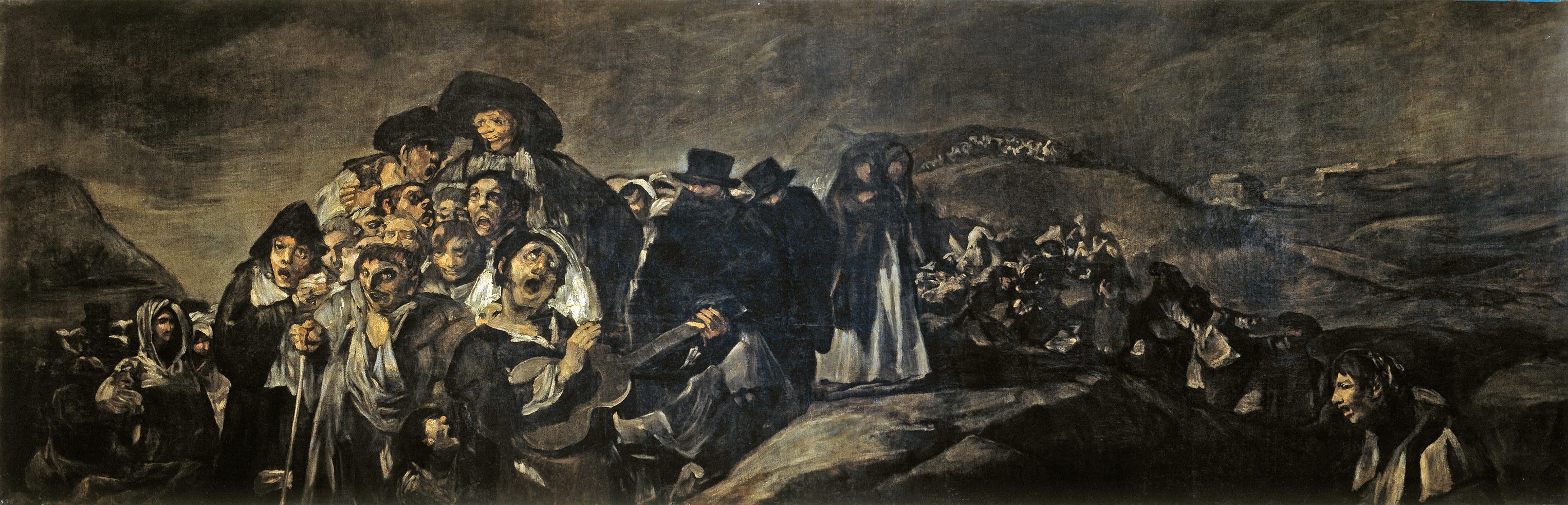
Francisco Goya, A Pilgrimage to San Isidro, 1820–1823
I think of myself as a sort of “no bullshit” kind of girl. I’m not interested in playing anything being more than it is. You can have your fetishistic “transition is a magical act” phrases. You can have your “transition is a radical act” phrases. I do not buy them. You can sell them. I am not against them. They serve a useful rhetorical purpose, but it is not a rhetoric that I am interested in. But I, personally, am not buying. Transition, to me, is already so full of rich meanings. It does not need more glommed onto it. The thing is important in and of itself. It was important to me because I wanted to do it, and it remains important to me because I did it and wish for others to retain access to doing it. The trans women I hear speaking about their lives seem increasingly on my side regarding this. The desire to aggrandize the act is largely gone. The call to transition of the past few years has not been intellectual, medicalized, psychologized, or spiritualized. It has been “if you want to be a girl, you can be.”
This is a far cry from the world I transitioned in, the 2010s, which seemed always searching for new highs of self-involved analysis. By 2019 this had reached a fever pitch, as if the zeitgeist was aware that this world we inhabited would soon burn down amid pandemic and fascism. At its height, transition was not merely a radical act, or merely magic. It was not just an increasingly bizarre mix of psychological symptoms and personality type. No, at its height transition was a way of life. If you mentioned that you were excited to complete your transition, you were immediately met with polite, friendly interrogation. People would tell you, with little to no prompting, how they felt that their transition would never be complete. During this period, it became the norm to say that you were “transitioning” no matter how many years you had been out, no matter how many surgeries you had undergone, no matter how comfortable you’d become in your body. The trans body was never permitted rest. The trans person had to be committed to constant movement. Change was the law of the land.
I silently hated it. I knew I did not have it in me. My body and mind were too frail to do this forever. I had no shame about being trans, but the idea of transitioning forever felt impossible. Afterall, what I was transitioning to was womanhood. To say that I would always be transitioning meant to me that I could never be what I was putting in so much work to achieve. The demand to remain, permanently in transition felt cruel: it asked me to create a new embodiment for myself in the world, to render it as a tangible working reality which I could inhabit and live, while simultaneously following a political dictate that demanded I prevent this new reality from developing a stability.[1] You see, rendering my transition as a process of fabrication, that produced an end result, that satisfied itself in its own completion, in synthesis, was antitheoretical to the idea of transness as movement. Transness was, briefly, for five to ten years, a movement. It was a movement that demanded movement. This is not to say that trans people no longer have political goals. We very much do. However, today we increasingly exist as a people. Currently we are a people who are trying to survive the battering tide of right-wing movements against us. We stand and try to secure ourselves. Or we run to higher ground. We do these things together, but while we belong together and are a people composed of many people, we are no longer a movement. Movements demand constant progress and constant change. Movements are not organizations. Organizations are stable, steady things. You can find an organization’s office. You can ask about its structure. You can ask about its self-definition and self-understanding. A movement cannot sustain these things, for eventually, they get in the way of primary goal of all movements, to keep moving.
During the period when transness was a movement, a period I am deeply nostalgic for despite my gripes, transness demanded not only constant advancement. It insisted that the trans subject, the trans individual, exist in a constant state of movement. The idea that one might “finish” transition was rejected. One of the central demands of the movement was that transness be normalized to the public, yet the experience of transness in the individual trans person was never permitted enough stability to normalize itself in the body. It was as though achieving a new equilibrium and allowing the body to rest, for transness to become merely one way of life among other equally valid forms of spending the time between birth and death, was unthinkable. Transness, and therefore trans people, had to be what would change the world. Half a decade later, it would appear that we only ended up changing ourselves. Which, to paraphrase Velvet Goldmine, is fine as long as you don’t look at the world.
Still, I can’t help but feel that this demand placed on transgender people by the transgender movement, to never stop transitioning, to never live one day after the other, but to always be destabilizing and destabilized, asked too much. The individual cannot turn their body into Trotsky’s “Permanent Revolution”. And if a person could do that, should we really be demanding it of our most precarious and downtrodden? It’s funny how the demand to destabilize your gender is almost always leveled at people who already have a vilified gender modality. The demands on it seem actually almost exactly inverse to how likely you are to be an acceptable subject to the patriarchy.
Likewise, what does this demand actually entail? It rarely if ever seemed to be a medical demand. No one insisted that we bankrupt ourselves, going deeper and deeper into medical debt as we modified and remodified our bodies, changing ourselves until gender, perhaps even species, became hard to register. No one said that transition was never over because our job was to become Cronenbergian monsters of evasive description. Nor was the demand fashion-forward. We were not asked to go beyond gender as our wardrobes became less and less gendered, eventually defying sense itself, with Gaga-style meat dresses, suffocating our skin wrapped in cellophane, eventually giving way to flaying ourselves, wearing our own skin pinned back onto our bodies as we strove to transition our wardrobe further and further away from any sort of sense gender could make out of it. The demand wasn’t even social. No one was attempting to discover new forms of interactions that traversed gender after gender, year after year, until new languages and new objects, appeared crafted by our hands finally allowing us to drink coffee, say hello, and jog at night in a manner that evoked both neither and all genders. The demand was always, seemingly, spiritual.
If the demand to don’t stop, never stop transitioning ever had an actual meaning, it was a protestant ethic of purification, and perhaps that is why it socially clung to trans women above all others. It was the idea that toxicity, understood implicitly as maleness, understood as sin, was innate to trans women, and could never fully be purged, but if you were one of the good and glorious few, you would spend your life purging it from your soul. The demand to keep transitioning was the demand to never be good enough, pure enough, to truly be a woman, while simultaneously always fighting against your nature to be one. Implicit in it was a claim that you could expunge all the worst qualities from yourself, as long as you turned your life into productivity, into project, into never stopping, never letting the diligence and vigilance waver.
The following people are “founding member” paid subscribers. That is, they are people who decided that my work was not only worth supporting, but that they could afford to pay more than the rate I was asking. On both a financial and emotional level these people mean an incredible amount to me. I screamed aloud the first time anyone ever became one. I cried when a second person did. The least I can do is thank each one individually. They give me hope. Thank you to:
X Valentine, T S, i.m., Hopestill, Jane Oxabel and Rachel K
You have filled me with joy, and helped make this writing possible.
[1] I am very loosely paraphrasing a wording that Hannah Arendt uses in “Totalitarianism in Power” (roughly page 391 of Origins of Totalitarianism). In doing so I have no desire to imply anything right wing or despotic about transness or even this conception of transness. Instead, I am interested in Arendt’s idea of “movement”. Overall, the chapters “The Totalitarian Movement” and “Totalitarianism in Power” played an outsized role in my thinking through this issue with movement, not because of the totalitarian aspect, but the movement aspect.
No posts
Comments
Nothing yet. Say the first thing.
Sign in to join the conversation.