
There are easier ways to steal a diamond than breaking into a locked room.
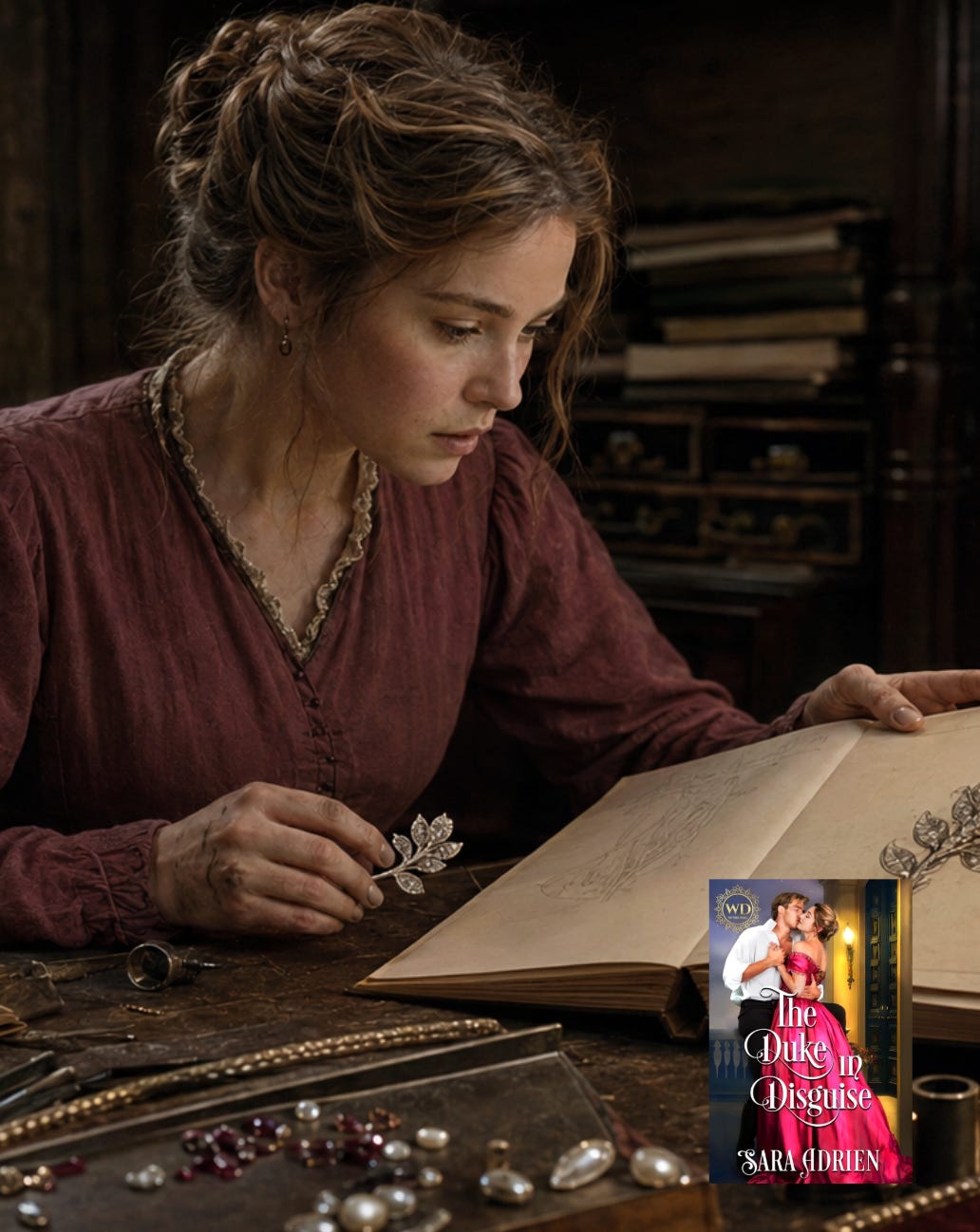
You can alter its description.
You can separate it from its papers.
You can bury it among hundreds of undervalued objects in a dead man’s estate.
You can arrange for the right bidder to acquire it at the right price—and then produce a catalog proving that everything happened openly, legally, and respectably.
By the time the auctioneer’s hammer falls, the theft no longer looks like theft.
It looks like a sale.
That realization shaped the mystery at the center of The Duke in Disguise.
When I began researching Regency auctions, I was struck by the peculiar intimacy of an estate catalog.
A person dies, and suddenly a stranger can buy his dining table, his books, his tools, his wife’s jewelry, his bed curtains, and the chair in which he may have spent the final evening of his life.
Everything is separated, numbered, described, and assigned a value.
An entire existence becomes a list of lots.
For the family of a prosperous gentleman, this might mean paintings, silver, horses, wines, furniture, porcelain, and the contents of several houses. For a tradesman, it could mean something even more devastating: the sale of everything required to earn a living.
Tools.
Materials.
Stock.
Ledgers.
Unfinished commissions.
The work of decades could be dispersed in a single day.
That became personal for Leah Hart and Simon Kingsley because the estate being auctioned in the novel belongs to Nathan Weiss, a Jewish jeweler from Clerkenwell. His benches, stones, settings, tools, and records are not merely possessions. Together, they represent his reputation, livelihood, and life’s work.
Nathan is dead.
But what is being done to him is not finished.
An auction catalog appears to be a neutral document.
It tells prospective buyers what will be sold, provides the order of the lots, and offers descriptions that allow interested people to decide what they wish to inspect or bid upon.
But every description is also an argument.
Consider the difference between:
An old diamond brooch.
And:
A fine antique diamond brooch of uncommon workmanship, formerly the property of a distinguished noble family.
The object might be identical. The words around it are not.
Here’s what I did with this in my new book:
Comments
Nothing yet. Say the first thing.
Sign in to join the conversation.