
Her radio clicked once at 6:13 p.m.
No voice.
Just the sound of an open channel—breath, distant movement—then nothing.
She checked the repeater, checked the battery, checked the settings. Everything looked normal.
Normal was a costume. She’d learned that the hard way.
She did her first perimeter walk slow, not because she was relaxed, but because speed looked like panic. The gates were closed. The cameras were on. The lights were steady—steady enough to feel intentional.
At the service road, Mateo was locking a shed.
He didn’t look up until she was close. He had the kind of stillness people get when they’ve spent years learning how to not invite conversation.
“You hear that?” she asked.
Mateo shook his head. “I hear lots of things.”
She almost smiled. “Fair.”
He glanced toward the main house. “They’re getting… comfortable.”
“Comfortable people do dumb things,” Lila said.
Mateo nodded once, like he’d been waiting for someone to say it.
Inside, laughter floated out from somewhere it shouldn’t have—too bright for the hour. Lila paused beneath a window and listened without meaning to.
A man’s voice, smooth: “You’re safe here.”
A woman’s voice, not as smooth: “That’s what scares me.”
Then the laugh again—someone turning fear into entertainment.
Lila kept walking.
You couldn’t patrol morality. You could only patrol outcomes.
She rounded the pool house and found two staff members arguing in whispers behind a hedge.
One of them—young, eyes wide—saw her and froze.
Lila held up a hand. “I’m not your problem.”
The older one swallowed. “There’s people in there that shouldn’t be.”
“People that shouldn’t be where?” Lila asked.
The young one spoke too fast. “In places. In rooms. In—”
The older one cut in, voice tight: “It’s not criminal. It’s just… it’s not right.”
Not right was the only language left when law had been replaced by discretion.
Lila nodded, slow. “Who’s in charge tonight?”
Both of them looked away at the same time.
That told her enough.
She walked to the side entrance where security staff usually checked in. The desk was empty. The logbook was gone.
Not stolen.
Removed.
That was different.
She tried her radio again. “Base. This is Lila. Check.”
Static. Then a soft click. Then nothing.
Her phone showed no signal, and she hated how quickly she started believing it was intentional.
A figure moved in the driveway—one of the residents, expensive casual clothing, posture like the ground owed him rent.
He saw her and smiled like they were colleagues.
“Evening,” he said. “Everything under control?”
Lila kept her voice neutral. “Who authorized removal of the logbook?”
His smile didn’t change. “We don’t need logs. This isn’t a prison.”
“It’s a security operation,” she said.
He stepped closer. “It’s a community.”
Community. The word people used when they wanted obedience without accountability.
Lila glanced past him. A dark SUV idled near the treeline. Unmarked. Engine running. Nobody getting out.
He followed her gaze. “Don’t worry about that.”
She looked back at him. “You’re giving me a lot of instructions for someone who doesn’t believe in rules.”
His smile thinned. “You’re smart.”
Flattery was a tool.
“So I’ll say it plainly,” he continued. “We’re handling things internally tonight.”
Lila felt the temperature drop inside her chest. “Handling what?”
He didn’t answer. He didn’t have to.
From behind the pool house, there was a sudden sharp sound—metal on stone—then a brief shout that ended too quickly, like someone had put a hand over it.
The man didn’t flinch.
That was the moment Lila decided what she was.
Not an employee. Not a guest.
A witness.
She moved toward the sound.
The man stepped into her path, gentle as a suggestion. “Hey. Let’s not create problems.”
Lila’s tone stayed calm. “Move.”
“Listen,” he said, still smiling, “we’re all stressed. People blow off steam. That’s normal.”
Normal. The dirtiest word in the world.
Lila looked him in the eyes. “If you’re blocking me, you’re part of it.”
His smile disappeared for the first time. “You’re overreacting.”
Lila stepped around him anyway.
Behind the pool house, the fire pit was still warm, and the air smelled faintly like lighter fluid even though nobody should’ve been using it this hour.
Mateo stood in the shadows near the hedge, frozen in place.
His eyes met hers.
He didn’t speak, but his face said: Don’t go closer.
Lila went closer.
On the ground, in the grass, a phone lay face-down. Expensive. New. The kind that still believed in signal.
Beside it, a cufflink.
Gold.
Initials carved into it.
Lila picked it up with the corner of her glove.
“Is someone hurt?” she asked quietly.
Mateo swallowed. “Not who matters.”
That hit her harder than any scream.
A light came on in the pool house for half a second, then snapped off again.
A flicker, like a mistake corrected.
Lila heard a soft voice behind her—calm, amused, too close:
“You’re very good at noticing things.”
She turned.
A man she hadn’t seen enter stood there, hands empty, posture relaxed, eyes bright with a kind of curiosity that did not belong in a crisis.
Not staff. Not security. Not resident.
Observer.
He smiled politely, like this was a fundraiser.
“Who are you?” Lila asked.
He tilted his head. “Someone who appreciates competence.”
Mateo’s jaw tightened. “She’s security.”
The man nodded. “I know.”
Lila felt her stomach go cold.
He held up his own phone. One bar of signal blinked briefly, then vanished.
“Funny,” he said, “how it appears for some people.”
Lila kept her voice steady. “What do you want?”
The man’s smile didn’t change. “To make sure you understand the game before you lose your piece.”
“What game?”
He glanced toward the dark pool house, then back. “The one where everybody thinks they’re insulated until they’re useful.”
A muffled thump came from inside. Then quiet.
Mateo whispered, “We should go.”
Lila didn’t move.
The observer leaned closer, voice soft, almost kind:
“If you walk away now, you’ll be safe.”
“And if I don’t?”
He smiled again. “Then you’ll be correct.”
Lila looked at the cufflink in her hand.
Initials.
Meaning.
Leverage.
And in the silence after the thump, she realized something worse than violence was happening here:
Someone was already writing the version of the story that would survive.
She slipped the cufflink into her pocket.
Not as proof.
As a promise.
Then she said, very calmly, to the observer:
“Tell me what you saw.”
He paused—just long enough to make it clear he’d been waiting for her to ask.
And behind them, the pool house door opened.
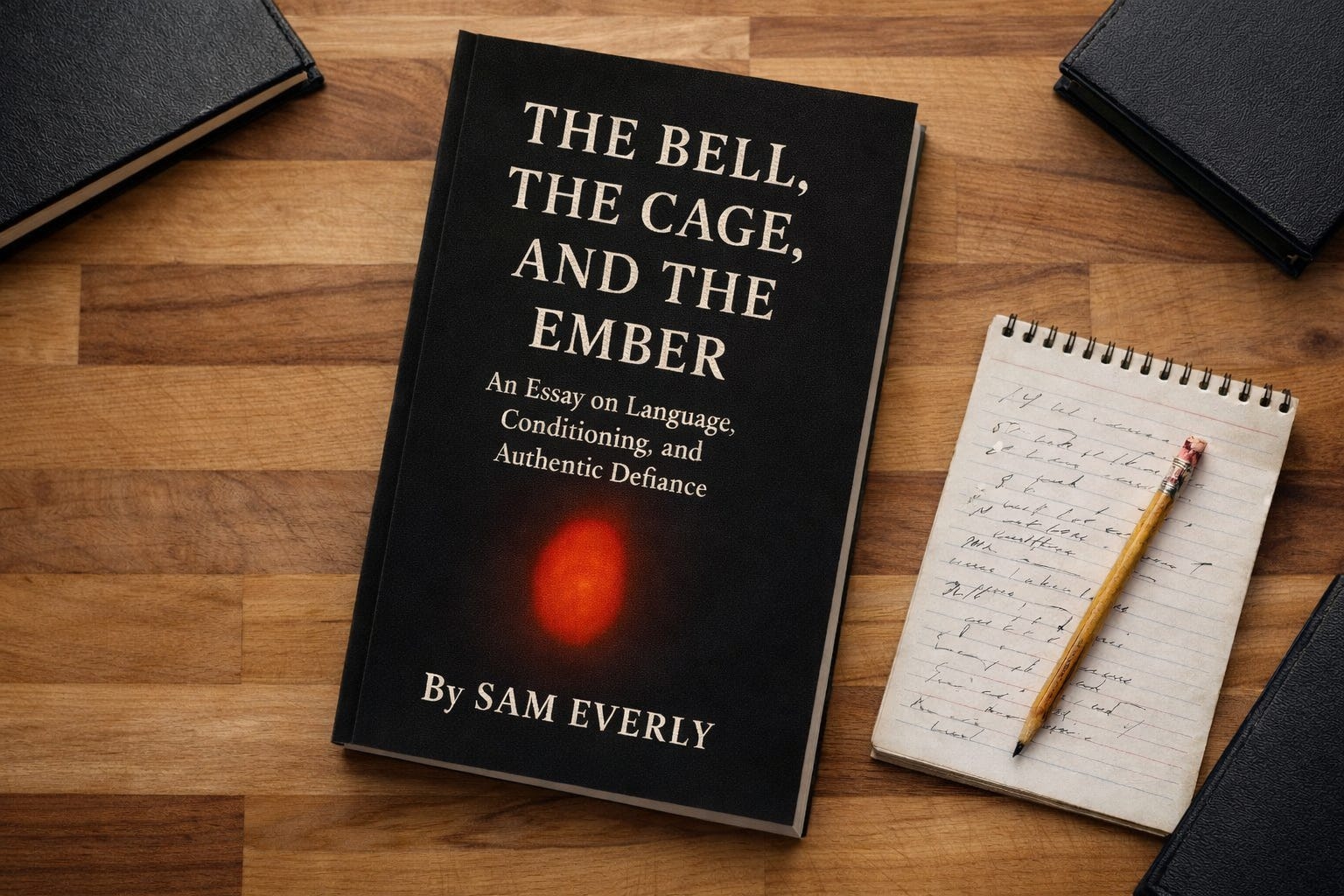
The book explores the quiet mechanics of power — how systems shape behavior long before anyone notices the shape forming.
If you’ve been following the online series Day Two After the Constitution Fell, you may already recognize some of the themes unfolding there. The current installment, Season 2, Episode 3: Lila, continues that exploration of time, compliance, and the small decisions that reshape a country.
The series will remain online for now, while The Bell, the Cage, and the Ember becomes the first work available in print.
Early copies at Read Mill will be limited. Preorders are recommended if you’d like to secure one.
And if you stop by the shop, feel free to mention you read about it in the series online — Day Two After the Constitution Fell.
— Sam Everly
No posts
Comments
Nothing yet. Say the first thing.
Sign in to join the conversation.