
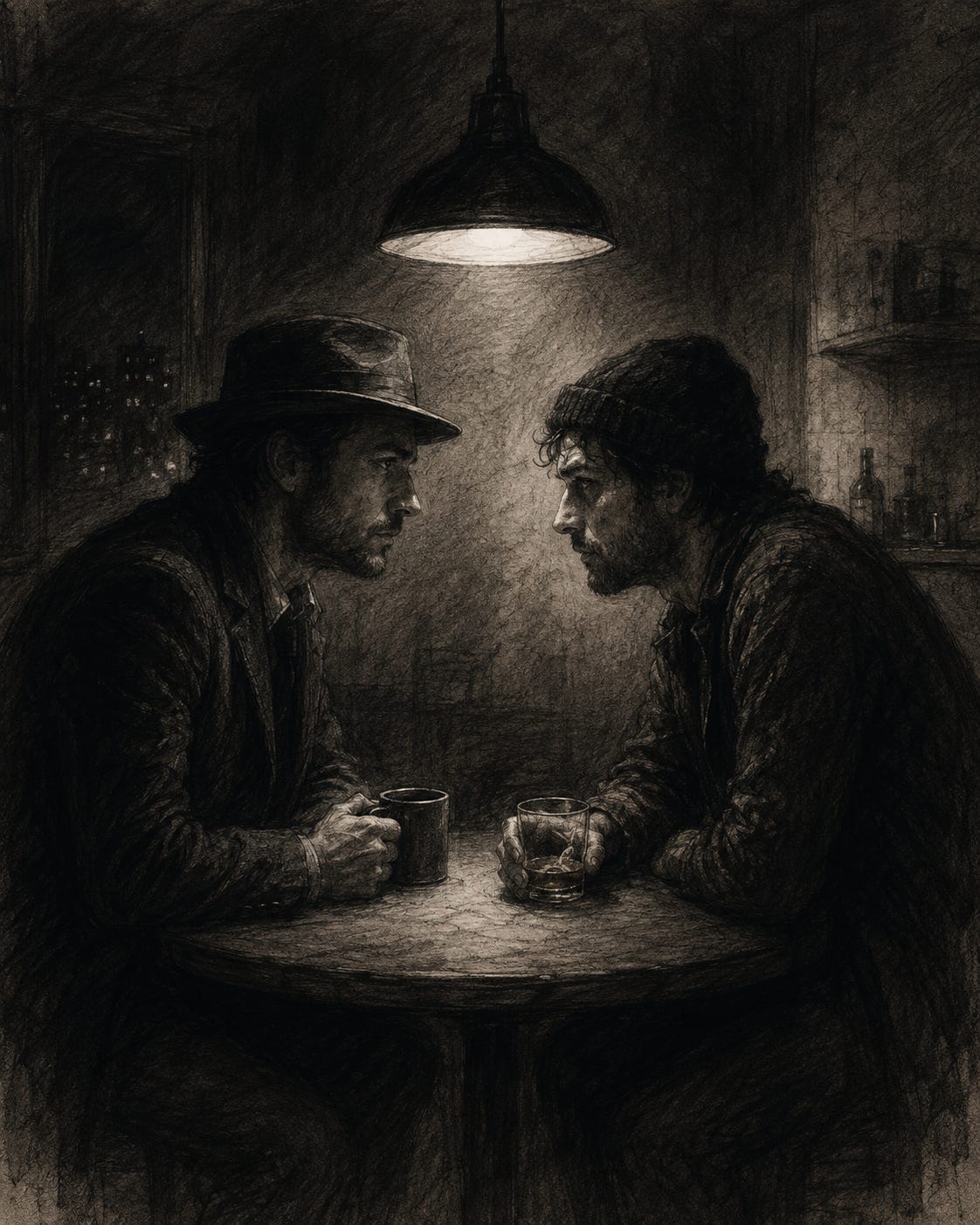
No.
You found a meme.
There is a difference.
There usually is.
The picture wasn’t important. Pictures are rarely the important part anymore. Pictures are bait. Colored feathers tied around hooks. Something bright enough to make the thumb stop moving.
What caught me was the candidate.
A man I’d never heard of, standing somewhere downstream from a series of endorsements I could not immediately reconcile.
So I went looking.
Not for confirmation.
Resolution.
There is a difference there too.
Accuracy and precision are very different things.
You can miss the target by one centimeter or by ten millimeters and congratulate yourself on improved measurement.
The hole is still in the wrong place.
So I asked the first question.
Did he actually say these things?
Some of them, yes.
Did he mean what people said he meant?
That was harder.
Good.
Harder is usually where the useful part begins.
The candidate had made jokes about Nazis. Holocaust jokes. Veteran suicide jokes. He owned a copy of Mein Kampf. He had said things that, isolated and arranged correctly, could make a perfectly serviceable political flamethrower.
But owning a book is not believing a book.
A joke is evidence that a joke was made.
It is not necessarily evidence of the entire philosophical architecture behind the person who made it.
So don’t cheat.
I’m not cheating.
You were about to.
I was about to make an inference.
That’s cheating when you dress it as evidence.
Fine.
So the question changed.
Not:
Is the meme true?
But:
Who is this man, and why are serious people willing to stand beside him?
That was the crack in the wall.
The Republican Party I remember was not this.
Careful.
Memory is a dishonest curator.
Fine.
The Republican Party I understood in the long wake of the Second World War was not primarily radical.
Better.
It contained radicals.
McCarthy did not arrive in a canoe.
The Birchers were not invented by cable television.
Goldwater did not descend from Mars.
But there were guardrails.
There were factions.
There were adults in gray suits whose chief political talent was making sure the boiler did not explode.
They were not saints.
Nobody asked them to be.
They were institutional.
And institutions, when functioning, have something resembling an immune system.
They reject certain things not necessarily because those things are evil but because those things threaten the organism.
What changed?
Trump.
Too easy.
Trump is a man.
Men die.
Movements survive them.
Try again.
What changed?
The party began capitulating to the will of the Trump party.
Better.
Again and again.
People who had condemned him stood beside him.
People who had warned about him endorsed him.
People who knew better discovered new definitions of better.
That is the part that bothers you.
Yes.
Because fealty this complete looks less like politics than a protection racket.
Careful.
I said looks like.
Good.
In organized crime, the arrangement is easy enough to understand.
Protection is offered against dangers that often originate with the people selling the protection.
Compliance buys safety.
Defiance acquires cost.
So I looked for the hidden transaction.
There must be one.
Must?
There usually is.
Usually is not must.
Fine.
There could be kompromat.
Epstein is the obvious gravitational body because it is large, ugly and already visible.
But not everyone had that access.
Not everyone had that appetite.
And a universal theory requiring a universal secret becomes ridiculous quickly.
So what else?
Power.
That’s embarrassingly simple.
Simple things embarrass people who prefer complicated explanations.
I prefer explanations with sufficient resolution.
Then increase the resolution.
What does power purchase?
Survival.
Access.
Money.
Committees.
Endorsements.
Audience.
Protection from a primary.
Belonging.
The continued ability to call yourself Congressman.
Senator.
Governor.
Relevant.
So the bargain may not be:
Do this or I expose you.
It may be:
Do this or you cease to exist here.
That is not a protection racket.
No.
But the architecture rhymes.
Still too easy.
Why?
Because I can count on my hands.
Primary win.
General loss.
Do that enough times and the fabric tears.
Short-term tactical reward.
Long-term strategic failure.
Little Bighorn with better catering.
A perpetual failure of the two-marshmallow test.
These are adults.
Yes.
Not merely adults.
Governors.
Senators.
Lawyers.
Fund managers.
Campaign professionals.
People who can calculate three states ahead while eating lunch.
We cannot explain an entire ideological reorganization across several generations by saying everyone became frightened of a straw man.
Agreed.
So the model is incomplete.
Good.
Now we’re working.
Perhaps the individual is rational while the institution fails.
Explain.
If I resist in the primary, I may lose my seat with certainty.
If I comply, I may win the primary and then perhaps lose the general.
One path gives me zero.
The other gives me something greater than zero.
But if everyone does that, the party becomes less electable.
Yes.
Then everyone is maximizing locally while destroying globally.
Fisheries do it.
Companies do it.
Armies do it.
Markets do it.
Families do it.
Nobody has to be stupid.
But the wise coordinate against the larger risk.
They should.
They don’t.
Why?
Because coordination itself has a cost.
And someone has to go first.
Little Bighorn again.
Different hill.
Same horses.
Still not enough.
No.
Because something else happened.
The people changed.
Not everyone.
Enough.
Selection.
Say it cleanly.
The institution did not need to convert every Republican.
It only needed to change which Republicans remained powerful inside it.
Some retired.
Some lost primaries.
Some became independents.
Some simply stopped speaking.
Some accommodated.
Some discovered that accommodation was conviction after enough repetitions.
The census of the room changed.
Then the room looked unanimous.
Survivorship masquerading as conversion.
Exactly.
You were asking how everyone changed their mind.
Perhaps many didn’t.
They left.
Or they were removed.
And the people who stayed became the sample by which we measured the whole.
That is cleaner.
Cleaner is dangerous.
Why?
Because it begins to explain too much.
Keep going.
Imagine ten people standing on a line.
One through ten.
The first four leave.
Nobody remaining changes position.
The average moves anyway.
Then pressure begins.
Five moves to six.
Six moves to seven.
Nine learns that ten gets applause.
Ten discovers that eleven exists.
Selection first.
Adaptation second.
Repeat.
Eventually the surviving institution can move a long distance while each individual move remains small enough to rationalize.
No one wakes up and sells the entire house.
They sell a chair.
Then a lamp.
Then the dishes.
The house feels spacious.
Eventually there is nowhere to sit.
Conditioning.
Yes.
Not bought.
Conditioned.
That’s worse.
Why?
Because bought implies a buyer.
Conditioned can become self-sustaining.
No one needs to issue the order anymore.
The institution learns.
The person learns.
The room learns.
The words change.
The definitions change.
And after enough repetitions, capitulation no longer feels like capitulation.
It feels like orthodoxy.
There it is.
There what is?
The cage.
But something else is happening.
What?
The solution is reorganizing.
Chemistry now?
Why not?
You’re going to misuse chemistry.
Probably.
Proceed.
A polar molecule can organize surrounding molecules—
Micelle.
What?
You’re describing something closer to a micelle.
Of course I am.
Carry on.
Fine.
The political body begins to organize around a polarized nucleus.
Material toward the outside remains more exposed to the surrounding environment.
Moderates.
Independents.
Traditional conservatives.
People loosely attached to the coalition.
They can fall out of solution.
The outer radius shrinks.
The center remains.
The surviving mass becomes more homogeneous.
Smaller.
Harder.
Purer.
And the loss of the outer material can be interpreted not as failure but purification.
The people who leave prove they never belonged.
Convenient.
Very.
The system manufactures confirmation out of its own losses.
That is elegant.
In the way tumors are elegant.
Don’t overwrite it.
Fine.
The fearful migrate toward the center.
Why fearful?
Preservation.
Those with the highest cost of separation need the strongest evidence that they remain inside.
They signal.
They conform.
They repeat.
The boundary moves and they move with it.
The peripheral material has another choice.
Dissolve.
Go independent.
Go home.
Cross the aisle.
Stop voting.
Become politically homeless.
And the center becomes more pure without persuading the outside at all.
Selection again.
Yes.
But there is another possibility.
The material that falls away can congeal somewhere else.
A second nucleus.
Now you’re thinking about Tucker Carlson and Marjorie Taylor Greene.
Yes.
The fracture inside the fracture.
People associated with the Trump movement becoming critical of Trump without becoming conventionally moderate.
So the expelled material does not necessarily travel toward the opposite pole.
It may preserve much of its original charge and reorganize around a new center.
Three masses.
Possibly.
But America hates three masses.
Our electoral structure punishes them.
Forty-five can beat thirty-five and twenty.
Even when thirty-five and twenty once shared a house.
So the third body need not survive to matter.
It can pull.
Distort.
Force recombination.
Seed new language.
Change the chemistry of whatever eventually absorbs it.
A failed party can succeed as an ideological solvent.
Or contaminant.
Depending where you’re standing.
There you go again.
What?
Trying to tell the reader where to stand.
Fair.
Let them observe.
This is where I expected to become frightened.
Instead I became strangely calm.
That’s suspicious.
Probably.
Why calm?
Because fracture is not necessarily death.
Now you’re being optimistic.
No.
Mechanical.
Systems shed material.
Forests burn.
Bodies scar.
Rivers relocate.
Institutions reorganize.
The important question is what survives the reorganization.
And what grows afterward.
You’re fine with the Republican fracture.
Politically?
Yes.
There it is.
Sleeve exposed.
Fine.
I don’t mind saying it.
I am not bothered by the possibility that a political coalition which has become unhealthy fractures.
What bothers me is the counterforce.
The pendulum.
The opposite mass gaining velocity because the first collapsed.
The correction overshooting.
One orthodoxy dying only to feed another.
That’s your actual concern.
Yes.
Not victory.
Balance.
Careful with that word.
I know.
Balance is not a destination.
It’s an activity.
Say it again.
Balance isn’t a destination. It’s an activity.
A tightrope walker is not balanced because he found the midpoint.
He is balanced because he never stops correcting.
Tiny movement.
Pressure.
Counterpressure.
Observation.
Adjustment.
Energy.
Balance costs energy.
Which means unnecessary mass makes balance harder.
Now we have the next piece.
Dead weight.
Exactly.
If balance requires energy to counterbalance, reducing dead weight lowers the energy necessary to maintain equilibrium.
Political systems drag enormous inherited weight.
Cold War identities.
Religious wars.
Race wars inherited from grandparents.
Economic doctrines created for industries that no longer exist.
Arguments assembled for technologies no one could have imagined.
Party loyalties formed around dead politicians.
Ancient injuries polished every election season until the blood shines again.
Not all inherited things are dead weight.
No.
Some are load-bearing.
Name them.
Constitutional government.
Equal protection.
Civil liberty.
Consent.
The peaceful transfer of power.
The presumption that citizens are not enemies merely because they vote differently.
The right to disagree without surrendering citizenship.
Those are beams.
Keep them.
What gets discarded?
Anything preserved only because our political parents hated one another over it.
That’s too broad.
Then say it more carefully.
We should regularly inspect inherited paradigms and ask whether they remain useful under present conditions.
Better.
Less poetry.
Sometimes precision needs fewer candles.
Counterpointed ideologies are healthy.
Explain.
Conservation asks:
What are we about to destroy that we may later discover we needed?
Progress asks:
What are we preserving merely because we inherited it?
Those questions belong in the same room.
Neither is sufficient alone.
One detects reckless change.
The other detects fossilization.
Counterweights.
Exactly.
The problem begins when the counterweights stop balancing the structure and begin fighting one another.
Then they become load.
Parental hierarchical wars.
Yes.
Children inheriting battles because the battles established family identity.
Our people fought their people.
Therefore their people remain wrong.
Therefore our conclusion must remain right.
The conclusion becomes ancestry.
The ancestry becomes virtue.
Nobody reopens the premise.
And eventually the argument survives the conditions that created it.
That’s dogma.
Yes.
And dogma is expensive.
Because?
It adds mass without adding information.
Good.
So where does this leave the candidate?
Almost irrelevant.
Then why did we begin with him?
Because doors are rarely the rooms they open into.
He was a datapoint.
A man in a Facebook post.
The initial question was whether he had said ugly things.
The useful question became why an institution would embrace him.
Then why institutions embrace anyone.
Then why people surrender.
Then whether they surrendered at all.
Then selection.
Then nuclei.
Then fracture.
Then balance.
You wandered.
I found north more than once.
Don’t steal your own line.
It’s mine.
Fair enough.
What did Herrera become?
A specimen.
Careful.
A case study.
Better.
Not proof of fascism.
Not proof of innocence.
Not even the central subject.
Just a place where the structure became visible enough to examine.
You wanted to call him a Nazi.
No.
You wanted permission to suspect it.
Maybe.
And?
Not enough evidence.
Good.
That matters.
Why?
Because if the entire purpose is to criticize orthodoxy, building the criticism on a preferred orthodoxy is embarrassing.
Exactly.
Increase resolution before increasing confidence.
There it is again.
It keeps surviving.
Useful things do.
I still don’t like the explanation.
Which part?
That power is enough.
Why?
Because it lowers my estimate of us.
There.
That’s the wound.
I wanted there to be coercion.
A secret.
A photograph.
A ledger.
Something terrible enough to explain behavior I found otherwise difficult to reconcile.
Because if there were a terrible secret, then the person surrendering principle might still possess principle.
He would simply be trapped.
Yes.
Blackmail preserves the victim’s moral architecture.
Power doesn’t.
Power says he made the trade.
Repeatedly.
For access.
For survival.
For another term.
For applause.
For proximity to the nucleus.
You wanted the explanation to be darker because darkness would have been kinder.
That’s unpleasant.
Most useful observations are.
So man really is that easily bought?
Again.
Conditioned.
Fine.
Conditioned.
But don’t make the opposite mistake.
Which?
Assuming everyone participating is cynical.
Some believe.
Some adapt.
Some fear.
Some calculate.
Some belong.
Some hate the opposition more than they distrust their own side.
Some genuinely think the structure they are defending is civilization’s last wall.
People rarely experience themselves as villains.
Even while?
Especially while.
That may be the most dangerous property we possess.
The ability to narrate accommodation as virtue.
And now?
Now what?
What’s Condition 26?
A diagnosis?
Too arrogant.
A working diagnosis?
Still pretending we’re physicians.
Observation, then.
Condition 26 is the condition of looking at a political body in 2026 and discovering that the body may not be failing in the manner outsiders think it is failing.
It can lose elections and gain purity.
Lose members and gain cohesion.
Lose doctrine and gain identity.
Lose history and gain mythology.
Lose a perimeter while hardening a nucleus.
Then fracture again.
Then reorganize.
Then attract new material.
Then call the new arrangement ancient.
That’s bleak.
Incomplete.
What is missing?
Balance.
You keep making balance sound passive.
Then stop hearing it passively.
Balance is labor.
Balance is muscle.
Balance is error correction.
Balance is admitting that yesterday’s successful counterforce may be today’s excess force.
Balance requires observing movement without becoming emotionally married to the direction of correction.
So no center?
Not necessarily.
The center is merely a coordinate.
Balance is behavior.
Then the goal is not moderation.
Correct.
A moderate answer can be catastrophically wrong.
Two people arguing whether the bridge can hold ten tons or one hundred tons do not become wise by agreeing on fifty-five.
Measure the bridge.
Resolution again.
Always.
Then what is the political goal?
Discard dead weight.
Preserve load-bearing principles.
Allow counterpoint.
Measure consequences.
Correct.
Repeat.
No ideology?
Of course ideology.
But ideology as instrument, not parent.
A hammer is useful until every problem becomes a nail.
Conservatism should conserve what deserves conservation.
Progressivism should progress where movement improves the structure.
Neither deserves obedience merely because it has a name.
That will annoy everyone.
Then perhaps it’s useful.
I started with a meme.
You did.
I thought I was fact-checking a candidate.
You were.
I thought I might discover a hidden mechanism explaining political submission.
You didn’t.
Not yet.
Good correction.
I found power.
Dependency.
Selection.
Identity.
Fear.
Belonging.
Purification.
Fracture.
Those are mechanisms.
Not conspiracies.
Conspiracies are emotionally satisfying because somebody is in charge.
Systems are worse.
Nobody needs to be.
A system can produce an outcome no single participant designed.
Everyone moves toward the nearest reward.
Away from the nearest punishment.
Locally rational.
Globally absurd.
And when the absurdity becomes visible?
Rename it.
Tradition.
Principle.
Destiny.
Mandate.
Patriotism.
Progress.
Resistance.
Whatever fits on the flag.
You’re getting cynical.
No.
Observational.
You’re enjoying that distinction too much.
Probably.
So write the conclusion.
I don’t trust conclusions.
Write one anyway.
Fine.
A healthy republic does not require ideological agreement.
It requires ideological counterpoint without inherited warfare.
It requires forces capable of opposing one another without needing to annihilate one another.
It requires citizens willing to discard dead paradigms without confusing age with wisdom, and preserve old principles without confusing novelty with progress.
It requires enough friction to control movement.
Not enough to ignite the machine.
And when an institution begins shedding its perimeter to preserve its nucleus, we should observe carefully before declaring either death or victory.
A smaller mass can be harder.
A fractured mass can seed another.
A defeated movement can reorganize.
A victorious counterforce can overshoot.
Nothing stays still merely because we have named it.
So perhaps the work isn’t finding the correct pole.
Perhaps the work is remaining awake while the weight shifts.
Apply force where force is needed.
Release it when it isn’t.
Discard what no longer bears weight.
Protect what still holds the structure.
And refuse the ancient invitation to inherit somebody else’s enemies.
That’s almost hopeful.
Don’t ruin it.
You don’t use that word anyway.
True.
Then what do you call it?
Practice.
Balance?
Practice.
Observation?
Practice.
Citizenship?
When we’re doing it correctly.
And when we’re not?
Condition 26.
A temporary diagnosis?
A warning.
To whom?
Both of us.
Which both?
Exactly.
No posts
Comments
Nothing yet. Say the first thing.
Sign in to join the conversation.