
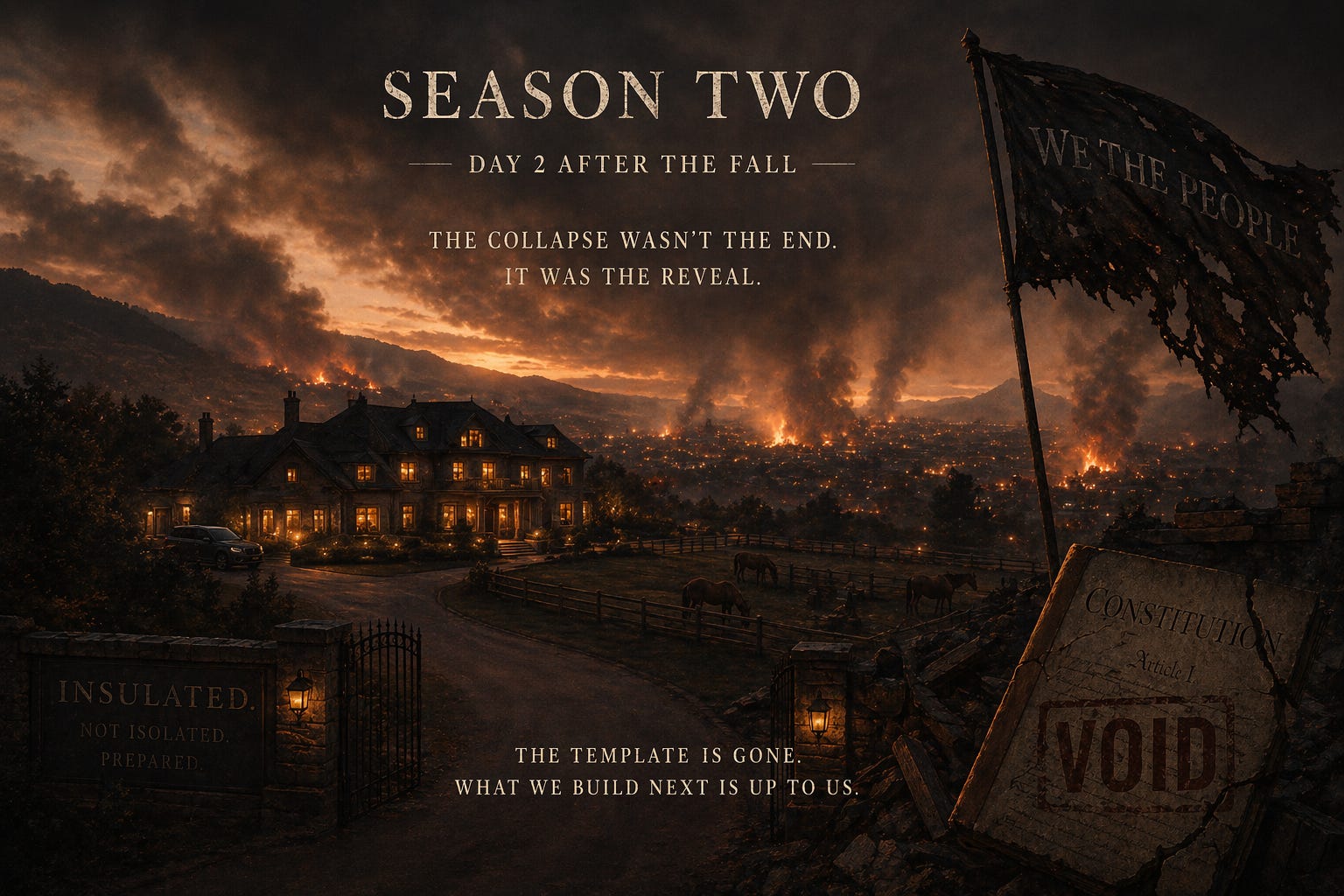
If this season felt excessive, that reaction is intentional.
What you’ve just read is not a story about violence erupting. It is a story about permission arriving.
Season Two begins on Day Two again—just as Season One did—because Day Two is when people stop asking what happened and start asking what still works. That shift happens faster in places that believe they are insulated.
We often imagine collapse as a downward force: poverty, desperation, chaos. But insulation creates its own vulnerabilities. Wealth delays consequence long enough for people to confuse comfort with virtue, access with merit, discretion with morality.
This estate did not fall apart.
It performed exactly as designed.
The speed with which control asserted itself—the narrative, the containment, the disposal—should feel wrong. It should raise the question the story refuses to answer directly:
How did everyone already know what to do?
Because this wasn’t rehearsal for collapse.
It was rehearsal for continuity.
Season Two exposes a truth that Season One only hinted at:
systems that survive upheaval are rarely built in response to it. They are built around it, waiting for a moment when accountability becomes inconvenient.
What looks like sadism here is not chaos—it is administration. The violence is not the point. The point is how quickly violence is reclassified as maintenance.
You may have noticed the absence of a clear antagonist.
That is also deliberate.
No single person “causes” what happens. Responsibility diffuses upward and outward until it disappears into process. Everyone involved tells themselves they acted to prevent something worse. That justification is the most dangerous tool in the story.
The observer exists because systems like this always produce witnesses—people who don’t intervene, don’t rescue, don’t expose. They record. Not out of virtue, but out of understanding that leverage outlives outrage.
The observer’s power does not come from violence.
It comes from memory.
From knowing who watched.
Who signed.
Who turned away.
Who touched the shovel and told themselves it was temporary.
As the seasons progress, you will see that this estate is not unique. It is a template—one of many. Season Three will move deeper into old wealth, old crimes, and older geography, where money was never meant to be seen, only protected.
Eventually, the world resolves itself into three dominant realms of power—not nations, not ideologies, but systems that extract value differently. What lies between them is not neutral ground. It is inventory.
This is not a story about evil people.
It is a story about ordinary people who discover that cruelty is easier when it arrives dressed as order.
If you felt compelled to keep reading even as things became unbearable, that reaction is part of the design.
Because systems like these don’t rely on force alone.
They rely on your reluctance to look away—and your hope that the worst part is already over.
It isn’t.
No posts
Comments
Nothing yet. Say the first thing.
Sign in to join the conversation.