
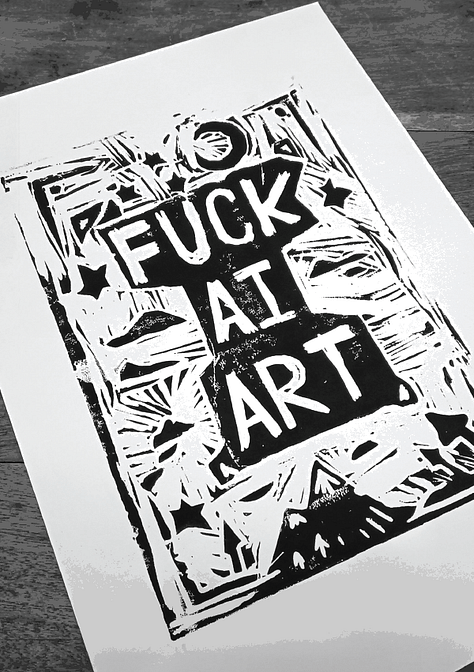
Let me start by saying that AI is an abomination, and I will never use it for my writing or art.
I’ve spent the last 3 years wrestling with the fact that AI exists. At times, I’ve believed that creativity is truly dead, and I’ve lived through every stage of grief - denial, pain, anger, and so on. I even wrote a novel about the subject, trying to reconcile things in my mind.
Finally, at least on a personal level, I’ve made my peace with it.
To be clear - I’m not talking about people losing their jobs. I’m not talking about copyright, and people’s work being stolen. I’m not talking about people being accused of using AI when they didn’t. Those things are a travesty.
I’m talking about the lone artist or writer who has spent their life pouring their hard-earnt passion into this thing we call “art” - now existing in a world where machines pump out infinite amounts of it with zero personal effort.
How do we live in a world like that?
A lot of people go with the argument that AI produces crap. This has never been my argument. I think it’s perfectly possible, even by chance, that AI could create something where, if a human made it, you’d say it was good. And it will only get better.
No, my argument is something that can never be taken away.
To sum up how I feel, consider the following conversation. I believe this is a perfectly rational conversation:
Person 1: Hey, look at this thing I made.
Person 2: Woah. That’s cool.
Person 1: Do you like it?
Person 2: Yes, it’s good.
Person 1: It’s AI.
Person 2: I don’t like it now then.
Person 1: It’s not AI. I made it.
Person 2: I like it again.
Person 1: It’s AI.
Person 2: I don’t like it.
Person 1: It’s not AI.
Person 2: I do like it.
That might sounds ridiculous - after all, it’s the same piece of art!
If the art itself isn’t changing, why is Person 2 changing their mind?
Maybe that conversation doesn’t sound ridiculous, but you can’t explain why.
Either way, now consider this conversation...
Person 1: This is Jimi Hendrix’s guitar.
Person 2: Woah. That’s cool.
Person 1: Do you think it’s worth anything?
Person 2: Yes. It’s worth a lot.
Person 1: It’s not Jimi Hendrix’s guitar.
Person 2: It’s worth very little.
Person 1: It is his guitar.
Person 2: It’s worth loads.
Person 1: It’s not his guitar.
Person 2: Worth nothing.
Person 1: It is his guitar.
Person 2: Worth everything.
Hopefully this one is clearer. But I believe it’s the same conversation.
Like the piece of art, the guitar itself isn’t changing. Only our relationship to it.
Both conversations are rational because our relationship with the material world goes far deeper than the material itself. We understand that things have inherent value1
We care. We care about everything going on behind the material. We care whether or not the guitar belonged to Jimi - it matters. And it matters if a piece of art was created with effort, skill, personality, authenticity, experimentation, struggle, sacrifice and passion.
And so, human-created art will always have inherent value purely by virtue of being created by a human.
If you’re a writer, an artist, a musician - or you’d like to be - and you’re struggling to cope with the fact that AI exists, remember that the things you make matter. They matter infinitely more than the things no one made.
Your voice matters, in all its messy imperfect crazy human glory.
With all this in mind, here are some ways I’ve found to cope with all this. They’re notes I’ve come up with or collected over the last 3 years, and I hope they’ll help you too.
If nothing else, you enjoy writing, painting, making music, etc. In a way, that’s all that matters.
There will always be people who crave and appreciate human-created art and literature
In a world of AI-abundance, actual human creativity will become a more sought-after skill
You can embellish your craft with other media - add music to your painting, paint a picture for your novel
You will always have your unique voice. Cultivate it, stay true to it, share it
You will always have your specific thoughts and observations. Look out for them
You’re not the only artist going through this. You’re not alone. You are part of a movement
Creating is thinking. You’ll learn more about yourself and the world by doing it
Record as much of your process as you can
Keep as many notes and drafts as you can
You can talk about every aspect of your work in a way that no one else can
Use it as an excuse to go more creative, more wild, more weird, more experimental, more human
For writers worried about other people using AI - even if someone used AI to write their book, they would still need to know enough about storytelling to know what’s good and what’s bad, to spot bullshit, to wrestle it into a shape that works line by line - and at that point, they might as well just learn how to be a good writer
Just pretend AI doesn’t exist
The main thing AI threatens is the internet, not real life
AI hasn’t ruined art - it forces us to look inward rather than out
Your audience was never the sort of person who enjoys AI slop anyway
All the more reason to make something human
AI is very good at making the specific thing it just made. Which makes it seem impressive. But if someone has a very specific vision in their mind of how they want something to look, sound, and feel, they won’t want to compromise with “that’s roughly what I asked for” - they’ll need to create it themselves, or work with a human who can. The job of the human is to get closer to this vision than a machine ever could, by listening, collaborating, understanding, and by working with creativity and passion.
There have always been people making crap, purely to sell it. And there have always been passionate people making things they care about, in the hope that other people might like it. In a way, nothing’s changed, it’s just become more extreme.
We care what was made by humans, and we always have. That’s because art is more than its surface. It is the doodle on a napkin that we discover was drawn by Picasso.
We have a habit of thinking that humans are worthless. But the things we create have inherent value. Human art is a finite resource. Machine output is not.
Just make things.
Incidentally, this is why you can’t walk into a shop with your own invented currency and expect to buy something.
Comments
Nothing yet. Say the first thing.
Sign in to join the conversation.