
Since my book came out on Amazon First Reads, I’ve been getting a lot of email solicitations from people wanting me to . . . pay them to publicize my book somehow? Give them money to feature my book in their book club? It can be unclear. In every single case except one, these emails have been obviously, and I mean blatantly, AI-generated. Which is kind of ironic given that my book is not exactly positive towards generative AI.
Here’s the subject line of one email:
Thanks for reading Root and Leaf - Anthony Tardiff! Subscribe for free to receive new posts and support my work.

“Scaling the OverNet legacy?” What does that even mean? Are you saying I should actually build the national hierarchical internet that the antagonist builds in my book?
One of the annoying quirks about Large Language Model slop is its tendency to use big, important-sounding phrases that fall apart if you look closely. It’s the language version of the way AI-generated images often have something that doesn’t quite work: a nearby doorway that merges impossibly with a pillar much further away, or the lack of a singular vanishing point, or an extra limb on a person in the background.
The body of this email is just as bad. LLMs are famously sycophantic. Usually that’s directed at the user, but if you ask the AI to butter up your spam target, they’ll do so. But when the only info you have to give the AI about your target is the publisher’s intentionally brief ad copy of their book, you get slop like this:

Another annoying stylistic quirk of LLMs is the way they randomly bold phrases, like an overwrought comic book. In the above case the LLM combines this tendency with quotation marks, which is even more jarring. Who are we quoting, exactly?
It gets better. Check out one of the services this publicist is offering:

LLMs love to label and categorize their responses in neat bullet-pointed lists. Often they invent category names that don’t really make sense. “Velocity engineering?” Sounds more like an aerospace term. Or, no: it sounds like the kind of vacuous marketing term that’s designed to sound impressive in an ad but doesn’t actually mean anything. “Only Sega has Blast Processing!” “Only this low-effort publicist has Velocity Engineering!”
The buttering up continues (sender name blurred to protect the guilty):

Professional integrity? That I brought to . . . an imaginary event in my story?
The very next sentence doubles down:

Jeez, you really do think we should build my antagonists’ network system! This AI has me confused with a character in my own story, and not one of the heroes, either.
The email I drew all these examples from is far from the worst I’ve received, by the way.
This is the worst:
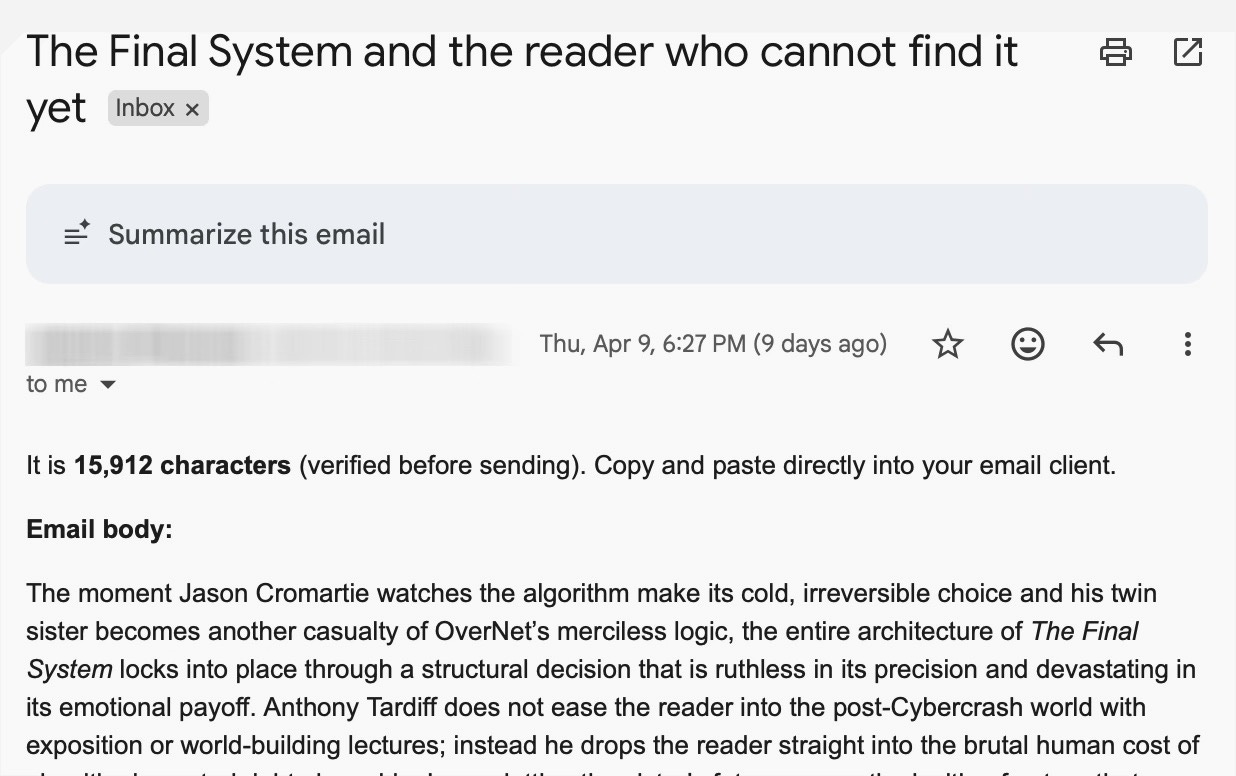
Sigh . . .
I’m guessing if I hired any one of these “publicists,” their work would consist of sending similar AI-generated emails on behalf of my book to a list of people also suggested by AI.
I wrote in a previous post about my ambivalence towards AI. I do think there are good use cases for a human language simulator. But there’s also, well, this slop.
I have ME/CFS, and one of its many downsides is that if I’m in a particularly bad crash, a negative trigger (like a stressful work or life situation) can send me into a depressive spiral. I’ve had bouts of situational depression a few times over the years. One of the worst things about depression is that it makes you feel like any meaning in life is just a veneer, and underneath that veneer is nothingness. (I don’t actually believe this, of course, but you try telling your feelings to get back in line when you’re depressed.)
AI slop like this gives me a similar feeling. It has the appearance of meaning, but that meaning only surface level. Underneath, there’s nothing but the ozone tang of the void. It kinda gets me down. And it’s not just showing up in spam emails. It’s increasingly everywhere. Youtube ads. Youtube videos. Substack posts. Comments on Substack posts.
Okay, I am going to put on my professional hat now (and with great integrity, too! ;)):
As a librarian who works in academia, my area of expertise is something called information literacy. Basically, that means the set of skills, and the mindset, necessary to interact with information effectively and ethically. For most of human history, the most friction in that process was obtaining information. Information took time, effort, and often money both to produce and to obtain, because it needed some sort of physical instantiation—a book, or a newspaper, a cassette tape, etc. Because of the expense involved, there was usually a whole series of gatekeepers who decided what information was worthy of dissemination. This meant that not every voice could be heard. But it also meant that the voices that were heard were more often (not always or anywhere near it, mind you, just more often) voices reaching a certain level of at least rhetorical quality that made them worth engaging with, even if you disagreed with them. Jim Bob in his mom’s basement couldn’t easily disseminate his conspiracy theories. The marketplace of information pre-filtered the majority of that information before it reached the common citizen.
Today, the internet has democratized information. There are fewer gatekeepers, and more voices are allowed to be heard. On the one hand, that’s a great thing! On the other hand, it means there’s a glut of information of wildly differing degrees of quality, and the burden is on us to spend the time and effort to navigate and parse and select from that firehose of information. The friction now is not obtaining information, but filtering and evaluating it, in order to select information of high quality. And let’s be honest: we’re not born naturally good at that. It takes skill, discernment, and practice.
(I’ll probably have a post in the future about how hypertext had its origins in a utopian idea that failed to account for human nature. We dreamed of a world of free information resulting in an enlightened humanity. We got social media.)
AI is making this problem exponentially worse by adding exponentially more “content” to sift through.
People are talking, somewhat hopefully, about a growing backlash to generative AI, but I think that’s like talking about a backlash to ads, or spam. Nobody likes it, but it’s not going away, because the people who make it derive some value in doing so. (And, again, there are good use cases for generative AI. It’s just so very, very easy to misuse it.)
I’m curious where it’ll all end. I hope not the way I imagined in my book:
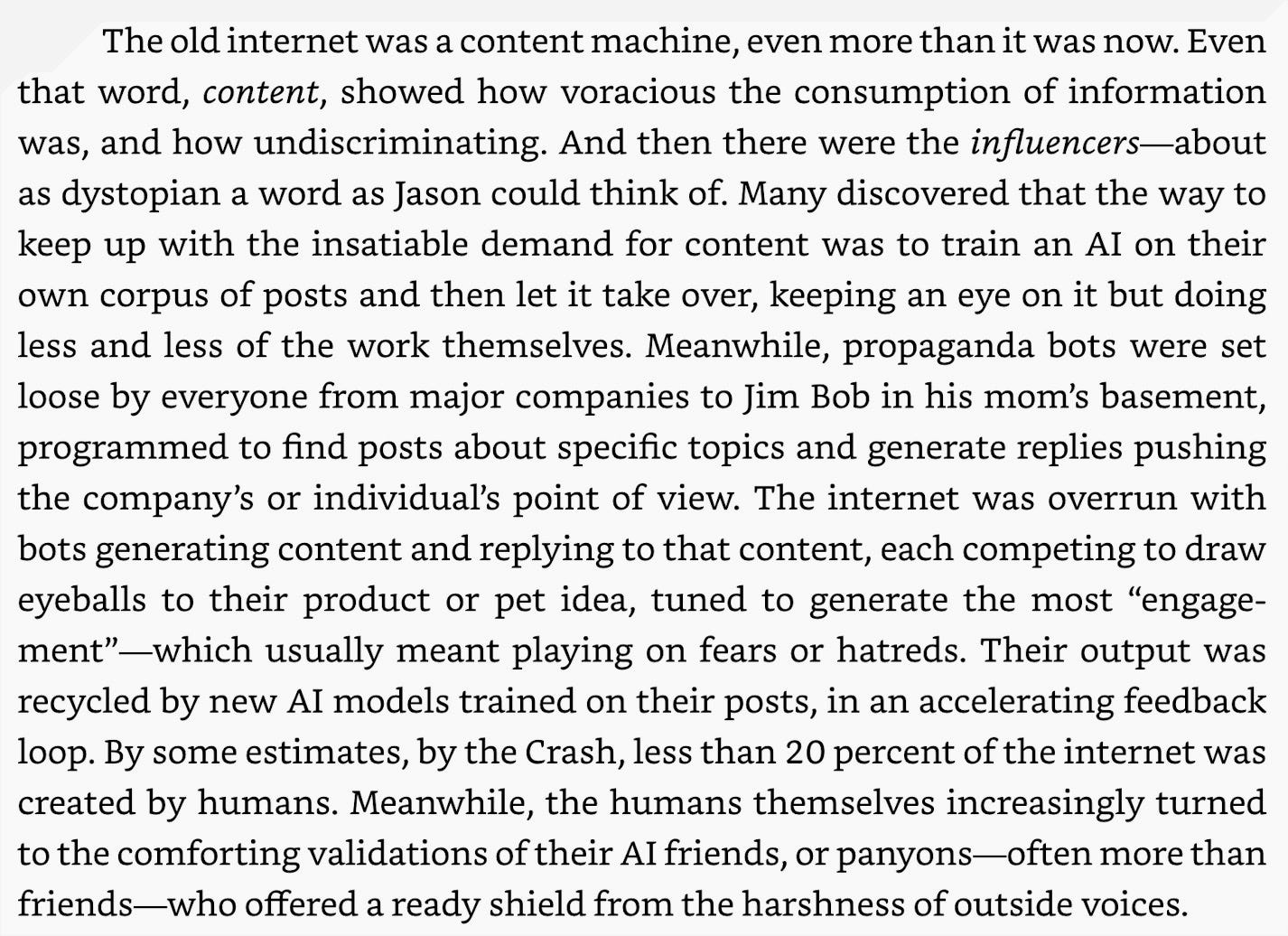
(AI companions is a topic for another time. But that’s already coming true, as well.)
Thanks for reading Root and Leaf - Anthony Tardiff! Subscribe for free to receive new posts and support my work.
Comments
Nothing yet. Say the first thing.
Sign in to join the conversation.