
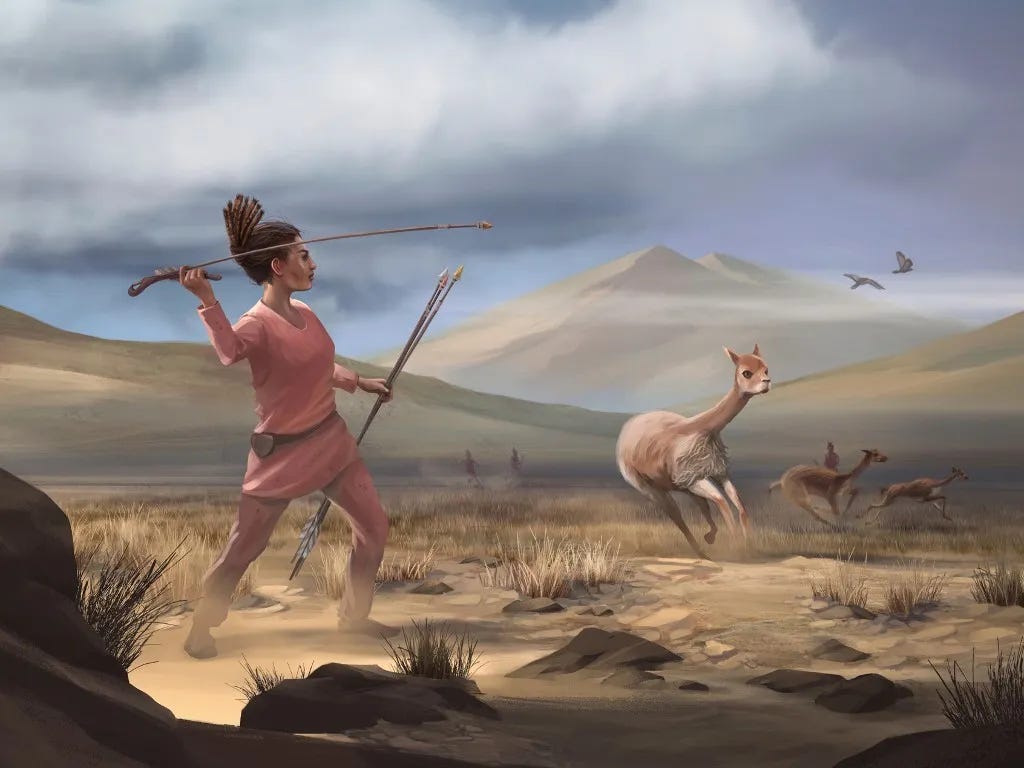
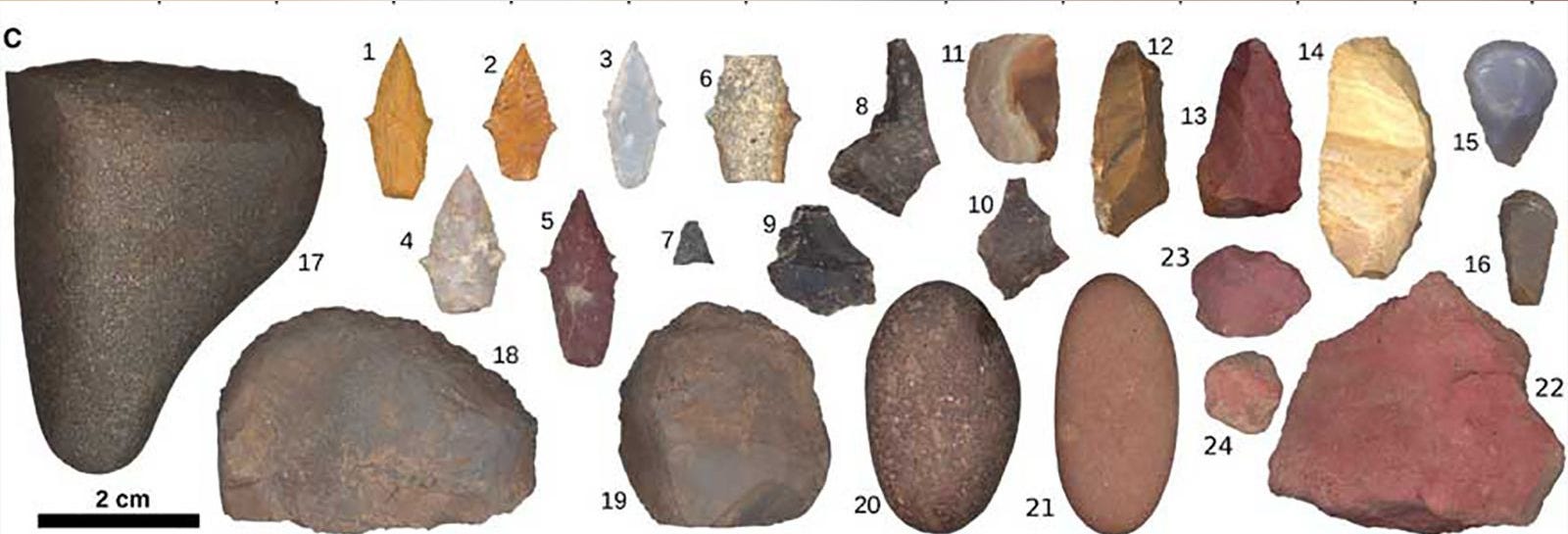
In 2018, archaeologists digging at a high-altitude site in the Peruvian Andes uncovered a roughly 9,000-year-old burial. The skeleton belonged to someone between seventeen and nineteen years old, laid to rest with extraordinary care. Beside the body: stone projectile points. Tools for processing animal hides. What researchers identified as a complete big-game hunting kit.
The team’s first assumption was the old one. A hunter buried with this much gear, this much evidence of skill and status, had to be a young man.
Dental protein analysis told them otherwise.
The hunter was a teenage girl.
Her name is lost to us. The researchers call her Wilamaya Patjxa individual six. Informally, they just call her Wilamaya.
For nearly sixty years, anthropology had an origin story for human evolution, and it had a title: Man the Hunter.
In April 1966, roughly seventy-five anthropologists gathered at the University of Chicago for a symposium organized by Richard Lee and Irven DeVore. Two years later, the proceedings became one of the most influential books in the field.
Its central idea was simple and enormous: hunting had shaped human evolution itself.
And hunting, in that framework, was men’s work.
This wasn’t just a cartoon caveman assumption picked up from old museum dioramas. It was formalized, published, cited, and built into explanations for human social life, cooperation, pair-bonding, and even the development of our bodies and brains.
So when Wilamaya appeared in the archaeological record — young, female, and buried with a hunting kit — she did not just complicate one grave.
She put the whole story under pressure.
One burial, by itself, could still be dismissed as an exception. A ceremonial oddity. A strange case. A single life that didn’t tell us much about a whole society.
So the researchers looked wider.
The Wilamaya Patjxa team did the responsible thing.
One grave proves nothing on its own. It could be an outlier, a ceremonial exception, a single life that doesn’t tell you how an entire society organized its labor.
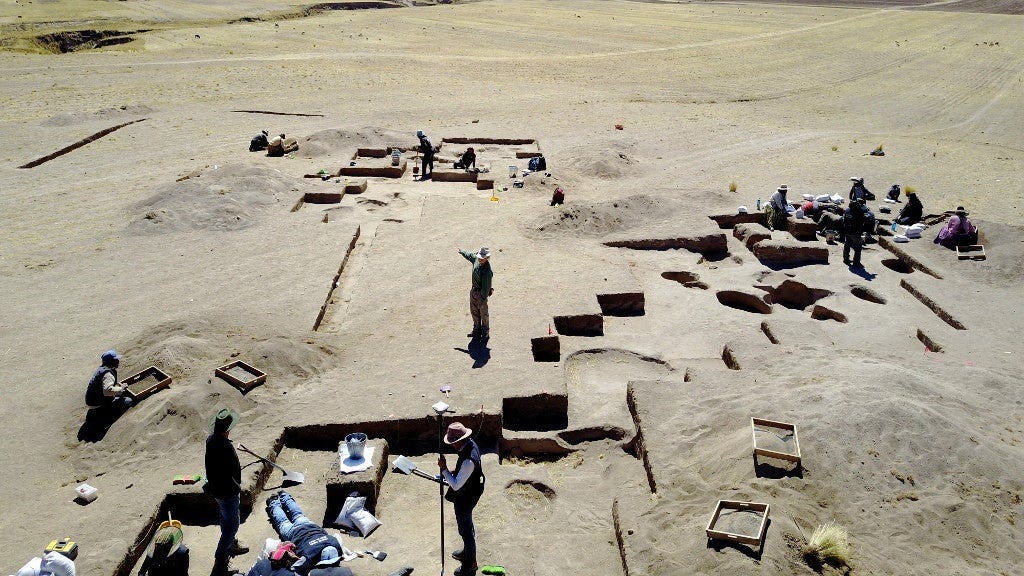
So Randall Haas and his colleagues went back through the archaeological record of the Americas and pulled every burial they could find where a person had been laid to rest with big-game hunting tools and where sex could be confidently estimated.
They reviewed 429 individuals from 107 sites.
They found twenty-seven people buried with big-game hunting tools.
Eleven of those twenty-seven were female.
Run the statistics on that, and the estimated range comes out between 30 and 50 percent female participation in early big-game hunting — high enough that the researchers concluded hunting was likely gender-neutral, or close to it, among Late Pleistocene and Early Holocene populations in the Americas.
That does not mean every woman hunted.
It does not mean every society worked the same way.
It means the old story — men hunt, women gather, forever and everywhere — was too small.
For comparison, many historic and contemporary hunter-gatherer societies do show men as the primary hunters. That pattern wasn’t imaginary. The problem was treating it as ancient, universal, and biologically inevitable.
The pattern had not been invisible. Archaeologists had seen women buried with hunting tools before. What they had not always done was take that evidence at face value.
Instead, the interpretation often bent around the assumption: weapons meant men, hunting meant men, and women found near that evidence had to be explained some other way.
The authors say the quiet part carefully: “modern gender constructs often do not reflect past ones,” and researchers have sometimes made “uncritical assumptions about past gender roles.”
Haas put it even more plainly:
“It took a strong case to help us recognize that the archaeological pattern indicated actual female hunting behavior.”
That strong case was Wilamaya.
The tools didn’t lie.
The assumptions did.
There’s a question that hovers under all of this: even granting the toolkit, even granting the statistics, could a teenage girl actually have done this?
For decades, the answer assumed in the field was simply no — and the reasoning behind that no reveals as much as the conclusion itself. Foundational work in the 1960s argued that hunting demanded raw physical power and psychological aggression that only males possessed, while gathering was framed, in one widely cited line of reasoning, as barely a skill at all — plants don’t run, don’t fight back, don’t need to be chased down or subdued. Pregnancy, lactation, and childcare were treated as simple disqualifiers, incompatible with the physical demands of the hunt by definition, not by evidence.
Recent physiological research tells a different story — one that was always available to test, and simply wasn’t.
Researchers reviewing exercise physiology and human metabolism have argued that women’s bodies are often better suited to endurance than older models allowed. Women tend to carry a higher proportion of fatigue-resistant slow-twitch muscle fiber. Hormonal differences, particularly around estrogen, can shift the body toward burning fat more efficiently during long exertion, sparing faster-depleting energy stores. Across ultra-endurance events — the kind that stretch on for many hours rather than a few minutes — the performance gap between men and women narrows, sometimes dramatically.
And this pattern is not limited to muscle. Modern medicine has had to relearn, again and again, that female bodies are not simply smaller versions of male ones — not in metabolism, not in hormones, not even in the heart.
None of this required new biology. It required new attention. The traits had always been there; nobody with influence had bothered to study them in women specifically, because nobody assumed the question was worth asking.
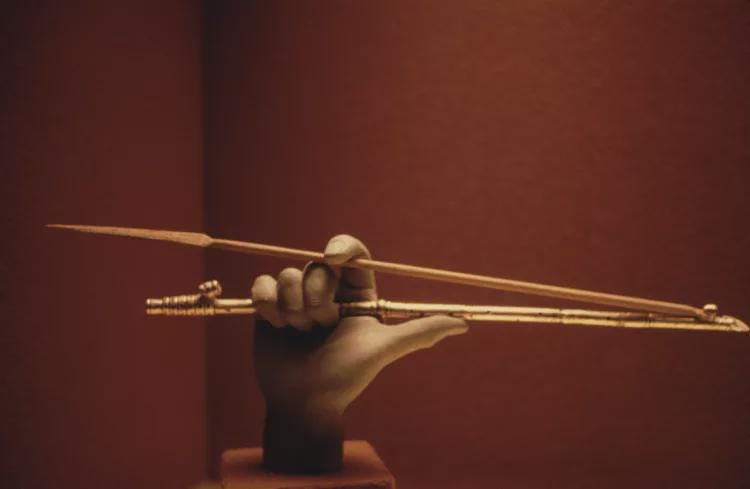
And the physical case for early hunting specifically tilts even further away from raw strength. The primary weapon available to Wilamaya’s generation wasn’t the bow — it was the atlatl, a spear-throwing lever that launches a dart well over 60 miles an hour using rotational leverage and timing rather than upper-body muscle mass. Researchers have shown both boys and girls can master it at a young age, well before strength differences between sexes become pronounced. Big-game hunting at altitude, with this technology, depended on group coordination, patience, and endurance more than brute force — and endurance is precisely where the old assumptions had it backward.
Even the modern era’s reaction to women testing their own physical limits tells the story. In April 1967 — one year after the Man the Hunter symposium helped formalize ideas about what women’s bodies were supposedly built to do — Kathrine Switzer registered for the Boston Marathon under her initials and ran it anyway, in a women’s division that did not yet exist. A race official tried to physically pull her off the course.
She finished anyway.
The science that would eventually show women’s bodies are often capable of exactly this kind of endurance was still decades away from being taken seriously.
The marathon official, in the meantime, settled the question with his hands.
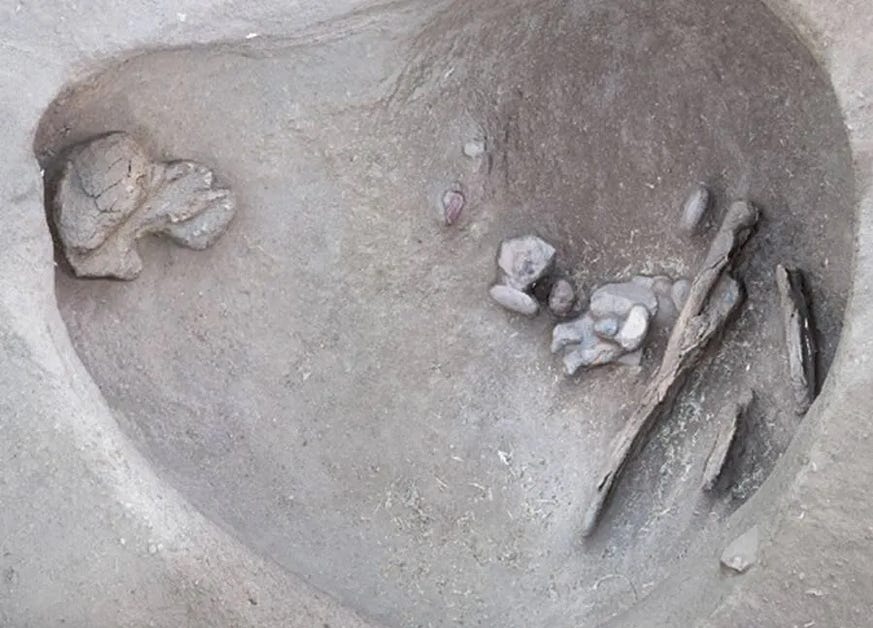
Wilamaya died young — somewhere between seventeen and nineteen — in a place and a time we can barely reconstruct, with no name that survived to reach us. What survived instead was the evidence: the bones themselves, the proteins in her teeth that confirmed her sex, the tools laid beside her with enough care that nine thousand years later, archaeologists could tell she’d been someone whose community valued her.
She didn’t get a name. She got something that, in this particular case, mattered more. She got proof that couldn’t be argued away — a grave so well-preserved, so cleanly associated with its tools, that the lead researcher called it about as secure as archaeology ever gets. That’s what it took. Not a theory. Not an argument. A body, undisturbed for nine millennia, finally excavated by people willing to test an assumption instead of confirming it.
The assumption had been load-bearing for the entire field. “Man the hunter” wasn’t a footnote in anthropology — it was a foundation, the explanation offered for everything from human pair-bonding to the size of our brains to why we walk upright. An entire architecture of theory had been built on the idea that this division was ancient, natural, and universal. One well-preserved grave in the Peruvian highlands, and the meta-analysis it forced, didn’t just add a woman to the historical record. It cracked the foundation the record had been sitting on.
She is not the only such crack.
Archaeologists working an ocean away have found women in Viking and Scythian burial contexts interred with weapons and martial equipment — graves that, in some cases, had long been assumed male because of what was buried inside them. A famous Viking-age grave in Sweden, long interpreted as male because of its high-status military equipment, was identified as female through genomic testing in 2017. Scythian burial sites have also turned up women, including young women, interred with weapons.
That is a different culture, a different era, and a different essay — one we’ll get to.
But it is the same lesson, learned again and again on different continents: the bones tell the truth. The people reading them are the ones who keep deciding, in advance, what the truth is allowed to be.
Kathrine Switzer ran that marathon a year after the symposium that helped certify what women’s bodies were assumed incapable of doing. Wilamaya had already complicated the same assumption nine thousand years earlier, and no one knew to ask her.
The tools didn’t lie. The assumptions took nine thousand years to catch up.
Haas, Randall, James Watson, Tammy Buonasera, John Southon, Jennifer C. Chen, Sarah Noe, Kevin Smith, Carlos Viviano Llave, Jelmer Eerkens, and Glendon Parker. “Female Hunters of the Early Americas.” Science Advances 6, no. 45 (2020): eabd0310. https://doi.org/10.1126/sciadv.abd0310
Smallwood, Ashley M., D. Shane Miller, Thomas A. Jennings, and Randall Haas. “Lithic Usewear Confirms the Function of Wilamaya Patjxa Projectile Points.” Scientific Reports 13 (2023): 18566. https://doi.org/10.1038/s41598-023-45743-7
Wall-Scheffler, Cara M. “Women Carry for Less: Body Size, Pelvis Width, Loading Position and Energetics.” Evolutionary Human Sciences 4 (2022): e36. https://doi.org/10.1017/ehs.2022.35
Ocobock, Cara, and Sarah Lacy. “Woman the Hunter: The Physiological Evidence.” American Anthropologist 126, no. 1 (2024): 7–18. https://doi.org/10.1111/aman.13915
Anderson, Abigail, Sophia Chilczuk, Kaylie Nelson, Roxanne Ruther, and Cara Wall-Scheffler. “The Myth of Man the Hunter: Women’s Contribution to the Hunt Across Ethnographic Contexts.” PLOS ONE 18, no. 6 (2023): e0287101. https://doi.org/10.1371/journal.pone.0287101
Hedenstierna-Jonson, Charlotte, Anna Kjellström, Torun Zachrisson, Maja Krzewińska, Veronica Sobrado, Neil Price, Torsten Günther, Mattias Jakobsson, Anders Götherström, and Jan Storå. “A Female Viking Warrior Confirmed by Genomics.” American Journal of Physical Anthropology 164, no. 4 (2017): 853–860. https://doi.org/10.1002/ajpa.23308
Guliaev, Valeri I. “Amazons in the Scythia: New Finds at the Middle Don, Southern Russia.” World Archaeology 35, no. 1 (2003): 112–125. https://doi.org/10.1080/0043824032000078117
Lee, Richard B., and Irven DeVore, eds. Man the Hunter. Chicago: Aldine Publishing Company, 1968.
Sussman, Robert W. “The Myth of Man the Hunter, Man the Killer and the Evolution of Human Morality.” Zygon 34, no. 3 (1999): 453–471. https://doi.org/10.1111/0591-2385.00224
Switzer, Kathrine. Marathon Woman: Running the Race to Revolutionize Women’s Sports. Boston: Da Capo Press, 2017.
Comments
Nothing yet. Say the first thing.
Sign in to join the conversation.