
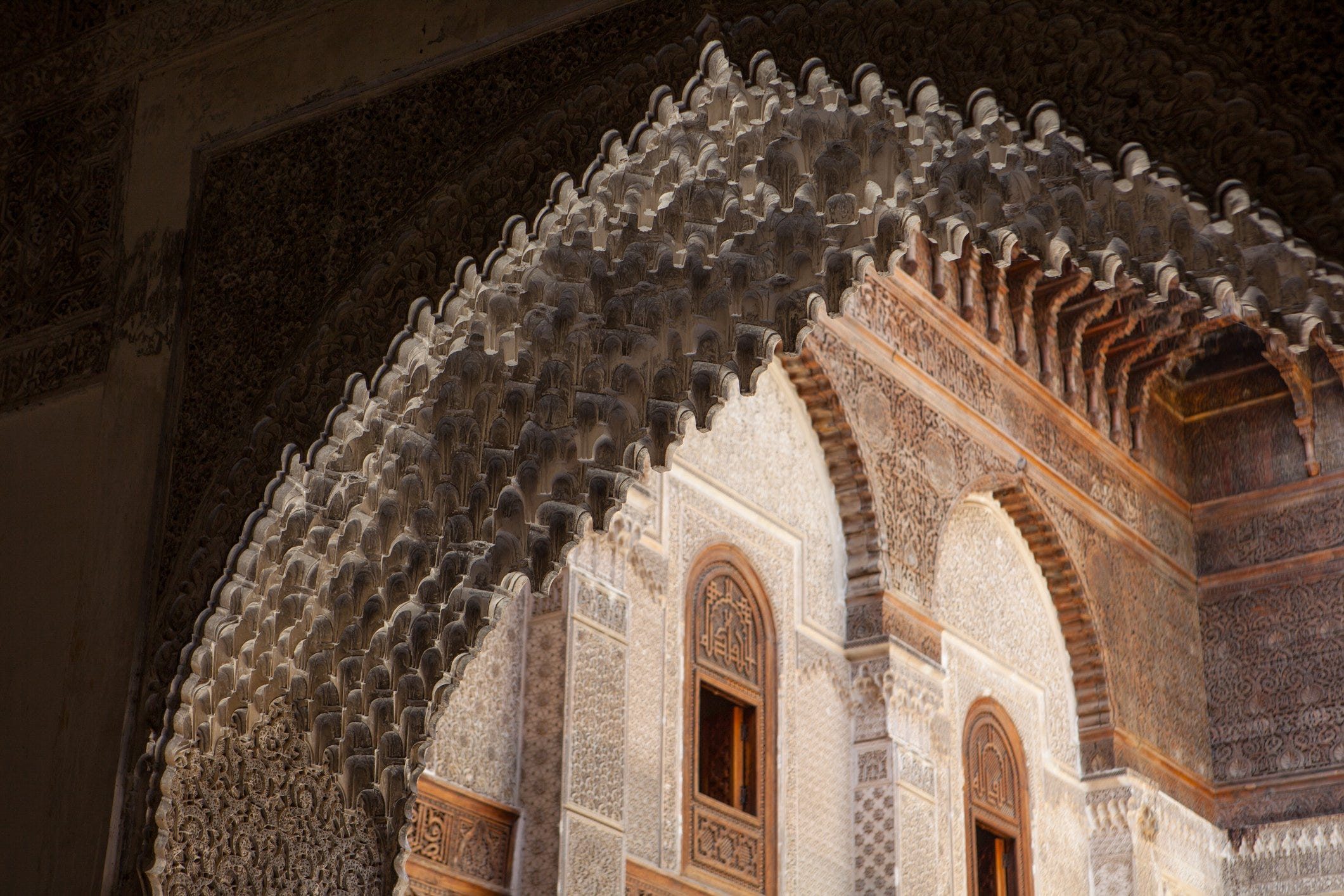
In 859, a woman in Fez stopped eating.
Not because she was poor.
She had just inherited a fortune.
Instead of spending it, she bought a piece of land and began building a mosque.
According to the only medieval chronicle that tells her story, she refused to break her fast until the work was finished.
The builders were instructed to take nothing from outside the site. The stone came from the ground beneath their feet. The sand came from the same earth. A well was dug within the courtyard. When the work was complete, she entered the mosque and offered prayers of gratitude.
The building she began is still there.
It has survived the Idrisids, the Almoravids, the Almohads, the Marinids, colonial rule, modern nation-states, and more than eleven centuries of continuous use.
Her name was Fatima al-Fihri.
And that’s where the mystery begins.
Today, Fatima is celebrated around the world as the founder of the oldest continuously operating university on Earth. Her story appears in museums, textbooks, university websites, documentaries, and UNESCO materials. She has become a symbol of women’s intellectual leadership in the Islamic world — a woman who supposedly founded a university centuries before Oxford, Bologna, or the Sorbonne.
I thought this would take a weekend.
A week later I was reading medieval Arabic chronicles, excavation reports, ceramic analyses, and arguments over whether a cedar inscription had been moved five hundred years after it was carved.
Medieval chronicles. Archaeological excavation reports. Architectural studies. Ceramic analyses. Epigraphy. Modern historiography. Arabic editions of medieval texts. By the end, I had spent more time verifying footnotes than reading the stories built upon them.
Historians disagreed. Fine, they always do. What surprised me was where.
The earliest surviving narrative identifying Fatima by name appears in the fourteenth-century Moroccan chronicle Rawḍ al-Qirṭās, written roughly four and a half centuries after the mosque’s traditional foundation date. The chronicle presents a vivid portrait of a woman remembered for using her lawful inheritance to build the Mosque of al-Qarawiyyin. It describes her devotion, her generosity, and even the details of the construction itself.
But it does not describe her founding a university. The chronicle gives us a mosque and a woman’s devotion. The university enters the story somewhere downstream, and nobody has fully mapped where.
Meanwhile, earlier geographical writers described Fez itself. They knew the city. They described its river, its markets, its twin districts of al-Qarawiyyīn and al-Andalus. Yet in the passages I examined, they did not preserve the story of Fatima and her sister Maryam.
That silence raises questions.
It does not automatically answer them.
Then archaeology entered the conversation.
Excavations beneath the present mosque confirmed something remarkable: beneath centuries of additions and renovations lies a genuine ninth-century mosque. The original building is real. Its foundations exist beneath the structure that still stands today. Archaeologists can literally trace the growth of the mosque across more than a thousand years of expansion.
And then there’s the cedar inscription dated 877 CE.
Some scholars believe the cedar inscription belongs to the mosque’s earliest history. Others argue it was moved centuries later. Both sides agree the inscription itself is authentic. They disagree over what it tells us.
The strangest part wasn’t the archaeology.
It wasn’t the medieval chronicle.
It wasn’t even the debate over whether the cedar inscription belonged where it was found.
It was how quickly the conversation kept collapsing into two extremes.
Either Fatima founded the world’s oldest university exactly as the modern story tells it.
Or she never existed at all.
The evidence never asked me to choose either position.
Instead, it pointed somewhere in between.
The sources preserve the memory of a woman associated with the foundation of one of the Islamic world’s most important religious institutions. They document a ninth-century mosque whose remains still lie beneath the present building. They also leave real historical questions unanswered.
Did Fatima al-Fihri found the world’s oldest university?
The evidence suggests a better question.
Whatever Fatima al-Fihri began, how did it become one of the greatest centers of learning the world has ever known?
Sometimes the truth isn’t smaller than the legend.
It’s simply more complicated.
And, at least in this case, far more interesting.
This week, I didn’t find certainty. I found a medieval chronicle, a ninth-century mosque beneath the floor of the present one, scholars arguing over a cedar inscription, historians disagreeing with one another, and a woman whose story refuses to stay neatly inside anyone’s preferred narrative.
Perhaps that’s where the real history begins.
Research Companion
This essay is the public-facing version of a much larger investigation.
If you’d like to explore the medieval chronicles, archaeological excavations, architectural evidence, and scholarly debates behind this story, I’ve made my working research paper available below.
Sources Cited:
Primary Sources
Ibn Abī Zarʿ. Rawḍ al-Qirṭās (The Garden of Pages). Dār al-Manṣūr edition, Rabat, 1972.
Al-Yaʿqūbī. Kitāb al-Buldān (The Book of Countries).
Al-Idrīsī. Nuzhat al-Mushtāq fī Ikhtirāq al-Āfāq (The Book of Roger).
Al-Bakrī. Kitāb al-Mughrib fī Dhikr Bilād Ifrīqiya wa’l-Maghrib.
Archaeology & Architectural History
Ahmed S. Ettahiri, Abdallah Fili, and Kaoutar El Baljani. Excavation studies of the earliest phases of al-Qarawiyyin Mosque.
Henri Deverdun. “Une inscription idrisside de la mosquée al-Qarawiyyīn de Fès.” (1957).
Chafik Benchekroun. Research on the Qarawiyyin foundation inscription and the early history of the mosque.
Abdelhadi Tazi. Jāmiʿ al-Qarawiyyīn (multi-volume history of al-Qarawiyyin).
Modern Scholarship
Encyclopaedia of Islam THREE, “al-Qarawiyyīn Mosque.”
Amira K. Bennison, “Sectarianism in the Landscape: The Transfer of the khuṭba of Fes from the Mosque of the Shurafāʾ to the Qarawiyyīn Mosque in 933 (321 AH),” Maghreb Review 40, no. 1 (2015): 12–27.
Ruggero Vimercati Sanseverino, Fès et sainteté: De la fondation idrisside à l’avènement des Mérinides (182–668/789–1269). Rabat: Centre Jacques-Berque, 2014.
The Reading Room is a reader-supported publication. To receive new posts and support my work, consider becoming a free or paid subscriber.
Comments
Nothing yet. Say the first thing.
Sign in to join the conversation.