
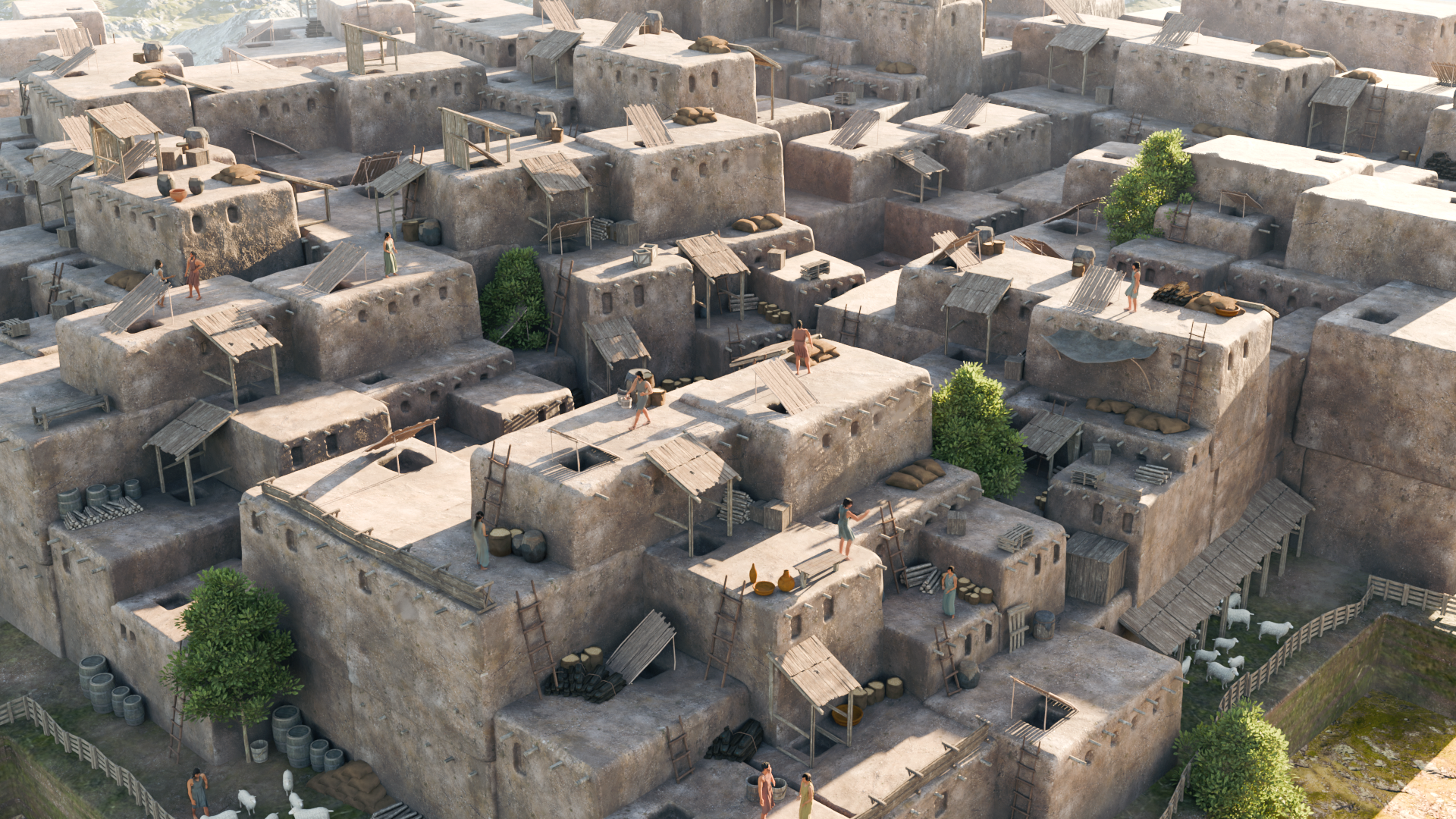
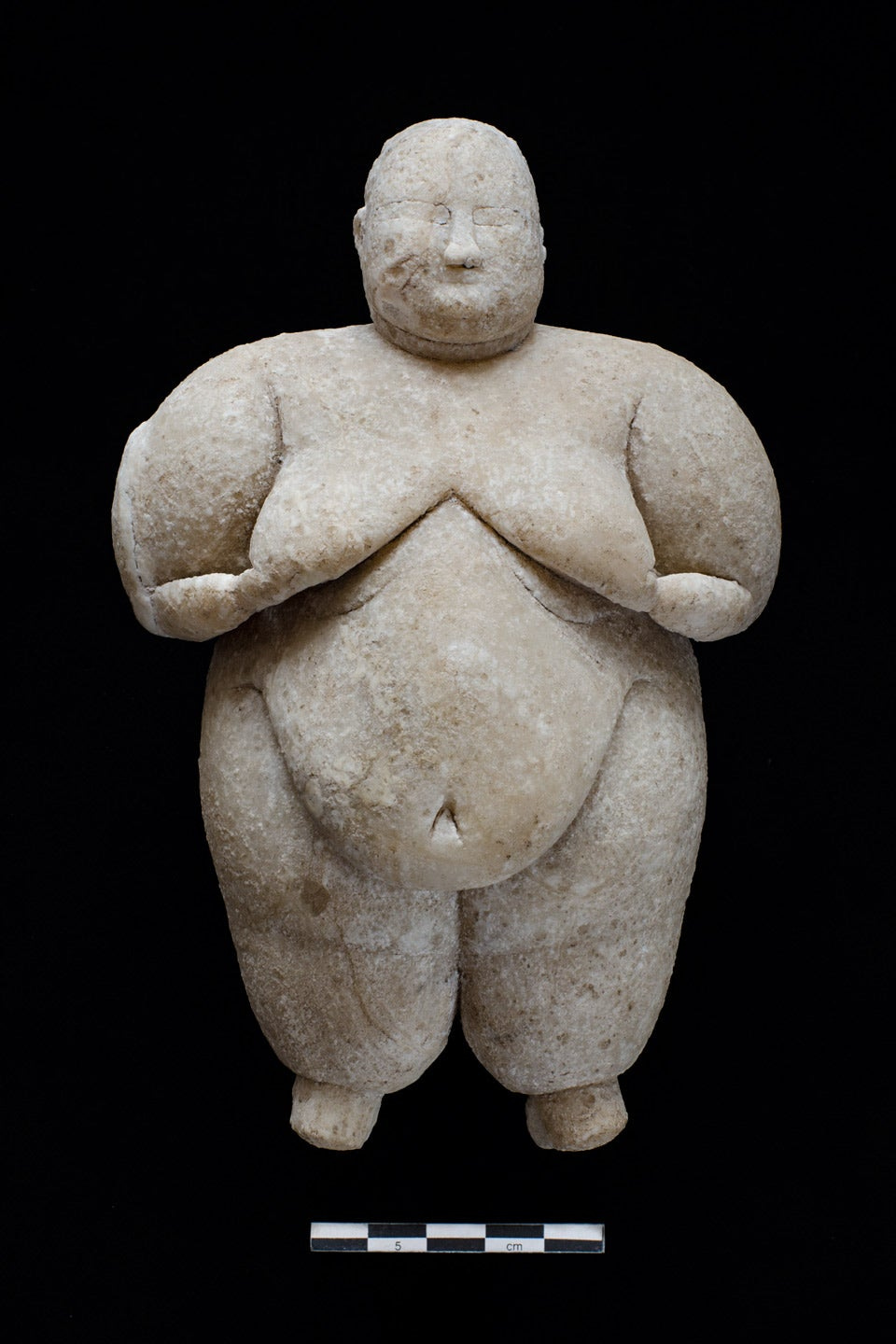
For sixty years, the most famous thing about Çatalhöyük was a clay woman on a throne. A rather stout goddess flanked by leopards, dug out of the Anatolian dirt in 1958 and pressed immediately into service as proof of a primitive fertility cult — the kind of tidy story that lets you file a 9,000-year-old city under charming and move on. Nobody could agree on how many people actually lived there. Estimates ran from a few hundred to ten thousand, and the argument never fully settled, because Çatalhöyük refused to leave the evidence a centralized authority leaves behind. No palace. No temple. No king’s house rising above the rest. Just thousands of mudbrick rooms packed wall to wall, entered through the roof, each one burying its own dead beneath the floor. The fight over the population number is itself the first clue: this was a city that somehow ran without anyone in charge of it.
In 2025, a team led by Turkish geneticists Eren Yüncü and Mehmet Somel published the largest ancient-DNA study ever attempted at the site. Twelve years of work. One hundred and thirty-one genomes pulled from bones buried under the floors of thirty-five houses, across roughly a thousand years of occupation. And the thing they found was not a goddess. It was a rule — unwritten, unenforced by any visible authority, and held in place for forty generations: the women stayed, and the men left.
The Reading Room is a reader-supported publication. To receive new posts and support my work, consider becoming a free or paid subscriber.
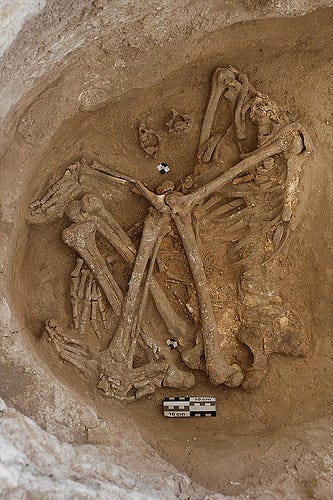
The skeletons under the floor
To understand why that finding took twelve years and a hundred and thirty-one genomes, you have to understand what the bones could not tell anyone before.
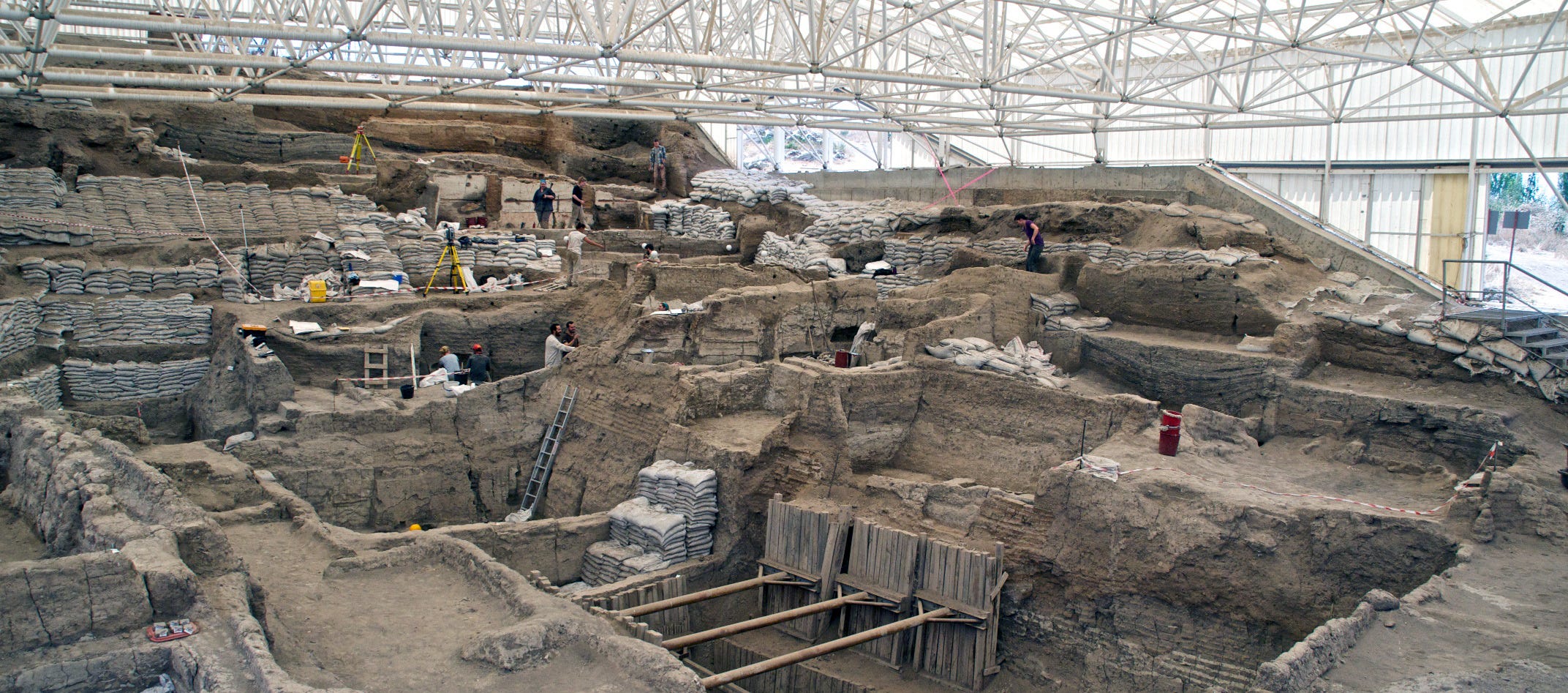
Çatalhöyük buried its dead at home. Not in a cemetery, not in a necropolis on the edge of town, but directly beneath the sleeping platforms of the houses people lived in. For decades this was a puzzle with no solution, because the obvious question — were the people buried together related? — was unanswerable from the skeletons alone. And the most basic fact about a child’s skeleton, its sex, is invisible before puberty. A nine-thousand-year-old infant gives up almost nothing to a tape measure.
So the field did what fields do: it inferred, and it assumed. The earlier consensus, built before genomics could touch the question, held that Çatalhöyük’s burials showed no real variation by wealth or gender — that the only bodies treated differently were children’s, dusted with red ochre and laid down with beads. A flat, egalitarian, gender-neutral death. That was the picture. It was not wrong, exactly. It was simply the picture you get when the tool can’t see the signal.
The DNA could see it.
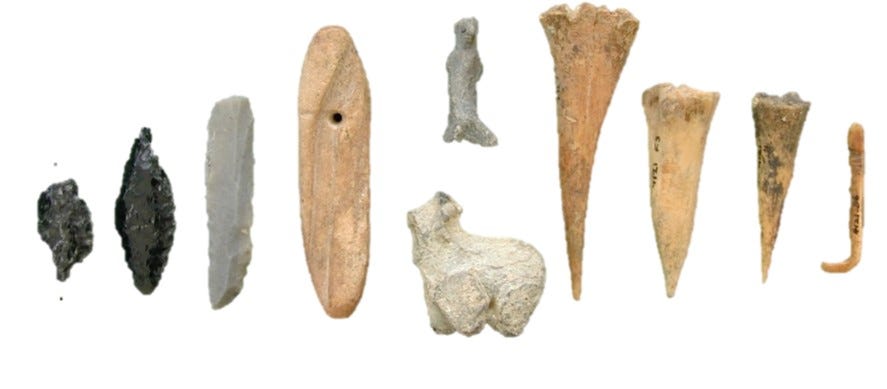
When the sex of those infants finally became readable — not from their bones but from their genomes — a pattern surfaced that no one had been able to confirm. Female infants and children were buried with about five times as many grave goods as males. Beads, mostly; the small wealth a community spends on its dead. And here is the detail that turns a statistic into an argument: among adults, there was no comparable gender gap in burial goods at all. The preference was concentrated entirely on the young. Female status at Çatalhöyük was not something a woman accumulated over a lifetime, not a thing earned through motherhood or survived into. It was assigned at the grave of a girl too young to have done anything but be born.
Three studies, one strange truth
This is the part where a careful reader gets suspicious, and should. A single dramatic study announcing a female-centered prehistory is exactly the kind of finding that gets ahead of its evidence. So it’s worth slowing down and watching the signal try to survive.
In 2015, long before the genome work, a stable-isotope study did something quietly subversive. It measured what people at Çatalhöyük actually ate, tooth by tooth, and discovered that people buried in the same house often had different diets from one another. The house, the researchers concluded, “may not have functioned as the simple domestic units that they are often assumed to be.” Translation: whatever was binding these households together, it wasn’t the tidy nuclear family the floor plan implied.
In 2019, a Polish-led team went looking for maternal kinship in the burials using mitochondrial DNA — the line that passes mother to child — and failed to find it. Their sample was small, a cluster of neighboring houses, and the maternal links simply weren’t there in the data. To their credit, they named the two honest possibilities: either maternal lineages varied so widely within a larger kin group that the signal washed out, or people were being selected for burial under a given floor by something other than blood.
Hold onto that, because it’s the whole game. A study designed to find maternal kinship came up empty — and a hostile reader, six years later, could wave that 2019 paper around as a debunking.
Except it isn’t one. In 2025, with ten times the sample and a thousand years of time depth, the maternal signal that the smaller study couldn’t resolve came through clearly. Where people buried together were genetically related at all, the relation ran through the female line. The men buried in a building were, generationally, the ones who’d married in; the women were the ones who’d been born there and stayed. Geneticists call this matrilocality, and the study put numbers on it: female offspring remained tied to their birth houses somewhere between 70 and 100 percent of the time, while adult males moved.
Three methods. A decade apart. Diet, then maternal DNA at small scale, then maternal DNA at large scale. The first said the house isn’t a blood unit. The second said we can’t find the mothers — and told you exactly why you might not, at that sample size. The third said the mothers are here, and the house is built around them. The finding didn’t arrive in spite of the field’s skepticism. It arrived through it, surviving even the study that went looking and came back empty-handed. That is what a real receipt looks like.
What the men got, and what it didn’t mean
It would be easy, and wrong, to flip the goddess story into its mirror image — to crown Çatalhöyük a matriarchy with women on the thrones the men used to occupy. The evidence won’t carry it, and the people who did the work are the first to say so.
There’s a tempting piece of color here. A separate 2022 study found that when bodies at Çatalhöyük were painted — and only some were — the pigments split by sex. Cinnabar, a rare and toxic red, turned up on adult males. Blue and green turned up on females. At a glance this looks like a status code, and you can almost feel the essay wanting to write itself: if the men got the rare imported red, who really held the power?
But the researchers checked, and the code doesn’t say what the glance wants it to. Yes, among the painted, color tracked sex. But who got painted at all — who was selected for that ritual treatment in the first place — had nothing to do with sex or age. The criteria, the study admits, “escape our understanding for now.” So the pigment split isn’t a hierarchy. It’s a grammar: a society marking male and female as different categories in its symbolic world without ranking one above the other. Which is, if you sit with it, the entire point. Differentiation is not domination. A culture can sort people into kinds without stacking the kinds into a ladder. We have so thoroughly fused “different” with “unequal” that a society which kept them apart reads to us as a puzzle.
And the women, crucially, weren’t queens. Men and women ate the same foods, shared the same kind of burial, lived in the same undifferentiated rooms. There was no female ruling class because there was no ruling class. What the women held was not power over. It was the lineage itself — the thread of belonging that ran through the house and passed, mother to daughter, while the husbands arrived from somewhere else and the bloodlines, in the city’s later centuries, loosened into something even stranger.
Family by choice, lineage by mother
Here is the finding inside the finding, the one that complicates the neat version and is better for it.
In the earliest layers of Çatalhöyük, households held real genetic kin — extended families under one roof. But over the generations, that blood relatedness thinned. By the later periods, many of the people buried beneath the same floor weren’t biologically related at all. Babies interred together, sharing the most intimate space a community has, with no genetic tie between them. Isotope work suggests their mothers had eaten alike, lived alike — but the blood link was gone.
The obvious reading is collapse: the kinship system fell apart. But that’s not what the data shows, and the distinction matters enormously. Even as the blood basis of the household dissolved, the relationships that did remain stayed biased toward the maternal line. The descent system held. What changed was its raw material. The house stopped being a container for one bloodline and became something we’d recognize and yet can barely practice — a family assembled by fostering, by adoption, by choice, and still organized, still anchored, through the women who belonged to it.
They didn’t lose the thread. They learned to weave it from people who weren’t born holding it.
The Arbuckle problem
Benjamin Arbuckle, an archaeologist at the University of North Carolina who had no part in the study, wrote the commentary that ran alongside it in Science. He put the uncomfortable thing plainly: “If the sex patterns were reversed, there would likely be little hesitation in concluding that patriarchal power structures were at play.”
Sit with the force of that. The matrilocal evidence at Çatalhöyük is strong — quantified, replicated, surviving a decade of methods. And still the researchers, properly cautious, hedge: maybe it’s only at the household level, maybe it’s “not quite a matriarchate in the sense of women wielding power.” That caution is good science. But Arbuckle’s point is that the caution is not applied evenly. Reverse the genders — men staying, women marrying in, boys buried with five times the wealth — and the field would not reach for hedges. It would reach for the word patriarchy and move on to lunch. The difficulty, he writes, is one “many scholars have in imagining a world characterized by substantial female power despite abundant archaeological, historic and ethnographic evidence that matriarchal fields of power were and are widespread.”
You don’t have to take his word for it. You watched it happen in the evidence. The maternal signal was there in 2019, in a society that organized itself around it for a thousand years — and the tools, the sample size, the default assumptions all conspired to leave it unseen until someone built a study big enough to force the issue. The bias Arbuckle names isn’t a hypothetical. It’s the literal reason this took twelve years.
The house that was born and burned
Return, at the end, to the floor.
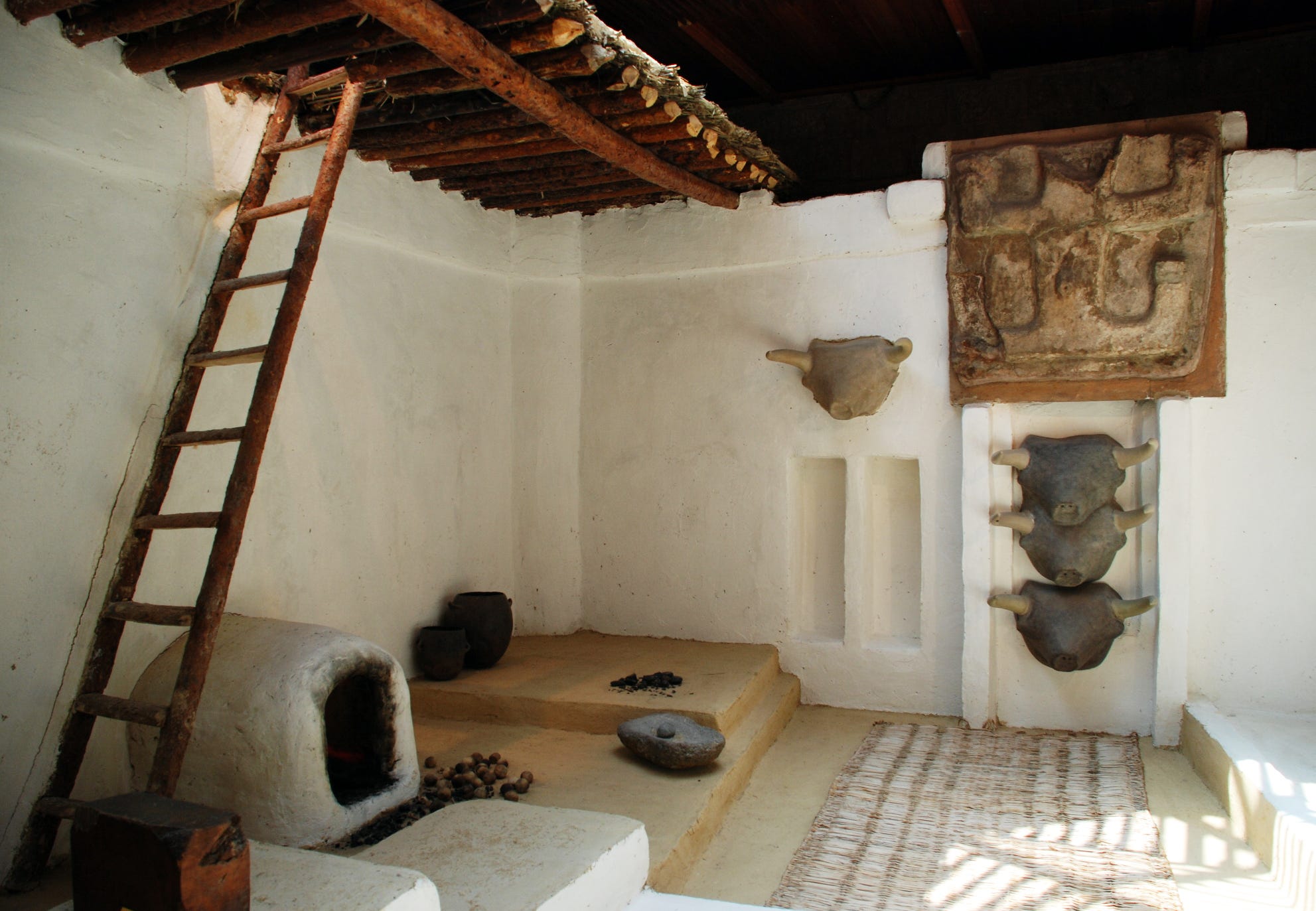
At Çatalhöyük the house was not a backdrop to life. It was something closer to a living body. When someone died, they went under the floor — and the walls were freshly painted, as if the building itself were being marked by the loss. Some of the dead didn’t even stay buried; their bones were retrieved, circulated through the community for a time, and laid down again, accompanied once more by paint. The number of burials in a house tracked the number of layers of plaster on its walls. Death and decoration were the same gesture.
And when a house reached the end of its life, the people did not simply abandon it. They burned it. Deliberately, in what looks like a closing ritual — a funeral for a building. The charred textiles we’ve recovered survived only because of those fires, threads preserved in the act of the house’s own death.
So picture the whole organism. A house is built. It is painted when its people die and painted again when their bones return. It is fed, across generations, with the dead who stay woven into its floor. The women are born into it and remain; the men arrive from other houses; the bloodlines blur until kinship becomes a thing you build rather than inherit. And when its time comes, the house is ritually killed and a new one rises, often directly on its bones. The lineage that runs through all of it — through the painting and the burying and the burning — runs through the women who never left.
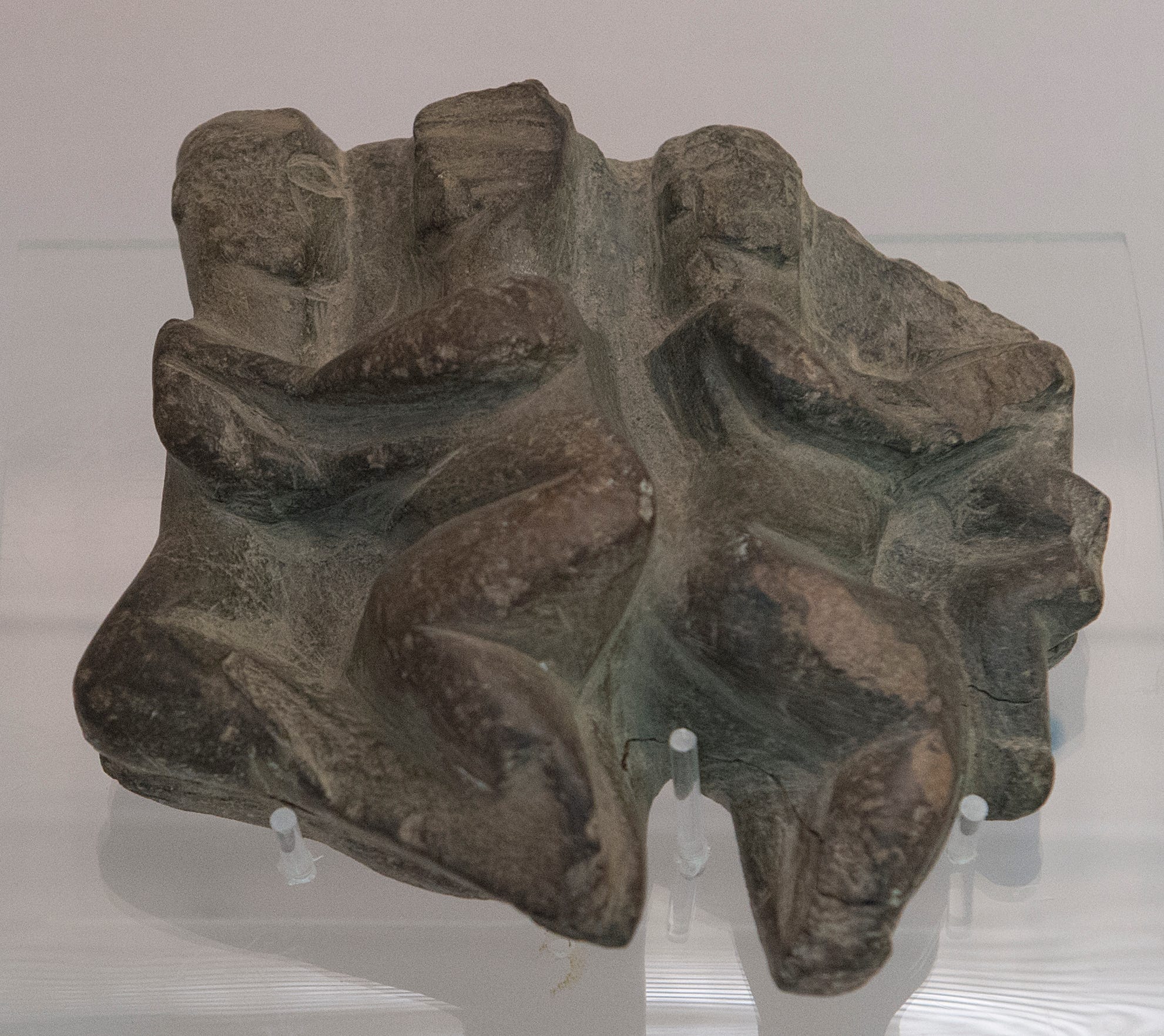
This is the thing the goddess story got backwards. The clay woman on her throne was never the point. She was a distraction, a single sculpture doing sixty years of work that the architecture was doing all along. The real argument isn’t sitting in a museum case. It’s in the floor plan: a city of thousands that organized itself around the maternal line, distributed its small wealth toward its daughters, dissolved blood into chosen family, and ran for a millennium with no king, no temple, and no one in charge — and did it so quietly that we needed a hundred and thirty-one genomes to notice.
If patriarchy were the natural default of settled human life, Çatalhöyük could not exist. It does. Which means the arrangement we were told was inevitable is just one option that won — later, elsewhere, and not here. A thing that was built can be built differently. The proof has been lying under the floor the whole time, waiting for us to be ready to read it.
Sources Cited:
Arbuckle, Benjamin S. “Genomic Insights into Social Life in Neolithic Anatolia.” Science, vol. 388, no. 6754, 26 June 2025, pp. 1372-1373. Accessed 14 June 2026. [1, 2]
Chacon, Manuel, et al. “Neolithic Obsidian Mirrors from Southwest Asia: A Reflection on Manufacturing and Use.” Journal of Archaeological Science: Reports, vol. 61, art. 104322, Feb. 2025. HAL Science, open access. Accessed 14 June 2026. [1]
Chyleński, Maciej, Edvard Ehler, Mehmet Somel, Reyhan Yaka, Maja Krzewińska, Mirosława Dabert, Anna Juras, and Arkadiusz Marciniak. “Ancient Mitochondrial Genomes Reveal the Absence of Maternal Kinship in the Burials of Çatalhöyük People and Their Genetic Affinities.” Genes, vol. 10, no. 3, art. 207, 11 Mar. 2019. Accessed 14 June 2026. [1]
Pearson, Jessica A., et al. “Stable Carbon and Nitrogen Isotope Analysis at Neolithic Çatalhöyük: Evidence for Human and Animal Diet and Their Relationship to Households.” Journal of Archaeological Science, vol. 57, May 2015, pp. 261-271. Accessed 14 June 2026. [1]
Schotsmans, Eline M. J., Marco Milella, et al. “New Insights on Commemoration of the Dead Through Mortuary and Architectural Use of Pigments at Neolithic Çatalhöyük, Turkey.” Scientific Reports, vol. 12, art. 4055, 8 Mar. 2022. Accessed 14 June 2026.
Yüncü, Eren, Mehmet Somel, et al. “Female Lineages and Changing Kinship Patterns in Neolithic Çatalhöyük.” Science, vol. 388, no. 6754, 26 June 2025. Accessed 14 June 2026
If this kind of work — primary sources, no shortcuts, the receipts laid out where you can check them — is something you want more of, you can support it with a coffee. Link below.
The Reading Room is a reader-supported publication. To receive new posts and support my work, consider becoming a free or paid subscriber.
Comments
Nothing yet. Say the first thing.
Sign in to join the conversation.