
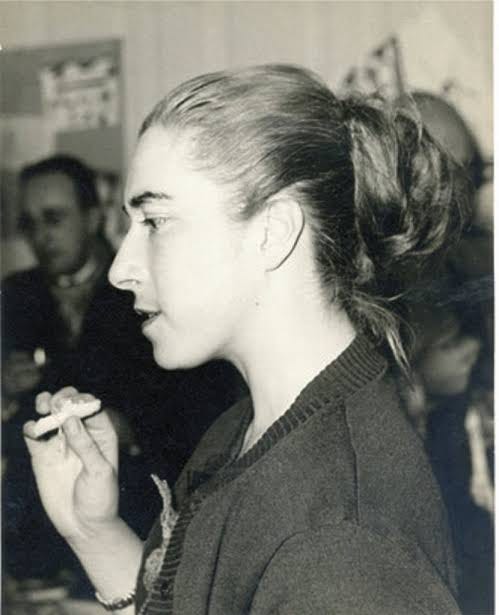
The Room Where the Discovery Began
She counted them twice before she let herself believe it. Forty-six, every time, in the healthy children’s cells - months of unglamorous, meticulous work behind that number. Plasma from a rooster she’d bought and bled herself. Serum from her own arm when nothing else was available. And then a slide from a boy with Down Syndrome, prepared in the same way, dried in the same way, stained in the same way.
Forty-seven.
She counted again. Forty-seven.
There was no one in the room to tell her she was right. No supervising professor hovering behind her - only a makeshift laboratory, a borrowed centrifuge, and a microscope which was not powerful enough to confirm what she saw. Marthe Gautier had built this laboratory out of a personal loan and her own sheer stubbornness. Now she was alone with the first hard evidence, in the history of medicine, that a mental disability could be written into the number of a cell’s chromosomes.
The laboratory itself wouldn’t have impressed anyone. No state-of-the-art equipment, no research center, no team of graduate students - only a pediatrician who happened to become an expert in tissue culture almost by accident, two technicians who she trained personally, and a room which had to become something it had never been before.
Gautier didn’t inherit a laboratory. She inherited a problem. Raymond Turpin, her new supervisor at Hôpital Trousseau, suspected for decades that the children with Down syndrome - “mongolism,” as they were called in 1956 - carried a chromosomal anomaly. It was an old hypothesis with nowhere to go: France had no laboratory which could grow human cells reliably enough to check it. Gautier had learned exactly that skill the year before, almost accidentally, working in a Harvard cell-culture laboratory while studying pediatric cardiology. When Turpin told her about the problem, she raised her hand.
So, she built it. Not on theories. On practice. Every contaminated culture needed to be prepared again. Every slide, which turned into an unreadable mess, went to the trash. She rejected colchicine, fearing that it might damage the chromosomes she wanted to keep. She rejected the popular “squash” technique in favor of air-drying which preserved the chromosomes and allowed her to count them. None of it looked like a breakthrough. It looked like a routine, unglamorous, meticulous work — which is where most of the breakthroughs begin.
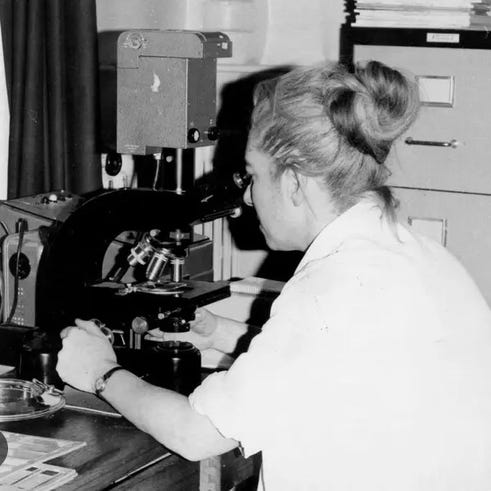
For months, the answer remained unchanged. Healthy cells: forty-six. Again: forty-six. Again: forty-six. Science thrives on such boring repetitions, because it is repetition which allows doubts to lose ground. Then the cells of the children with Down syndrome decided not to cooperate. Forty-seven. Not once. Not because of a damaged slide, not because of contamination. Again: forty-seven.
The discovery did not come with an applause. It came as a number which could not be denied.
When a Discovery Leaves the Laboratory
Finding something is only the first step. Other scientists must see it, challenge it, accept it - and acceptance in science relies on the evidence which can be taken much farther than the person who holds the microscope.
That was the next step, and it was a real one, not a manufactured one. A count of chromosomes, observed through a microscope, convinces the person observing. An image convinces the world. Gautier’s laboratory was able to produce preparations clear enough to be counted by eyes. It was not able to produce images - the microscope she had was, as she admitted fifty years later, “à faible définition.” Low-power. Not absent. Just not powerful enough for what was to come.
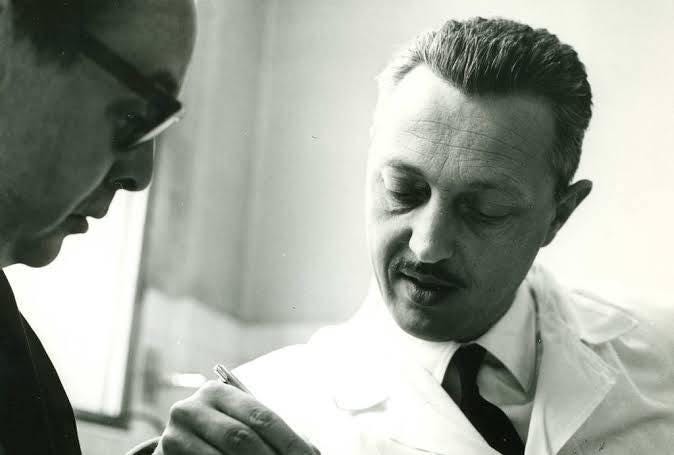
Here is when Jérôme Lejeune appears in the story - not as an outside intruder into somebody else’s work, but as a young CNRS researcher and Turpin’s protégé, interested in the possibility that intellectual disorders may have a chromosomal origin. He began to visit Gautier’s laboratory, fascinated with her cultures. She did not know him before this. In her own words: “Je ne connaissais pas [J.L.]... Je comprends vite l’intérêt qu’il porte aux cultures cellulaires.” She realized quickly that he knew what he was doing.
The slides left the laboratory because Lejeune had access to the better-equipped laboratory elsewhere and offered to make the images. Gautier agreed. It is the sole decision which the rest of this story hinges upon, and by all accounts - hers, of the Foundation, of the historical record - it was made in good faith, between two colleagues, without a contract, without witnesses, without any paper trail, except that which survived by accident.
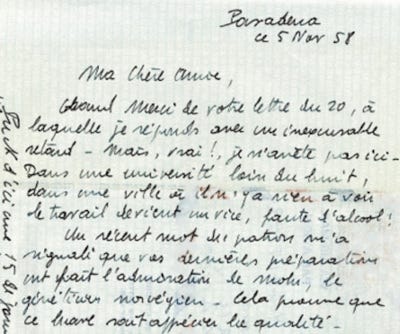
What survived by accident is a letter. Lejeune wrote to Gautier from Pasadena on November 5, 1958, in the middle of his trip, giving some laboratory gossip: “Un récent mot de mes patrons m’a signalé que vos dernières préparations ont fait l’admiration de [notre généticien norvégien]” - a recent note from my supervisors tells me your last preparations have drawn the admiration of [a Norwegian geneticist]. Casual, friendly, addressed to “Ma chère amie.” It confirms only what is not in dispute: her preparations were circulating, under her name, weeks before publication, and Lejeune knew it.
By January, Lejeune had returned from his travels, found two additional cases to confirm the discovery, and the paper was ready. Gautier says that she was notified by phone, the Saturday before it was to be announced to the Academy of Sciences on Monday - asked to approve the wording she had not seen yet, for the discovery she claims to have made months earlier, alone.
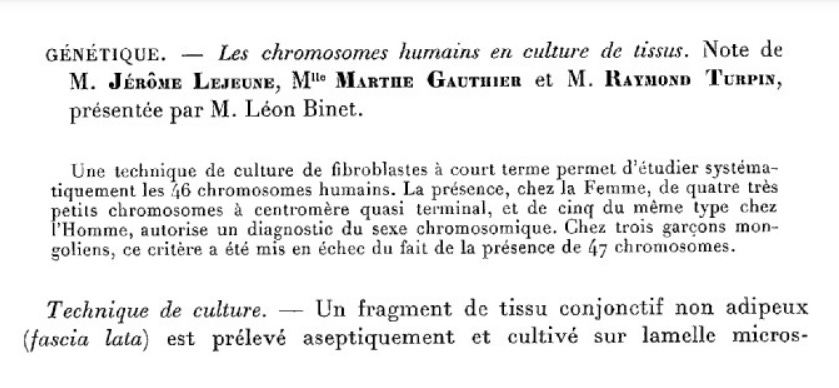
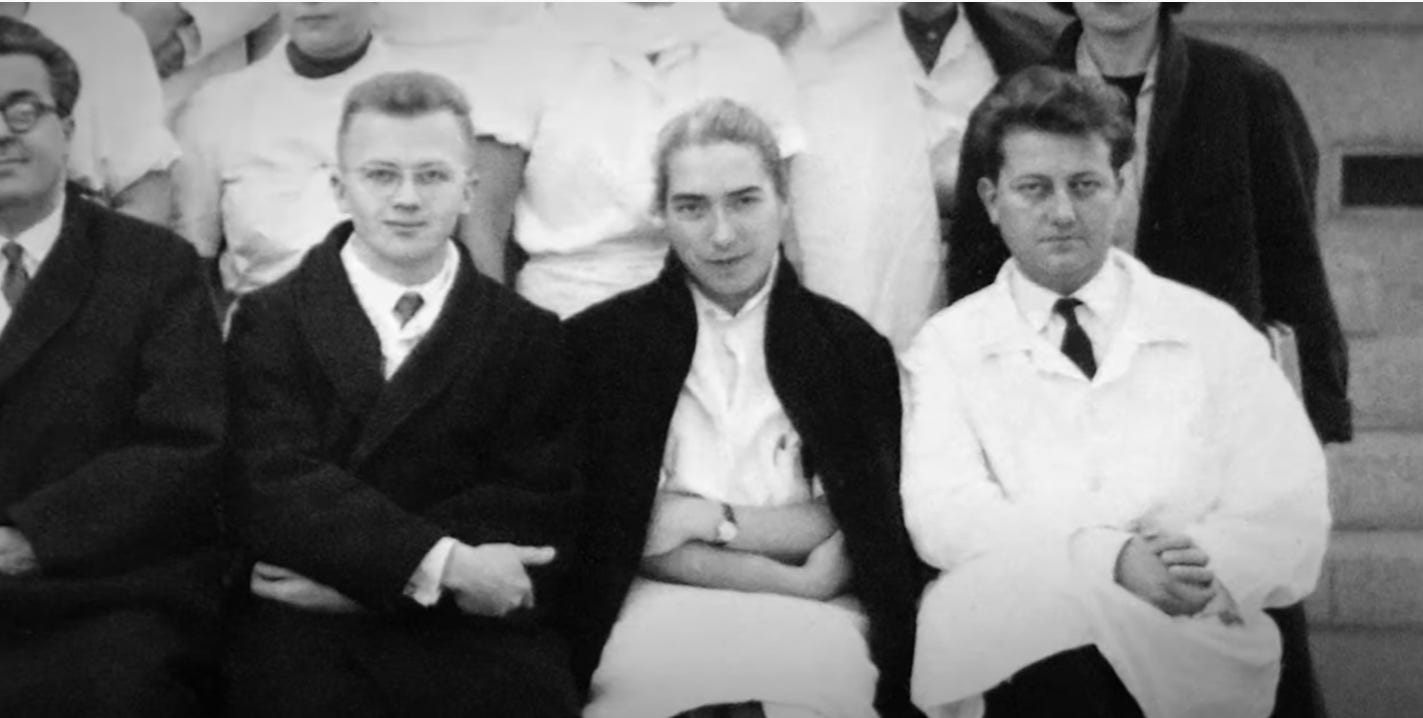
On January 26, 1959, the Comptes Rendus of the French Academy of Sciences published “Les chromosomes humains en culture de tissus” — a two-page note, read to the Academy by Léon Binet on behalf of the three. The authors, in order: Jérôme Lejeune, first; Marthe Gauthier - her surname misspelled, the H added, confirmed against the original page - second; Raymond Turpin, last. A second paper followed in March, this time with her name corrected, confirming the finding in nine patients.
That was it, in black and white. Three names, one order, sixty-five years of consequences.
The Story Changes
For fifty years, that was the end of the story, and the public version of the story had only one hero. Lejeune became the face of the discovery - interviewed, decorated, given the first chair of human genetics in France, a chair which Turpin established for him. Gautier went back to pediatric cardiology, the specialty she’d trained for in the first place, and remained in it for the rest of her life. She and Lejeune kept corresponding for years afterwards, addressed, on her part, to “Cher ami.” She even co-authored papers with him until as late as 1969. Nothing in the record suggests a dramatic break.
Until 2009, the fiftieth anniversary of the paper, and the same year when Lejeune’s canonization process was gaining momentum - when Gautier published her own version in Médecine/Sciences, later translated into English in Human Genetics. She wrote, of the months after the slides left her laboratory: “Je suis consciente de ce qui se dessine sournoisement, mais n’ai pas assez l’expérience ni d’autorité... Je soupçonne des manœuvres politiques… je n’avais pas tort.” I sensed something happening behind my back. I suspected some political maneuvering. I wasn’t wrong.
That single essay did not end the discussion. It began a new one, and it has not stopped since.
In 2014, the French Federation of Human Genetics tried to give Gautier — then eighty-eight - its grand prize and let her tell her story at a conference in Bordeaux. Hours before her talk, bailiffs appeared, sent by the Jérôme Lejeune Foundation, with a court order - obtained, according to the Foundation, by the president of the Bordeaux Tribunal de Grande Instance - authorizing them to record her remarks as possible evidence in a future defamation suit. The conference organizers, unwilling to risk being sued for something they could not afford, canceled her talk. She received her medal in private, the next day, in her hotel room. According to her family, the stress of that morning made her lose her hair; she wore a wig for the rest of her life. The cancellation was big news - it made international headlines in Nature and Science, and it did more for spreading her story than her single 2009 essay had done.
Seven months later, INSERM’s own ethics committee, asked to investigate by a group of researchers, published its findings. It did not split the difference. It concluded that Lejeune’s contribution to the discovery itself “a peu de chance d’avoir été prépondérante” - had little chance of being decisive - unless one was willing to ignore the importance of the special training, especially gained in another country. But it also concluded that his contribution to the publicity and defense of the discovery internationally was “sans doute très significative” — almost certainly very significant. Two distinct contributions, argued the committee, not one contested one: “L’approche technique est une condition nécessaire à la découverte... mais bien souvent il faut la prolonger pour en faire émerger la reconnaissance.” The technical work is the necessary precondition for a discovery. Recognition is a different, subsequent accomplishment - and, the committee was specific, Lejeune’s later activism had nothing to do with it either way.
The Jérôme Lejeune Foundation rejected all of it. Their case, elaborated in detail on their own website, argues that Lejeune was the intellectual driver of the discovery from the very start - that he identified the chromosome as 21 specifically, confirmed it in two additional patients, and encouraged the hesitant Turpin to publish, while Gautier, according to them, “had found nothing” in the three months that Lejeune was traveling in North America. They quote a letter, dated October 27, 1958, from Turpin to Lejeune, which, according to them, proves that Gautier counted forty-six chromosomes in October - placing her own “discovery” months later than she remembered it. No independent historian has examined that letter. It survives, as far as the public record shows, only as a sentence that the Foundation has quoted about itself in its own defense, ever since at least 2014.
What the Evidence Actually Says
Some of this can be said plainly. Some cannot, and pretending otherwise does not help anyone - neither Gautier, nor the reader, nor the truth.
Established, independently confirmed:
Gautier built the cell-culture laboratory at Trousseau essentially alone, with borrowed money and self-taught technique, after learning the method in Boston. Confirmed by her own account, the Foundation’s own account, and the 2014 INSERM investigation, which specifically located and interviewed Jean Aicardi - a colleague from her Harvard year - to corroborate that she was the only person on Turpin’s team with the relevant skill.
Her surname was misspelled on the founding publication - “Gauthier” for “Gautier” - confirmed directly against the original January 26, 1959 page in the Academy’s own Comptes Rendus.
Lejeune was in active, documented contact with Gautier about “your preparations” in November 1958, weeks before publication, while traveling in North America.
The 2014 INSERM ethics committee found Lejeune’s role in the technical discovery itself was probably not decisive, while his role in promoting the finding afterward probably was.
Contested, with real evidence on both sides:
Whether Lejeune independently and materially advanced the finding - narrowing it specifically to chromosome 21, confirming it in additional patients - during the months the slides were in his possession, or whether this represents confirmation of work already essentially complete. Both the Foundation’s account and Gautier’s account agree Lejeune did this confirming work; they disagree about how much intellectual weight it carries next to the original observation.
The circumstances and sincerity of the authorship order. Turpin’s own daughter, in a 2005 account - predating the public controversy by four years - states that it was Turpin himself who proposed Lejeune sign first, to support his doctoral thesis, as an accepted convention of the time. If accurate, this complicates the “usurpation” framing considerably. It has not been independently verified beyond her account.
Unresolved, and stated here as unresolved:
The exact month Gautier first observed forty-seven chromosomes. Various secondary sources give May or July 1958; her own essay gives no month at all.
The full contents of the October 27, 1958, Turpin-to-Lejeune letter, quoted only in fragment, only by the Foundation, and never released for independent examination.
The identity of the “Norwegian geneticist” named in Lejeune’s November letter - plausibly Otto Lous Mohr, a prominent figure in the field at the time, but resting on one non-specialist transcription of a low-resolution scan.
You’re entitled to notice what this ledger doesn’t do: it doesn’t produce a verdict. That’s not a failure of the research. It’s what fifty years of institutional silence, followed by fifteen years of institutional combat, actually leaves behind.
Who Discovered Trisomy 21?
Maybe that’s the wrong question, or at least an incomplete one. History wants a single discoverer, standing at a podium, applauded. Laboratories are rarely built that way. One person develops the method. Another recognizes what the method has revealed. A third convinces the rest of the field to believe it. Sometimes those are the same person. Here, they clearly weren’t.
The tragedy of this story isn’t that Marthe Gautier failed to contribute. Nobody - not even the Foundation, in its most combative public statements - has ever claimed she contributed nothing. The tragedy is that the public version of the discovery, for fifty years, was allowed to become so simple that it erased the difference between making a finding and announcing it. Those are not the same act, and treating them as interchangeable is exactly the confusion the INSERM committee spent five careful paragraphs trying to undo.
The Last Count
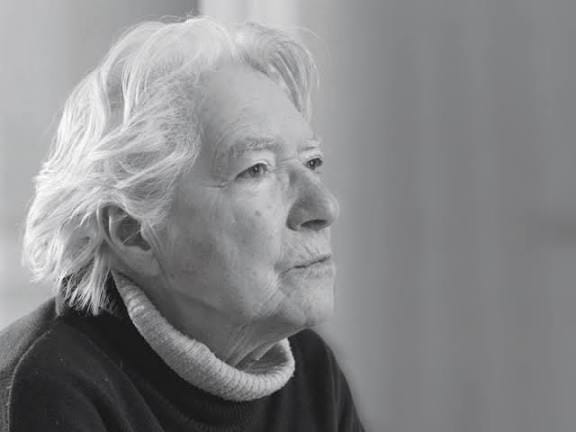
History eventually awarded Marthe Gautier a medal, a decoration, a plaque in the village where she was born, a hospital wall bearing her name ahead of the other two. It gave her interviews, in her nineties, where she finally could say what she had carried in secret for half a century. It gave her, before she died in 2022 at ninety-six, at least something resembling vindication.
What history could not give her back is the room. The weak microscope. The rooster’s blood. The morning when the number which was supposed to be forty-six turned out to be forty-seven, and there was nobody there to see it but her.
Whatever the record will eventually establish - and some of it may never establish - it is impossible to tell the story of that number in honest way without telling the story of the woman who discovered it first, alone, in the room which was not supposed to produce anything at all.
Postscript, August 2026: The dispute remains active. In July 2026, descendants of Jérôme Lejeune brought legal action against playwright Élisabeth Bouchaud and the Théâtre La Reine Blanche over La Découvreuse oubliée, a play about Marthe Gautier’s role in the discovery of trisomy 21. The claim concerns alleged defamation of Lejeune’s memory. Nearly seventy years after the original paper, the argument over who gets to tell this history is still unfolding.
Sources Cited:
Primary documents
Gautier, Marthe. “Cinquantenaire de la trisomie 21. Retour sur une découverte.” Médecine/Sciences 25, no. 3 (2009): 311–316.
Gautier, Marthe, and Peter S. Harper. “Fiftieth anniversary of trisomy 21: returning to a discovery.” Human Genetics 126, no. 2 (August 2009): 317–324. Authorized English translation, Cardiff University Centre for Lifelong Learning.
Lejeune, J., Gauthier, M., and Turpin, R. “Les chromosomes humains en culture de tissus.” Comptes Rendus Hebdomadaires des Séances de l’Académie des Sciences 248 (January 26, 1959): 602–603. Original scan, Gallica/BnF.
Lejeune, J., Gauthier, M., and Turpin, R. “Étude des chromosomes somatiques de neuf enfants mongoliens.” Comptes Rendus de l’Académie des Sciences (March 16, 1959): 1721–1722.
Lejeune, Jérôme. Letter to Marthe Gautier, Pasadena, November 5, 1958. Reproduced as Figure 2 in Gautier (2009).
Comité d’Éthique de l’Inserm. “Avis du Comité d’éthique de l’Inserm relatif à la saisine d’un collectif de chercheurs concernant la contribution de Marthe Gautier dans la découverte de la trisomie 21.” September 2014. Full text via HAL (inserm-02110704).
Contemporaneous reporting
Casassus, Barbara. “Down’s syndrome discovery dispute resurfaces in France.” Nature, February 11, 2014.
Pain, Elisabeth. “After more than 50 years, a dispute over Down syndrome discovery.” Science, February 11, 2014.
Later journalism and retrospectives
Grady, Denise. “Marthe Gautier, 96, Dies; Had Key Role in Down Syndrome Breakthrough.” The New York Times, obituary (2018, published following her 2022 death), reprinted in Helen: The Journal of Human Exceptionality, March 2026.
Galliot, Lorena, and Sophie McNulty. “This Researcher Discovered the Cause of Down Syndrome, But For 50 Years Got None of the Credit.” Scientific American / Lost Women of Science podcast, February 13, 2025. Includes interviews with Marc Brodin (Inserm ethics committee), Aude Bernheim, Clara Lejeune Gaymard, and Tatiana Giraud.
Galanopoulo, Léa, interviewing Julie Batut. “A supernumerary discoverer.” CNRS News, September 7, 2026.
Thomann, Lisa M., and Julie Batut. “Equity, Diversity and Inclusion: Four women whose pioneering contributions to science have been largely overlooked.” eLife
15 (February 11, 2026): e110644.
Kean, Sam (host). “The Battle Over the Cause of Down Syndrome.” The Disappearing Spoon podcast, Science History Institute, April 8, 2025.
Seidl, Carol A. “Marthe Gautier, Forgotten by the Misogynistic March of History.” cas d’intérêt, October 7, 2022.
Maouche, Seraya. “Les bagarres entre auteurs ne finissent jamais... et peuvent durer 50 ans. Exemple de la trisomie 21.” Rédaction Médicale et Scientifique, October 2014, and associated comment thread (contributors “Aliboron” and Sylvain Bernès), which independently verified spelling variants against the original Gallica scans.
Institutional / biographicalAWIS (Association for Women in Science). “Marthe Gautier,” historical women profile.
scientificwomen.net. “Marthe GAUTIER.”
Jérôme Lejeune Foundation materials (cited as contested advocacy, not independent fact)
“Controverse sur la découverte de la trisomie 21 : éléments de réponse.” fondationlejeune.org, September 29, 2014.
“À qui profite la polémique sur la découverte de la trisomie 21?” fondationlejeune.org (press release confirming the Bordeaux court authorization).
“Questions / Réponses sur la découverte de la trisomie 21.” fondationlejeune.org, June 14, 2021.
“Jérôme Lejeune, pionnier de la découverte de la trisomie 21.” fondationlejeune.org.
Consulted, lower confidence or unresolvedCouturier Turpin, Marie-Hélène. Account of authorship arrangement, La Revue du Praticien, 2005 - cited secondhand via the Maouche comment thread; not independently verified.
Berger, Roland. Oral history interview, Peter Harper / genmedhist.org project - cited secondhand.
Le Figaro. “Jérôme Lejeune: ces archives qui attestent sa découverte de la trisomie 21,” April 3, 2024 - content not independently accessed; existence and headline only confirmed.
The Reading Room is a reader-supported publication. To receive new posts and support my work, consider becoming a free or paid subscriber.
Comments
Nothing yet. Say the first thing.
Sign in to join the conversation.