
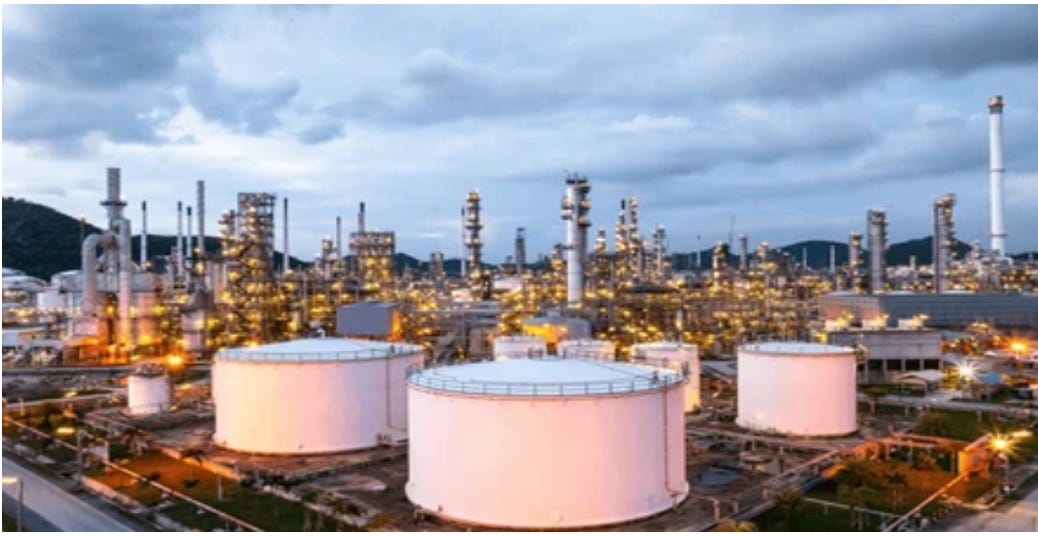
The Strait of Hormuz can no longer be assessed solely by the number of barrels of oil passing through it or the price of crude oil. The widening gap between refined products and crude, China’s obscure strategy, and the fragile US economy indicate that the war will impose heavy costs on the global supply chain because the world moves mainly on diesel power. Two indicators attract the most attention: the volume of crude oil passing through the Strait and global oil prices.
These two indicators are important, but they do not measure the true depth of the energy crisis. A more decisive indicator is the condition of refined petroleum products, where diesel, gasoline, and jet fuel are directly tied to transportation, production and which directly affect everyone’s daily lives. At present, the price gap between refined products and crude oil, known as the crack spread, has reached unprecedented levels, with the diesel spread at $100+ per barrel. At the same time, diesel exports from Russia, the Middle East, and Asia have declined as the global market faces an increasing shortage of refined products.
The Hormuz crisis is no longer merely a crisis of “crude oil supply”; it has become a crisis of refining capacity and access to refined products. Damage to Russian refineries during the war in Ukraine, disruptions at refineries in the region, and limited access to refinery feedstock, combined with reduced traffic through Hormuz, have created fractured supply chains. As a result, the Russian Federation, one of the world’s major gasoline suppliers, has now become an importer.
Crude oil prices may appear relatively contained compared with the scale of the disruption, while diesel, gasoline, and jet fuel prices have experienced significant increases. This where an energy crisis moves from financial markets into the real economy. Recent reports have also pointed to severe restrictions on diesel supplies resulting in US-sourced refinery feedstock from alternative suppliers.
China’s response is another determining variable in this equation. Official data show that China’s oil imports rose to 8.41 million barrels per day in July, lower than last year’s, as China absorbed part of the market pressure by reducing its demand. However, in the physical oil market, information obtained from major traders involved in selling Persian Gulf oil points to an increase in Chinese buying demand in August.
Although this information is not yet reflected in official monthly statistics or public international reports, it has already had a practical impact on the market. In some transactions, the offered price for cargoes increased by around $2 per barrel within a single day. This trend would result in greater competition for available cargoes and thus greater pressure on the price of refinery feedstock and refined products going forward.
The greater strategic significance is the condition of the US economy. US economic growth fell to 1.5% in Q2 2026, compared with Q1 at 2.1%. In financial markets, a $25 billion auction of 30-year US Treasury bonds on August 13 raised the yield to 5.22%, the highest auction rate for these securities since 2001. At the same time, the July budget deficit reached $432 billion, while the cumulative fiscal-year deficit approached $1.8 trillion.
In these conditions, higher energy prices can create a multi-layered shock: refined-product prices rise, inflation remains elevated, the Federal Reserve has less room to cut interest rates, and long-term rates remain high. As a result, the cost of government financing and debt servicing increases. Therefore, war does not impose only military costs on Washington; it can also create financial, inflationary, and political costs across the world.
Trump’s recent threat to impose “heavy economic pressure” on Iran, if accompanied by increased pressure on Hormuz, creates a strategic contradiction. The US may be able to exert greater pressure on Iran’s economy, but a counter reaction, as indicated by Iran this week, will prolong energy disruptions, with a significant portion of the cost of that pressure resulting in disrupted and volatile global markets, especially in refined products like diesel.
The effects of a war intended to increase pressure on Iran have rebounded like a boomerang and have now become an issue of gasoline and diesel prices, inflation, purchasing power, and the Trump administration’s economic performance ahead of the mid-term elections. Two-thirds of Americans oppose the war and the resultant economic pressure has become one of the Republicans’ vulnerabilities.
With the end of the MoU this week, the war has now become a war of attrition. Iran will face severe economic pressure, but the US will also have to manage the rising costs of energy, inflation, interest rates, debt, and the elections simultaneously. If Washington intensifies economic pressure on Iran, it will risk renewed energy disruptions and their transformation into a global economic shock which will further alienate the US standing in global affairs, especially in the GCC, Middle East, and the Global South.
Therefore, the equation of the Iran war is shifting from “the ability to exert pressure” to “the ability to withstand reciprocal pressure.” Trump can threaten to increase economic pressure on Iran, but the more that pressure runs through the energy market and Hormuz, the greater the possibility that it will turn into an economic and electoral crisis for the US.
The most important indicator of the situation in Hormuz is no longer the number of barrels of crude oil passing through it. What matters is how many dollars this crisis adds to the price of diesel, gasoline, and jet fuel, and how much of the US economic and political capacity those higher prices will consume. In this framework, the war is no longer merely a contest measuring the military strength of the two sides; it has become a test of America’s economic and political resilience up to the mid-term elections.
If the situation in Iran and Ukraine persists or intensifies, as witnessed this week, then the outcome is no mere speculation. Complex systems tend to self-organise into simplification once a tipping point is reached. The Global Financial System is no different and will eventually find an equilibrium when demand destruction creates a severe recession which could morph into a prolonged economic depression. The 2008 GFC was a warning shot, ignored by the financial wizards, but is now reaching a point of no return. The seeds of its destruction were sown long ago. Affordability, not scarcity, is the real energy crisis. History back to 1820 gives hints regarding what may follow.
In 1694 the King of England borrowed 1.2 million sterling at a perpetual rate of interest, and in exchange the King granted a banking syndicate a monopoly on issuing the new national currency. From that day to this, every pound in circulation began its life as somebody’s debt. The mathematics of this arrangement contain a problem the inventors understood and the public refuses to recognise.
When the principal is created and the loan is made, the interest is not. The interest must come from a future loan, made by someone else, and that loan in turn carries its own interest, which must come from a third loan, and so on into perpetuity. This is an engineering specification of a Ponzi scheme, written into the foundation document of British finance and exported, by gunboat and by treaty, to every country that now uses a central bank. The British are guilty of the original sin. Every single central bank in existence has been founded on this formula created by the bankers in the City of London.
A monetary system that requires perpetual new debt to service old debt requires, at every level, a population willing to keep creating loans, mainly through bonds and promissory notes (mortgages). The consumer becomes a yield-bearing asset paying compound interest at every stage. Favourable credit terms are reserved for entities close to the central bank. The corporation, that sits at the top of the pyramid, borrows at near zero, buys the assets the consumer is too indebted to buy, and rents them back. The government takes the rest of the debt onto its own books and presents the bill to the next generation.
This is not capitalism in its original form which meant a system in which capital is privately owned, freely priced, and earned through providing something other people want. Under that definition capitalism hasn’t existed in any of our lifetimes. What America has, and what every member of the post-war Western order has, is called financialisation for the institutions that can borrow at the central bank rate, and a brutal Hobbesian struggle for everything below them.
“In early May, BlackRock quietly froze redemptions in several of its private-credit funds, limiting withdrawals in vehicles that had been marketed as offering easy liquidity. The move was legally valid, but investors felt that the contractual fine print had been weaponized against them. It was the most visible stress fracture to date in a $3 trillion shadow-banking market that has grown almost entirely outside federal oversight.”
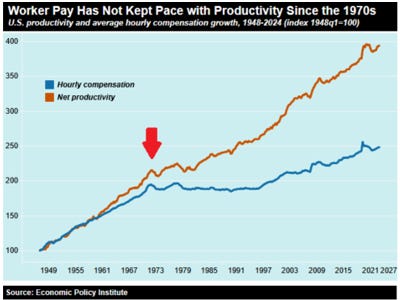
The bank that mismanages a trillion pounds gets bailed out at midnight on a Sunday by a treasury minister who used to work for it. The plumber whose van breaks down eventually goes bankrupt. Since 1971, both outcomes are described by the same Chancellor, in the same speech, as the natural workings of the free market. The result is described in graphic form HERE.
The 2008 crisis was engineered through financial alchemy. Risky subprime mortgages were transformed into securities that received Triple-A credit ratings despite being built on unstable foundations. Much of this occurred in the shadow banking system, a network of non-bank lenders, securitisation vehicles (SPV), money market funds, and private investment funds operating with less oversight than traditional banks.
Because these securities were treated as virtually risk-free, they became collateral for additional borrowing, creating a dangerous bubble. When confidence collapsed, governments rescued many of the institutions deemed “too big to fail.” Millions of households, however, lost their homes and savings. And now it’s about to happen again!
Today, the rapidly expanding asset class is AI data-centre infrastructure, the foundation of AI, cloud computing, and hyperscale digital services. There is already talk of massive AI companies being “too big to fail.” These projects require not only continuing supplies of cheap energy, like electricity, diesel and water, but also trillions of dollars in financing, much of it supplied through private credit, non-bank lenders, and other shadow banking institutions often hidden off-balance sheets estimated to approach $3 trillion. Several similarities to 2008 are apparent:
Heavy reliance on lightly regulated shadow banking and private credit markets.
Multiple layers of leverage as investors and lenders borrow against borrowed funds.
A gradual weakening of capital, liquidity, and supervisory standards.
Higher interest rates increasing refinancing, debt-servicing risks, and competing against US Treasury markets.
None of this guarantees another financial crisis. However, it does increase systemic vulnerability should investor confidence weaken. Many of the reforms introduced after 2008 GFC have since been repealed. The Financial Stability Oversight Council (FSOC) has reduced its use of systemic-risk designations for large non-bank financial institutions, shifted toward activities-based regulation, and eliminated committees focused on climate-related financial risks. The Consumer Financial Protection Bureau (CFPB) has withdrawn dozens of guidance documents covering mortgage lending, debt collection, credit reporting, and consumer protection standards.
If the AI and data-centre boom continues to rely on highly leveraged, lightly regulated financing while financial oversight continues to weaken, the ingredients for another systemic crisis is again accumulating. The assets are different. The investors are wealthier. But leverage, opacity, regulatory erosion, and the expectation of public rescue remain strikingly familiar. Perhaps this is why the title Great Recession 2008 Redux? no longer seems far-fetched. Sources
Looking at energy data going back to 1820, low demand (affordability) has repeatedly produced financial crashes, wars, and collapses. We appear to be entering another such period https://ourfiniteworld.com/
Edited extracts from the widening crack spread between refined products and crude, China’s different behaviour indicates that prolonging the war will impose increasing costs on global supply chains https://nournews.ir/en/news/338689/Why-will-Trump%E2%80%99s-new-threat-against-Iran-impose-greater-costs-on-US
Selected edited extracts from: dailynewsfroaolf Substack
The structural vulnerabilities that triggered the 2008 Global Financial Crisis are re-emerging in a different form. https://lgeconomicinsights.com/2026/07/16/great-recession-2008-redux/
No posts
Comments
Nothing yet. Say the first thing.
Sign in to join the conversation.