
One of the things we try to do in this section is separate the part of a claim that deserves scrutiny from the part where speculation begins.
The 2026 Census religion question provides a particularly good example.
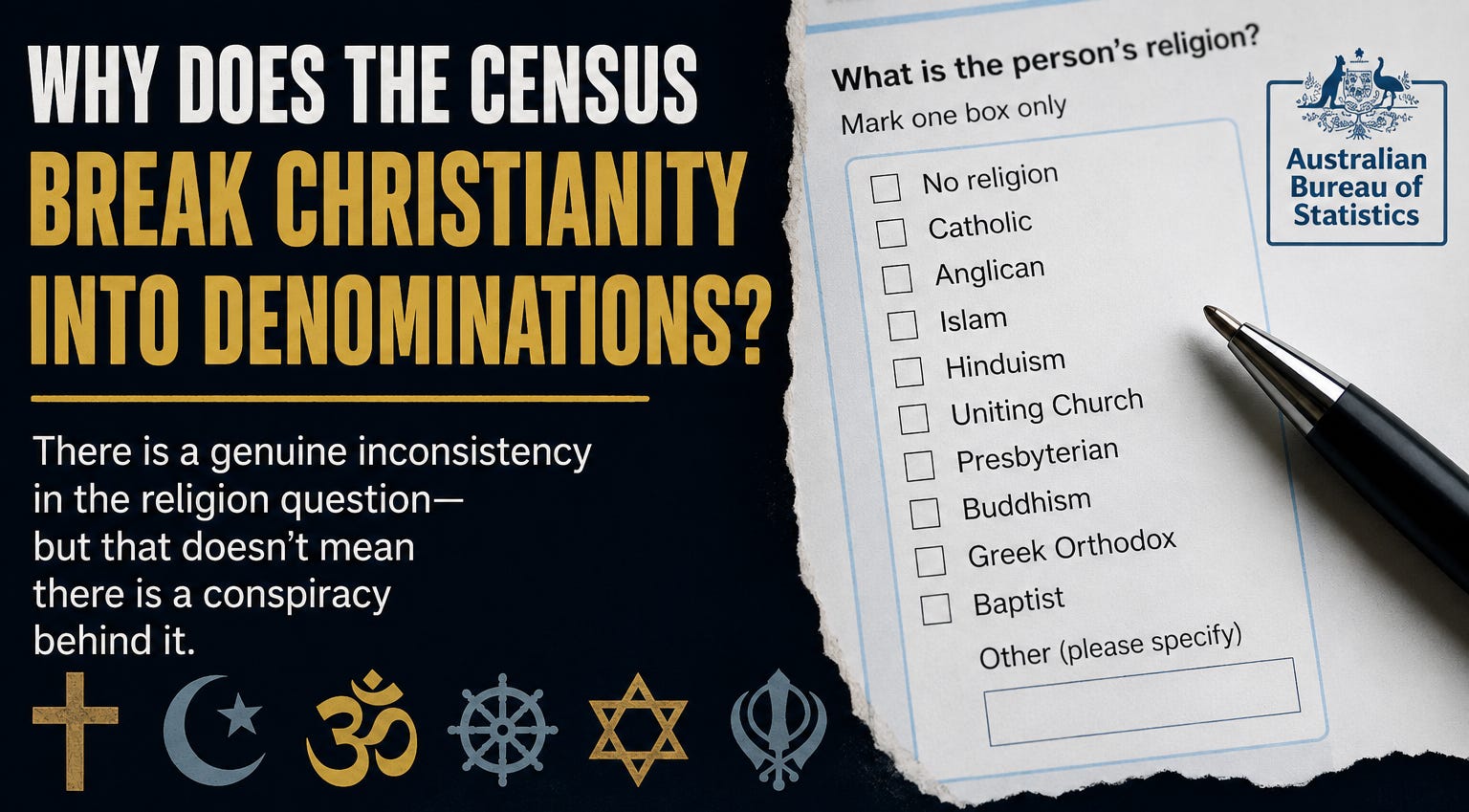
Looking at the choices presented to Australians, something immediately stands out.
Respondents could select:
No religion, Catholic, Anglican, Islam, Hinduism, Uniting Church, Presbyterian, Buddhism, Greek Orthodox or Baptist, with an additional option to specify another religion.
At first glance, there is an obvious question:
Why is Christianity broken into denominations, while Islam, Hinduism and Buddhism are presented as complete religions?
And why isn’t Christianity itself simply one of the choices?
That is a fair question.
But it is also exactly the sort of question where an unusual-looking form can quickly turn into a claim about motive:
They didn’t want Christianity appearing as Australia’s largest religion.
Before accepting that conclusion, it is worth looking at what the Australian Bureau of Statistics actually does with the information.
The first important distinction is between what appears on the Census form and how the ABS ultimately classifies the answers.
Christianity remains one of the ABS’s major religious classifications.
In the Australian Standard Classification of Religious Groups, the ABS recognises broad groups including Buddhism, Christianity, Hinduism, Islam, Judaism and Sikhism, along with other religious categories. Christianity is then divided into numerous denominations and religious groups beneath that broad classification.
So when someone identifies as Catholic, Anglican, Baptist, Presbyterian, Orthodox or another Christian denomination, those answers can ultimately be brought together to produce an overall Christianity figure.
That is exactly what happened in the 2021 Census.
The ABS reported that 43.9 per cent of Australians identified with Christianity, even though the Census form itself presented several Christian denominations separately.
That makes it difficult to sustain the stronger claim that the ABS has structured the form so that there will be no overall Christian figure.
There will be one.
That doesn’t mean the presentation should escape scrutiny.
Consider what respondents are actually being asked.
A Muslim can simply select:
Islam
A Hindu can select:
Hinduism
A Buddhist can select:
Buddhism
But many Christians are presented with:
Catholic
Anglican
Uniting Church
Presbyterian
Greek Orthodox
Baptist
These aren’t equivalent levels of classification.
Islam is a broad religion containing different traditions and denominations.
Buddhism contains different major traditions.
Christianity does too.
Yet Christianity is substantially unpacked for the respondent while several other religions are not.
Interestingly, the ABS itself has recognised this issue.
During its review of Australia’s religion classification and Census question, the ABS examined the fact that response options had contained a mixture of religions and Christian denominations, rather than categories operating at the same level.
So this isn’t simply something suspicious people on Facebook have suddenly discovered.
It has been a genuine methodological question within the ABS’s own review process.
This is another interesting problem.
Plenty of people regard themselves simply as Christian, without strongly identifying as Anglican, Baptist, Catholic, Presbyterian or another denomination.
They aren’t prevented from identifying that way.
Someone can use the write-in option and enter Christian.
The ABS classification provides for Christianity where a more specific denomination isn’t given, so that person can still be counted within the broader Christian population.
But that raises another reasonable question.
Why should someone identifying simply as Christian have to find the write-in option, while someone identifying simply as Muslim or Hindu receives a prominent tick box?
That isn’t proof of bias.
But it is a legitimate criticism of the design.
This year’s Census has already attracted criticism from Jewish organisations because Judaism does not have its own tick box.
Jewish respondents need to use the other religion field and write in their answer.
The Executive Council of Australian Jewry specifically reminded Jewish Australians that there was no Jewish or Judaism box and encouraged them to enter their affiliation manually.
The Australian Jewish Association went further, publicly criticising the omission and raising concerns that Judaism could consequently be underrepresented.
The ABS responded by stressing that Judaism is recorded in the Census even though it isn’t one of the displayed choices.
There is an interesting inconsistency here too.
Under the ABS’s own classification system, Judaism is a broad religious group.
Yet Catholic and Anglican subdivisions of Christianity receive their own boxes while Judaism does not.
Again, population size helps explain why.
But it doesn’t eliminate the underlying question about how the categories are presented.
There is certainly an argument for it.
Imagine instead that the Census first asked:
Does this person have a religion?
If yes:
Which religion?
Christianity
Islam
Hinduism
Buddhism
Judaism
Sikhism
Other
A further question could then ask Christians whether they identify as Catholic, Anglican, Orthodox, Baptist, Pentecostal, LDS or another denomination.
The same principle could apply to other religions where detailed information was statistically useful.
That would arguably make the hierarchy much easier to understand:
Religion first. Denomination or tradition second.
Interestingly, the ABS has already expanded its underlying classification to recognise greater diversity within religions other than Christianity. The revised classification includes additional Buddhist groups and new groups within Islam, meaning the statistical system itself is capable of recording that detail.
The ABS also tested alternative approaches to the Census religion question before settling on the current version.
One alternative asked whether the person had a religion and then allowed the respondent to specify it an approach intended to give people of different religions a more equivalent experience. After consultation and testing, however, the ABS retained the existing question structure for the 2026 Census.
This is where the evidence matters.
There is something unusual about the way the question is structured.
Christian denominations and entire world religions appear beside one another as though they are equivalent categories.
Christianity itself isn’t offered as a prominent standalone selection.
Judaism and Sikhism don’t receive boxes despite being broad religious groups in the ABS classification.
People belonging to other Christian traditions, including Latter-day Saints, need to specify their affiliation themselves.
Those are legitimate things to question.
But none of them establishes that the ABS deliberately designed the Census to prevent Australians seeing a large Christian figure.
The evidence actually points the other way.
The ABS still classifies Catholic, Anglican and other Christian responses beneath Christianity and publishes an overall Christianity figure. In 2021, that figure was 43.9 per cent.
So there is an important distinction between saying:
“The religion question is inconsistently designed.”
and:
“The Census was designed to hide the number of Christians.”
There is evidence for the first.
At present, I can’t find evidence for the second.
This is precisely where conspiracy theories often begin.
Someone notices something genuinely strange.
They ask a perfectly reasonable question.
Nobody provides a satisfying explanation.
And gradually:
“Why did they do this?”
becomes:
“I know why they did this.”
The first is investigation.
The second requires evidence.
In this case, Australians are perfectly entitled to ask why Christianity is treated differently on the Census form and whether a simple Christianity option would have been clearer and more consistent.
Jewish Australians are equally entitled to question why Judaism wasn’t given its own box.
And the ABS should be expected to explain how its choices affect the quality of the data being collected.
But we don’t have to choose between blindly defending the Census and assuming sinister intent.
There is another option.
We can acknowledge that the question has a genuine design inconsistency, examine how it came about, and then wait for evidence before deciding what motivated it.
That is a considerably safer place to stand before we accept claims as fact.
This article examines the presentation of the religion question rather than suggesting that Census results themselves exclude particular faiths. The ABS uses a much more detailed classification system behind the Census form, and responses including Christianity, Judaism and other religions can be recorded even where a dedicated tick box is not provided.
The distinction is important: questioning whether a survey is designed well is not the same as alleging that its designers intended to manipulate the result.
Comments
Nothing yet. Say the first thing.
Sign in to join the conversation.