
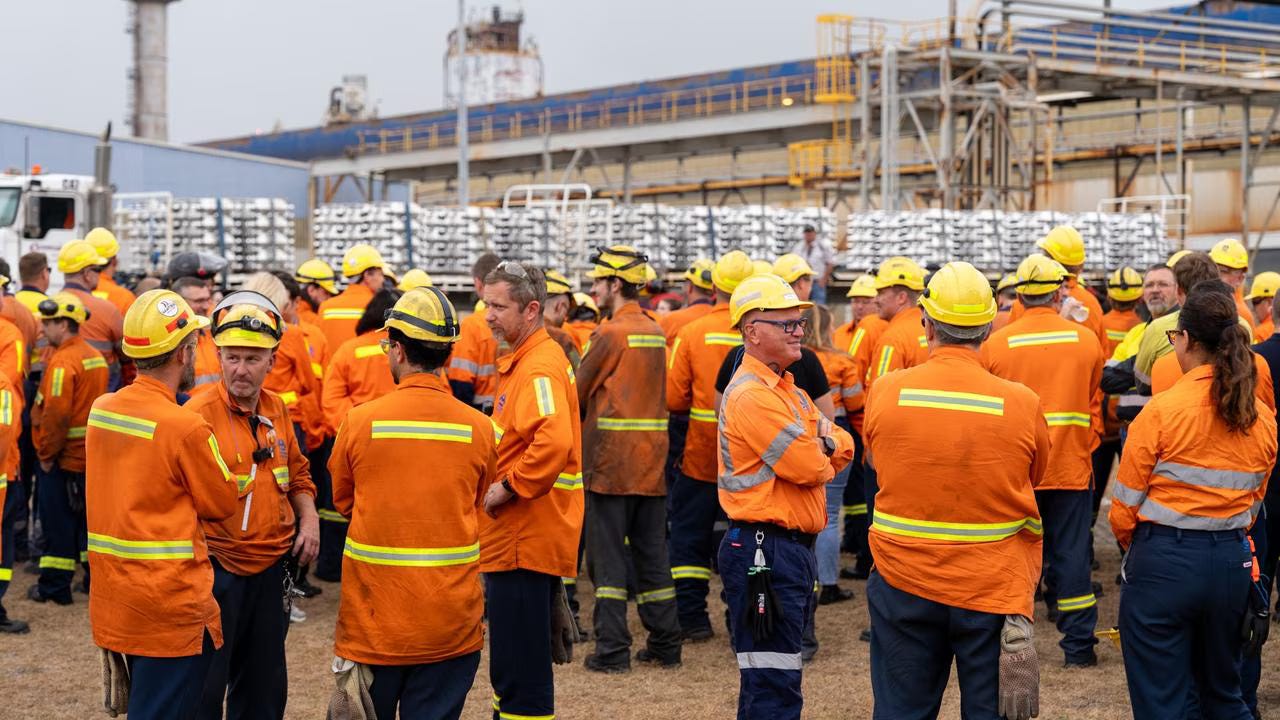
Australia’s largest aluminium smelter has been given another decade of life.
Earlier this month, the federal Labor government and the NSW Labor government announced a $2.5 billion taxpayer-backed package to secure the future of the Tomago Aluminium smelter in the Hunter region beyond 2028.
For the roughly 1,000 people who work there and the thousands of other jobs that depend indirectly on the plant that’s very good news.
But there’s another side to this story.
Tomago isn’t simply receiving a cheque to keep doing what it has always done. The agreement is designed around a new 10-year electricity arrangement beginning in 2029, when its existing power contract expires.
Tomago has also agreed to invest at least $1.1 billion of its own money in the plant through to 2038, including $100 million for decarbonisation. The governments say the arrangement should help underpin nearly 3 gigawatts of new renewable generation and firming capacity in NSW.
Rio Tinto, which is the majority owner, says the new power arrangement should provide reliable, internationally competitive electricity, with Tomago’s supply intended to become 100 per cent renewable from 2033.
So this isn’t quite as simple as government handing billions to a struggling factory.
But neither is it insignificant.
And Tomago is far from alone.
Governments have increasingly found themselves supporting major Australian industrial facilities that might otherwise shrink or close.
There’s been assistance for the Boyne Island aluminium smelter, the Mount Isa copper operations, Nyrstar’s smelters and the Whyalla steelworks, among others. Government support for metals production now runs into billions of dollars.
Each case can be defended individually.
Lose an aluminium smelter and Australia becomes more dependent on overseas aluminium.
Lose steelmaking capacity and we become more dependent on imported steel.
Lose copper refining and another part of the supply chain moves offshore.
COVID, geopolitical tensions and disruptions to international trade have made the concept of sovereign industrial capability considerably easier to understand than it might have been 20 years ago.
But sooner or later we need to ask an uncomfortable question.
Why are so many strategically important Australian industries becoming commercially difficult to operate without government assistance?
That’s where the politics gets interesting.
For Labor, Tomago is essentially an industrial policy decision.
Prime Minister Anthony Albanese and NSW Premier Chris Minns argue that allowing Australia’s largest aluminium smelter to close would mean losing skilled jobs, regional economic activity and an important piece of Australia’s manufacturing supply chain.
There is also a climate argument.
Tomago is Australia’s largest single electricity user, consuming roughly a tenth of NSW electricity demand. Moving something that large towards renewable electricity has consequences far beyond the factory fence.
Labor therefore sees the package as doing several things at once: preserving manufacturing, protecting Hunter jobs, encouraging new electricity generation and helping decarbonise one of Australia’s biggest industrial energy users.
There’s a reasonable argument there.
Countries around the world are becoming far more interventionist about industries considered strategically important. Australia pretending it operates in some perfectly free global marketplace while everyone else subsidises their own industries isn’t necessarily sensible either.
But the cost matters.
A lot.
And taxpayers are entitled to ask whether these investments eventually produce industries capable of standing without continuing government assistance.
The Coalition reaches almost the opposite conclusion.
Opposition Leader Angus Taylor argues that the Tomago rescue is evidence that Australia’s energy policy has gone badly wrong.
His argument is straightforward: if an electricity-intensive manufacturer can only survive because governments spend billions making its energy affordable, perhaps the underlying problem is the price and reliability of electricity in the first place.
Taylor described the package as a “$2.5 billion admission of failure”, arguing that manufacturing should not have to depend on permanent subsidies simply to remain in Australia.
That’s also a question worth taking seriously.
Tomago’s predicament isn’t theoretical.
The company warned in 2025 that it might cease operations after its existing electricity contract expires at the end of 2028 because it could not secure power at a commercially viable price.
And aluminium smelting needs extraordinary amounts of electricity, continuously.
Electricity accounts for a huge portion of a smelter’s costs. Australian plants compete against facilities overseas with different energy markets, wage structures, regulations and government support.
If Australian energy remains structurally expensive for heavy industry, governments may find themselves repeating the same rescue exercise again and again.
The Greens take a different approach again.
They support protecting workers and maintaining industrial capacity, but question why billions of dollars of public money should support a facility majority-owned by a highly profitable multinational without taxpayers receiving an ownership stake.
Greens Senator Penny Allman-Payne argues that if the community is taking part of the financial risk, the community should receive part of the potential return.
The Greens have therefore called for public equity in Tomago rather than assistance effectively flowing to private shareholders without ownership being transferred in return.
Whatever you think of government ownership, there’s a legitimate principle behind the argument.
If taxpayers provide billions because an asset is considered nationally important, should taxpayers simply subsidise it?
Or should Australia acquire an interest in the asset?
It’s a question we’re probably going to hear more often as governments become increasingly involved in strategic industries.
Independent economist Saul Eslake raises another concern.
He accepts there can be strategic reasons for retaining aluminium production in Australia, particularly given Australia’s enormous bauxite and alumina resources.
But he questions whether Australian aluminium smelting can ultimately compete against larger overseas operations with cheaper power, lower costs, larger domestic markets and closer access to customers.
His preference is that, where governments decide an industry deserves assistance, subsidies should at least be transparent so taxpayers can see exactly how much they’re paying.
He is far less enthusiastic about tariffs.
Tariffs might protect Australian producers from cheap imports, but Australian households and businesses ultimately pay higher prices for protected goods as a result.
Commercial lawyer Dan Ryan, from the National Conservative Institute of Australia, comes from almost the opposite direction.
He argues Australia’s embrace of free trade has contributed to the erosion of domestic industry and believes tariffs should be used to make Australian manufacturing competitive against large overseas producers.
His argument is that without changing trade policy, Australia will simply continue moving from one industrial bailout to the next.
There is some uncomfortable logic in both positions.
A tariff makes imported products more expensive.
A subsidy makes taxpayers pay.
Allowing the industry to close makes Australia more dependent on imports.
There isn’t a painless option.
One Nation has also used Tomago as an example of its broader opposition to Australia’s net-zero energy policy.
The party argues that aluminium smelters require dependable, low-cost power around the clock and says Australia should retain or expand dispatchable generation rather than compensating industries after energy costs rise.
One Nation had been warning about Tomago’s future before the rescue package was announced and characterised proposed government support as treating the symptom rather than the underlying energy problem.
That puts it broadly alongside the Coalition in blaming energy policy, although One Nation takes a more explicitly protectionist approach to Australian manufacturing and trade.
This is where I think the debate becomes much more difficult than simply calling Tomago’s package either a “bailout” or an “investment”.
Imagine Australia refused to intervene.
Tomago closes.
Around 1,000 direct jobs disappear, thousands more are affected, an enormous pool of industrial knowledge and apprenticeships is lost, and Australia exports raw materials only to buy more finished aluminium back from overseas.
That doesn’t sound particularly clever.
But consider the other possibility.
Australia spends $2.5 billion now.
The company invests another $1.1 billion.
The electricity system is expanded.
Tomago operates until 2038.
And then we arrive at exactly the same problem because Australian aluminium still isn’t commercially competitive.
Grattan Institute energy analyst Tony Wood identified essentially this risk: transitioning Tomago to renewable energy may make sense, but if it remains commercially unviable in another ten years, governments may simply face another request for assistance.
That’s the part of the Tomago agreement worth watching.
Not whether the smelter survives 2028.
We now know it probably will.
The real test is whether 2038 Tomago can survive without another rescue package.
For decades, Australians were often told that the market would decide which industries survived.
If production was cheaper overseas, manufacturing would move overseas and Australians would benefit from cheaper goods.
That argument worked reasonably well while international trade was secure and strategic dependence wasn’t considered particularly dangerous.
The world has changed.
China heavily supports strategic industries. The United States has embraced tariffs and industrial subsidies. Europe is increasingly protecting strategically important manufacturing.
Australia now seems to be moving towards industrial policy as well but somewhat reluctantly, one rescue package at a time.
Perhaps we need to decide what we actually want.
If aluminium, steel, copper refining, critical minerals processing and other industries really are strategically important, then Australia may need a coherent policy for keeping them here.
That might involve cheaper and more reliable energy.
It might involve targeted subsidies.
It might involve public equity.
It might involve tariffs or other trade protections.
Most likely, it will involve some combination of them.
But continually waiting until another major factory announces it may close and then reaching for the taxpayer chequebook doesn’t feel much like an industrial strategy.
It feels like emergency maintenance.
And at $2.5 billion for Tomago alone, it’s becoming very expensive maintenance.
Anthony Albanese Wikipedia
Chris Minns Wikipedia
Angus Taylor Wikipedia
Penny Allman-Payne Wikipedia
Saul Eslake no substantial Wikipedia biography located; official biography
Dan Ryan no Wikipedia biography located; National Conservative Institute of Australia profile
Comments
Nothing yet. Say the first thing.
Sign in to join the conversation.