
First up, congratulations to Spain on winning the World Cup this morning. If you were up early enough to watch the game, may your morning coffee be as caffeine-ful as you need!
Over the the news and this week, the digital economy conversation moved from capability to control.
In AI, Australia stepped directly into the centre of the debate with a new Office of AI, proposed national standards and a firm line on copyright, data centres and public trust. Globally, the same theme appeared in different forms: OpenAI argued for new ways to measure the value of AI work, China positioned itself as a leader of an alternative global AI order and the pressure around AI infrastructure continued to grow.
In digital assets, the focus shifted further towards market plumbing. Stablecoins, tokenised equities, digital settlement and AI-agent wallets are no longer edge cases. They are becoming part of the infrastructure conversation for payments, capital markets and machine-to-machine commerce.
The clear message this week is that AI and blockchain are both entering a more serious phase. The question is no longer simply what these technologies can do. It is who governs them, who pays for them, who controls the rails and how much trust the public and institutions are willing to place in them.
Thanks for reading The Network Dispatch! Subscribe for free to receive new posts and support my work.
This week in AI news
Australia establishes an Office of AI and moves towards national AI standards
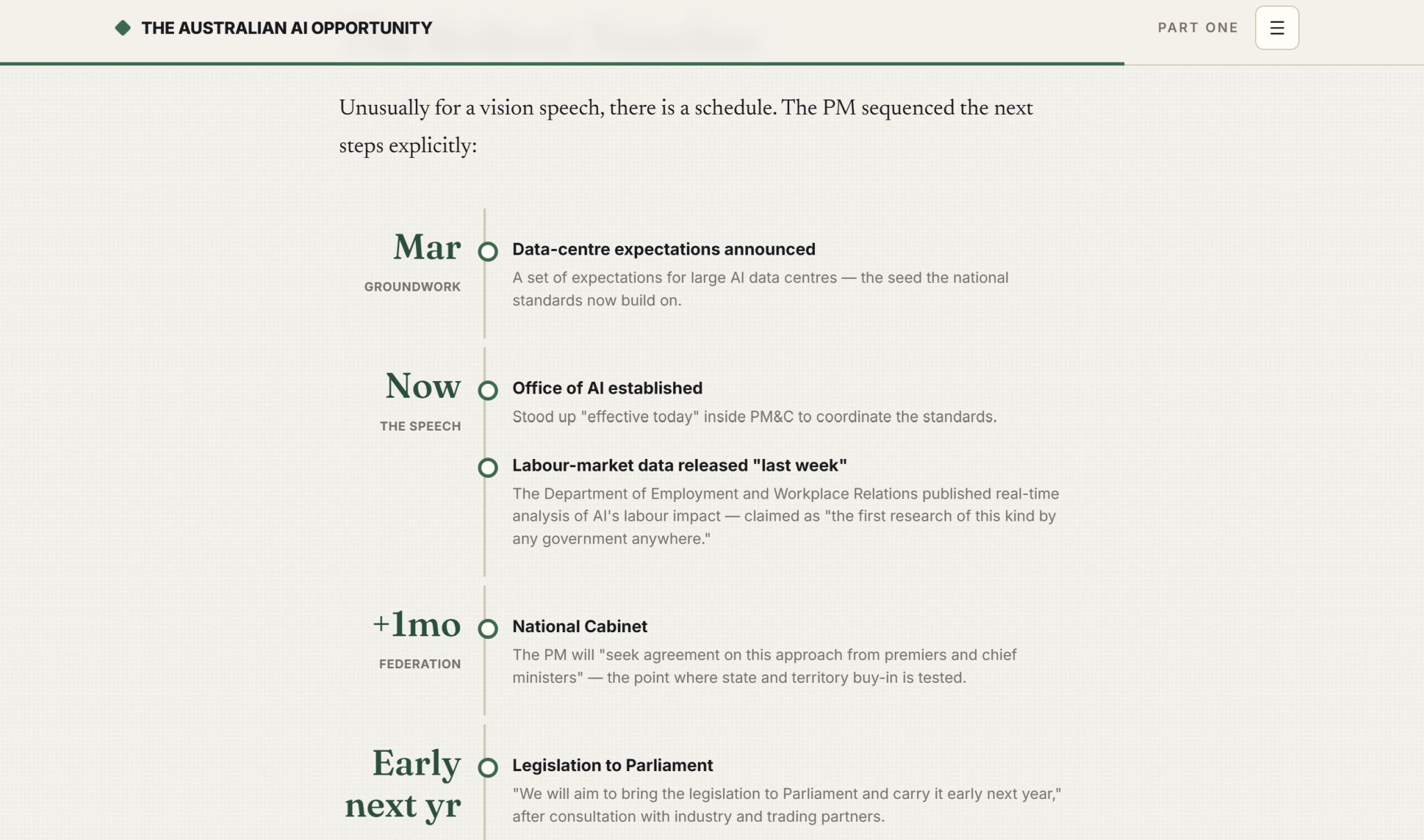
Prime Minister Anthony Albanese announced that Australia will establish an Office of AI inside the Department of the Prime Minister and Cabinet. The new office will coordinate work across government and help design and implement Australian AI standards.
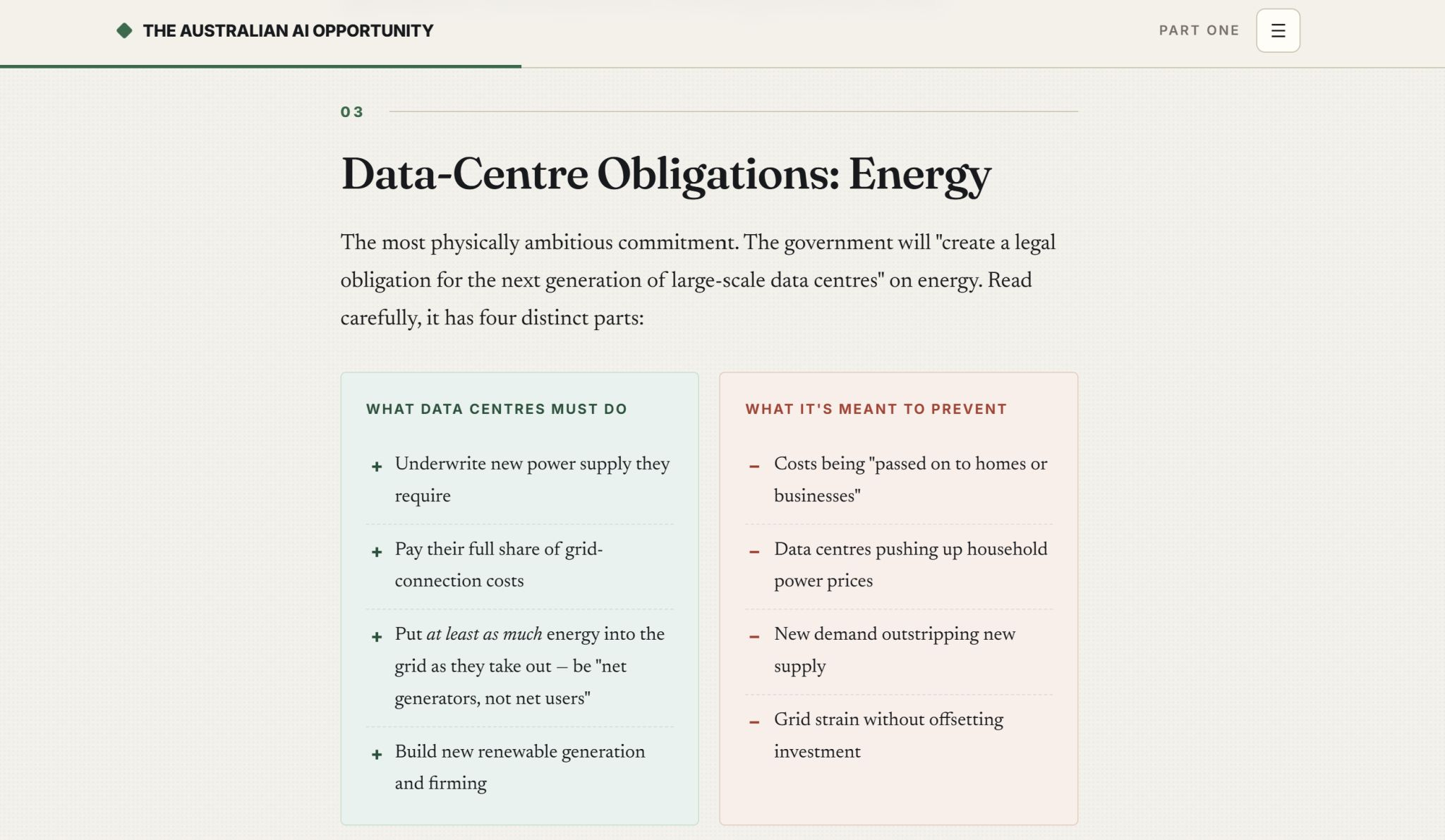
The announcement also covered data centre expectations, energy and water use, AI infrastructure, safety and the broader question of how Australia attracts AI investment while protecting national interests.
This is one of the most important Australian AI policy moments so far. It brings AI into the centre of government and signals that the next phase will involve national coordination rather than fragmented rules across agencies, regulators and states.
Read more: Prime Minister of Australia
Many shared opinions and you can even read our interactive report on it here: https://australian-ai-opportunity.vercel.app/thrives.html
Australia vows to protect creatives from uncompensated AI training
In the same AI policy push, Albanese said Australian writers, musicians, artists and journalists must retain ownership and control of their work, and that companies should not use Australian creative work to build or train AI systems without permission.
This matters because copyright is becoming one of the defining issues in AI policy. Australia wants data centres, investment and AI capability, but the government is signalling that this should not come at the expense of local creators or the broader creative economy.
Read more: The Guardian
Calls grow for a data centre moratorium until new rules are in place
Following the Prime Minister’s AI blueprint, environmental and community groups called for a pause on new data centre developments until stronger regulation is in place. The concerns centre on power use, water demand, land use, community impact and the risk that AI infrastructure is approved faster than local safeguards can keep up.
This is where AI becomes very real. The debate is no longer only about model safety or copyright. It is about electricity grids, planning systems, housing competition, local communities and whether countries can build AI infrastructure without shifting the cost onto the public.
Read more: The Guardian
OpenAI publishes a “scorecard for the AI age”
OpenAI published a new framework for thinking about AI value, arguing that businesses should move beyond simple adoption metrics and focus instead on “useful intelligence per dollar”. The proposed scorecard asks whether AI is completing meaningful work, what each successful task costs, how dependable the output is and whether each AI dollar produces more value as usage grows.
This is a useful shift in the AI debate. The next stage of enterprise adoption will not be judged by how many licences are purchased or how many staff have access to tools. It will be judged by whether AI can complete useful work, reduce total cost, improve quality and scale safely.
Read more: OpenAI
China positions itself as a leader of a new global AI order
At the World Artificial Intelligence Conference in Shanghai, China promoted itself as a leader in global AI access and governance. Reuters reported that China is positioning its open-source and lower-cost models as part of an alternative vision to the US-led AI ecosystem.
This is another sign that AI is becoming geopolitical infrastructure. Countries are not just competing over models. They are competing over standards, compute, access, values, industrial strategy and who gets to set the rules for the global AI economy.
Read more: Reuters
This week in Blockchain news
UK digital finance push could deliver a £33 billion boost
The Financial Times reported that speeding up the UK’s shift to digital finance could deliver a £33 billion boost to the economy. The report highlighted tokenisation, digital securities and the possibility of a blockchain-based sovereign bond as part of a wider wholesale markets agenda.
This is exactly the kind of institutional tokenisation story worth watching. The UK is not just asking whether crypto trading should be regulated. It is asking whether digital market infrastructure can make capital markets more efficient, free up capital and strengthen its financial centre.
Read more: Financial Times
Visa introduces a stablecoin platform as Open USD gains momentum
Visa announced the Visa Stablecoin Platform, an enterprise service designed to help financial institutions, fintechs and crypto companies access stablecoin capabilities through a Visa-managed environment. The platform will begin with Open USD, a new stablecoin from Open Standard.
The stablecoin market is moving from crypto-native issuance to payment network distribution. That is a major change. The winners may not simply be those with the best on-chain liquidity. They may be the networks with the strongest merchant reach, banking relationships and enterprise integrations.
Read more: Visa
Alpaca raises US$135 million for tokenised markets and AI-native financial services
Alpaca announced that it raised US$135 million to scale its brokerage infrastructure for tokenised markets and AI-native financial services. The company said the raise will help expand regulated access to tokenised global markets and support financial applications built for the next phase of AI.
This is a useful reminder that tokenisation is not only about large banks and market infrastructure providers. Brokerages, API platforms and developer-facing financial infrastructure companies are also building the pipes that could bring tokenised assets to consumer and institutional apps.
Read more: Alpaca
Ledger launches toolkit for AI agents to interact with crypto wallets safely
CoinDesk reported that Ledger is launching Ledger Agent Stack, an open-source toolkit designed to let AI agents interact with crypto wallets without directly controlling private keys.
This is one of the clearest AI and blockchain crossover stories of the week. If AI agents are going to operate in financial environments, they will need ways to prepare transactions, request approvals and interact with assets without being given dangerous levels of control. Hardware-backed authorisation could become an important part of the agent economy.
Read more: CoinDesk
The race to build financial rails for AI bots accelerates
CoinDesk also highlighted the growing race to build financial infrastructure specifically for AI bots and autonomous agents, including efforts around open standards for agent payments.
This connects directly to stablecoins, programmable wallets, API monetisation and agent identity. The internet was built for humans clicking buttons. The next layer may need to support software agents transacting continuously and safely on behalf of people and organisations.
Read more: CoinDesk
DTCC processes first live tokenisation transactions with JP Morgan, CME and BNP Paribas
Ledger Insights reported that DTCC has processed its first live tokenisation transactions with major institutions including JP Morgan, CME, BNP Paribas, Societe Generale and Citadel Securities. The transactions included tokenised securities used as margin, tokenised Treasuries posted as collateral and a securities lending transaction.
This is a stronger story than a tokenisation roadmap because it involves real market infrastructure activity. DTCC sits at the centre of US securities settlement, so live tokenisation activity from that layer is a meaningful signal for where institutional capital markets may be heading.
Read more: Ledger Insights
Closing insights
This week’s strongest theme is the arrival of the control layer.
For AI, control means national standards, copyright protections, data centre rules, better measurement of AI value and a more serious debate about the economics of model use. The hype cycle is giving way to questions that CFOs, regulators and boards actually care about: what does it cost, what does it produce, who owns the inputs and how do we know the output can be trusted?
For blockchain, control is showing up through stablecoin distribution, tokenised securities, brokerage infrastructure, digital settlement and AI-agent wallets. The sector is moving from speculative markets towards programmable financial infrastructure, but that also means the governance burden becomes much higher.
The most interesting overlap is agents.
AI agents need payment rails, permissions and identity. Blockchain systems need safer custody, authorisation and settlement. Stablecoins and tokenised assets may become the financial layer for machine-driven workflows, but only if they can operate within systems people and institutions trust.
The next phase of the digital economy will not be defined by capability alone.
It will be defined by who builds the control layer well enough for everyone else to use it.
Thanks for reading The Network Dispatch! Subscribe for free to receive new posts and support my work.
ABOUT AUSTRALIAN BLOCKCHAIN & AI NETWORK
The Australian Blockchain & AI Network (ABAI Network) is a non-profit community organisation dedicated to increasing education and awareness of blockchain technology, specifically blockchain and AI-based projects. Their goal is to empower the Australian community with the knowledge and tools to participate in the digital economy, and to promote the adoption and growth of emerging technology in Australia and beyond.
SPONSORS
This newsletter is brought to you by the following sponsors:
Comments
Nothing yet. Say the first thing.
Sign in to join the conversation.