
$28,405,844 across 193 films in Australian cinemas this week.
Australian breakdown:
Fiction (6 films): $154,583.24 — Leviticus, Saccharine, First Light, How to Talk Australians: The Movie, Wolfram, Imagine
Documentaries (3 films): $8,780.50 — Common Wealth, EPiC: Elvis Presley in Concert, Live It Up: The Mental As Anything Story
Rereleases (1 film): $3,934 — Moulin Rouge!
Total Australian box office: $167,297.74 — around 0.6% of the market this week, with two new fiction openers (Saccharine, First Light) landing on modest screen counts.
So we are now in the second half of the year. No post last week becuase I was having a break so I didn’t burn out and there were no new Australian films.
I’m going to drop the Australian films in cinemas search. I can see now that just doing the Wednesday posts helps bump the Australian films in there. I think maybe we need to get a larger organisation (is it Screen Australia or is it the guilds? to help advocate to organisations like Flicks, letterbox, and justwatch to help promote Australian films in Australia.). What I’m talking about below should also help bring the current Australian films into the search engines. I’ll keep watching this but I’m not going to do any deep dives each week unless I notice something unusual.
Ok the next thing I’m thinking of well I’ll be honest I’m a bit scared about doing this publicly becuase it’s going to be tricky and I’m a bit worried about how it might be percieved by my fellow producers and the distributors/exhibitors I hope to work with in the future. Maybe this newsletter is the end of my producing career. Who knows - maybe I’ll become a distributor or open my own cinema one day and become an exhibitor.
I’m going to drill in a bit more to the awareness (which might hit a nerve with producers and distributors) and then availablity and habit (which will be more about the exhibitors but also a little bit distributors) and so we’ll see how we go and the feedback I get on wether I continue doing this.
Maslow Entertainment | Week 4 | 54 screens | $125,839.19 week total | $2,330.36 per screen | $1,330,092.23 cumulative
Maslow Entertainment | Week 1 | 23 screens | $12,706.01 week total | $552.44 per screen | $31,481.64 cumulative
$3,846.90 from 5 theatres in previews
Bonsai Films | Week 1 | 8 screens | $12,604.76 week total | $1,575.60 per screen | $60,714.72 cumulative
First Light had $405 from 1 theatre in previews
Umbrella Ent. | Week 5 | 4 screens | $1,673.28 week total | $418.32 per screen | $39,780.00 cumulative
Dark Matter / Bonsai Films | Week 11 | 5 screens | $1,580.00 week total | $316.00 per screen | $158,556.80 cumulative
Screen Inc. | Week 24 | 1 screen | $180.00 week total | $180.00 per screen | $44,809.51 cumulative
Garage / Madman | Week 3 | 1 screen | $4,880.50 week total | $4,880.50 per screen | $11,114.90 cumulative
Universal | Week 21 | 2 screens | $3,845.00 week total | $1,922.50 per screen | $4,243,137.28 cumulative
Bonsai Films | Week 19 | 1 screen | $55.00 week total | $55.00 per screen | $105,959.87 cumulative
Walt Disney | 1 screen | $3,934.00 week total | $3,934.00 per screen
Ok so here’s the new section. This week our two new films are Saccharine and First Light.
I think yes - But there’s a but…
Elevated/festival horror fans
People who follow Sundance Midnight, Fantastic Fest, and directors like Ari Aster or Julia Ducournau. James already has credibility here from Relic (2020, Shudder) and Apartment 7A (2024). Does the general public know who James is? Probably not. Australian screen industry people should. Australian horror audiences likely would from Relic.
Body horror specifically, post-Substance-boom
The Substance proved there’s a mainstream-adjacent appetite for “beauty standards as literal bodily torment.” Saccharine’s ash-eating/ghost-that-grows-as-you-shrink premise is a near-perfect thematic sequel to that conversation. It’s a hard one here because sometimes that’s treated as “it’s not original”.
Queer audiences, especially queer women
The sapphic relationship framing and “queer lens” quotes from James in interviews signal this isn’t incidental. I couldn’t see how much queer coverage there was on the film, but it’s a possible angle for marketing.
Women 18–34 engaging with diet-culture/wellness-industry discourse
The premise (an “obscure weight-loss craze”) lands right in the middle of current GLP-1/Ozempic-era cultural anxiety and wellness-influencer skepticism. This could pull in viewers who aren’t habitual horror watchers but are drawn to sharp social commentary. The same crossover The Substance and Fresh achieved.
So the but… do these women actually go to the cinema? This is where it would be really great for producers to understand the whole cinema going audience from exhibitors. They have the data on their members. Obviously that doesn’t cover everyone but I reckon they would be able to show broad generalisations. I’d be asking how many 18-34 women go and see horror films. My gut instinct is this audience bracket watches more at home - and here’s where the STAN original makes sense but also makes it slightly harder to convince an audience to go to the cinema to watch this.
Ok so lets play with the premise that these 18-34 women engaging with diet culture don’t generally go to the cinema to watch horror films. How could you convince them to watch the film at cinemas?
18-34 year olds are more chronically online. This age bracket is known to sit more on TikTok and Instagram rather than Facebook. But when I went looking - There’s nothing on TikTok. And on the day of release there’s only 10 posts, 5 reels on the Instagram page.
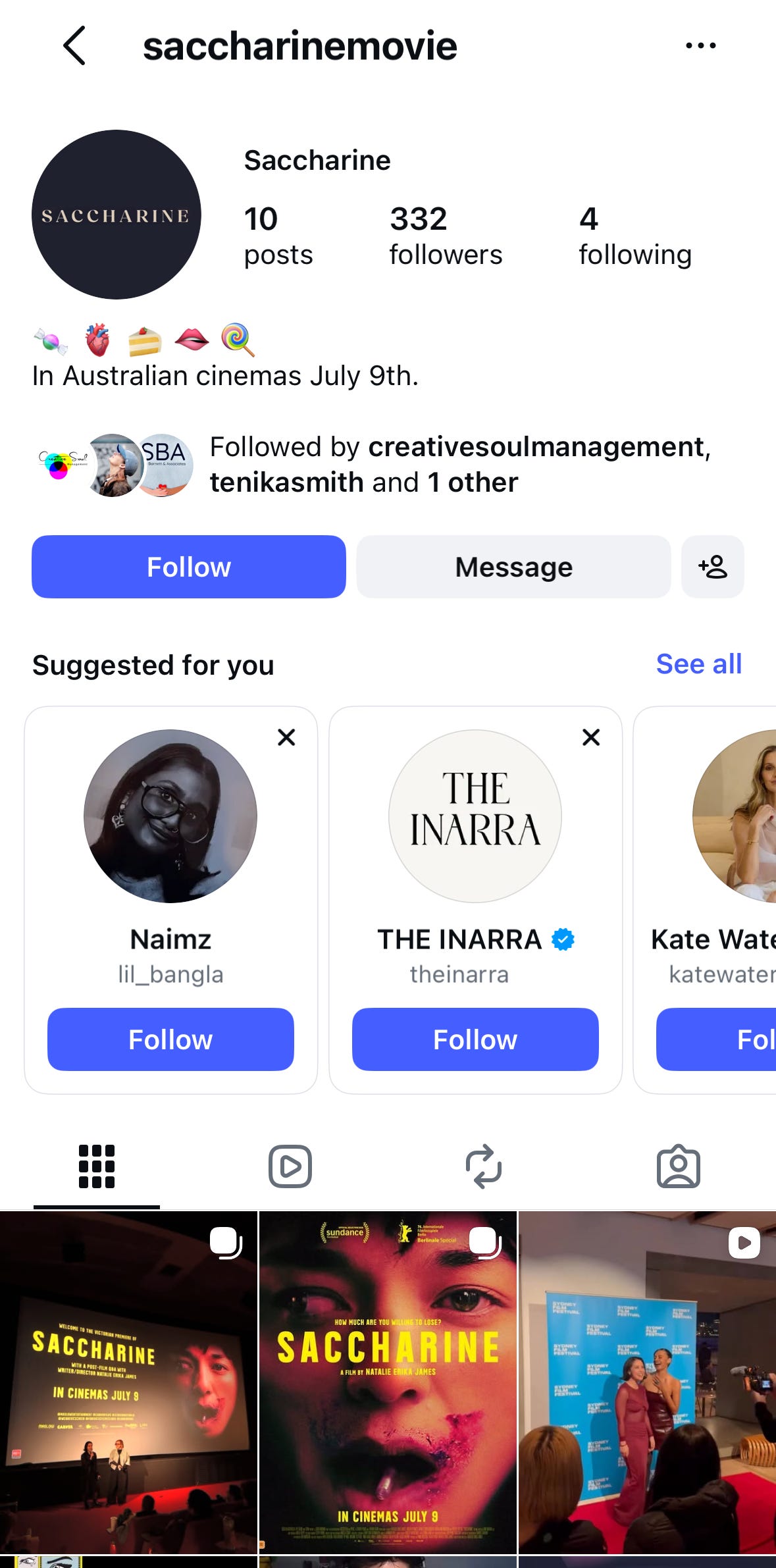
So 23 screens, very little online presence - this film was never going to do well as it could have.
What would it take to do more? Of course as a producer I still ask myself the question yeah but where does the money come from to do this? It takes dedicated people to record content that can be used during shoot - that’s an additional cost that when budgets are tight is easy to cut. I hope that Screen Australia’s Market Audience Assets program will help make this possible BUT it’s something that we should be including in our budgets anyway if we want them to be successful.
This is the kind of release that makes it feel like the producer offset is not working the way it should. Did the film need a cinema release to satisfy the ATO for the 40%. Would the cinemas that it could have played best at choose not to program it? I’ll look at this when I get to habit!
Oh and if you haven’t explored the world of reddit. Saccharine is a great one to look at the discussions that happen around film - Try this post to start with. To me it shows there’s a life for this film - maybe it just needed a chance to reach it’s right audience.
Yes. It’s not as wide as many other Australian films but I’d say there is a clear core audience.
Arthouse/festival cinephiles
This is the anchor group. I haven’t seen this yet but it’s described as a quiet and meandering piece of slow cinema which reckons with faith, mortality and modernization in the Philippines. Press quotes call it “an astonishing debut… a quiet miracle of a film” and praise “a wholly distinctive voice at the helm.” The festival trail confirms this. It premiered at Sydney Film Festival, was in competition in the Bright Horizons section at the 2025 Melbourne International Film Festival, IFFR (Rotterdam), and Shanghai’s Australia Focus.
Robinson’s Blackmagic Design Best Australian Director Award win at MIFF, plus reviews from outlets like The Film Verdict calling him “a wholly distinctive voice... a director to watch,” positions this for audiences who track “one to watch” debut directors. And this is devastating to know that even though I wanted to watch this film and have been keeping an eye out for it - it’s not available at any cinema in WA.
Filipino diaspora in Australia
Given the subject matter, this is likely the most important niche segment. The film is the first official co-production between Australian and Filipino government funding bodies, filmed in Filipino language.
Robinson himself is born and raised in Melbourne’s south-eastern suburbs to a Filipino mother and an Australian father, and the film reckons with modernization in the Philippines, from where Robinson’s mother migrated in the ‘70s — a story pitched partly as generational/diasporic reckoning.
Australia has many Filipino communities, and cinemas are a logical hub for this audience. A quick search on the ABS Table Builder shows that you could map out the cinemas that have Filipino communities close by. (Also a reminder - it’s census year! hooray for data nerds!)
Faith-engaged / Catholic audiences interested in institutional critique
The plot is explicitly theological. IFFR comments from Michelle Carey (hello Aussie film programmer doing amazing things in the world of film) describe it as an elegant and quietly devastating examination of belief, community and institutional corruption in a mountain community, centred around a rustic nuns’ convent, where Sister Yolanda, after giving last rites to a young man involved in a horrific construction accident, is troubled by the nature of his death. That’s a natural draw for viewers interested in films that interrogate church authority and colonial legacy (a smaller but engaged audience — think the crowd for films like Ida, Corpus Christi, or The Nun’s Story-adjacent stories). It’s a small audience and I’m not sure how you’d reach them - there’s not really anti-church groups. But there might be some interesting seeding in reddit threads that could be done.
Crossover fans of Robinson’s photography/visual work
A distinct secondary audience, there are people who know Robinson not as a filmmaker but from his other career. He’s known for luminous 35mm film portraits of celebrities like Rihanna, as well as the viral image of a burning St Kevin’s blazer in protest of the private school’s homophobic culture. That protest photograph made him a recognizable name in Australian media/culture conversations well outside cinema circles — a distinct on-ramp for image-conscious, culturally-engaged younger viewers who might not otherwise seek out a slow-cinema Filipino drama. I do feel like there is a big crossover with the fans of the artist and the festival cinephiles.
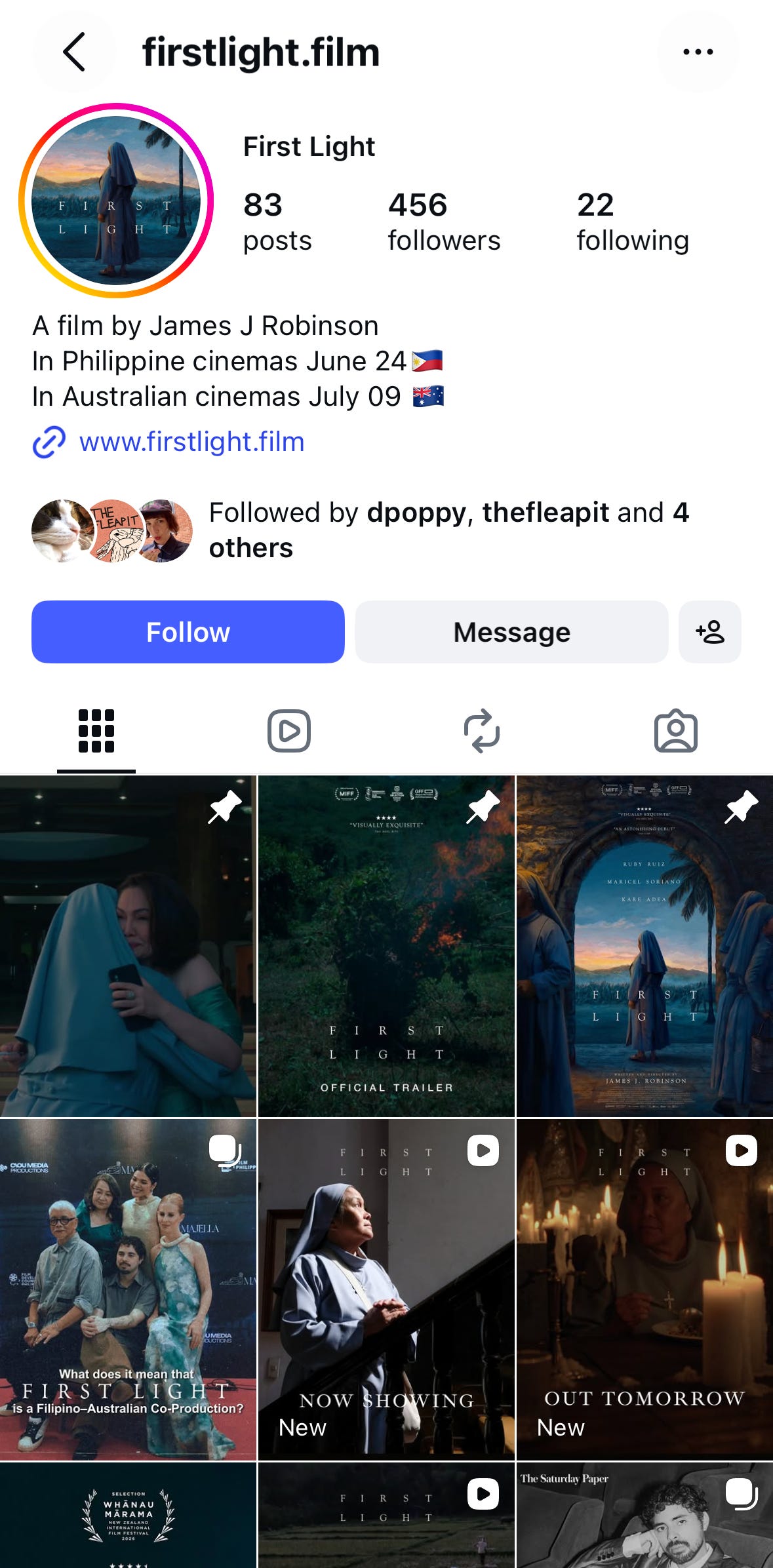
Ok so this film only ended up being in 8 cinemas this week.
You could work with the Philippine embassies around Australia to reach the Filipino community. Without having seen the film I don’t know if it’s something that you could include a faith audience and utilise church groups - but they like a very specific kind of ending that adheres to their values.
BUT here’s some interesting difference to Saccharine - still no TikTok but the Instagram has way more content, and a link to the film’s webpage which is really beautifully put together for the search engines to find information, a link to where tickets can be bought which is where I learnt that in WA there is a Bunbury Regional Entertainment Centre International Film Festival.
What could exhibitors do to help these Australian films (or others like it)?
Let me go back a step and talk about cinema programming because I think that’s the element that needs to change the most.
So think of a cinema week and audiences like this image below - yes, very broad generalisation, but when you think about each of these groups’ lifestyles now (not 20 years ago) this is when these groups are most likely to be available to watch films at the cinema, and if we program the films for these times at the locations that work for them we might get more people into the habit of going to the cinema.
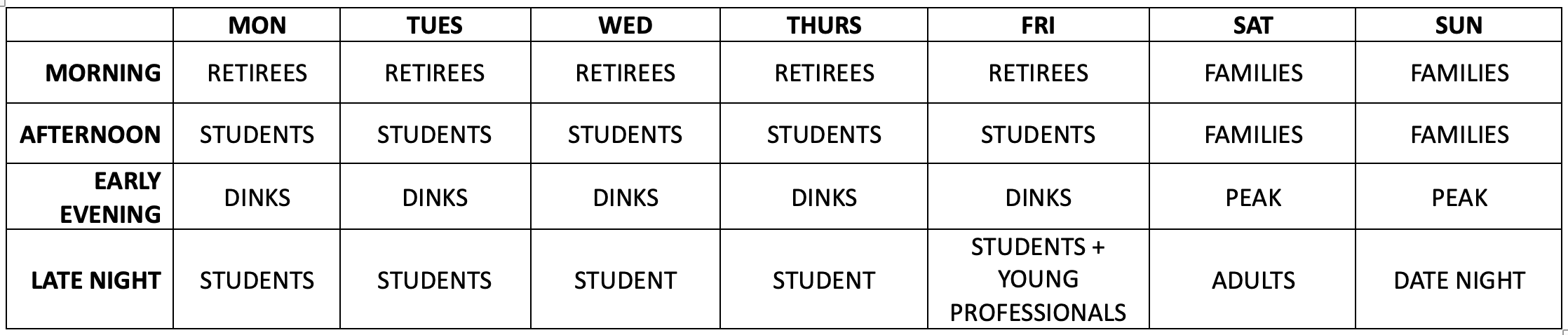
The silver audience (retirees) are more likely to go to the first sessions in the morning. It’s also when people who don’t work regular jobs would go or when I had small kids who would sleep in the pram I loved going to these early morning sessions.
Uni Students quite often have more time in the early afternoon, if they don’t have casual jobs to go to.
The “Double Income No Kids” have the time to go to an evening session. I’d put these in an older age bracket to the young professionals.
Then you have families. But even on those Saturday and Sunday days - there is still sports, dance, washing neverending piles of clothes that conflict with this availability.
You might get some adults with or without kids who take the oppurtunity on a Friday Satruday night to get a babysitter and have a night out at the movies - then a Friday - Sunday night date night is possible.
It’s not a perfect split but I reckon you go to a cinema at any of those times and that’s generally who you’ll see there. Each cinema location will have its own quirks - is the cinema regional, is it in a high socio-economic or low socio-economic area.
Exhibitors ultimately want as many bums on seats buying stuff from the candy bar as possible, so if films are programmed sensitively - rather than studios first and then everything else tries to fit around it - we might get more people going to the cinema.
So with this in mind….
18-34yo women would include universities. In my dream world I’d start by only trying to get the film played at cinemas that are near universities. I’d probably try and reach out to the medical schools at the universities. Could an exhibitor get away with programming the film in the afternoon - I think yes, as long as the audience that would likely come to it knows that it’s available.
Ok so this is a film that more of the core audience that will love it will watch online. What if … The distributor and the producers decided themselves lets skip cinemas. Except you can’t without then potentially running afoul of the ATO and the producer offset requirements for a cinema run. And the problem is with making a film like this you NEED the 40% to make the financing viable in this country.
OR they decide to do a special event screening in each state. What if - the unusal cinema release was a partnership with the Butterfly Foundation. There was a psychologist that specialised in body dysmorphia in each capital city that talked about the film in a Q&A afterwards. Yes ok some might say no that’s too triggering and I haven’t watched the film but maybe you wouldn’t want the people actually suffering the body dysmorphia to come watch it, but they might be able to send their family to help understand part of what they are going through. Audiences aren’t stupid. We can handle hard topics.
Or take the queer lens instead - special event screenings again that are promoted through queer clubs and organisations.
I feel like a film like this where the core audience is more on streaming - you have to do something non-traditional for the cinema release, if you have one at all. But that needs exhibitors to agree to it. And they are going to program to what works for them - but why don’t we do more bespoke cinema releases of Australian films?
I guess it’s that challenge that until you know where/when the film will be programmed, how can you craft the audience drive - or does it work the other way, where the distributor might say this is how we are going to bring the audience and then the exhibition programmer can say well here’s where we will program it so you can target your advertising. I guess it’s a real catch 22.
Back to delusion of what could be possible… I’d program First Light in the mornings for the ‘silver audience’, maybe some afternoons for uni students to encourage film students to come and watch - but probably not every day. If I was going to target the film students I’d be pushing for ‘special event’ style screenings that maybe included a Q&A with the director or cinematographer.
Could you do a young professionals reach out for the “intelligence/philosophical audience”? And then maybe an early evening targeting the Filipino diaspora.
So this is a film that you’d expect to have a small audience - and at 9 cinemas in the whole country there’s an availability issue - 20 maybe would/could have been a sweet spot for this film. But if a film like this did 10 rotating cinemas each week around the country for 4 weeks, could that be a feasible release that would generate an audience in cinemas - particularly if it focused on those audiences.
It feels like a film that wouldn’t have as clear an audience on a streaming platform - or could have a wider audience on a streaming platform if it had word of mouth built from a limited theatrical release. But that’s a hard thing to build when you may only get 2 weeks in cinemas.
I’m really curious to find out what it would take to program a film this way - could we program films earlier out if there was less sessions. I feel like that could be a way to be able direct people to the session time. It feels like the way cinema is programmed at the moment if for the spontaneous audience rather than the planned cinema goer.
and if we are going to build habit back into the cinema audience in Australia we need to allow more time to direct them there.
Anyway … let me know what you think of this new look at the Australian films in cinemas. Asking these questions on each of my films helps me work out what my ambitions and targets for the film are realistic and as such where I should be positioning the budget level for the film - which then includes the casting and production methodology. And I don't think social media is the answer to every awareness building exercise but that look at both the instagram page and website (or lack of) for both these films is a great starting place of what should be a bare minimum.
No posts
Comments
Nothing yet. Say the first thing.
Sign in to join the conversation.