
The total Australian box office for the week of 18-24 June was $23,769,126 across 210 films. That’s a significant jump from last week’s $18,657,614, and most of it is one film: Toy Story 5 opened with $11,948,410 on 701 screens.
Australian films accounted for $527,546 of that total across 13 titles:
10 current-year Australian fiction releases earned $526,509, led by the opening week of LEVITICUS
3 current-year Australian documentaries earned $1,036
1 Australian film in rerelease: GOING DOWN (1983) on 2 screens, earning $2,414
One note before we get into it: BEAUTY FROM PAIN, which is listed as releasing on June 18 (the same date as LEVITICUS), does not appear anywhere in this week’s MPDAA data. No screens, no revenue, nothing. I don’t have any information on what happened there.
This week I searched before I put out my article. I wanted to see again if it is make a difference in teh asearch results. And just did the usual film/movie search.
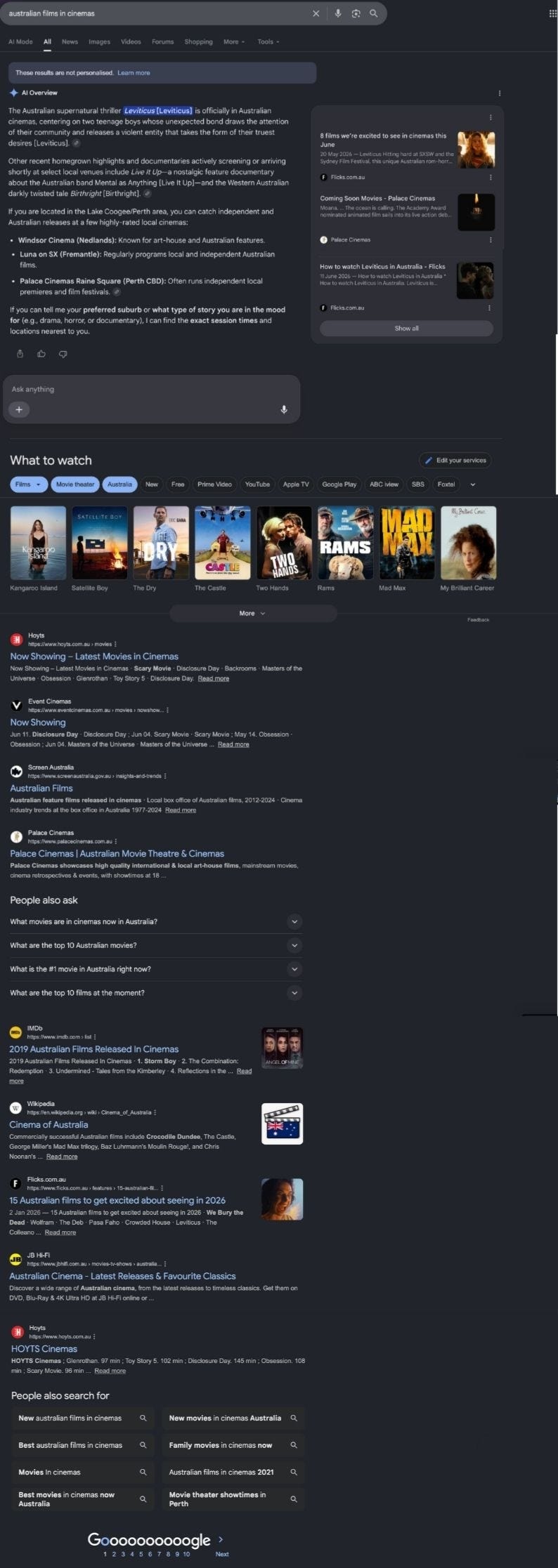
The AI Overview leads with Leviticus by name, calling it “officially in Australian cinemas.” It also mentions Live it Up and Birthright. That’s a genuinely good result for a film in its opening week. Leviticus is being recognised by Google’s AI as a current, relevant answer to this question, and that hasn’t always been the case for new Australian releases.
The “What to Watch” carousel, though, is the same collection of older titles it always is: Kangaroo Island, Satellite Boy, The Dry, The Castle, Two Hands, Rams, Mad Max, My Brilliant Career. There’s still no mechanism connecting “australian films in cinemas” to what’s actually playing in cinemas right now.
Below the fold, the organic results are the usual mix: Hoyts and Event Cinemas “Now Showing” pages (which list everything, not just Australian films), Screen Australia’s industry data pages, Palace Cinemas, and an IMDb list of 2019 Australian films. Flicks.com.au has its “15 Australian films to get excited about seeing in 2026” article from January, which does mention Leviticus alongside others like We Bury the Dead, Wolfram, and The Deb.
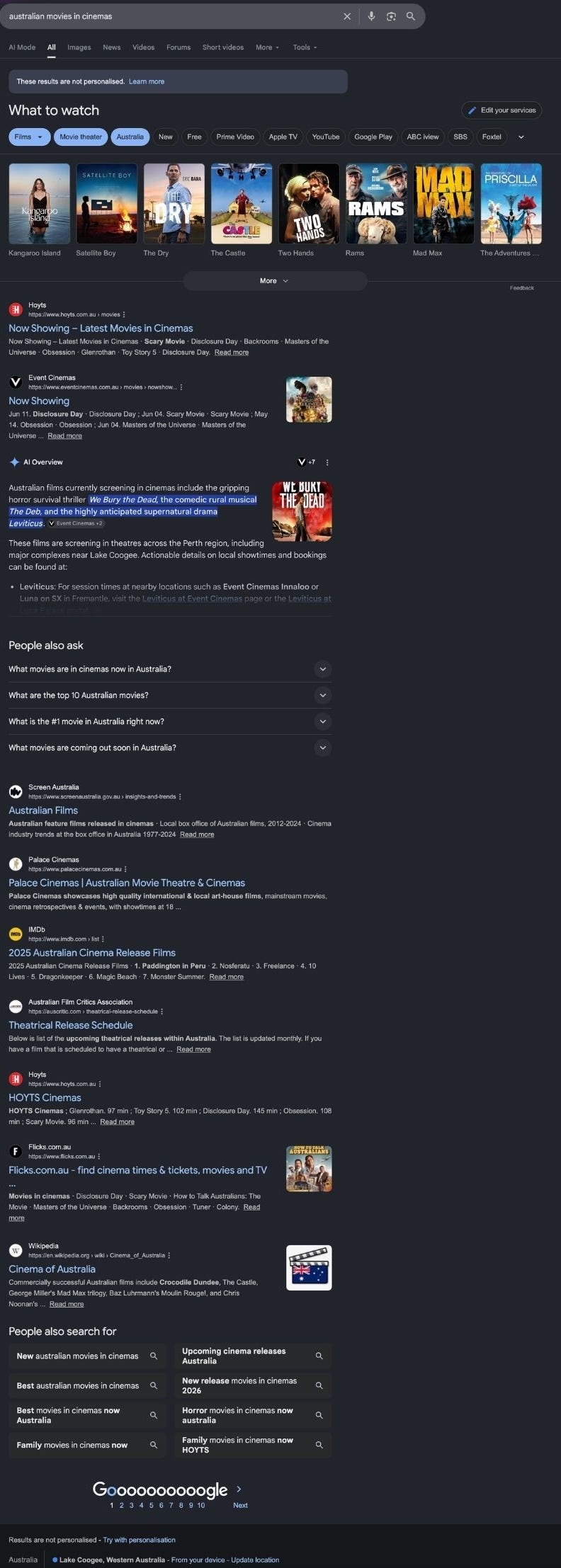
The AI Overview here names three films: We Bury the Dead, The Deb, and Leviticus. It then gives specific screening location guidance for the Perth region, mentioning Event Cinemas Innaloo and Luna on SX. That’s useful, localised information, even if We Bury the Dead and The Deb have been out of cinemas for a while.
The “What to Watch” carousel is essentially the same older titles again, with Priscilla swapped in for My Brilliant Career.
In the organic results, the Flicks.com.au listing is actually helpful this week. It names Disclosure Day, Scary Movie, How to Talk Australians: The Movie, Backrooms, Obsession, Tuner, and Colony. Only How to Talk Australians is Australian, but at least it’s surfacing as part of “what’s in cinemas.” The Australian Film Critics Association’s Theatrical Release Schedule also appears, which is a useful resource.
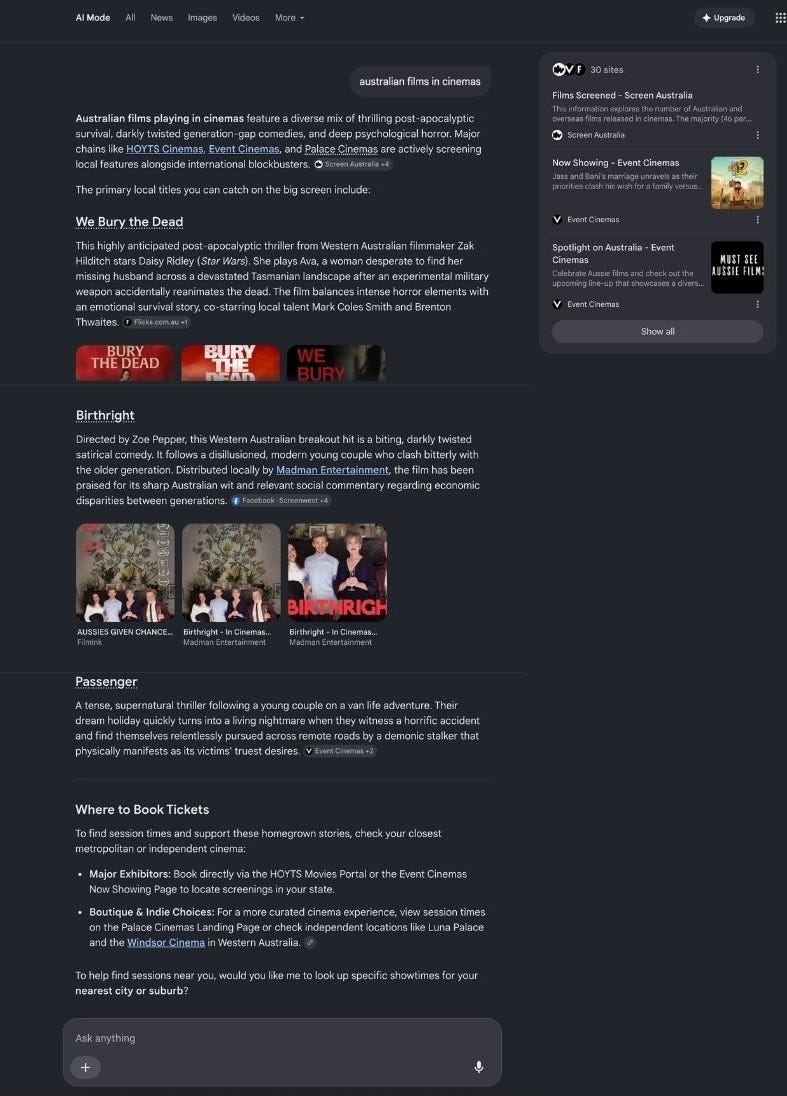
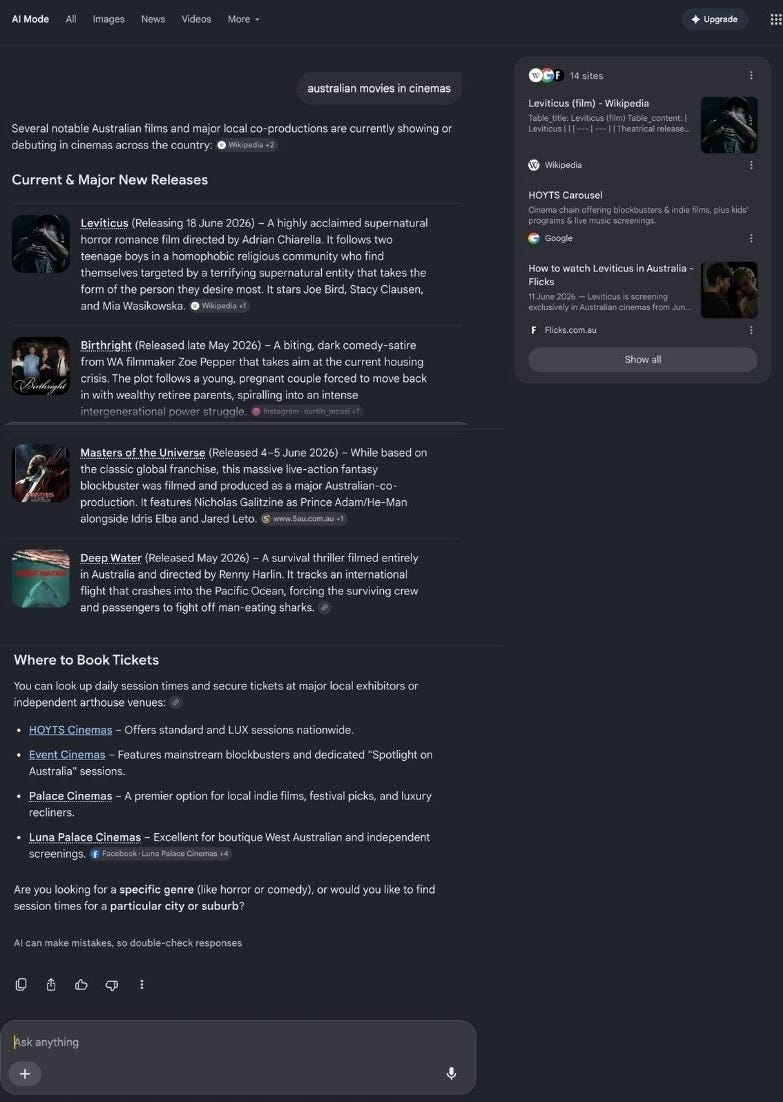
I also ran both searches in Google’s AI Mode, and the results were worth flagging.
For “australian films in cinemas,” AI Mode returned We Bury the Dead, Birthright, and Passenger. No Leviticus at all, despite it being the biggest Australian opening of the week. We Bury the Dead isn’t currently in cinemas. Passenger isn’t an Australian film. And Birthright, while technically still screening, was on 2 screens in the entire country. So the one Australian film that actually opened wide this week (152 screens) didn’t make the list, and the three films that did were either not in cinemas, not Australian, or barely available.
For “australian movies in cinemas,” AI Mode did put Leviticus first, which is great. It also correctly listed Birthright. But then it included Masters of the Universe, describing it as “a major Australian co-production,” which it isn’t. It’s a Sony/Mattel film. Some visual effects work may have been done in Australia, but that doesn’t make it an Australian film. It also listed Deep Water, which wasn’t released in cinemas. So of four films listed, two were wrong.
Across both AI Mode searches, seven films were recommended. Three were correct. That’s a worse-than-coin-flip accuracy rate for a system that’s presenting its answers with full confidence.
This is the tension with AI-driven discovery. The system is getting better at recognising Leviticus (and recognising it quickly, which is new), but it’s also filling gaps with confidently presented misinformation. Someone relying on AI Mode to find Australian films to see this week would get a list that’s half wrong.
Just keeping this in from last week: The next challenge is getting people interested in actually watching Australian films in cinemas. Accurate information is the foundation, but interest has to be built on top of it. And accessibility remains a problem until exhibitors start programming more Australian films.
I've been running this web search experiment every week for the past quarter, and I'm thinking that next quarter I'll shift to searching TikTok and Instagram instead. I've been changing the focus every three months, and after 13 weeks of watching Google's results, I hope you all have a pretty clear picture of what web search does (and doesn't do) for Australian film discovery and what we need to do collectively to start showing more accurate results.
Maslow Entertainment | Week 1 | #8 | $506,840 week total | $633,946 cumulative inc previews | $3,334 per-screen average
Leviticus opened on 152 screens this week, up from 42 preview screens the week before. For an Australian film released through Maslow Entertainment, that’s a solid rollout. For comparison, THE AMAZING DIGITAL CIRCUS: THE LAST ACT opened on 217 screens and HOW TO TALK AUSTRALIANS: THE MOVIE opened on 27 screens.
152 screens puts Leviticus in the mid-range of what’s available in the national market this week. It’s well behind the major studio releases (Toy Story 5 on 701, Disclosure Day on 410, Obsession on 271) but comfortably ahead of most other new releases. THE DEATH OF ROBIN HOOD, for instance, also opened this week on 95 screens. COCKTAIL 2 opened on 68.
This is where Leviticus is doing something different to most Australian releases I’ve tracked this year. It has genuine, visible, organic momentum.
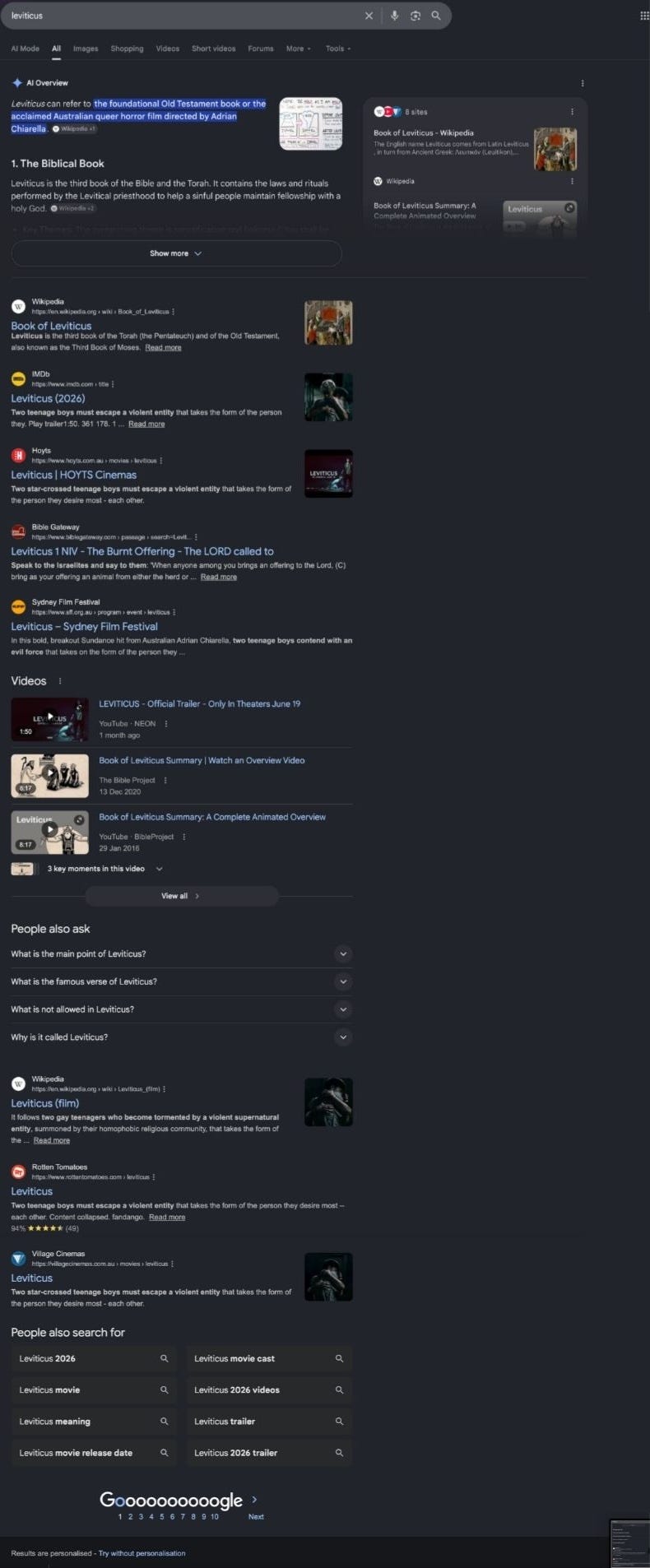
The biblical book still dominates the AI Overview (understandably). But the film is breaking through: IMDb sits at the third organic result, Hoyts has a dedicated Leviticus page at fourth, and the Sydney Film Festival listing and Wikipedia film page both appear on the first page. The NEON trailer is the first result in the Videos section. Rotten Tomatoes shows the film at 94% from 45 reviews, which appears on the first page via Village Cinemas.
The “People also ask” questions are still all about the biblical book (”What is the main point of Leviticus?”, “What is not allowed in Leviticus?”), which is ironic given the film’s subject matter. But the related searches at the bottom tell a different story: “Leviticus 2026,” “Leviticus movie,” “Leviticus movie release date,” “Leviticus 2026 videos,” “Leviticus trailer.” People are looking for the film.
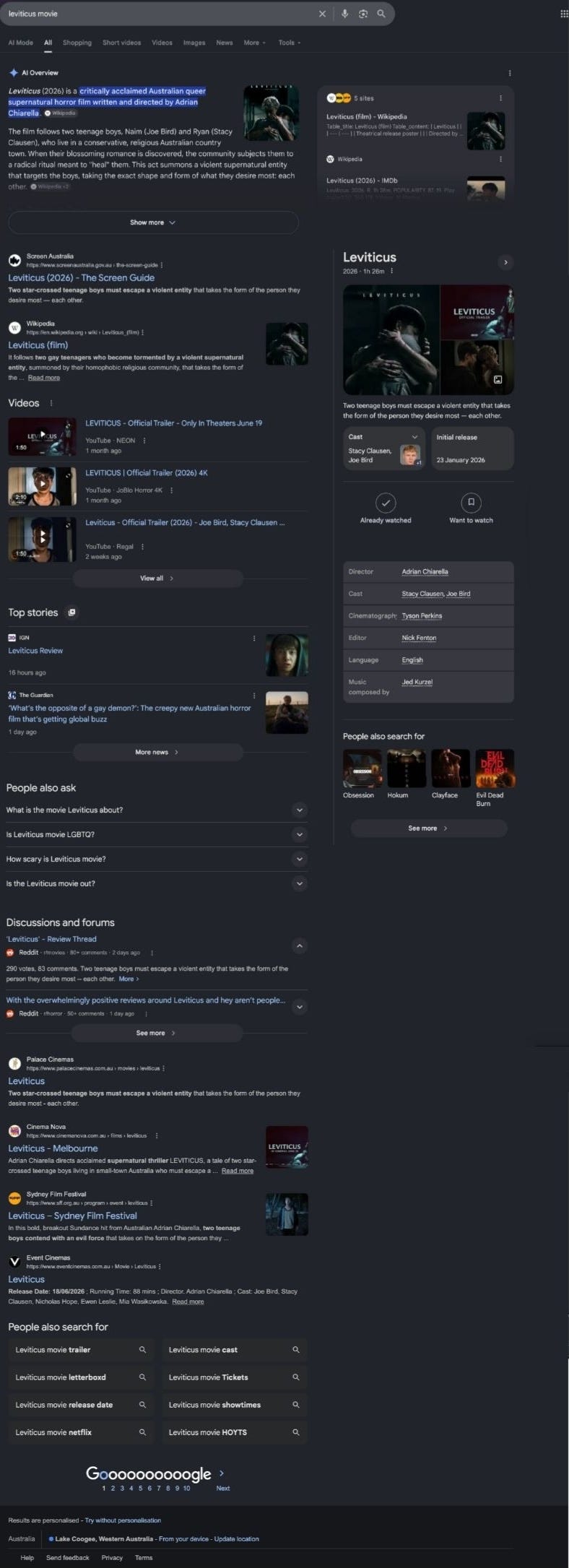
This is an excellent result. The AI Overview correctly describes Leviticus as “a critically acclaimed Australian queer supernatural horror film written and directed by Adrian Chiarella.” It names the cast , describes the plot, and sources from Wikipedia. The knowledge panel on the right is full and there even “Already watched” and “Want to watch” buttons.
Screen Australia’s screen guide is the first organic result. The Videos section has the NEON trailer (*note not the Maslow, the australian distributor trailer), plus other YouTube coverage. Top Stories include an IGN review and a Guardian article headlined “’What’s the opposite of a gay demon?’: The creepy new Australian horror film that’s getting global buzz.” The Reddit discussion threads show active conversation (290 votes, 83 comments on the review thread).
The “People also search for” at the bottom lists Obsession, Hokum, Clayface, and Evil Dead Burn, which positions Leviticus alongside genre films with established audiences. And the related searches include “Leviticus movie Tickets,” “Leviticus movie showtimes,” and “Leviticus movie HOYTS,” which are buying-intent signals.
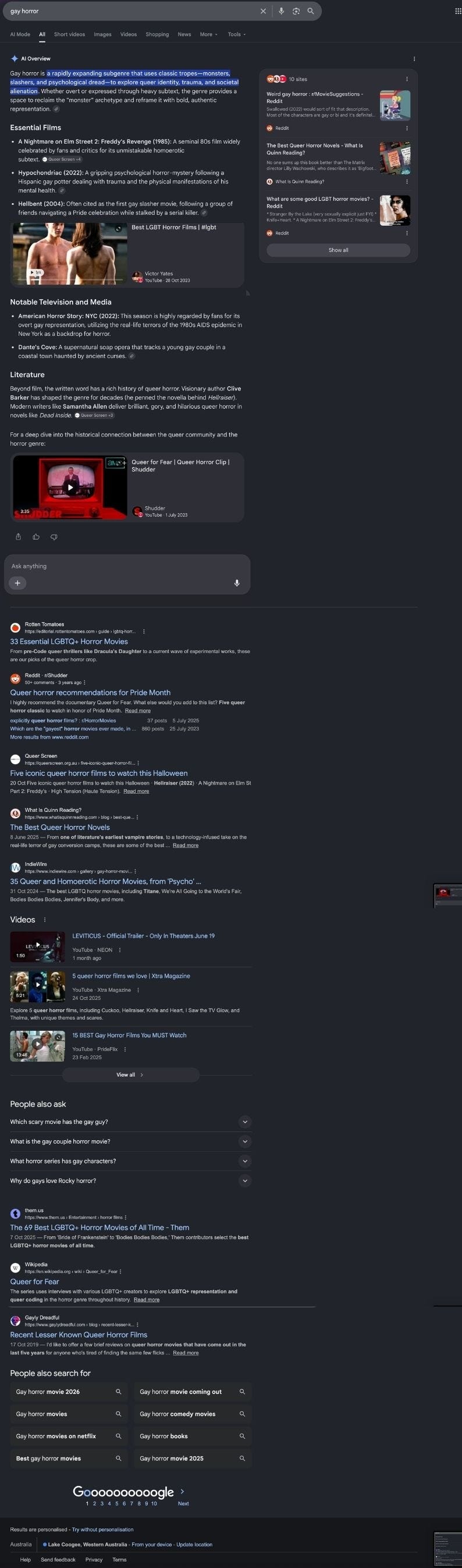
I searched “gay horror” partly because I’m making one (Parrot), so I was curious about this space. I also searched “queer horror,” which returned similar results with some stronger press coverage. Leviticus is clearly being marketed as a queer film, but whether audiences search for “gay horror” or “queer horror” when they’re looking for something like this is an open question, and the results are different enough to matter.
The AI Overview for “gay horror” describes it as a subgenre and lists essential films: A Nightmare on Elm Street 2, Hypochondriac, and Hellbent. These are all older titles. Leviticus doesn’t appear in the overview itself, but the official trailer does show up in the Videos section. And “gay horror movie 2026” appears as a related search at the bottom, which is a signal that people are actively looking for something new in this space.
In the “queer horror” search, Leviticus has a stronger presence. The Guardian’s article appears both in the organic results and in Top Stories, alongside pieces from Gizmodo and SBS Australia (”Australia has built a reputation for horror films. Leviticus is the latest proof”). The Leviticus trailer is the second video result. That’s meaningful press coverage positioning an Australian film within a global genre conversation.
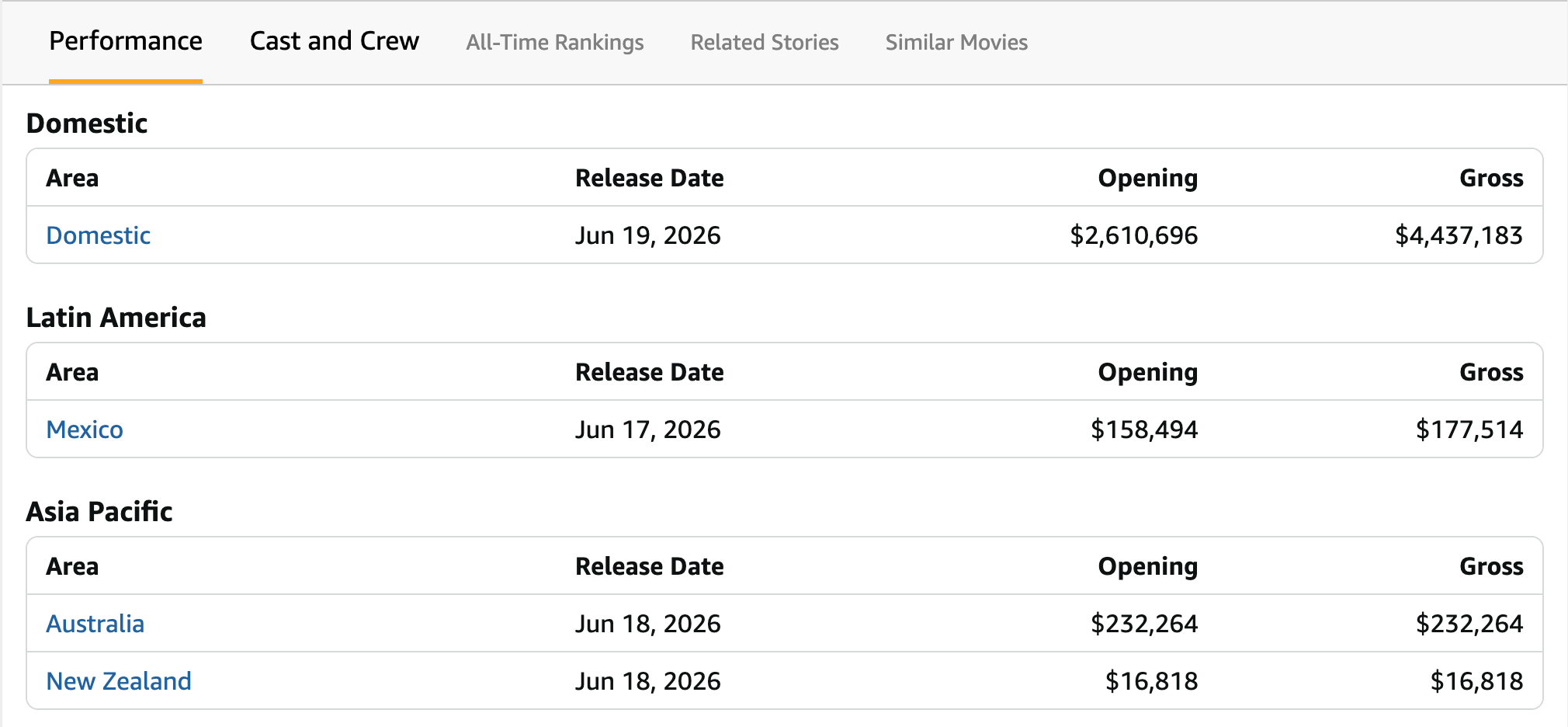
Leviticus earned $506,840 (AUD) in its opening week from 152 screens, with a per-screen average of $3,334. Including previews, the cumulative total is $633,946. On Box Office Mojo, the Australian opening is listed as US$232,264.
This is a day-and-date release with the US, which makes the international comparison worth looking at. In the US, NEON opened the film to US$2,610,696 with a gross so far of US$4,437,183. Mexico opened a day earlier at US$158,494 (US$177,514 gross). New Zealand opened on the same day as Australia at US$16,818.
I’ll be honest, the US number is lower than I hoped it would be. This is a film with a 94% Rotten Tomatoes score, active TikTok conversation, press coverage from The Guardian and IGN, and NEON’s distribution muscle behind it. US$4.4 million gross from all of that feels like it should be higher. It’s possible the film will hold well given the word of mouth, but as an opening statement, it suggests the Awareness picture in the US has similar gaps to what we see here.
To put the Australian numbers in context within this week’s chart: Leviticus on 152 screens earned nearly as much as MASTERS OF THE UNIVERSE on 251 screens ($517,608) THAT’S GOOD!!!. It outperformed STAR WARS: THE MANDALORIAN AND GROGU in its fifth week ($340,363 from 221 screens), and it comfortably beat every other new release apart from TOY STORY 5.
As an opening week for an Australian film, $506,840 from 152 screens is a strong result. It’s well below TADC’s $2.2 million opening (217 screens), but TADC had a built-in global audience from 600 million YouTube views. What Leviticus has is a different kind of momentum: critical acclaim (94% on Rotten Tomatoes), organic social media conversation, international distribution through NEON, and a genre (queer horror) that has an active, engaged audience looking for exactly this kind of film.
The opening day figure of $70,839 suggests the film’s audience skews toward weekend viewing rather than Thursday-night openings, which is typical for horror and for younger audiences discovering films through social media rather than advance booking.
Umbrella Ent. | Week 2 | 6 screens | $4,409 week total | $735 per screen | $30,902 cumulative
A steep drop from 27 screens in its opening week to 6. That’s a 78% reduction in availability, and the weekly revenue fell from $21,776 to $4,409. The per-screen average of $735 is low. This looks like a film that had a wide first-week push and then contracted quickly.
Independent | Week 3 | 5 screens | $536 week total | $107 per screen | $2,385,578 cumulative
From 106 screens last week to 5. That’s the sharpest contraction I’ve tracked this year. TADC’s weekly revenue went from $173,980 to $536. The cumulative of $2.39 million is impressive, but now that it’s out on streaming it’s clear it’s no longer a cinema film. It’s interesting that it managed to keep these few screens.
Madman | Week 5 | 2 screens | $2,856 week total | $1,428 per screen | $109,945 cumulative
Down from 3 screens to 2, but the per-screen average of $1,428 is actually solid. Birthright has been quietly persistent, earning close to $110,000 cumulative on very limited screens. It nearly doubled its weekly revenue from last week’s $1,556.
Maslow Entertainment | Week 6 | 1 screen | $888 week total | $888 per screen | $47,162 cumulative
Down from 2 screens to 1. Maslow’s other release continues its slow, community-driven run. $47,162 cumulative from a film that has never been on more than a handful of screens.
Rialto Distribution | Week 6 | 1 screen | $205 week total | $205 per screen | $6,495 cumulative
Returning after dropping out of last week’s data. One screen, $205 for the week. The Run has earned $6,495 cumulative across its six weeks.
Athabasca Film | Week 7 | 2 screens | $564 week total | $282 per screen | $18,794 cumulative
Down from 3 screens to 2. The per-screen average of $282 is very low. $18,794 cumulative in seven weeks.
Dark Matter / Bonsai Films | Week 8 | 3 screens | $957 week total | $319 per screen | $153,735 cumulative
Down from 4 screens to 3. Wolfram has built a respectable $153,735 cumulative, almost entirely on single-digit screen counts. The per-screen average has dropped to $319 though, which suggests it’s close to the end of its run.
Screen Inc. | Week 9 | 4 screens | $6,436 week total | $1,609 per screen | $61,410 cumulative
An interesting result this week. Alphabet Lane jumped from $1,481 last week to $6,436, on one fewer screen. The per-screen average of $1,609 is the strongest it’s posted in weeks. Something drove people to those 4 screens. A per-screen of $1,609 in week 9 is worth paying attention to.
Kismet | Week 18 | 1 screen | $2,820 week total | $2,820 per screen | $395,578 cumulative
Returning after not appearing in last week’s data. One screen, $2,820. Jimpa’s cumulative of $395,578 has been built steadily over 18 weeks, with the film appearing and disappearing from the data as individual cinemas pick it up for screenings. That single-screen per-screen average of $2,820 is higher than most of the new releases this week.
Smart Street Films | 2 screens | $2,414 week total | $1,207 per screen
An Australian rerelease of the 1983 film, playing on 2 screens this week.
There are a few threads I’m pulling on this week, and they all come back to Leviticus.
The clipping question
On June 4, the Leviticus Film Instagram account (in partnership with NEON) posted a note from director Adrian Chiarella inviting fans to use an official scene pack: That post had 22.2K likes when i took the screenshot last week. Honestly from a Neon account I expected a bit more than that.
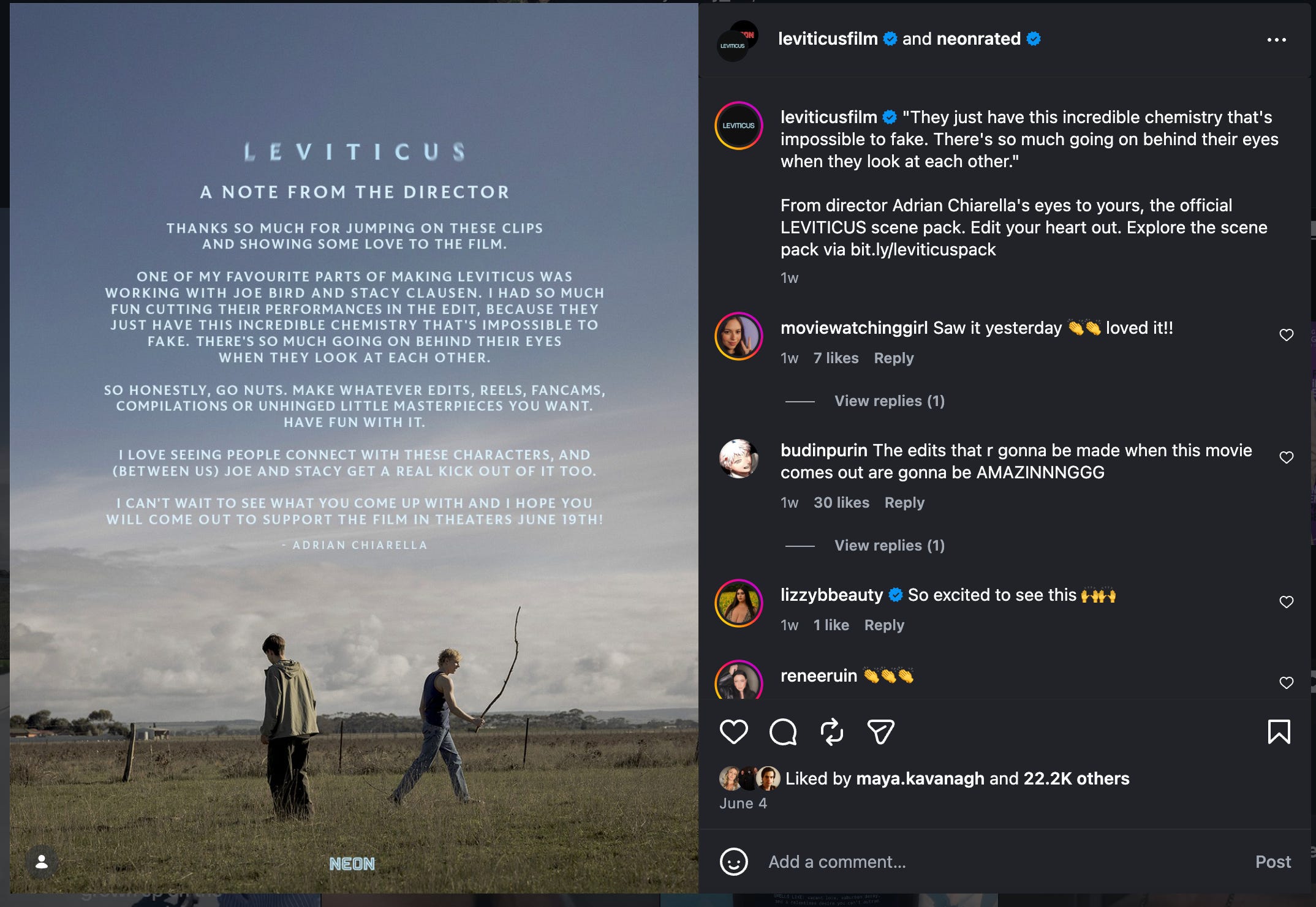
Three weeks later, I went looking for the results. I searched on June 17 and again this morning, and I couldn’t find much content that had actually used the official pack. The fan edits aren’t really there.
Searching “leviticus” on TikTok returns a wall of content with serious engagement: individual videos with 74.6K, 86.2K, 41.3K, and 11.2K likes. But when you look at what that content actually is. It’s reaction videos, reviews, recommendations, spoiler discussions. Creators talking about the film, not clipping it.
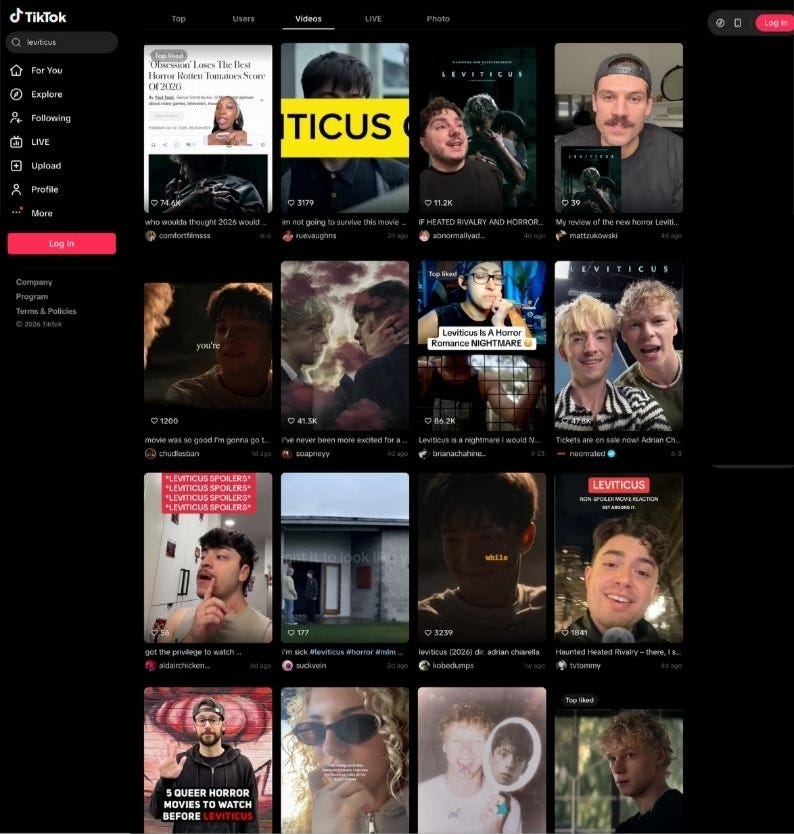
This connects to something I posted last week from The Town podcast about clipping. (Right at the end of this article)
I’m questioning if organic clipping (releasing assets and hoping fans create content) actually works, or whether it takes a clipping service actively seeding that content to make it happen. Leviticus is a useful case study because it had the best possible setup: a director who genuinely wanted fans to use the material, a distributor (NEON) with the infrastructure to release a proper scene pack, and an engaged online audience. And from what I can see the clipping still didn’t really materialise.
There’s another layer to this: the world is still really homophobic. Posting a reaction video where you’re the subject of the content is one thing. Creating and sharing fan edits and fancams of a queer romance is a different kind of public identification. You’re putting yourself on the record. For a lot of people, especially younger audiences who might be exactly the demographic this film is reaching on TikTok, there’s real social friction in that.
It’s possible the clipping gap isn’t just a marketing mechanics question. It might also be about who feels safe enough to make that content publicly.
I don’t have a neat answer for this. But I think it’s worth asking whether the clipping playbook works differently for queer films, and what that means for how we market them.
The distributor question
Something that’s been sitting with me about Leviticus: Maslow Entertainment have used NEON’s logos on the Australian marketing materials. And that’s probably smart, because NEON has brand recognition with the kind of audience this film is trying to reach. It’s possible NEON was even subsidising some of the Australian marketing costs to make this possible.
But look at the other side of that relationship. Maslow doesn’t appear anywhere on NEON’s marketing.
Normally, an Australian distributor puts in a Minimum Guarantee (MG) or a Distribution Guarantee (DG). That gets recouped in a priority position in the waterfall but only in Australia. Which means their return is tied entirely to what the film earns in Australia. If the film makes US$4.4 million in the US, Maslow doesn’t see any of that.
So here’s a thought: what if we started thinking about our Australian distributors as investors rather than just distributors? What if, instead of an MG that gets recouped only from Australian revenue, the Australian distributor’s contribution was structured as part of the investment pool, giving them a share of the international returns? (and moved down the waterfall prorata pari pasu with the other investors).
This isn’t just about fairness (though it is unfair). It’s about incentives. If Maslow had a stake in the global performance of Leviticus, their interests would be aligned with NEON’s. They’d benefit from the US marketing working, even if they aren’t included on it, from the TikTok conversation converting, from the film holding in its second and third weeks internationally. Right now, they have no financial reason to care about anything beyond the Australian box office.
I should note some context I’m not fully across: Leviticus was originally going to be fully financed through VicScreen’s Originate program, but it’s possible that arrangement changed. Rob Connolly and Liz Kearney are still listed as Executive Producers on the film. If the financing structure shifted, that might affect how the distribution deal was set up.
But the broader question stands regardless of this specific film’s arrangements. What are your thoughts on this?
Till I see you at the cinema next, Kate
No posts
Comments
Nothing yet. Say the first thing.
Sign in to join the conversation.