
The whole market took $18,657,614 across 207 films this week. Australian films took $207,252 across 14 titles.
Fiction: 8 films, $200,566
Documentaries: 4 films, $3,494
Rereleases: 2 Australian films in re-release, $3,192
Last week, one film (The Amazing Digital Circus) accounted for $2.2 million of the $2.2 million Australian total. This week, after a 92% drop, it still accounts for $173,980 of the $207,252. A new Australian comedy (How to Talk Australians) opened on 27 screens and contributed $21,776. The other six fiction films and all four documentaries made about $8,300 between them.
This week I searched “Australian films in cinemas,” “Australian movies in cinemas,” and “Aussie movies in cinemas.” I also tried “Australian Comedy movies” as an alternative, given that a new Australian comedy opened this week.
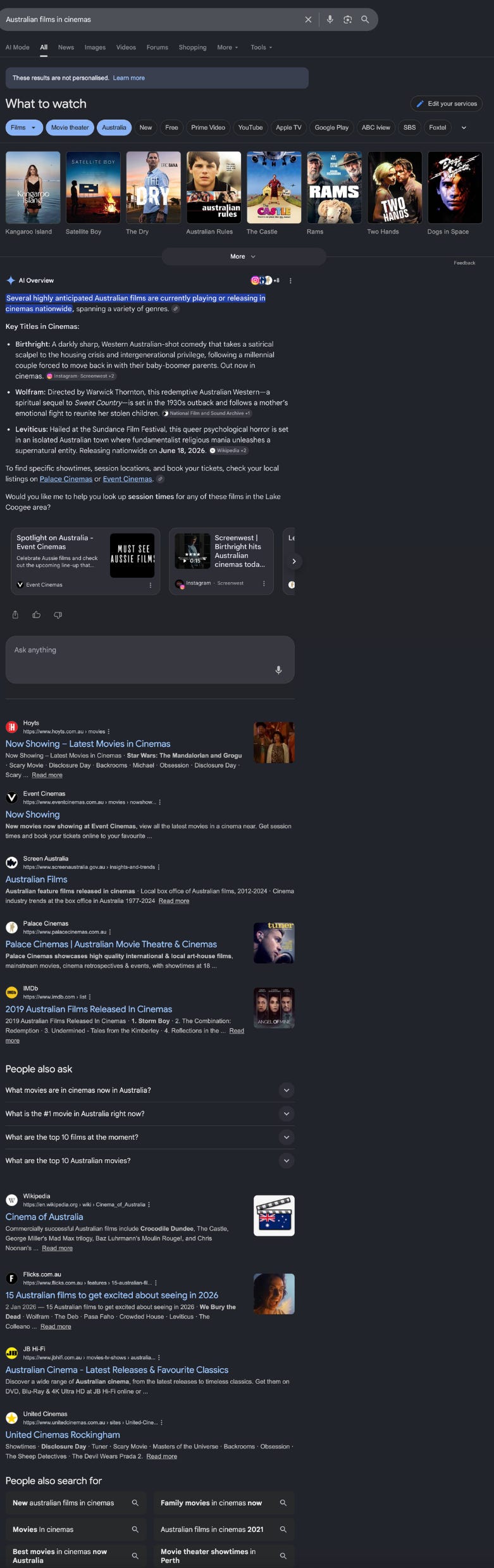
The AI Overview picked up Birthright, Wolfram, and Leviticus (which releases on June 18, so it’s correctly flagging an upcoming title). The “What to Watch” carousel is still stuck on the same legacy titles. No current releases in that layer. The organic results are Hoyts, Event Cinemas, Screen Australia’s historical data page, Palace Cinemas, then still that IMDB list from 2019. None of those will tell someone what Australian film they can see this weekend.
I am spending this afternoon doing a 2026 Australian movies in cinemas list on IMDB so hopefully that starts moving out of there.
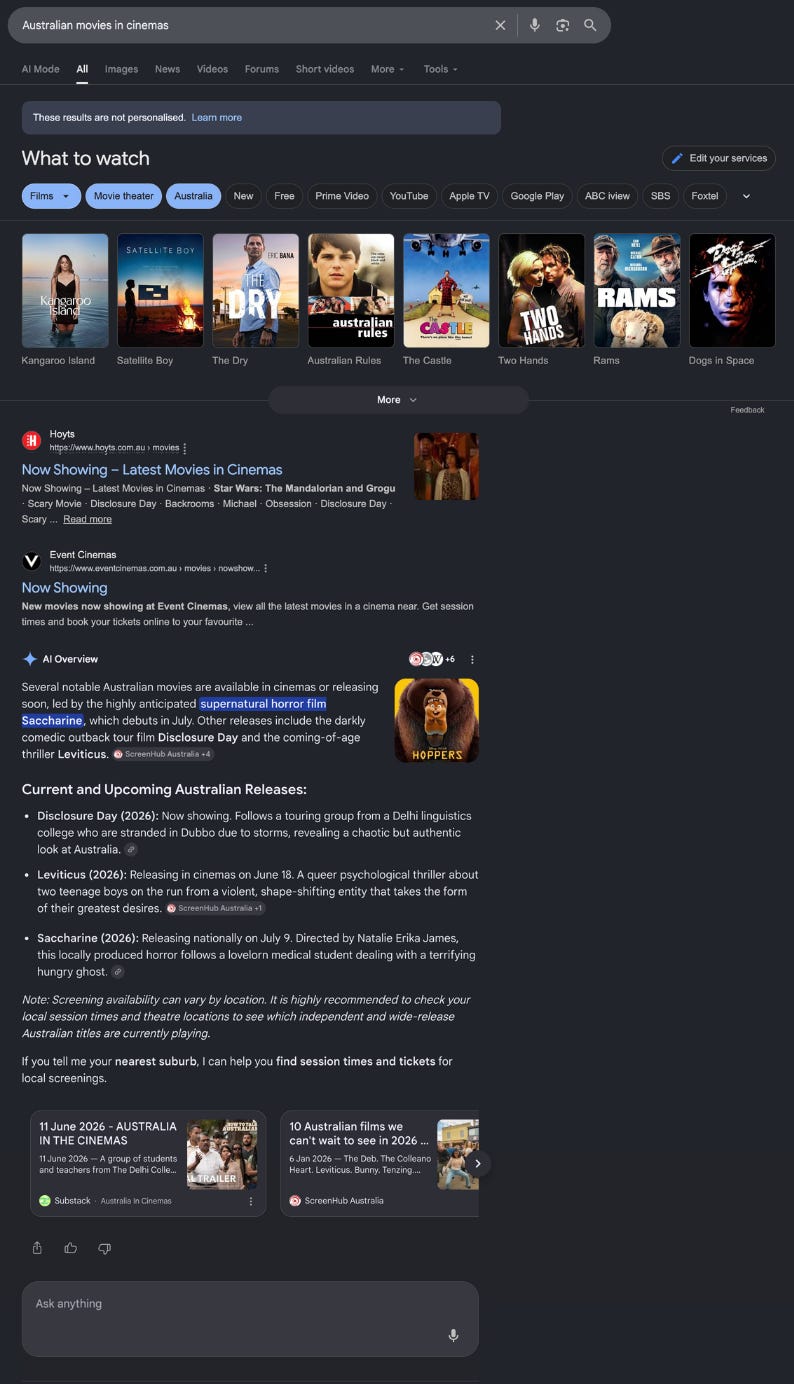
The AI Overview here made a notable error. It listed Disclosure Day as an Australian film and then attributed How to Talk Australians’ entire plot to it, describing it as following “a touring group from a Delhi linguistics college who are stranded in Dubbo.” Disclosure Day is a Universal release and not Australian. This is a reminder that these AI Overviews are still unreliable when it comes to correctly identifying which films are Australian.
It did correctly identify Leviticus and Saccharine as upcoming Australian releases. And there's something worth noting in the sources: the AI Overview cited this newsletter and Flicks.com.au as its primary references. Hooray!
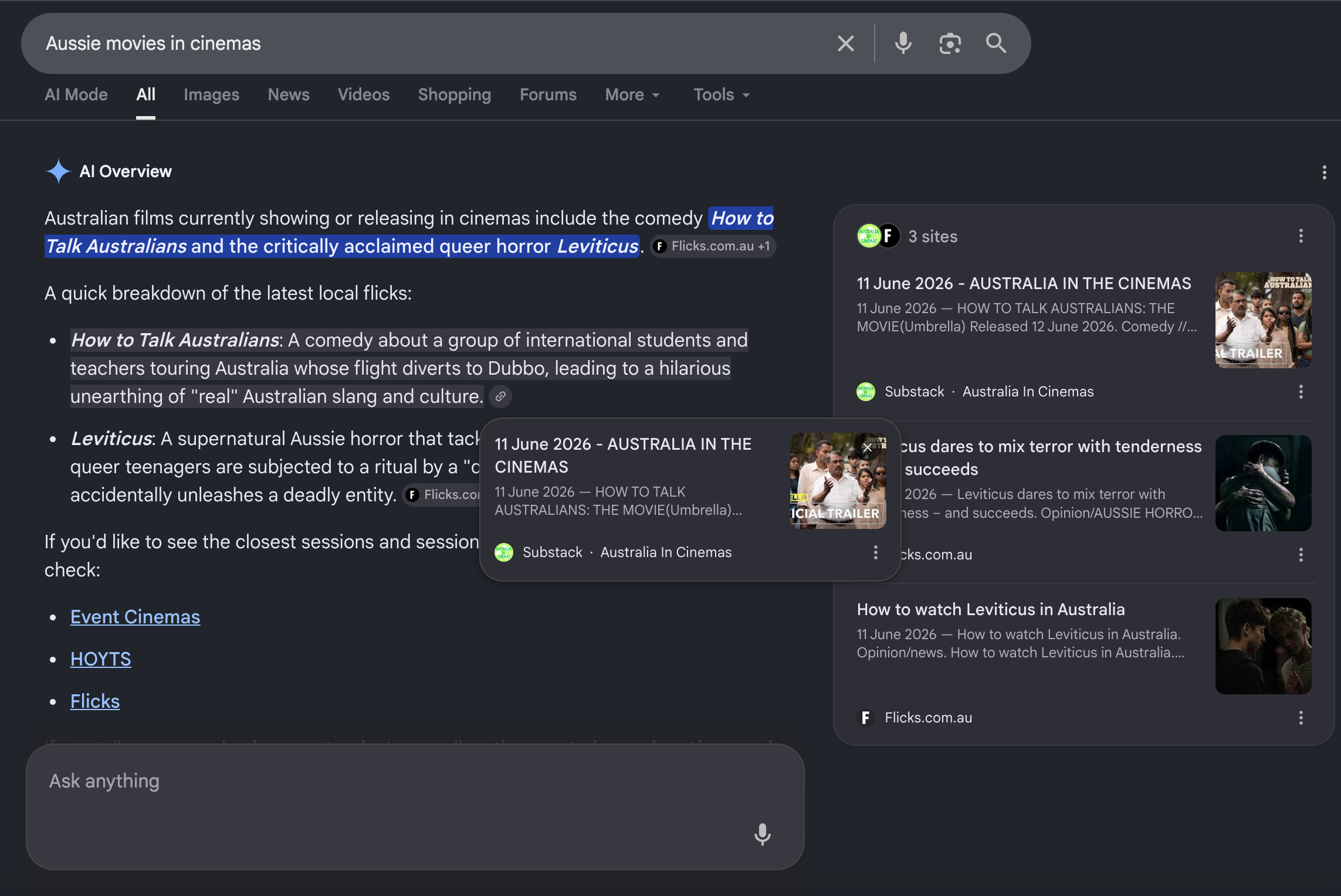
I ran this search about an hour after sending last week’s newsletter. The AI Overview named How to Talk Australians and Leviticus with accurate descriptions, linked to Event Cinemas, Hoyts, and Flicks for session times, and cited this newsletter as a source in the sidebar.
This is a milestone. The consistent weekly publishing is starting to feed accurate, current information into the AI layer. When someone asks a variation of “what Australian films can I see right now,” the answer is getting better because this newsletter exists.
The next challenge is getting people interested in actually watching Australian films in cinemas. Accurate information is the foundation, but interest has to be built on top of it. And accessibility remains a problem until exhibitors start programming more Australian films.
Umbrella Ent. | Week 1 | 27 screens | $21,776 week total | $26,493 cumulative | $807 per-screen average
27 screens. For context, the number one film this week (Disclosure Day) opened on 496 screens. The Amazing Digital Circus opened last week on 217 screens. How to Talk Australians opened on 27.
This is Umbrella Entertainment distributing an Australian comedy based on a web series. 27 screens is a limited release, and it means the vast majority of Australians who might want to see this film don’t have a screening within easy reach.
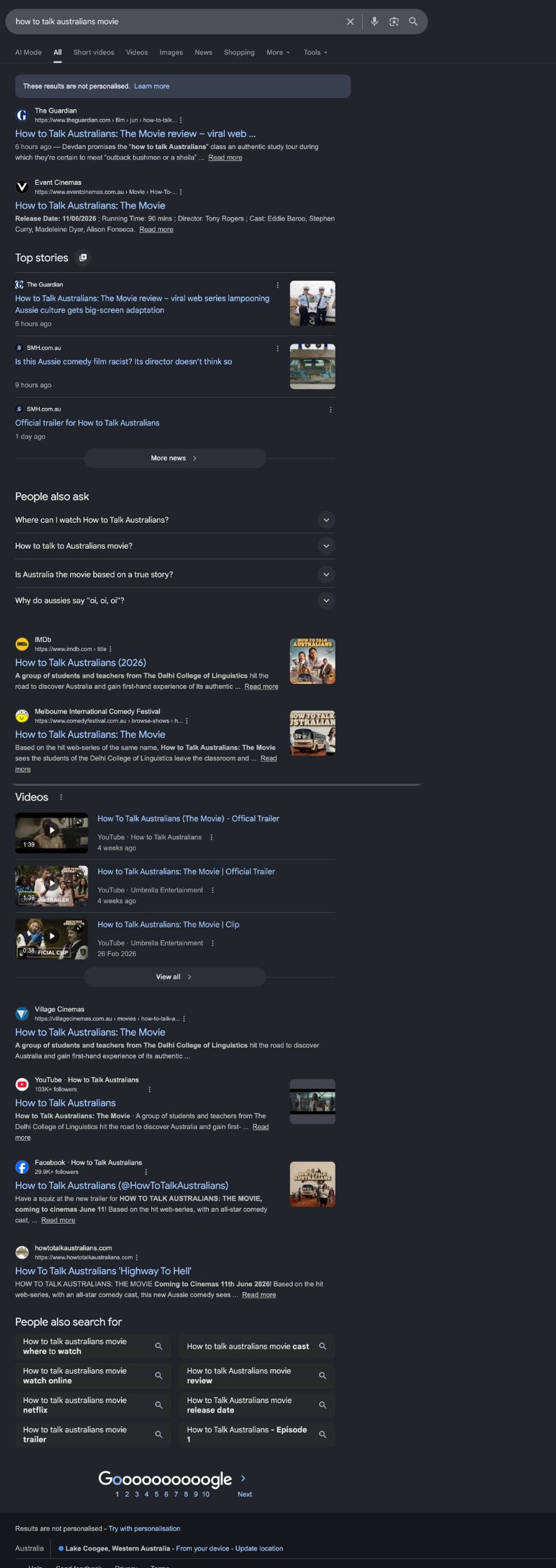
The search results for the film itself are actually quite strong. A Guardian review sits at the top. SMH has two pieces including “Is this Aussie comedy film racist? Its director doesn’t think so,” which is a provocative headline but it’s coverage. The Age ran the official trailer story. Sky News did an interview with director Tony Rogers. Village Cinemas, the YouTube channel (103K subscribers from the web series days), and Facebook (29.8K followers) all appear. The official website rounds it out.
There’s one significant absence: no Google Knowledge Panel. This is the sidebar that normally appears when you search a film title, showing the poster, cast, ratings, release date, and “where to watch” information. It’s the first thing most people scan. Opening week, with reviews from major outlets and an IMDB page live, and Google hasn’t generated it yet.
The AI Overview has done a solid job. It correctly identifies the film as an Australian comedy released on June 11, 2026, based on the viral YouTube web series with over 12 million views. It has the plot, cast, creative team, distribution details, and embedded the trailer. It's comprehensive and accurate. The AI layer has caught up faster than Google's own structured data.
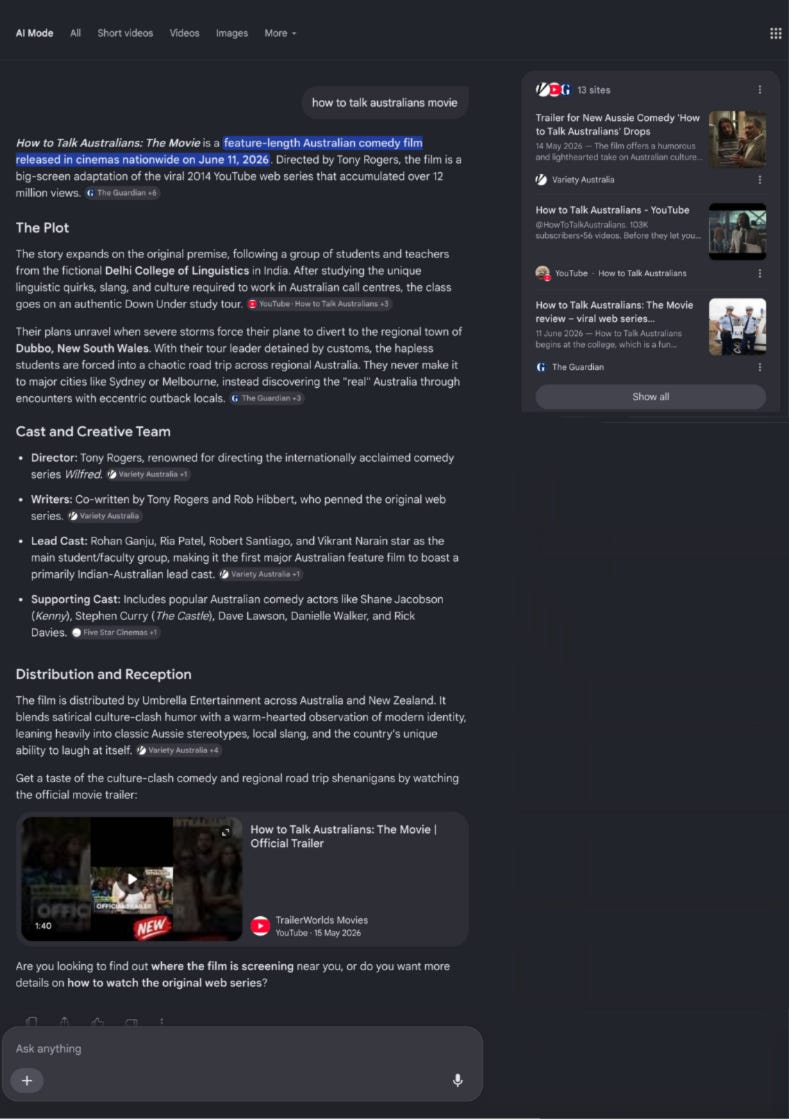
Before I get into this next bit, the usual caveat. The “What people are saying” section is trending social media and news. It changes depending on when you search. The screenshots are from a specific moment in time, and your result right now will look different.
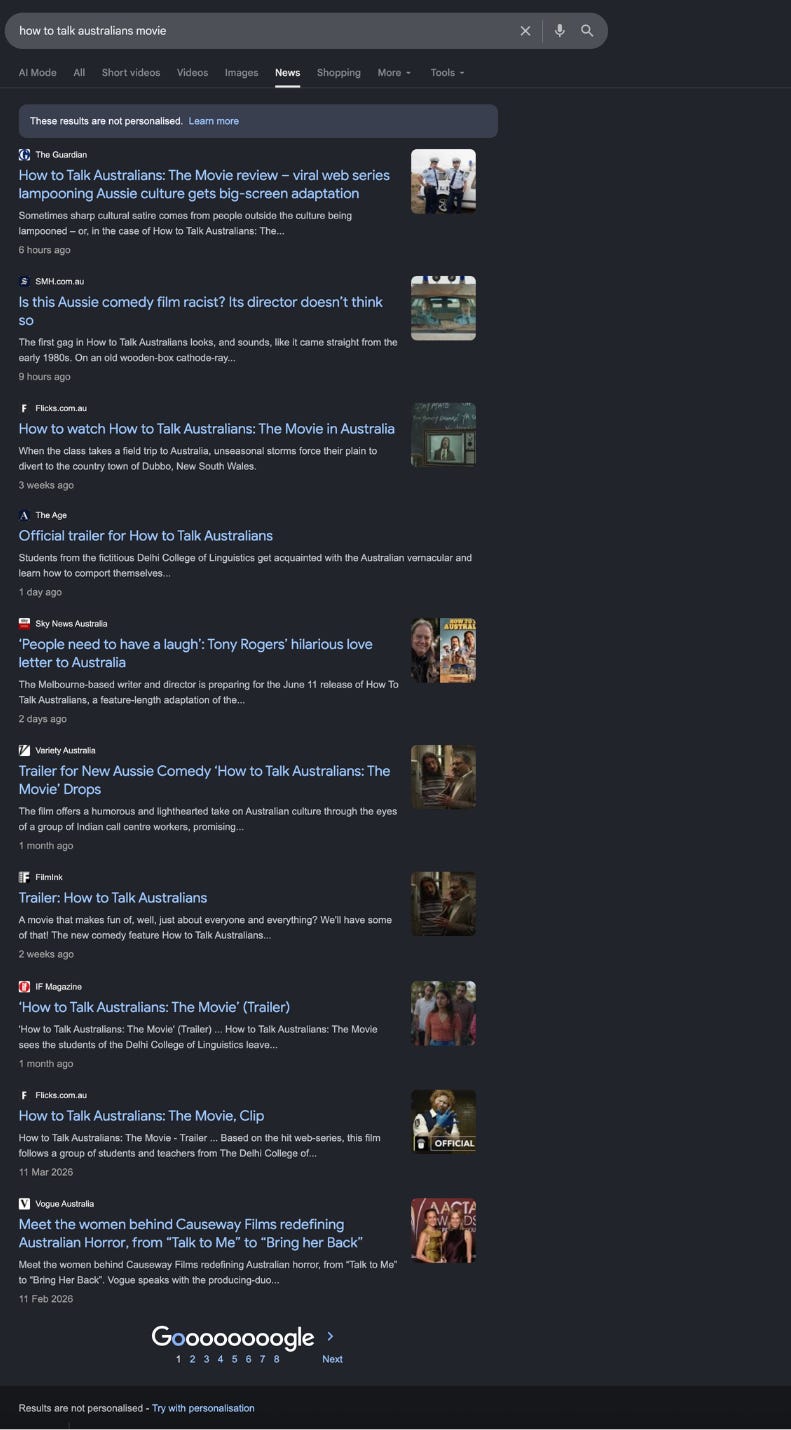
The news tab shows solid coverage. Guardian review, SMH with two pieces, Flicks, The Age, Sky News, Variety Australia, Filmink, IF Magazine. For a film opening on 27 screens, this is a good amount of press attention. The coverage is there.
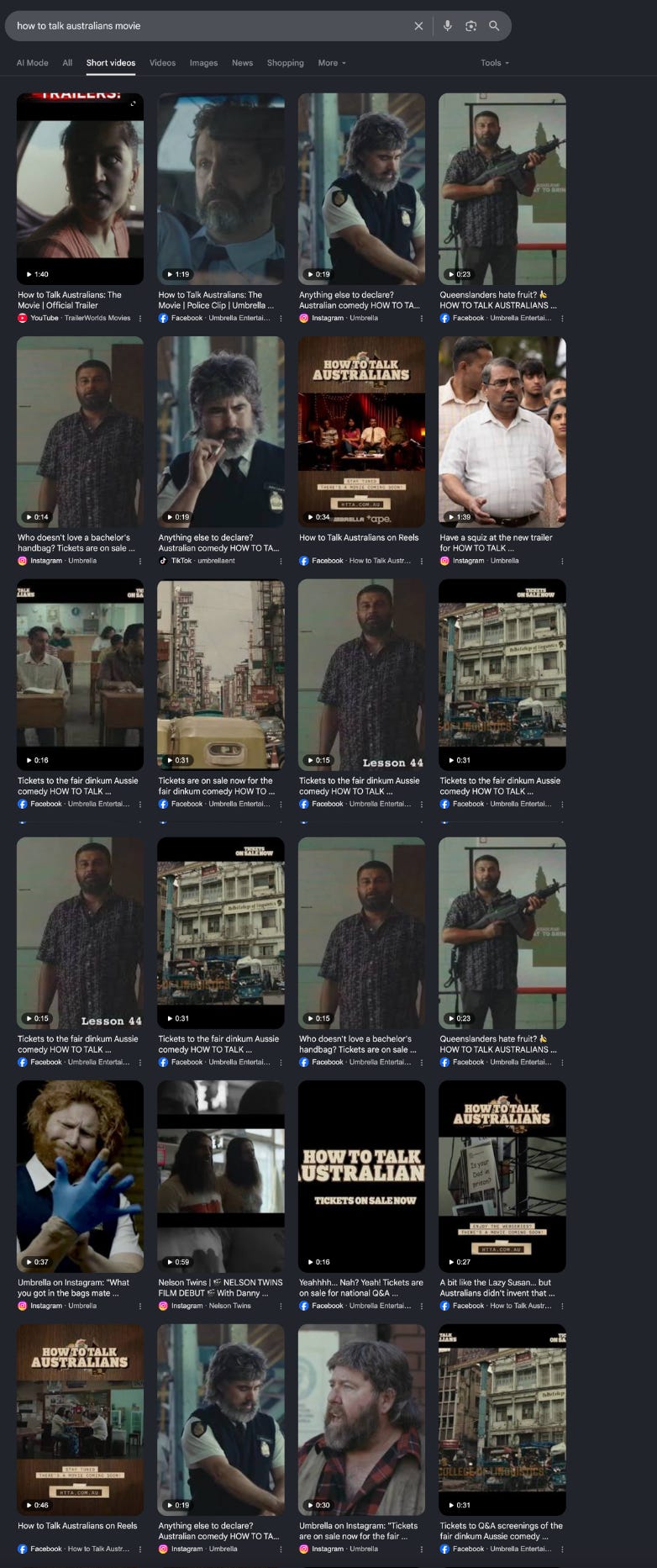
The short videos tab shows that Umbrella has been putting in real work across Facebook, Instagram, and TikTok. Multiple clips, character moments, behind-the-scenes content. This is active social media marketing from the distributor. And we are going to talk about this a little bit more next week with Leviticus and clipping.
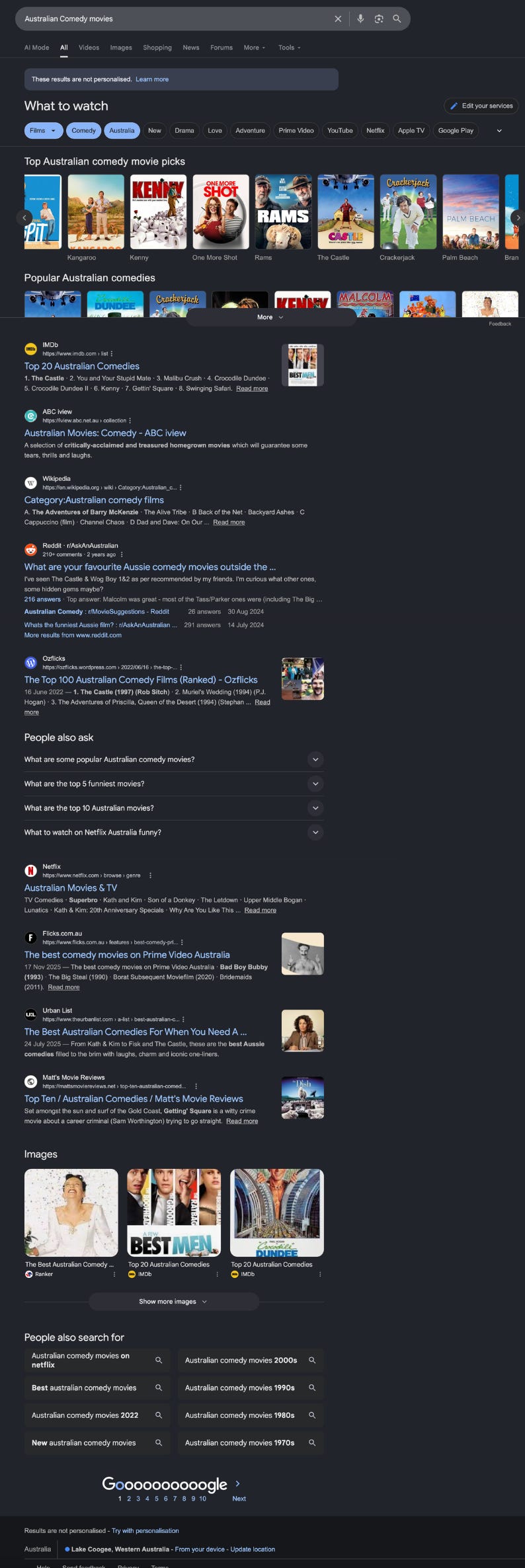
I searched this one because a new Australian comedy was opening that same week and I was curious whether it would surface. It didn’t. The image panel, IMDB lists, Reddit threads, an Ozflicks ranking, Netflix’s Australian genre page. Someone searching for an Australian comedy to watch this weekend would have no idea How to Talk Australians exists.
So the awareness picture is split. Search the film by name and the results are solid: reviews, trailers, social media, an accurate AI Overview. Search the genre and the film is invisible. If you already know it exists, you can find out about it. If you don’t, nothing in the search landscape is going to tell you.
It’s interesting to look at the list of what other people searched for as well.
$21,776 for the week on 27 screens. $807 per-screen average.
There are a few ways to read this.
The web series that How to Talk Australians is based on has over 12 million YouTube views and a YouTube channel with 103K subscribers. Not as many as the Amazing Digital Circus so we shouldn’t expect the same kind of results. The film is the first Australian feature with a primarily Indian-Australian lead cast. It won Best Comedy at the New Delhi International Film Festival and the Jaipur International Film Festival. Director Tony Rogers created Wilfred. The supporting cast includes Shane Jacobson, Stephen Curry, Danielle Walker, and Dave Lawson.
With all of that behind it, $807 per screen is low.
I was curious whether the South Asian diaspora audience would come out for this one, given the Indian-Australian lead cast and the Indian characters. Films from the Indian and South Asian diaspora consistently post strong per-screen averages in Australia by mobilising their communities before release. That pattern didn’t show up here. And it makes sense: this is an Australian comedy about Australian culture seen through Indian eyes. It’s made for the general Australian comedy audience, not for the South Asian community specifically. The web series audience and the diaspora audience are different groups with different reasons to show up.
Independent | Week 2 | 106 screens | $173,980 week total | $2,385,041 cumulative | $1,641 per-screen average
The Amazing Digital Circus dropped 92% week-over-week. Screens halved from 217 to 106. The weekend total fell from $1.98 million to $145,484.
That is a huge drop by any measure. But there’s important context around these numbers that’s worth laying out.
First, the release was always designed as a short event window. In the United States, the Fathom Entertainment release was originally scheduled for just four days. It was extended to June 18 due to fan demand. This was structured to front-load, and it did. A steep Week 2 drop is the natural shape of that kind of release.
Second, $174K in Week 2 still makes The Amazing Digital Circus the highest-earning Australian film in the market this week by a wide margin. It earned more in its second week than the other seven Australian fiction films combined.
Third, the global picture is remarkable. As of the latest Box Office Mojo reporting, the film has earned approximately US$23.4 million domestically in the United States alone. The global opening weekend (June 4-7) grossed an estimated US$36.6 million from more than 5,700 cinemas across the US, Europe, Australia/New Zealand, and Mexico. Australia’s $1.4 million opening weekend was reported separately as a strong result. In the US, it placed fifth overall on opening weekend, above The Mandalorian and Grogu.
All of this was achieved without any traditional marketing spend. There was no distributor logo at the start of the film. The MPDAA data lists the distributor as “Independent.” Glitch Productions went direct to exhibitors. That means no distributor fee, no marketing budget to recoup, no minimum guarantee to pay back before the producers see returns. The built-in YouTube and Netflix audience replaced the entire traditional distribution and marketing apparatus.
When a film earns US$23.4 million domestically with no distributor and no marketing spend, the return to the producers is a fundamentally different proposition to a comparable gross that came through a traditional distributor who spent hundreds of thousands on P&A and is taking 25-30% off the top. The ROI on this film in the US alone has to have been worth it for the producers. Australia is a nice addition on top. And that’s before factoring in the Netflix licence fee, which for a title with this kind of audience and proven global performance would also be significant.
This is actually one of those films where the cinema-to-streaming window makes perfect sense. The audience is predominantly online. Cinema screenings work as community events, a way to experience the content together in a room. But the film was never going to sustain weeks of traditional theatrical play. You eventise it, you give the community their moment, and the content lives on where the audience already is. The 92% drop isn’t a failure of the release. It’s the shape of exactly what this kind of release is supposed to look like. The numbers though are phenomenal for this kind of release.
I went and saw the film with my kids. The cinema experience was different from any traditional film screening I’ve been to. Before the film started, there was an introduction with a recap of the story so far, a message asking the audience not to spoil the ending for people who can’t see it in cinemas, and a reminder to stay at the end for a QR code linking to exclusive merchandise. The film itself played, and then the post-credits merch activation.
The audience was predominantly teenagers, and their behaviour in the cinema was fascinating. They were treating it like they were watching content at home. Kids were yelling “SMASH” and “KISS” at different moments. This is completely different from the whispered “noooo” you hear when a character in a traditional film does something you know they shouldn’t (like what happened in Obsession). It’s not a cinema audience engaging with a film. It’s an online community engaging with their content in a cinema setting. They brought their viewing habits with them.
I’m still thinking about whether The Amazing Digital Circus functions as a traditional narrative film at all, or whether it’s something else that happens to be screening in cinemas. The recap at the start, the anti-spoiler message, the merch QR code. That’s structured as an event for an existing online community. Maybe narrative films need to look at this model more.
The cumulative in Australia is $2.39 million. That is an enormous result for an Australian film, and an Australian story that the local trade coverage has largely missed by filing it under “YouTube-to-Hollywood” rather than recognising that this is Australian IP, made by an Australian company, from Australian creators.
Madman | Week 4 | 3 screens | $1,556 week total | $519 per screen | $107,089 cumulative
Birthright actually went up week-over-week, from $1,373 to $1,556, on fewer screens (down from 4 to 3). That’s an unusual pattern in Week 4. The per-screen average improved.
Screen Inc. | Week 8 | 5 screens | $1,481 week total | $296 per screen | $54,974 cumulative
Alphabet Lane picked up screens this week, going from 3 to 5 in Week 8. That’s also unusual. The week total nearly doubled from $764 to $1,481.
Athabasca Film | Week 6 | 3 screens | $675 week total | $225 per screen | $18,230 cumulative
Maslow Entertainment | Week 5 | 2 screens | $560 week total | $280 per screen | $46,275 cumulative
Dark Matter / Bonsai Films | Week 7 | 4 screens | $417 week total | $104 per screen | $152,778 cumulative
Kismet / Rialto | Week 14 | 1 screen | $120 week total | $120 per screen | $14,667 cumulative
Two Australian films were in rerelease this week.
Smart Street Films | 5 screens | $2,841 week total | $568 per screen
Roadshow | 1 screen | $351 week total | $351 per screen
This week had two Australian films in cinemas that both started as online content. The Amazing Digital Circus started as a YouTube animated series from Glitch Productions, then went to Netflix, and its final episode came to cinemas as a cobined epsiodes feature film.
How to Talk Australians started as a YouTube web series in 2014, accumulated 12 million views over 12 years, and was adapted into a feature film.
One made $2.2 million in its opening week. The other made $21,776.
They both had pre-existing online audiences. So what was different?
Scale. The GLITCH YouTube channel has 20.5 million subscribers and over 3 billion total views. The Amazing Digital Circus pilot alone has over 400 million views. How to Talk Australians has 103K subscribers and 12 million views total. Those are completely different scales of audience.
Active community vs accumulated views. 12 million views spread across 12 years since 2014 is a catalogue number. It tells you people watched the content at some point. 20.5 million subscribers actively watching new episodes, commenting, making fan content, is a community that’s engaged right now and waiting for what comes next. The difference between having been watched and being watched matters.
Serialised and ongoing vs completed. The Amazing Digital Circus had a cliffhanger. The audience needed to know what happened next, and cinema was the only place to find out before the YouTube/Netflix release on June 19. That 15-day exclusive window is what made the cinema screening an event. How to Talk Australians’ web series was a finished thing. People watched it and moved on. The film is an adaptation of that concept, not a continuation of an unresolved story. There’s no urgency to see it in a cinema.
Audience mobilisation vs audience existence. The TADC cinema screening had a recap intro, an anti-spoiler message, exclusive merchandise via a QR code at the end. The whole experience was designed to make the community feel like this was their event. How to Talk Australians had press coverage, social media clips, and festival awards. Those are traditional marketing activities. They let people know the film exists. They don’t mobilise a community to show up together in a specific window.
Platform compounding. TADC was on YouTube and Netflix. Two platforms feeding the same audience. The Netflix deal expanded the reach without Glitch losing creative control or funding independence. How to Talk Australians was YouTube only.
The learning here isn’t that How to Talk Australians did something wrong. On 27 screens with a limited release from Umbrella Entertainment, the film’s result reflects the reality of its distribution. The learning is about what “having an online audience” actually means when it comes to converting that audience into cinema tickets. Having online content is one thing. Having an active online community is another. Having an active online community that you can mobilise to show up in a cinema in a specific window is something else again. Each step requires different infrastructure, different scale, and different strategy.
I’ll be honest. The idea of having to build an audience for my projects online is something that right now I’m finding really exhausting. I like the idea. I understand the theory behind it. It just feels like so much work when it’s already so much work to make a film. Right now I just want to make the feature films. I don’t want to do the audience building. How do I do that with no money? These are things I want to start exploring.
Because the data this week doesn’t say “you need 20.5 million subscribers or don’t bother.” That’s Glitch Productions’ path. They spent nearly a decade building that audience. They have over 100 employees. They had a Netflix deal. That’s not a template. Most independent producers can’t replicate it and shouldn’t try.
But the data also doesn’t say audience building doesn’t matter. How to Talk Australians had 12 million views and 103K subscribers and it still opened to $807 per screen. An existing audience didn’t automatically convert to ticket sales. So somewhere between “no audience” and “20.5 million subscribers” there has to be a middle ground that’s actually practical for independent filmmakers who are already stretched thin making the work itself.
I don’t know what that middle ground looks like yet. I suspect it’s less about scale and more about the specific things TADC got right: giving the audience a reason to show up in a specific window, making the cinema screening feel like something you couldn’t get at home, and having a direct relationship with your audience that doesn’t depend on a distributor to activate. Those things don’t necessarily require millions of subscribers. They require intention and planning, and they require starting earlier than most of us are comfortable with.
This is the part of the conversation I want to start having. What does realistic, affordable audience building look like for an independent Australian filmmaker? What can you actually do during development and production that sets up a better opening week, without burning out before the film is finished?
We’ll look at it a little bit next week with clipping, which is something I’d already planned to talk about with the release of Leviticus. But The Town has already done a great primer for me with this episode that was released on Friday. Please have a listen before next week’s newsletter!
Till I see you at the cinema next,
Kate.
No posts
Comments
Nothing yet. Say the first thing.
Sign in to join the conversation.