
The whole market took $27,601,335 across 207 films this week.
Australian films took $2,225,282 across 12 titles.
Fiction: 9 films, $2,220,993
Documentaries: 3 films, $4,289
Rereleases: no Australian films in re-release this week
Of the $2,225,282, one film accounts for $2,211,090. The other eight fiction titles and all three documentaries put together made about $14,000 between them. So this isn’t a broad good week. It’s one enormous result sitting on top of several very quiet ones.
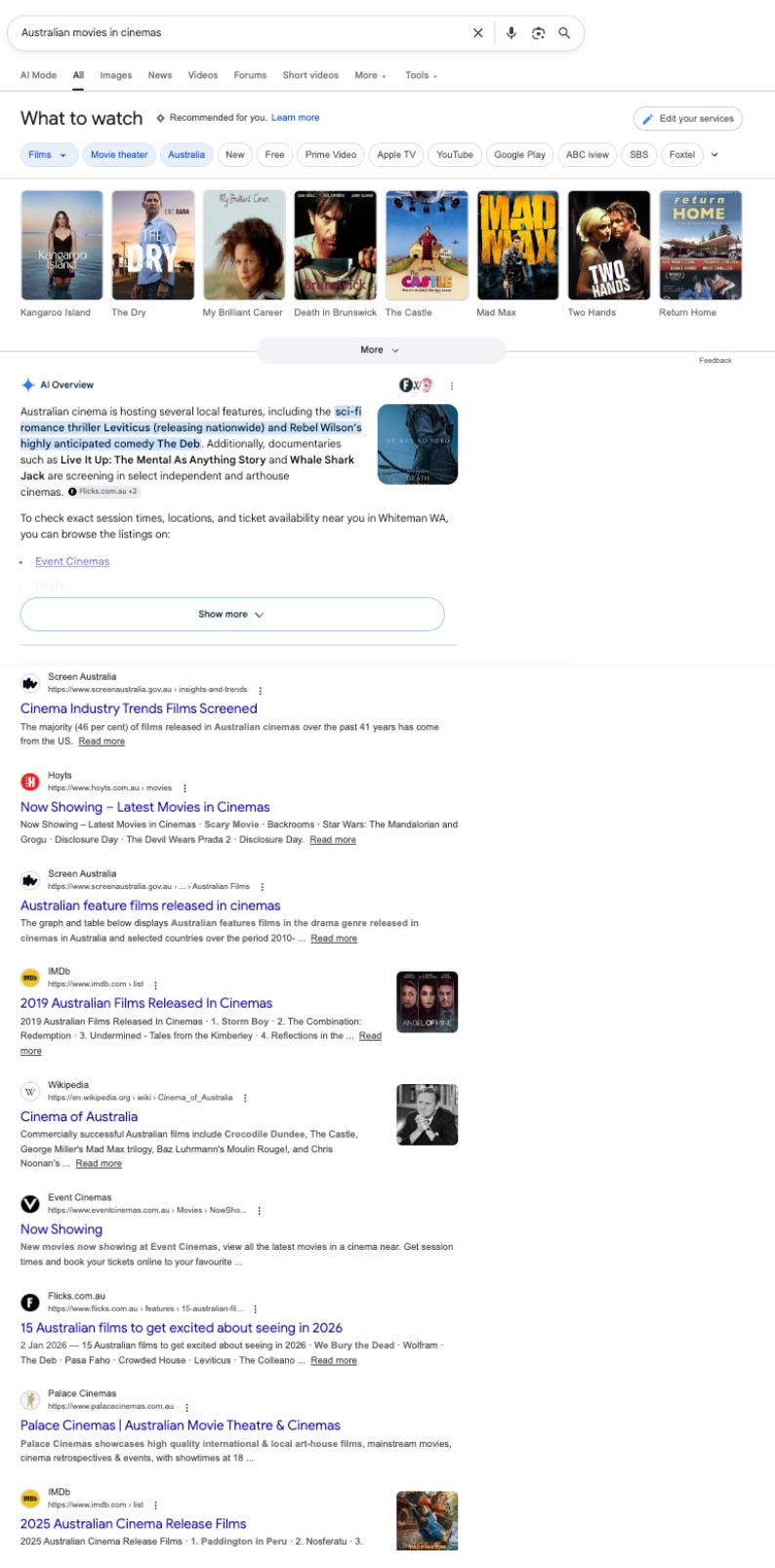
The main Google results still lead with the old "What to watch" carousel: Kangaroo Island, The Dry, The Castle, Mad Max, Crocodile Dundee, Priscilla. The standard AI Overviews is still inaccurate - listing films that havent’ been released yet or have left cinemas. But look! The Australia In Cinemas newsletter is in there again for the films search - but not in movies. I’m still trying to work out what google thinks the diffrerence is.
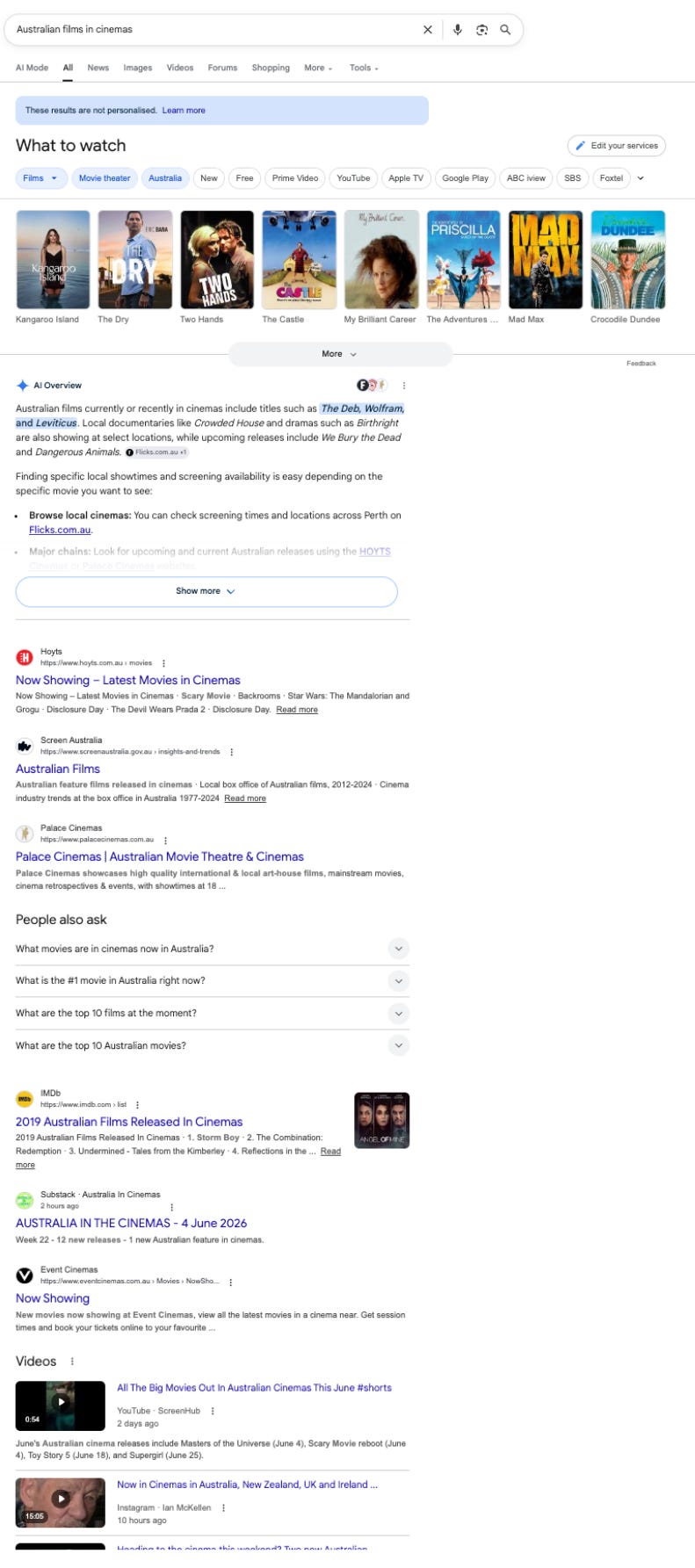
I find it very odd that both this searchs come up with an IMDB list from 2019.
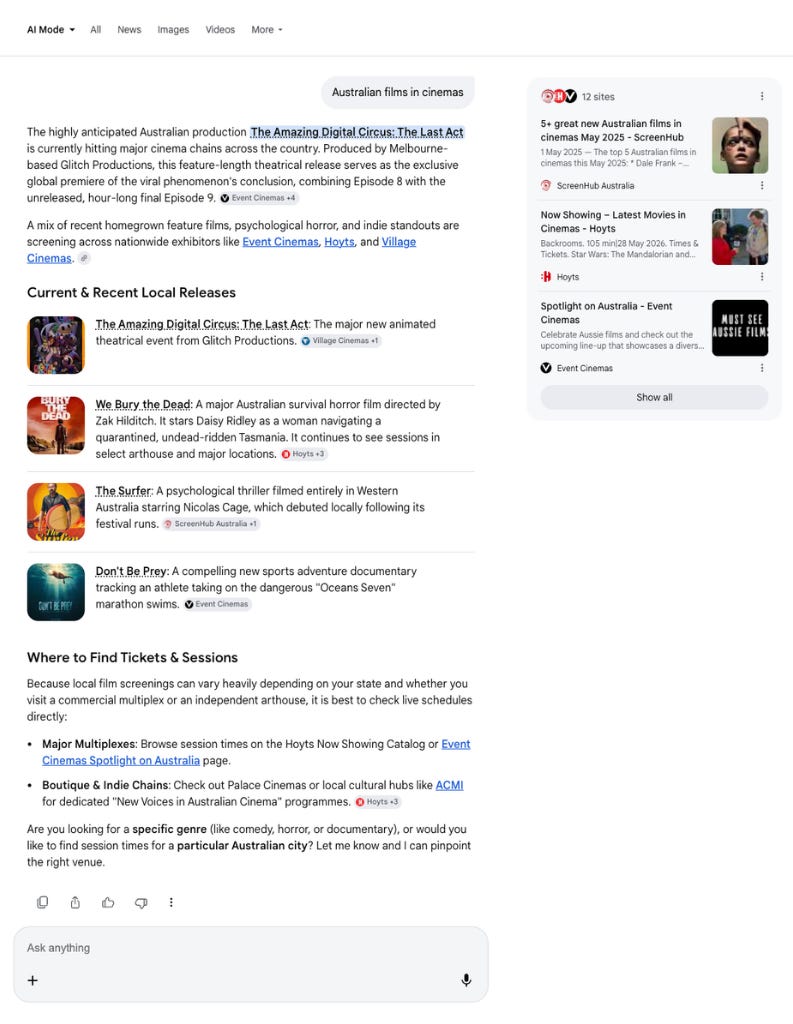
Only AI Mode surfaces Digital Circus, and thankfully there it leads.
BUt the great thing is the AI Search is using this substack to start showing relevant current data.
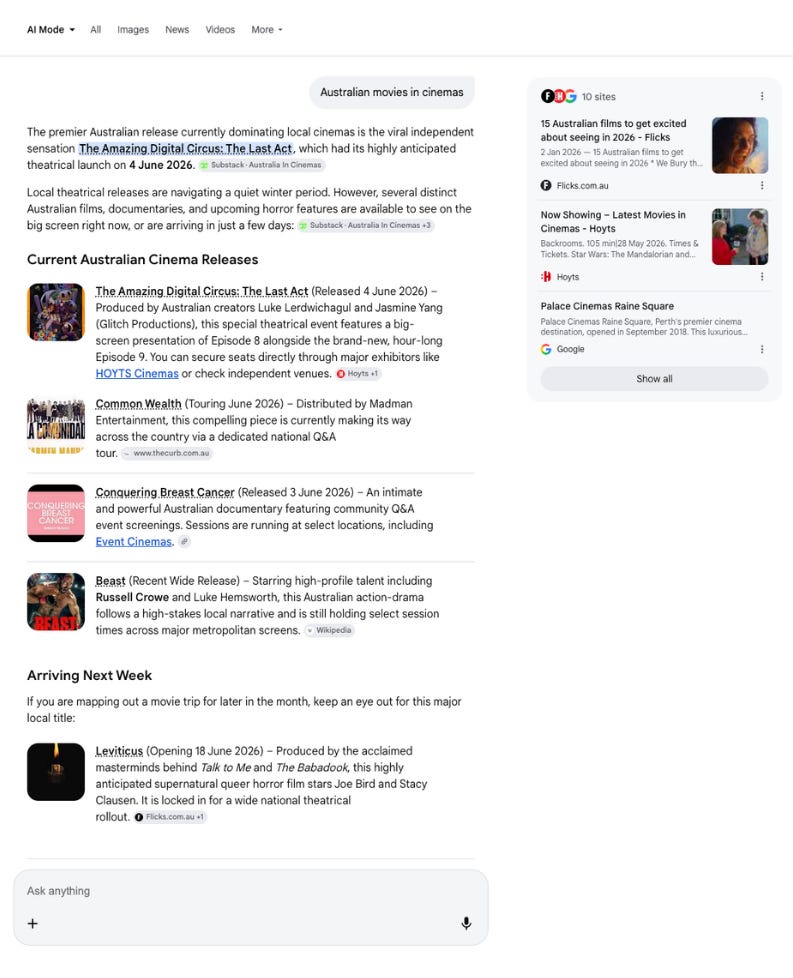
The great thing is - now that the data is slowly starting to come up correctly with what Australian films are showing in cinemas the next job is how we start getting people to be interested in watching Australian films in cinemas. Can you see how I’m trying to make the environment better for my next film (and other Australian films). When I said this was a long game I meant it!
Independent | Week 1 | Position 6 | $2,211,090 week total | $2,211,090 cumulative inc previews | $9,740 per-screen average
Glitch Productions, appears to have self-distributed in Australia/NZ - I have no clear answer on if htey used a cinema booker or they actually did this themselves.
227 screens, rank 6, $9,740 per screen. Availability was never the constraint here, which is a rare thing to be able to say about an Australian title.
Digital Circus opened wider than most local releases ever manage, and it sat on the chart next to the biggest commercial titles of the week without looking out of place. For once, screen count is not the problem. Everything interesting about this film is on the other side of that.
So this is the curious thing about this film. And I’m just realising here I didn’t search the actual title - just the title of the series so that has somewhat skewed results.
When I ran my usual searches, I searched “the amazing digital circus”. The series. I didn’t search the actual film title, “The Amazing Digital Circus: The Last Act”. One careless slip, and it skewed everything I saw. It also, by accident, showed me exactly where the awareness problem sits.
Search the series name, which is the name almost everyone knows, and Google hands you the 2023 web series. The knowledge panel. The cast. A Netflix button telling you where to watch it. The film, the thing actually in cinemas this week, turns up well down the page as a single Event Cinemas link and a Reddit thread. That's where the film gets lost. People are looking, plenty of them, but the name they look under points everywhere except the cinema.
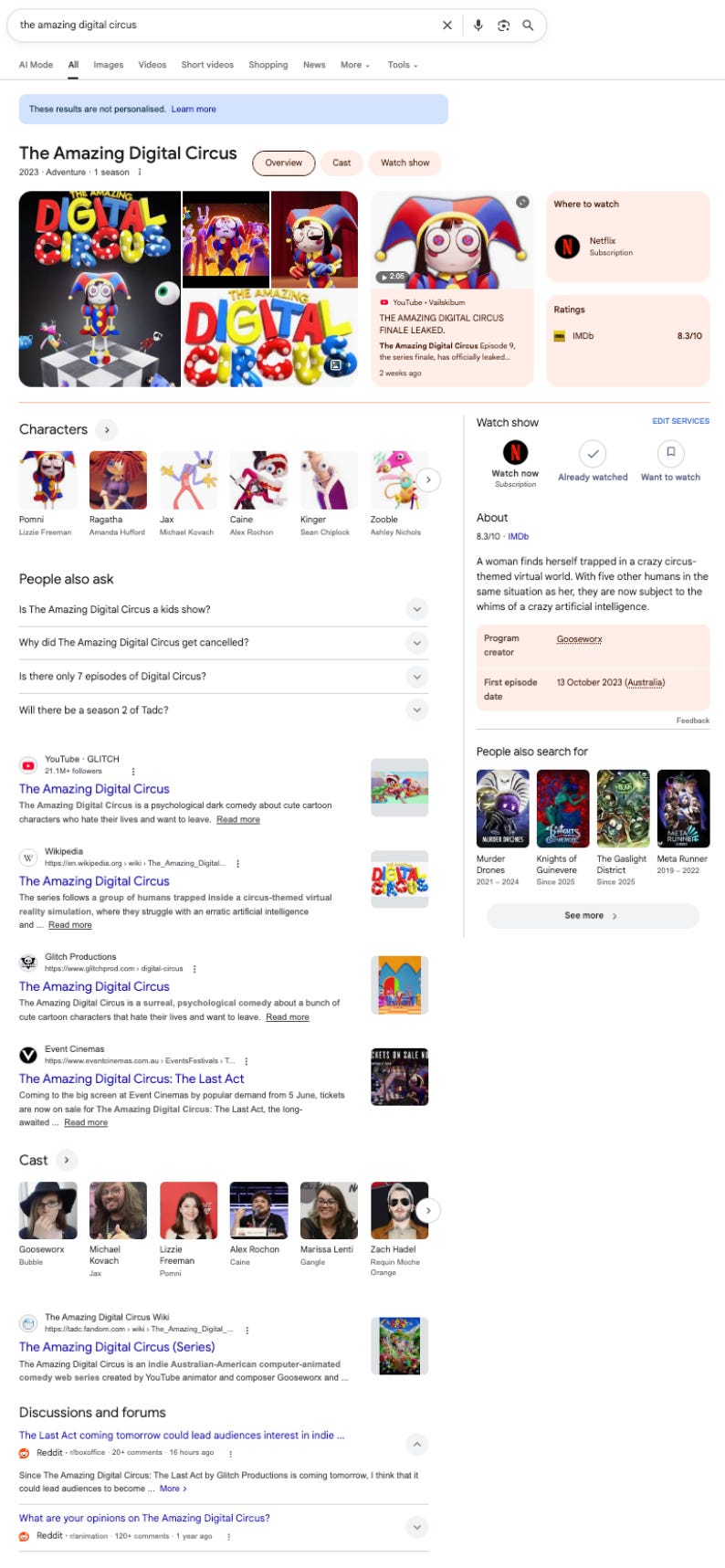
That gap is the awareness story for this film. The committed fans find it fine, and the Trends data below is emphatic on that. But the casual edge of the audience, the people I most want to turn into ticket buyers, search the name they know and land on a streaming button for a three-year-old show. For a film carrying this much built-in interest, that’s a strange place to lose people. (And it’s a lesson that travels. Any Australian film going out under a festival name, a working title, or the name of the novel it came from has the same trap waiting. Unless the work has been done to mitigate it.)
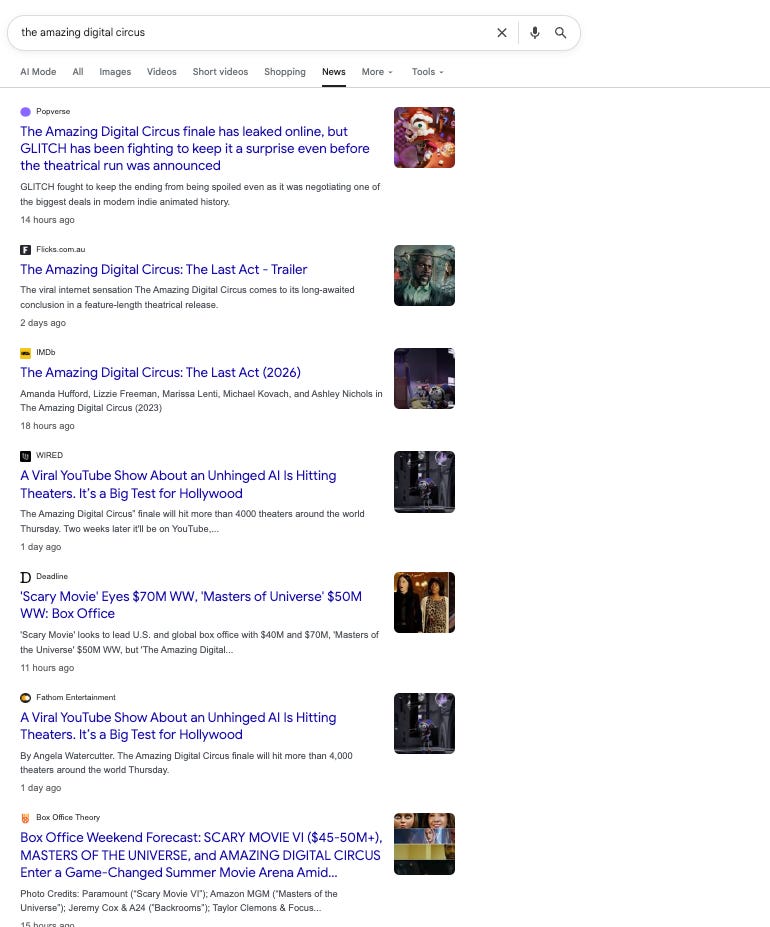
The news tab tells a different story again, and not the one I expected. There’s plenty of coverage. WIRED, Deadline, Box Office Theory, the trades are all over it. But this is all US coverage. Read the headlines and it’s a YouTube-show-takes-on-Hollywood story, a box-office-forecast story, a there-was-a-leak story. WIRED frames it outright as a test for Hollywood. The film is being reported widely. The Australian ownership, that this is a Melbourne studio that made and owns the thing, isn’t being talked about in Australia. It’s so weird. I’d almost guess that no Australian media was done for this film.
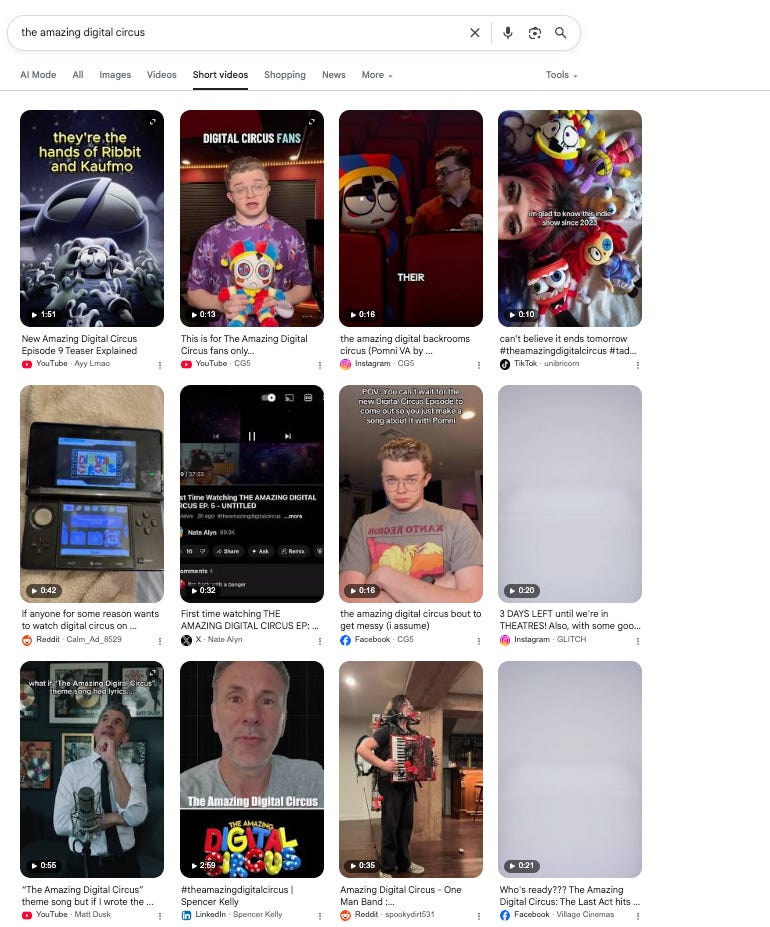
Then the short videos, and this is where you finally see the engine. GLITCH's own "3 DAYS LEFT until we're in THEATRES". Village Cinemas reposting. A wall of fan clips counting down, reacting, grieving the ending. None of it is really paid media, and none of it shows up in a normal search or a news feed. It's the part of the awareness picture that did the actual work, and the part the standard tools can't see.
One caveat on this layer, the same one I’ll flag every week: what people are saying is a moving snapshot. These are from a moment in time, and your results will look different to mine. Awareness here is a live conversation, not a fixed result. BUT these results are great for an Austrlaian film.
Now the search data, because this is where it gets interesting.
The Google Trends rising queries for Australia, the week of 4 to 10 June, are almost all about this one film, and almost all in breakout. Watch. Where to watch. Full episode. Box office. Review. Release date. Runtime. Ending. This is a fandom actively hunting one specific film during its opening week. Whatever else is true, nobody needed to be told this film existed.
This is a different image because I wanted to capture them all in one image.
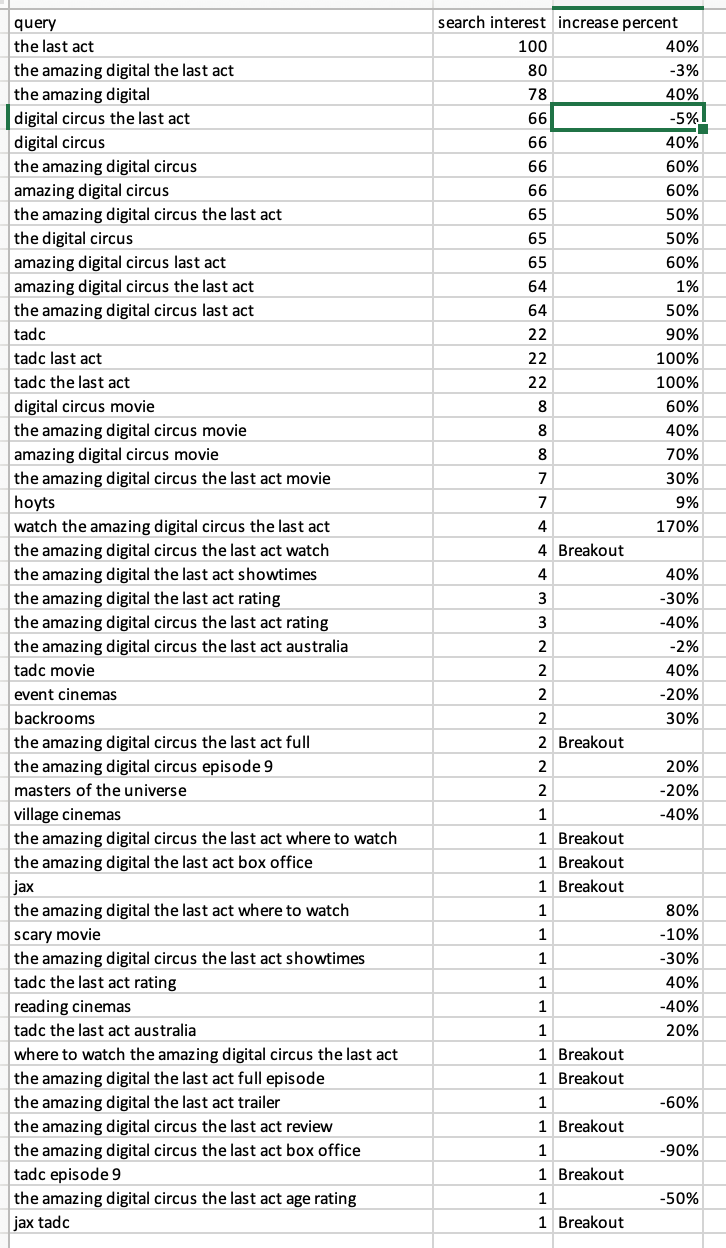
Two things in that data jumped out.
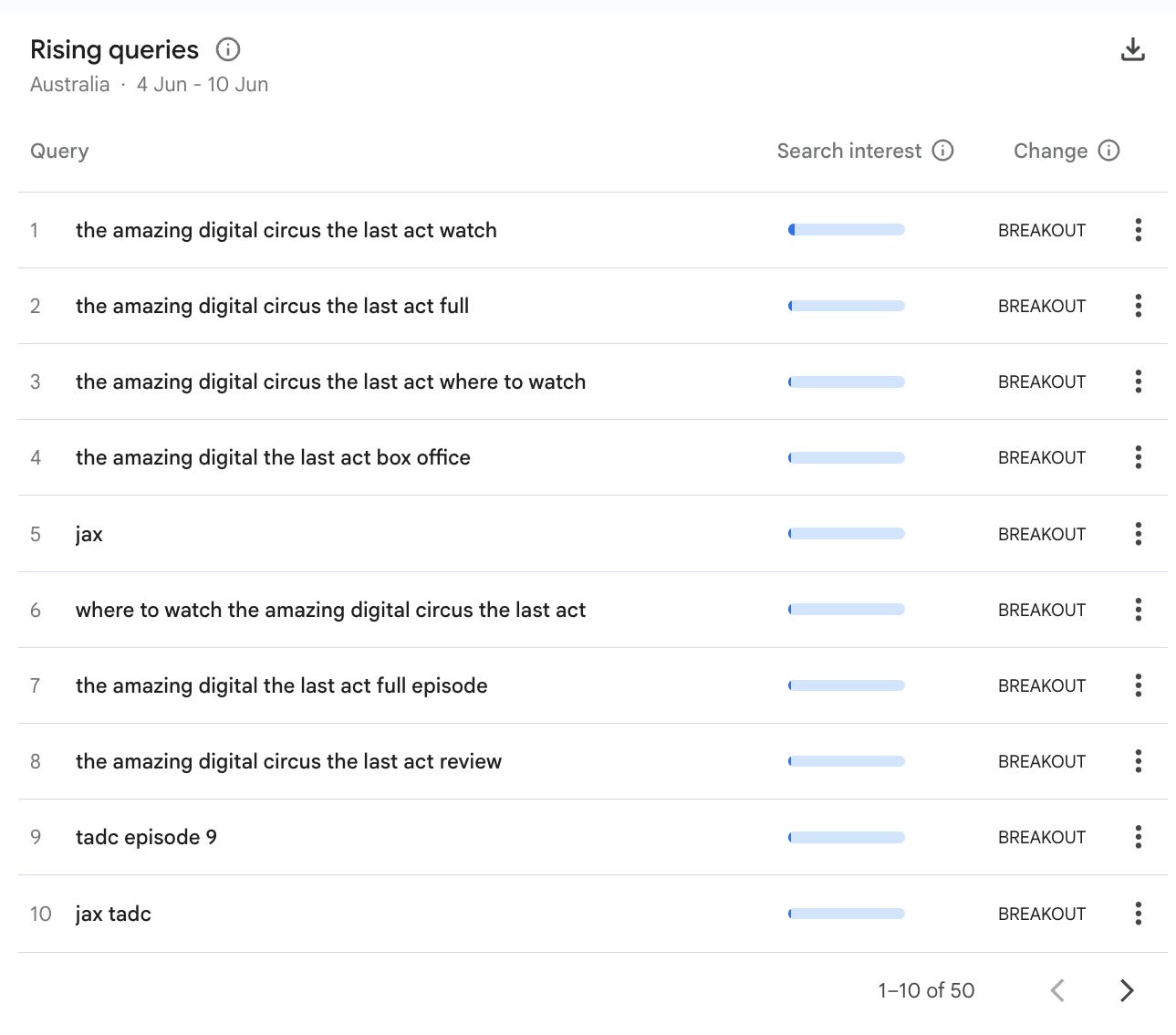
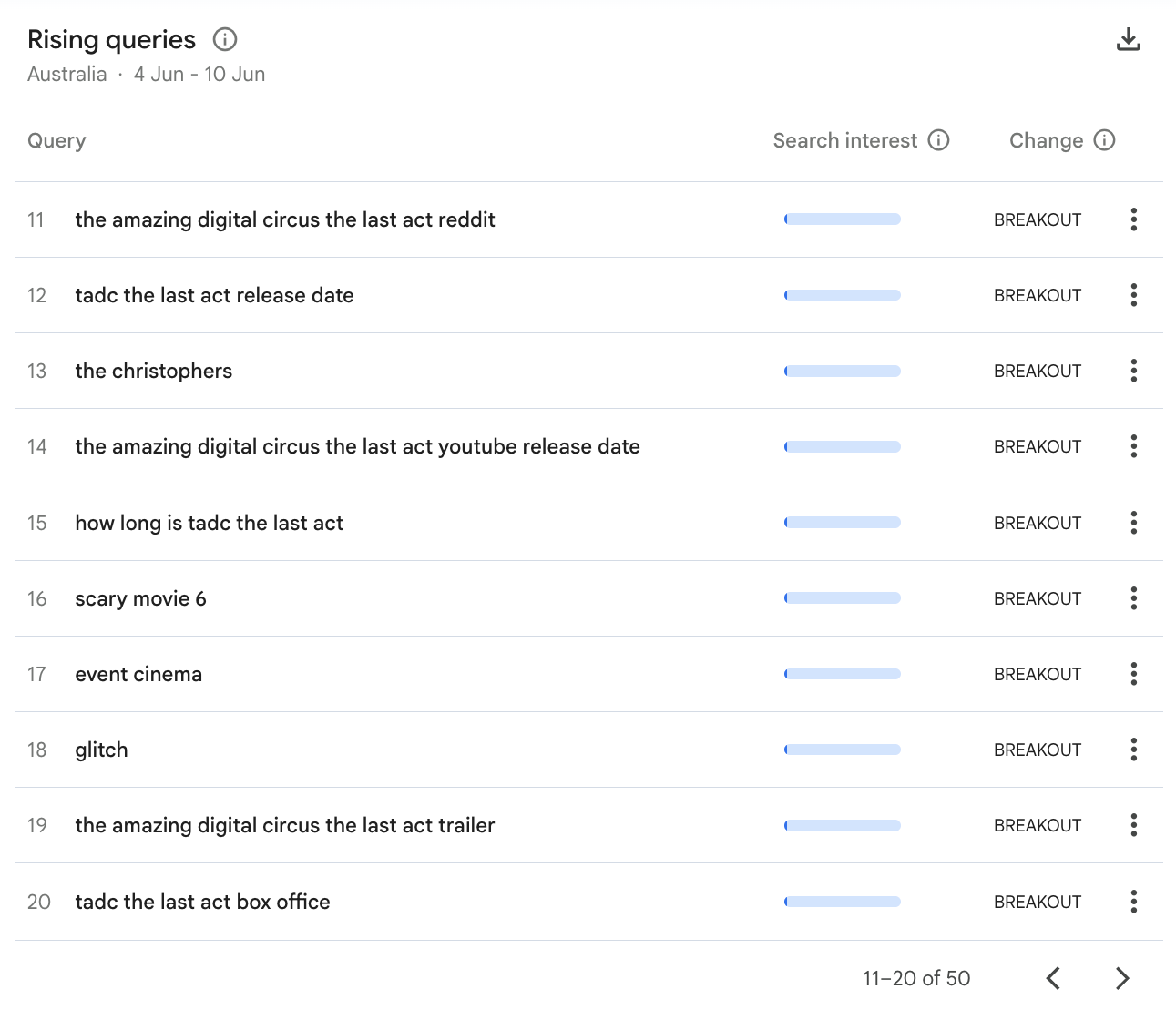
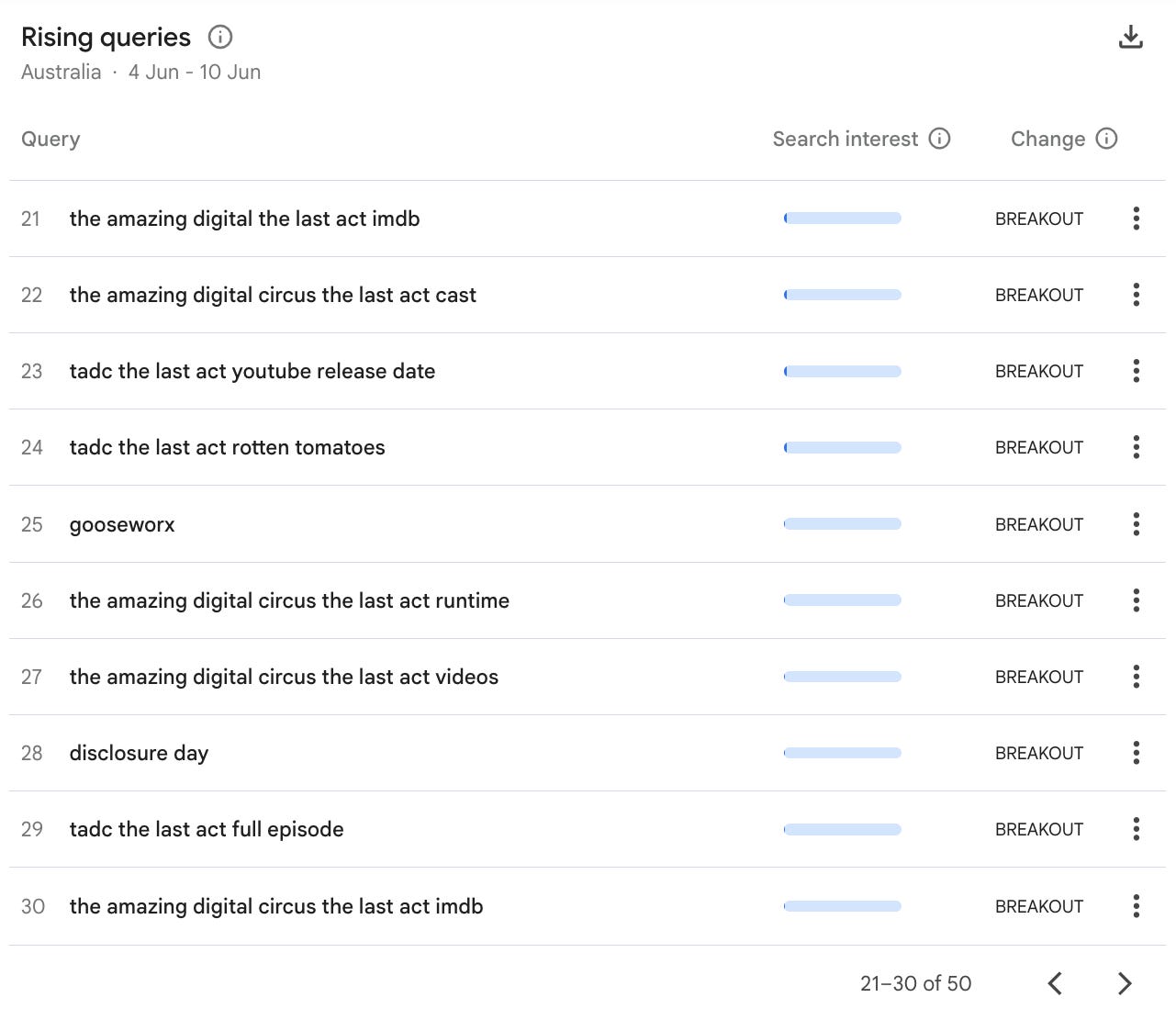
The first I almost got wrong. The rising queries are full of other film titles, and my first instinct was to wave them away as noise. They’re not noise. They’re the films playing the same week: Scary Movie, which was number one, Backrooms at three, Masters of the Universe at four, and a few more further down. The people searching Digital Circus were searching the rest of the current slate too, along with “cinema near me”, “event cinema”, and the chain names. That’s the opposite of noise. That’s cinema intent, plain as day. These are people planning a trip to the pictures and working out what to see, and Digital Circus was in that decision, up there with the biggest releases of the week rather than off in a fan corner.
The second is about streaming Some of those rising queries are streaming-shaped: where to watch, full episode, and twice over, youtube release date. The traditional fear is that a near streaming date eats the cinema audience, that people just wait. Maybe that holds for some films. I don’t think it made much difference here, because the cinema screening wasn’t really competing with the couch. The film was sold as the place to see the finale before anyone else in the world. The ones who went came for something a couch can’t offer: a room full of people who love this thing, together, on the night. Those read like two separate audiences to me, not one audience choosing between windows. (I can’t prove that from Trends alone, so take it as my read, not a finding.)
$9,740 a screen, on 227 screens, in week one. I went back through every week of this year to see how unusual that is, and the answer reset my own sense of the scale.
Here are the best Australian openings of 2026 by per-screen average, on a real release footprint:
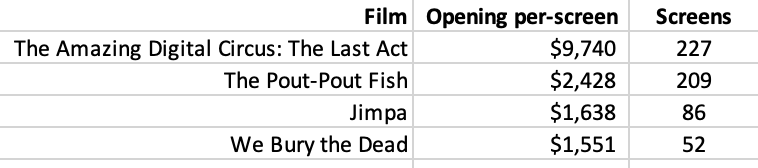
The next best wide opening by an Australian film all year was The Pout-Pout Fish at $2,428 a screen. Digital Circus did about four times that. Most local films open somewhere between a few hundred and fifteen hundred dollars a screen. This one cleared nine and a half thousand.
And it isn’t only strong “for an Australian film”. That $9,740 beat Masters of the Universe in the same week, a studio tentpole sitting on 389 screens and averaging $7,193. Same week, same multiplexes, and the Australian-owned title out-earned it per screen.
What that number measures is demand that was already there before opening night. The film didn’t have a screens problem, and it didn’t run the kind of paid campaign most releases depend on. The audience was built years ago, and on opening night it simply turned up.
Dark Matter / Bonsai Films | Week 6 | 6 screens | $2,904 week total | $484 per screen | $152,361 cumulative
Maslow Entertainment | Week 4 | 2 screens | $1,959 week total | $979 per screen | $45,715 cumulative
Athabasca Film | Week 5 | 7 screens | $1,690 week total | $242 per screen | $17,455 cumulative
Madman | Week 3 | 4 screens | $1,373 week total | $343 per screen | $105,533 cumulative
Screen Inc. | Week 7 | 3 screens | $764 week total | $255 per screen | $53,493 cumulative
Rialto Distribution | Week 4 | 1 screen | $633 week total | $633 per screen | $6,290 cumulative
Kismet / Rialto | Week 13 | 1 screen | $469 week total | $469 per screen | $14,547 cumulative*
*The Plague had 0 screens last week and returned this week.
Rialto Distribution | Week 9 | 1 screen | $112 week total | $112 per screen | $321,280 cumulative
The lesson this week is a business one, and it’s the one worth carrying out of the issue: start building your audience now. I’m looking at ways I can start building the audience on my next two features.
The transferable point isn’t “go and get 21.5m subscribers.” It’s the three things sitting underneath that number.
Timing. The worst time to start building an audience is the week of release, which is when most films start. Glitch began in 2023 and arrived in 2026 to an audience already there. Awareness you rent at release evaporates when the spend stops. Awareness you build over years compounds, and it stays yours afterward.
Owned relationship. Every promo post went straight to 21.5m people, for free, instantly, with no gatekeeper deciding who saw it. The “3 DAYS LEFT until we’re in THEATRES” short on its own pulled 7m views, more reach than the paid campaign behind most Australian releases.
Audience as finance. Glitch has said roughly 80% of its show funding comes from merch, which is why it runs its own merch company. A real audience is demand you can borrow against, and they’re borrowing against it instead of against a distribution guarantee and the offset.
Two rules that bind a normal release loosen once the audience is yours. You can open into a crowded week, because a pre-committed audience comes for your film, not for whatever’s on. And a streaming date close behind doesn’t bleed the cinema run, because the trip is the community event, not just the content. Both are downstream of the same thing: an audience that turns up for you specifically.
Two honesty notes so this doesn’t read as a fairytale. The 2023 series wasn’t built toward a cinema release. Theatrical was only pursued late in 2025, once the audience existed, so we’re reading the lesson backwards from the proof rather than pretending there was a master plan. And it started inside the system: Meta Runner’s first two seasons and Sunset Paradise were funded by Screen Australia’s online production program. The arc is recognisably Australian. Public seed funding, build an audience.
The model is real, and so are its costs. In March 2024 the studio was accused of firing Celeste Notley-Smith, a voice actress on Meta Runner and SMG4, in a callous way and recasting the role, which opened into wider allegations of long hours, blacklisting of former employees, and harassment directed largely at CEO Kevin Lerdwichagul. He put out a statement and apology, acknowledged he’d been inexperienced in the early years, said harassment of staff wasn’t tolerated, and claimed conditions had largely been resolved by 2023. These are allegations with a company response, not settled findings. The reason to include them is that holding a studio up as a model honestly means showing the cost side too. An audience-first business that scales fast can lean hard on the people inside it, and a sector that wants more of these stories has to build the support so the growth doesn’t come out of its workers.
The surprise underneath all of it: how little of the Australian conversation clocked that this was an Australian film at all.
Till I see you at the cinema next,
Kate.
No posts
Comments
Nothing yet. Say the first thing.
Sign in to join the conversation.