
The total box office this week came to about $24.74 million, led by Backrooms opening at number one. Nine Australian fiction films were in cinemas, earning $18,420.83 between them across 45 screens. That’s 0.1% of the national box office. There were also four Australian documentaries on screens and five Australian films in re-release.
Most of the week’s Australian story is in the small movements, so let’s go through the films in release order, starting with the most recent.
What comes up when you search “australian films in cinemas”
A confession this week: there’s no screenshot. The whole point of this check is to run it right at the moment of release, on the 27th to 29th of May in this case, when someone deciding what to see that weekend would actually be searching. I didn’t take the screenshots in those days, and running the search now, a week and a half on, wouldn’t tell us anything real about what was findable when it counted. Maybe I forgot because there was nothign being released.
So the category check sits out this week and returns with the next batch of releases. If nothing else, it’s a reminder of how time-sensitive this kind of discoverability is. The window to be found is the release window, and once it’s passed, it’s passed.
BIRTHRIGHT
Madman | Week 2 | 7 screens | $7,147 week total | $1,021 per screen | $104,159 cumulative
Birthright came down from 9 screens to 7 this week, with the weekend easing to $4,189 and the week landing at $7,147. The cumulative now sits just over $104,000.
I’m reading the decline as expected rather than disappointing. Most of the audience that was ever going to see Birthright saw it on the festival circuit (Sydney, MIFF, CinefestOz, Perth International Arts Festival, Adelaide Film Festival). For some films, a festival-focused life is genuinely the smartest path for both the film and the filmmakers, more so than a distributor pouring money into P&A and marketing for a theatrical run where the core audience has already turned up.
The frustration I feel as a filmmaker is that POCU, the Producer Offset office, currently requires a planned “legitimate theatrical release” from distributors, so there’s only so far anyone can move outside the frame the legislation sets. The offset rules end up shaping release strategy whether or not theatrical is the right fit for the film.
What I did love about this release was the marketing that we didn’t cover last week. Birthright partnered with Coposit, a company that lets Australians buy property with a $10,000 deposit and pay the rest over time, and turned a ticket into a competition entry to win $10,000. Buy a ticket, download the app, submit your ticket and a short review, and you’re in the draw.
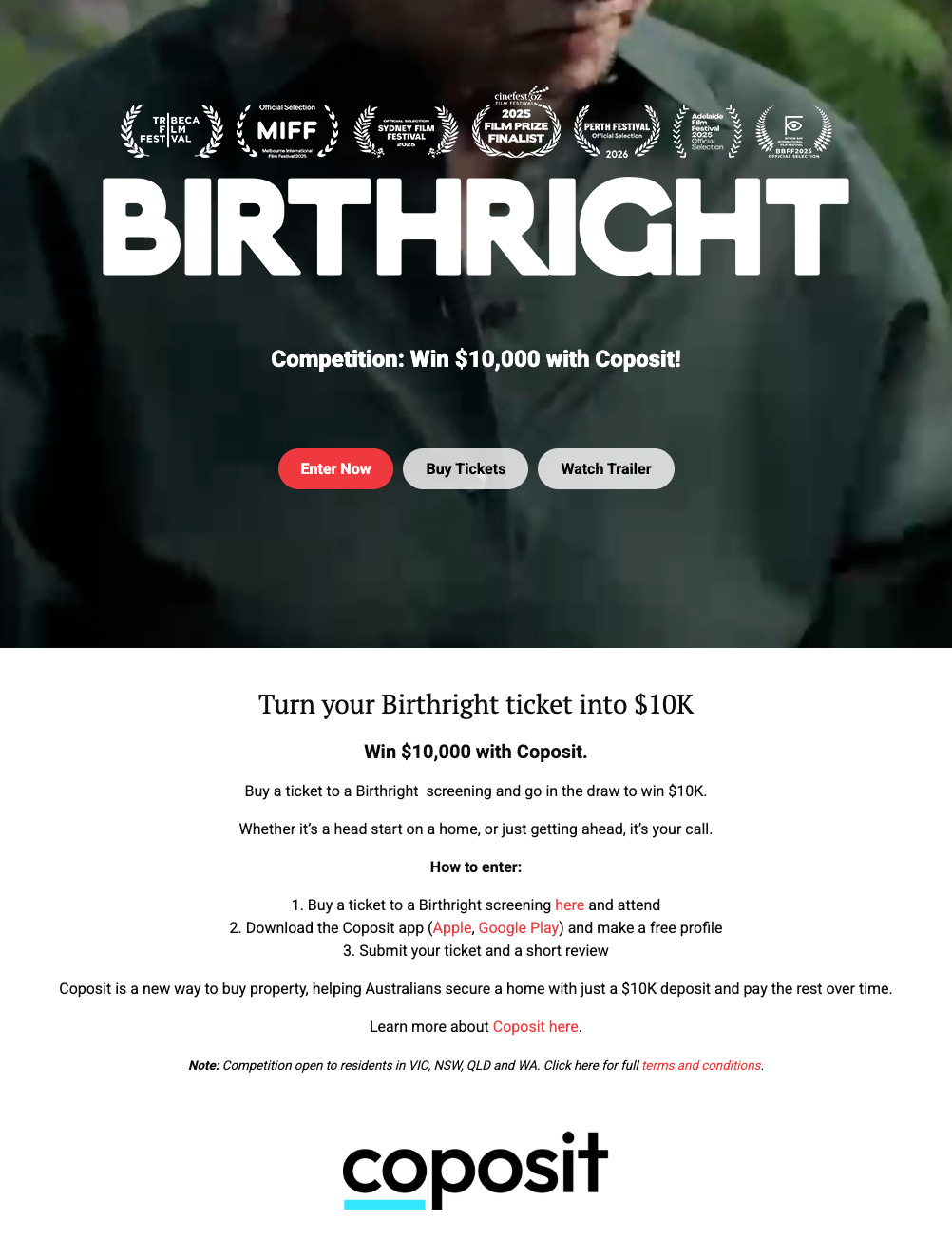
It’s a clever piece of audience activation. It gives a small film a reason to be talked about beyond the film itself, it ties the prize to something the target audience actually wants, and it’s a good example of trying something different with a release. The odds were the best part for the people who showed up. Across the whole run, roughly 5,069 people bought a ticket to Birthright. Those are very good odds on $10,000.
LIFE COULD BE A DREAM
Maslow Entertainment | Week 3 | 2 screens | $496 week total | $248 per screen | $43,757 cumulative
This is the first week Life Could Be a Dream has shown up in the data at all. It’s in its third week, but it’s absent from the reports for weeks one and two, so the $43,757 cumulative has arrived without us ever seeing the rows that built it. We can see where it landed, not how it got there, and that makes the screen averages for those opening weeks impossible to reconstruct.
This week it’s down to 2 screens with $496 for the week. But the cumulative is the point here. Nearly $44,000 is a result worth paying attention to, and it’s more evidence that it’s worth trying something different with how these films are released in Australia.
THE RUN
Rialto Distribution | Week 3 | 1 screen | $137 week total | $137 per screen | $5,657 cumulative
Down to a single screen in week three, $137 for the week, $5,657 cumulative.
FROM ITALY WITH LOVE
Athabasca Film | Week 4 | 16 screens | $4,561 week total | $285 per screen | $15,765 cumulative
This is the one I want to spend a minute on, because it’s doing something I went back through the whole year so far to check.
From Italy With Love grew its weekend takings again this week, from $2,596 to $3,648, while expanding from 14 screens to 16. That’s now three weekends in a row of weekend growth. I looked at every Australian fiction film across the past 22 weeks, and no other one strung together three consecutive weekends of growth like this. Small films do post weekend jumps, but they’re nearly always a single community screening or a one-off event making a tiny number swing wildly. This is different. It’s a film building steadily while exhibitors keep adding screens to back it.
If the reported figures are accurate, that’s a genuinely good result and exactly the kind of trajectory we want to see more of.
One thing to flag honestly. Daniel Mulvihill from Roaring Entertainment, who is releasing the film, has raised a discrepancy between what he’s seeing on the ground and what’s showing up in Numero. I’m not going to claim which way that runs, just that it’s been raised and is worth looking into. There’s also a small label mismatch in the data itself: the film reports under Athabasca Film as distributor, while Roaring/Jaggi are the companies releasing it.
That makes two films this week sitting right at the edges of the dataset. From Italy With Love with a reporting discrepancy, and Life Could Be a Dream appearing three weeks into its run. It’s a small reminder of something I keep coming back to in this newsletter: the data has edges if it’s not transparent and accurate. Titles slip in and out of the reporting, and the picture we work from is only ever as complete as what gets captured.
WOLFRAM
Dark Matter / Bonsai Films | Week 5 | 10 screens | $3,289 week total | $329 per screen | $149,457 cumulative
Down from 12 screens to 10, $3,289 for the week, $149,457 cumulative.
ALPHABET LANE
Screen Inc. | Week 6 | 3 screens | $1,516 week total | $505 per screen | $52,730 cumulative
Another small film building quietly. Alphabet Lane grew its weekend again this week, from $999 to $1,374, on a flat 3 screens. Six weeks in and still nudging upward on a steady footprint is a good sign, the kind of slow word-of-mouth result that doesn’t make headlines but keeps a film alive and I bet that team is working really hard to keep those numbers going.
THE DEB
Rialto Distribution | Week 8 | 3 screens | $373 week total | $124 per screen | $321,168 cumulative
Holding on 3 screens at week eight, $373 for the week, $321,168 cumulative.
JIMPA
Kismet | Week 15 | 2 screens | $535 week total | $268 per screen | $392,758 cumulative
Fifteen weeks in cinemas, which is a great run for an Australian film. $535 for the week takes it to $392,758. Fingers crossed it nudges past $400,000 before it finally leaves cinemas.
IMAGINE
Screen Inc. | Week 18 | 1 screen | $368 week total | $368 per screen | $44,630 cumulative
Back again. After being off screens last week, Imagine returned on a single screen for $368, taking it to $44,630.
RERELEASES
RERELEASE - Stone (1974)
Umbrella | 1 screens | $1,376 week total
RERELEASE - Babe (1995)
Universal | 1 screen | $1,100 week total
RERELEASE - Malcolm (1986)
Umbrella | 1 screen | $882 week total
RERELEASE - Rabbit-Proof Fence (2002)
Icon | 2 screen | $522 week total
RERELEASE - Love And Other Catastrophes (1996)
Umbrella | 1 screen | $330 week total
SURPRISES AND WHAT THIS WEEK CAN TEACH US
The two biggest films in the country this week were both horror, and both are worth a hard look if you’re an Australian filmmaker tempted to read across from them.
Backrooms opened at number one with $6.87 million across 314 screens. Obsession sat right behind it at number two, in its third week, taking $4.39 million on 248 screens and still adding screens this far into its run. Low-budget horror is having a moment, and I think a lot of people here are about to draw exactly the wrong lesson from it.
Start with Backrooms, because it gets called low-budget and by our standards it really isn’t. It was made for $10 million USD, which is around $14 million in our money. To put that in terms we’d recognise, think about We Bury the Dead, the Daisy Ridley zombie film shot here in Western Australia. There’s no published budget for it, but from what I know about what shooting in regional WA costs, I’d estimate it landed somewhere between $10 and $15 million. In other words, Backrooms sits right in the same zone as a properly-resourced Australian horror film, not below it. We Bury the Dead paid its crew to Australian standards.
Backrooms also has two Oscar-nominated leads in Chiwetel Ejiofor and Renate Reinsve, and the producer list runs to about eleven names before you even reach the executive producers, people like James Wan, Shawn Levy and Peter Chernin, who will each have taken a meaningful slice. It shot for 30 days in Vancouver, which is a unionised jurisdiction, so I’d be confident the crew were paid properly there too. A $14 million film with that cast, that many producers, and crew paid award-equivalent rates is exactly the kind of properly-resourced production we’d love to make more of here. In US terms it’s a genuine bargain, a film that cost around $14 million and has already made more than $100 million worldwide. What it isn’t is a micro-budget miracle built on unpaid work, and that’s the film some people here will mistakenly think they can copy.
Then there’s Obsession, the one held up as the true miracle. Independently produced for a claimed $750,000 and acquired by Focus Features for $15 million, it’s now nearing $175 million worldwide. This week the rest of that $750k showed up. The film’s art director, Sally Choi, went public about what the budget meant for the people who built it. She was paid $300 a day, which came to $6,741.36 after tax, with no mileage. She described other crew as effectively volunteers, paid in gas and mileage, sometimes not even on time, some coming out of pocket to work on a film that’s grossed hundreds of millions.
This is one of the real differences between making films here and in the US, and it shows up in what crew actually take home. On Obsession, the art director was paid $300 USD a day, around $420 in our money, with no superannuation. In Australia, the minimum for an art director is $2,349 for a fifty-hour week plus 12.5% super, which works out to roughly $470 a day before super is even added. Our floor for that role is higher than what an art director was paid on a film now nearing $175 million worldwide.
And the pay rate is only the start of it. On a professional production in Australia, crew get superannuation, they get overtime when the hours run long, they get mileage once they’re travelling outside a 20-kilometre radius, and underneath all of it we have Medicare. These aren’t perks a generous producer chooses to hand out. They’re the standard, the framework every professional production is built on, and they exist to treat crew as people with a stake in the work rather than the cheapest line in a budget.
So before an Australian low-budget horror filmmaker looks at “$750k USD” and thinks I could do that here, sit with what that number is hiding. It isn’t a clever budget. It worked because the people on set absorbed the cost in their own wages and their own time.
I believe, at the very least, as producers, we should be paying our crew the minimum award rate for the work they do. Yes, that means our films cost more than $750k USD to make. They should. But I made Proclivitas as a low budget Australian horror and everyone working on that production got paid award as minimum.
I would rather make a more expensive film that paid and protected everyone on it and didn’t make $100million than build a “miracle” on the foundation Choi is now warning people about. Of course I’d love both and that’s what I’ll always try to work towards. But I know where my morals and values are and I’m glad to be working in Australia.
Till I see you at the cinema next,
Kate.
Thanks for reading! Subscribe for free to receive new posts and support my work.
Comments
Nothing yet. Say the first thing.
Sign in to join the conversation.