
This week the total box office was $28,413,947 across 210 films in cinemas. Australian films took $365,500 of that, spread across 15 titles.
8 fiction titles: Leviticus, How to Talk Australians: The Movie, From Italy With Love, Alphabet Lane, Beast, The Plague, The Run, Beauty From Pain ($353,145 combined)
4 documentaries: Common Wealth, Dont Be Prey, Live It Up: The Mental As Anything Story, EPiC: Elvis Presley in Concert ($3,550 combined)
3 rereleases: Strictly Ballroom (1992), The Adventures of Priscilla, Queen of the Desert (1994), Bedevil (1993) ($8,800 combined)
That’s about 1.29% of the market this week. No new Australian film opened, so this week’s deep dive looks back at the first half of 2026 instead of a single release.
Half the year is done, so I want to step back and look at where Australian films are sitting inside the broader theatrical picture. My mission with this newsletter is to help grow Australian film from about 2% (in 2025) to 10% (by 2035) of the national box office. That’s the yardstick and if we are going to track it we would want this year to be sitting at roughly 3-4% of the total box office.
Here’s the top-line for the first half of 2026:
Total national box office: $496,275,150
Total films released: 421 (includes features, documentaries and special events)
Australian films released: 41 (9.7% of the release slate)
Australian film box office: $17,151,544 (3.46% of national)
3.46% is above last years 2.33%, so on face value that reads as progress.
Before I get excited about it though, the honest answer to “how are we doing” is really two answers, depending on where you draw the line.
So lets dig in.
Two of the 41 Australian films this half-year were released through Hollywood studios: Mortal Kombat II through Warner Bros. ($5.07M) and EPiC: Elvis Presley in Concert through Universal ($4.24M). Together they contributed $9.31M. More than half of the ‘Australian’ total box office for the half-year comes from those two titles alone.
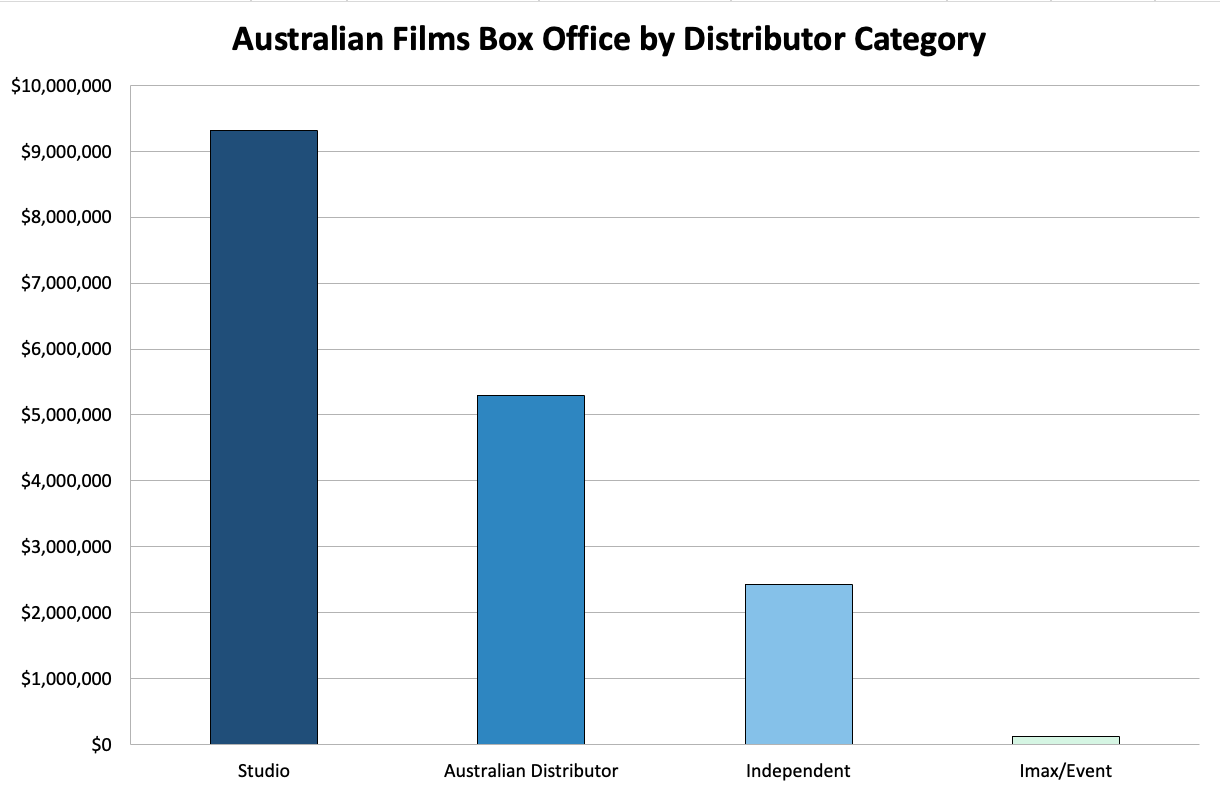
The other 39 Australian films (Australian distributors and independents combined) earned $7.84M between them.
All Australian vs all films: 3.46%
Non-studio Australian vs all films: 1.58%
Non-studio Australian vs non-studio films only: 5.61%
That third number is a like-for-like comparison. If we strip Hollywood studio releases out of both sides (the Australian films and the national total), Australian films sit at 5.61% of what’s left.
Just before I hit enter on that calcuation I was hoping that was a higher figure but without the historical research done yet I have nothing to compare that to. I’ll add that to the do list for the end of year comparison.
I’m measuring the 10% mission using the data from Numero that lists a film as Australia. So the dataset headline is 3.46%. But more than half of that number is coming from two films that most audiences would not think of as Australian when they walk into the cinema.
If you want to understand why these two titles between them earned more than the other 39 Australian films combined, look at what the studios brought to the table financially.
A P&A budget an Australian distributor can’t match. Studio marketing spend on a wide theatrical release routinely runs into eight figures. Australian distributors typically work with a fraction of that. When you compare box office outcomes, a lot of what you’re really measuring is marketing spend.
Wide release from day one. Mortal Kombat II opened on 376 screens. EPiC peaked at 373 screens (with an IMAX-exclusive first week). The widest non-studio Australian release of the half-year was Pout-Pout Fish at 224 screens, but the median non-studio Australian film peaked at just 17 screens. That’s the more honest comparison. Studio releases don’t have to fight for availability.
Premium format access. EPiC’s IMAX-exclusive first week generated a large chunk of that $4.24M at premium ticket prices, in cinemas that most Australian films can’t get near. IMAX slots go to studio releases first. There is one Australian Imax released documentary though, Shark Kingdom.
Global distribution and cross-promotion. Mortal Kombat II is a video-game franchise release with fanbase activation across every territory. EPiC ties into Baz Luhrmann’s 2022 Elvis (one of the highest-grossing Australian films of all time) and an active Sony Music release. Australian distributors rarely have that ecosystem to lean on.
By the criteria i’m using, both films count as Australian. Whether they should count is where I’d say no. Here’s what each looks like on closer inspection.
Mortal Kombat II was filmed entirely in Queensland, directed by Australian filmmaker Simon McQuoid, and made with a predominantly Queensland crew. It was backed by Screen Queensland and shot at Village Roadshow Studios on the Gold Coast. The Australian creative and labour contribution is significant. The film itself is owned by Warner Bros. and New Line Cinema. Copyright and profit sit offshore.
EPiC: Elvis Presley in Concert is directed by Australian filmmaker Baz Luhrmann and co-produced by his Australian company Bazmark Films (alongside Sony Music Vision and Authentic Studios in the US). Post-production was done by Peter Jackson’s Park Road Post in New Zealand. Australian distribution is through Universal.
I don’t want to write off the Australian involvement in either film. Simon McQuoid is an Australian director. Baz Luhrmann is an Australian director. Both projects employed substantial Australian crew and built Australian industry capability. That work matters.
At the same time, when the copyright, ownership and profit share sit with an international studio, counting the full box office of these films toward “the Australian share” is a stretch. Look at Send Help from this year - yes not an Australian director but filmed in Australia and used lots of Australian crew. Does that one not count in the “studio system” as Australian because the director isn’t Australian?
I guess both things can be true at once, and I don’t think there’s a clean way to resolve that tension in a single line on a spreadsheet unless we start reflecting all the films made here that use the Australian location offset.
But lets at least try.
Splitting the 41 films into fiction and documentary tells a slightly different story again, and it becomes more interesting once you factor in which category each of the two studio films sits in.
Mortal Kombat II is fiction. EPiC is documentary. So the studio effect is distributed between both categories.
All Australian films (studios included):
Fiction: 25 films, $12.10M (70.5% of the Australian total)
Documentary: 16 films, $5.06M (29.5% of the Australian total)
Without the two studio-distributed films:
Fiction: 24 films, $7.02M (89.6% of the non-studio Australian total)
Documentary: 15 films, $0.82M (10.4% of the non-studio Australian total)
Strip out the two studio films and fiction is carrying the non-studio slate. 24 fiction titles earned $7.02M between them.
EPiC accounts for 84% of Australian documentary box office this half-year. Take it out and documentary as a category has done $816,000 across 15 films.
The mean per film (the average box office per title) makes the difference look stark:
Fiction non-studio: $292,643 per film
Documentary non-studio: $54,403 per film
Fiction titles are averaging over five times what documentary titles are. But means get pulled around by outliers, and fiction has a couple of bigger ones.
Look at the median per film and the picture shifts.
Fiction non-studio: $71,220 per film
Documentary non-studio: $29,760 per film
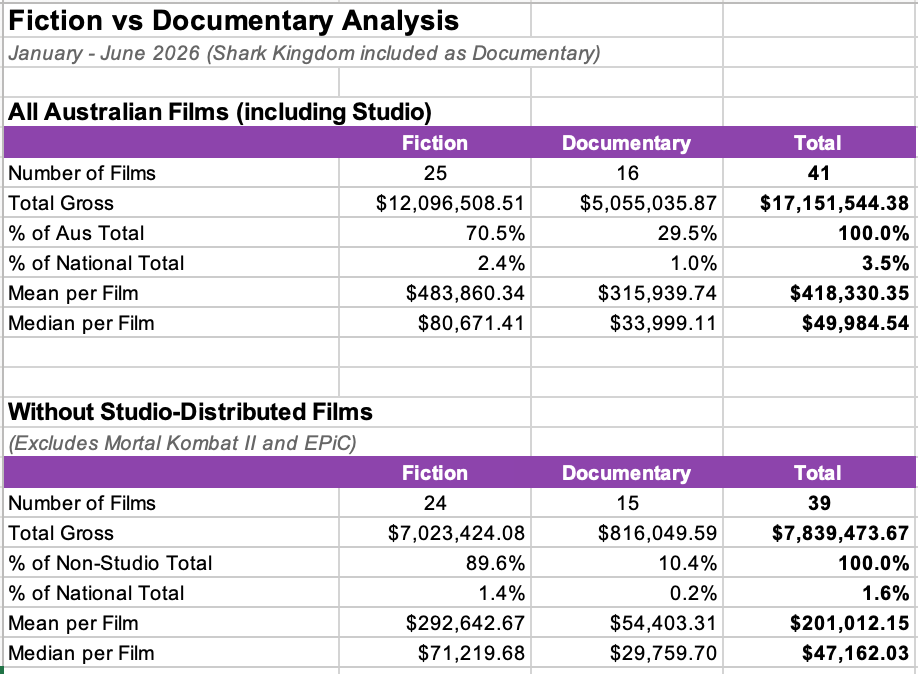
Fiction is still ahead at the median, but the gap is far smaller than the totals or the means suggested. What’s inflating the fiction total is a handful of big performers.
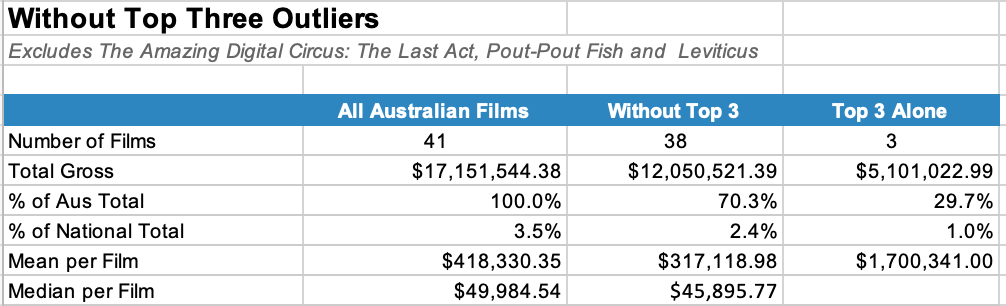
Three fiction titles between them account for $5.10M of the $7.02M fiction total: The Amazing Digital Circus: The Last Act ($2.39M), Pout-Pout Fish ($1.73M) and Leviticus ($983K). Three films out of 24 earned 73% of the fiction box office this half-year. Noting that only two of them have got over $1million at the box office. The next highest film is Jimpa with $395,578.
Documentary has nothing at that scale. The highest-earning non-studio documentary is Dance for Your Life at $217,565.
This actually really surprised me. It felt on a week by week level when I was looking at the data that doco was outperforming Fiction. And it may be on a screen average total that I was feeling was outperforming fiction. I just need to work out how to get my spreadsheet to show me this - hopefully I can work on that by the end of the year.
When I look at the three non-studio fiction titles carrying the top of the slate, I can’t find an obvious common thread. Different genres. Different creative teams. Different budgets. Different audience targets.
Those three films between them accounted for 29.7% of the entire Australian box office for the half-year, and lifted the mean per Australian film from $317,119 to $418,330. Take them out and the median barely moves, from $49,985 to $45,896. That’s the outlier effect in one snapshot.
The Amazing Digital Circus: The Last Act ($2.39M) was released independently. Animation, based on the hit YouTube series that had hundreds of millions of views before it ever went theatrical.
The Pout-Pout Fish ($1.73M) was released by Maslow Entertainment. Family animation adapted from the Deborah Diesen picture book series. Widest non-studio release of the half-year at 224 screens.
Leviticus ($983K) was released by Maslow Entertainment. Queer supernatural horror, a debut feature from Adrian Chiarella, produced by Causeway Films (the company behind The Babadook and Talk to Me). Premiered at Sundance in the Midnight section, picked up worldwide (excluding AU/NZ) by NEON, and arrived in Australian cinemas with a 94% Rotten Tomatoes score behind it.
If we were in a different kind of industry, this is the point where I’d compare what the winners did and start extracting the playbook. But we aren’t making cars or computers. Every film has its own individuality. Every audience is different. Every release strategy is bespoke. Comparing winning films the way you’d compare products off an assembly line doesn’t really work.
I can see something like an external-awareness thread in two of the three. Digital Circus arrived in Australian cinemas with a YouTube fandom that already existed. Leviticus arrived with Sundance prestige and international critical validation. Both were, in some sense, pre-endorsed by an audience or a system that sits outside the Australian film ecosystem.
Pout-Pout Fish doesn’t fit that pattern cleanly. It’s based on an American picture book series, but the US theatrical release came later in the year, so the Australian release wasn’t riding a US marketing wave. It got there through something else. A wide release footprint (224 screens), family audience timing, distributor confidence, or maybe just the right film for parents.
If the three fiction winners are the top of the non-studio slate, the tail is where the other conversation lives. 21 of the 39 non-studio Australian films that released in H1 earned under $50,000 each at the Australian box office. Combined, those 21 films took $403,300. That’s 5.14% of the non-studio Australian total, from more than half the films that came out this half-year.
Eight earned under $25,000. My own film Proclivitas is on this list at $21,312 on 21 screens, released March 2026.
The tail isn’t uniformly one thing. Some of these films were made for particular audiences and released on one or two screens by design. Others got a wider footprint and still couldn’t earn enough to move the top-line numbers.
The question I don’t yet have an answer to is how much of this tail was inevitable. Films made for niche audiences on tiny budgets are always going to gross what tiny-budget-niche-audience films gross. But when a film gets over 50 screens and cant earn more than $100k, availability wasn’t the whole story. Something else in the awareness or release strategy didn’t do the work it needed to do.
Honestly, I feel a bit lost trying to make sense of what the winners have in common. And that might be the diagnosis itself. If a data-driven industry analyst can’t reverse-engineer what worked in an easy way, it’s not obvious how a filmmaker or distributor is meant to plan around it in advance.
The instinct at this point in the analysis is to reach for “we just need to make better films.” I catch myself doing it too.
That framing lets the exhibitor and distributor industry off the hook, and it also skips right past what I’m actually trying to work out with this newsletter.
What does “better” mean when we’re looking at box office results? Better at connecting with an audience? Better at building awareness? Better at earning festival prestige that becomes marketing? Better at meeting audiences where they already are? Those are all different problems, and they require different responses from filmmakers, distributors and exhibitors.
I don’t know what “better” looks like yet. That’s part of why I do this weekly. Watching the data as it accumulates is how I hope to earn the right to say something specific.
But I do have one question I’m holding myself to on my own slate right now, and I think I can apply it to every Australian release and might be the question for Q3. Two questions, really: is there a clear audience for this film? And do I know how to reach them?
If the answer to either is no, that’s where the work needs to happen before release, not after. I want to start posing those two questions to every Australian release I write about, and see what I learn.
Alongside that, my plan going into H2 was to spend more time looking at what films are doing on social media. Following the conversations, tracking what content lands, whether TikTok clips are driving cinema visits, whether Instagram organic reach translates to opening weekend. But I’ve been questioning that plan for two reasons.
The first is the “dead internet” concern. If a meaningful chunk of what’s showing up as engagement is bots, seeded content, or algorithmic amplification with no human on the other end, then measuring “the conversation around a film” is measuring something closer to the algorithm than the audience. That’s a serious problem for anyone trying to use social signals as a leading indicator.
The second is resource. Doing this properly takes tools. Brand24 or similar isn’t cheap on an annual basis, and my funding application to help cover it is still just an idea whilst I’m working on in a TV Production role till September. I can look at a few films manually, but I can’t do 40-plus releases across a half-year without infrastructure, and manual sampling introduces its own bias problems.
I might do it anyway. I might do it partially. I might drop it and pick a different lens. I don’t have a clean answer yet but I’ve got till the 9th July to work it out when our next Australian films are in cinemas.
Till I see you at the cinema next, Kate
No posts
Comments
Nothing yet. Say the first thing.
Sign in to join the conversation.