
This weekend, I’ll be speaking at an Episcopal Young Adults retreat in West Virginia on the topic of peace. Given my bookish tendencies, I took this as a good excuse to read lots of old books and try to learn from the saints who have gone before us. Since this retreat happened to align with the end of my semester and the deadline for my final manuscript edits, I’ve been swamped, to say the least.
However, rather than putting off an essay this week, I decided I could simply return to my “Notes from an Armchair Theologian” series in which I give a brief rundown of the books I’ve been reading. The first installment was dominated by books on St. Augustine for a project I’m working on. While that project and the accompanying research continues, it has largely been on the back burner due to more pressing matters. In place of books on or by St. Augustine, today I’ll be giving an overview of a few of the books I’ve found particularly rich on the topic of peace.
Yes, Saint Julian of Norwich. She has a feast day in the Episcopal Church (reason enough to join us if you ask me). Y’all in the Catholic Church need to catch up on this one.
I digress.
St. Julian holds a special place in my heart. We have a lovely modern icon of her from Gracie Morbitzer hanging on the wall behind our kitchen table (seen above). I’ve mentioned this before, but when I first came across her famous line, “all shall be well, and all shall be well, and all manner of things shall be well,” I won’t lie, it seemed like bumpersticker theology. Stick it on a throw-pillow and sell it at one of those kitschy knick-knack stores.
I was far too sophisticated for such, “Let Go and Let God” theology. I studied this stuff after all.
And then I realized I’m a spiritual dunce (a common theme in my life).
In fact, St. Julian was right. More than that, I’m pretty convinced that just about the entirety of the Christian life is learning to believe this all the way down to your bones.
While all these writers’ fingerprints will be found in my retreat talks, it’s St. Julian who I’ve leaned on the most heavily. If I can get the people there to come away believing all shall be well, then I’ll call it a success.
Side note: Essay series on Revelations of Divine Love after I finish the Cassiciacum Dialogues? Maybe? We’ll see. Let me know if you’d like that.
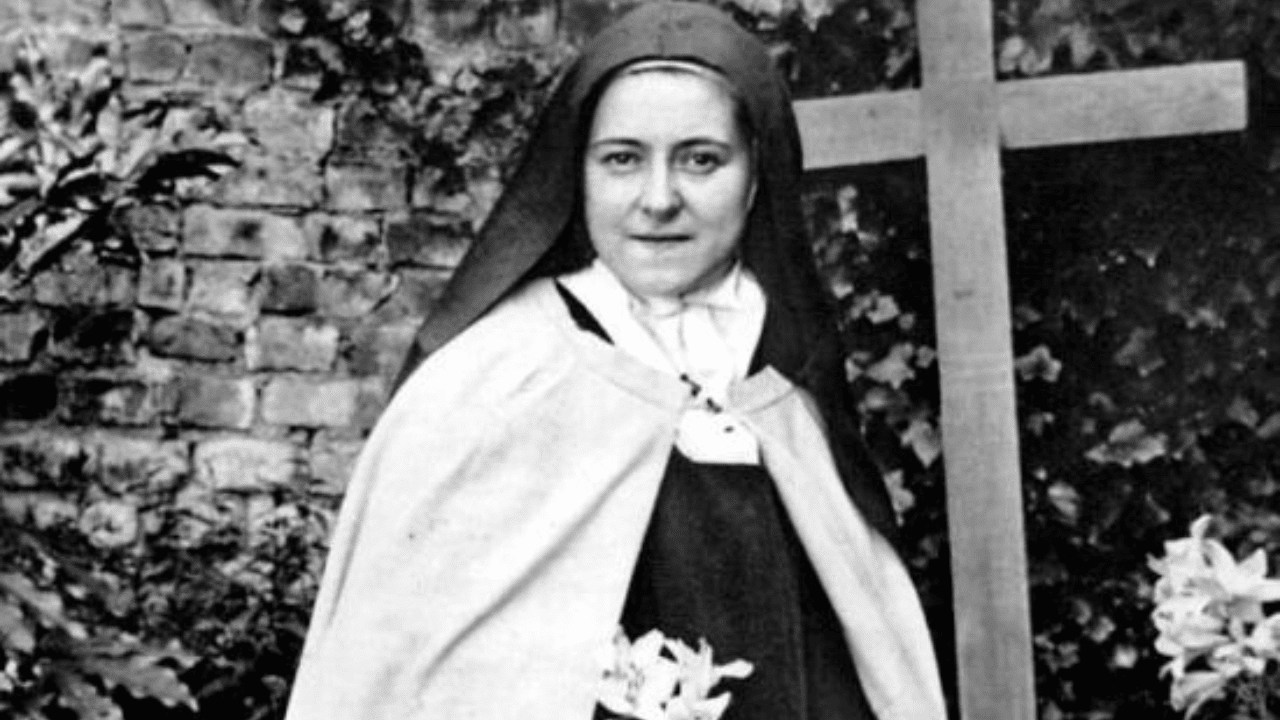
Unlike some of the other works, I didn’t specifically read this to prepare for this retreat. A very kind priest sent this to me a few months ago (shoutout Fr. Jose), and I’ve been slowly making my way through it. I’ve delighted in it, but it wasn’t until very recently that I began to see the overlaps with peace. And then once you see them, they’re everywhere.
For instance, early in the book, when a young Therese desperately wants to join the monastery but is experiencing roadblocks, she says that surrendering herself to the will of God is what brought her profound peace even as she came up against disappointment. As a teenager, she was already learning that faith is about saying, “thy will be done” and resting in God’s providence. Toward the end of the book (chapter 8, I believe) St. Therese mentions how “self-abandonment” became her only compass. It’s through this complete surrender to the will of God that she finds the peace that surpasses understanding.
The main takeaway for current purposes is that total abandonment is at the core of her spirituality. And it’s also at the core of peace. Until we can truly learn to rest in God’s providence, our peace will only be as strong as our circumstances are favorable. That is peace as the world gives not the peace of Christ.
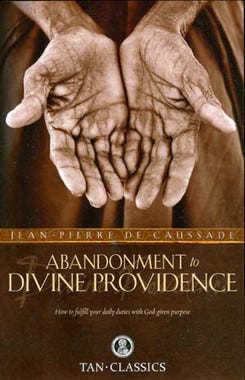
Speaking of total abandonment, this is the real classic for that idea. While I’m sure this book is popular in some circles, it’s a Tan Classic, after all, I’ll admit that it had flown under my radar. When you start reading in the “Spiritual Formation” category, certain names pop up a lot. Even Protestants like John Mark Comer or Dallas Willard are constantly citing Thomas Merton, Henri Nouwen, St. Teresa of Avila, and St. John of the Cross.
But Fr. Jean-Pierre de Caussade? I’d never heard the name.
However, I found his work—which, full disclosure, I haven’t completed yet—to resonate deeply with the general approach to peace I am taking in this retreat. For Caussade, the whole of religion comes down to fully entrusting oneself to God. Preempting much of our modern emphasis on “living in the present,” Caussade coined the term, “the sacrament of the present moment.” It is in the present that God meets us with his grace. He writes, “Leave the past to the infinite mercy of God, the future to His good Providence, give the present wholly to His love by being faithful to His grace.”
This also relates to my post last week about avoiding self-castigation. The past is in the past. Confess your sins, repent, and move on, seeking Christ in this moment. And as it relates to the future, do not be anxious about tomorrow, for tomorrow will be anxious about itself. Sufficient for the day is its own trouble.
If we wish to move beyond the anxiety of worrying about the future, we must learn to trust that God is good, he will work all things together for the good of those who love him, and all shall be well. That’s what makes Caussade et al. different from secular varieties of “live in the present.” The latter is often, essentially, a tactic of ignoring the future. It’s an “out of sight out of mind” approach. But the Christian approach is far deeper. We don’t turn our eyes away from the future because it’s scary—that’s like telling people to not look at the tiger in the room because, hey, it hasn’t attacked yet—rather, we can rest in the present, abiding in Christ, because we have nothing to fear.
As a brief, autobiographical side note, I find it interesting that these days I’m drawn to ideas like Caussade’s. If a Calvinist on the internet was talking about Divine Providence, I’d probably get a bit uneasy. A 14th century anchoress or a 17th/18th century Jesuit? Count me in.
That’s probably a touch of hypocrisy.
However, at least in the case of St. Julian, I would argue that there’s a significantly different flavor to her approach to providence. Less, “glory in double predestination” and more “all shall be well.” Alas, though, I suppose there are probably some superficial reasons mixed in there too. Cue the need for some soul searching.
Anyway, I’m touched by Caussade’s simplicity of approach. He’s also eminently quotable.
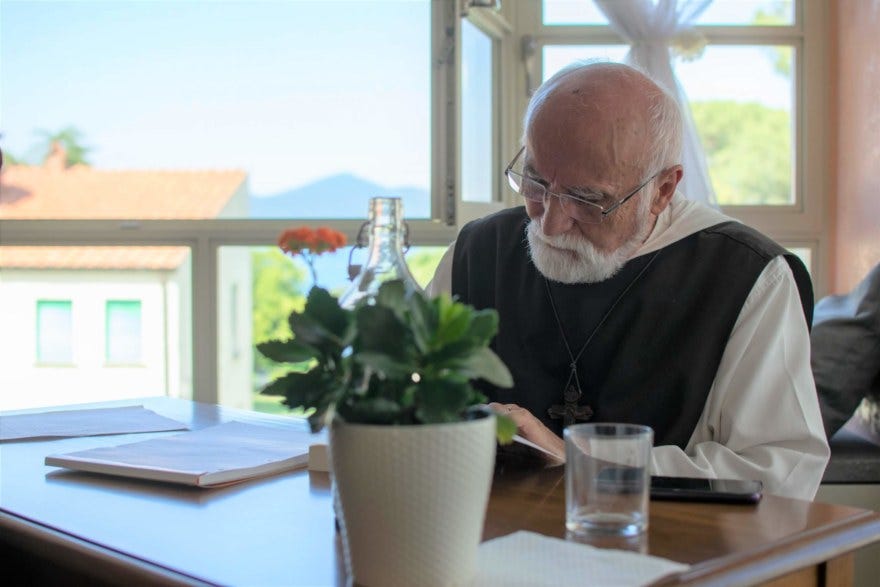
The final main conversation partner for this retreat has been Fr. Jacques Philippe. Although he doesn’t have that same mystique that older writers have, his work is brilliantly accessible, and I would point people here first. Philippe has a wonderful way of synthesizing the tradition without feeling stuffy. In this book you’ll hear from Dom. Lorenzo Scupoli, St. Francis de Sales, and many others, without feeling like the author is trying to impress you with all he’s read. That’s harder to do than it sounds. Most of us writing historical theology on Substack—myself included—would do well to learn from him in this.
One thing I really found helpful in this book is the way he talks about the things that get in the way of our peace. It’s easy to talk about peace from a 30,000-foot, aspirational vantage, but it’s much more helpful to the average person to say, “yeah, but what about the fact that people are sometimes really annoying?”
Because my rushed writing of this piece has been anything but eloquent (forgive me), I’ll leave you with a long quote from Fr. Jacques Philippe which hopefully ensures you get something out of this:
And how does one grow in this total confidence in God; how can we maintain and nourish it in ourselves? Certainly not only by intellectual speculation and theological considerations. They will never withstand the moments of trial. But by a contemplative gaze on Jesus. To contemplate Jesus Who gives His life for us, nourishes us with “too great a love” that He expresses on the cross; that is what really inspires confidence. Would not the supreme proof of love — Greater love than this no man has than to lay down his life for his friends (John 15:13) — untiringly contemplated and captured in a gaze of love and faith, fortify our hearts little by little in an unshakable confidence? What can one fear from a God Who manifested His love in so evident a manner? How could He not be for us, completely, entirely and absolutely in our favor; how could He not do all things for us, this God, friend of humankind, Who did not spare His only Son for us, even though we were sinners? And if God is for us, who could be against us (Romans 8:32)? If God is for us, what evil could possibly harm us? Thus, we see the absolute necessity of contemplation for growing in confidence.
No posts
Comments
Nothing yet. Say the first thing.
Sign in to join the conversation.