
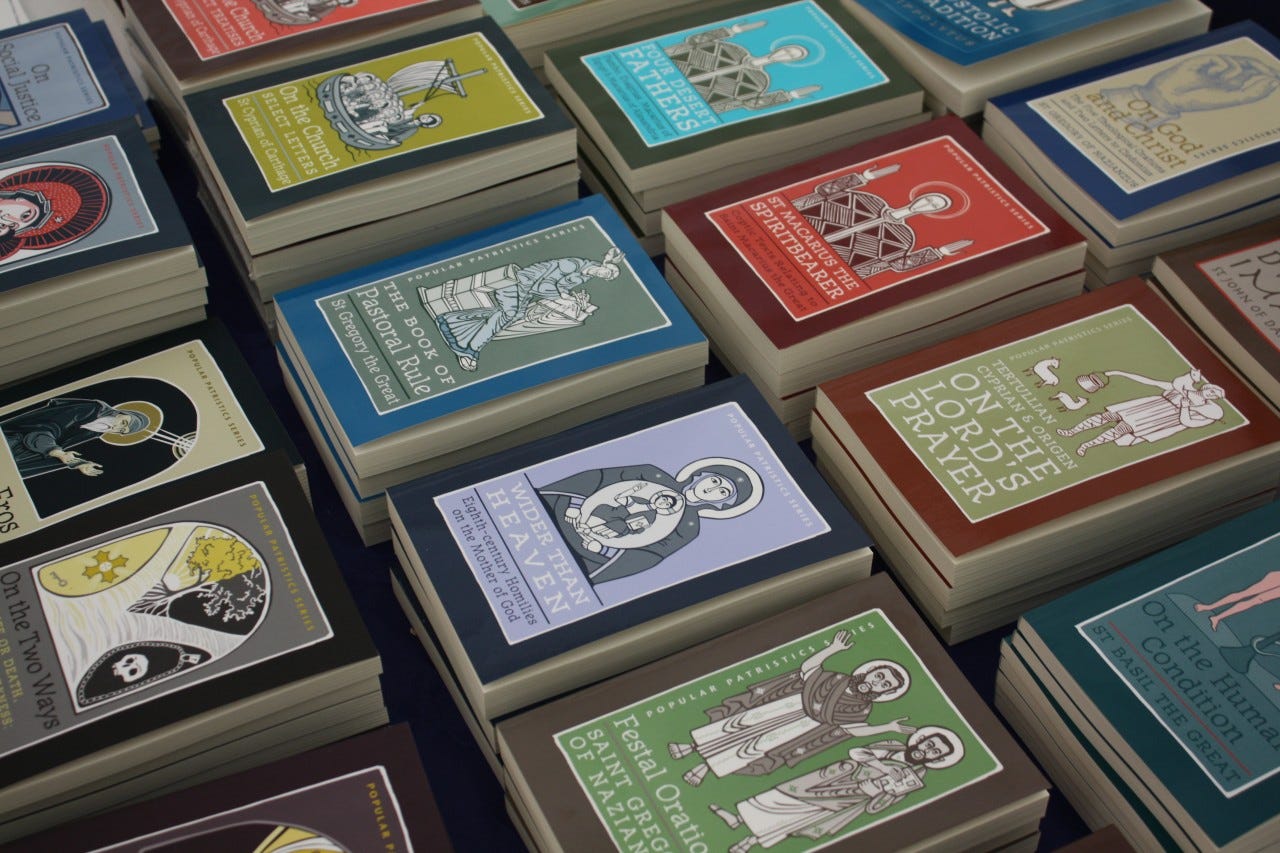
When St. Vladimir’s Seminary Press began its Popular Patristics series nearly 50 years ago, the title might have been a touch aspirational. True, the currents in academia had decidedly swung toward patristics with the ressourcement theologians in the Catholic Church and the neo-patristic synthesis types in the East, but “popular,” at least at a lay level, was probably a stretch.
As is often the case, what was popular in the halls of major universities decades ago has now made its way into the pews, and the study of the Church Fathers is beginning to become “popular” indeed. Granted, this popularity is still niche—I don’t recommend starting small-talk on the train with, “so, what do you think of the logoi in St. Maximus?”—but there does seem to be a genuine rise in the popularity of patristics. Would people have predicted 50 years ago that YouTube and TikTok would be full of young men opining on the relevance of St. Cyprian to contemporary debates between Catholics and Orthodox? Probably not.
Whether this is simply a passing fad or a genuine shift in Christian consciousness is hard to predict. Nevertheless, for now at least, it’s here, and in my experience, it’s creating lots of new questions. Pastors who went to seminary two decades ago were probably not anticipating having young parishioners ask them whether the filioque is theologically accurate or not. In all likelihood, such debates were probably little more than a footnote in an assigned reading for a Church History class that has been long since forgotten.
To be clear, I don’t fault pastors or seminaries for this. The niche interests of people who consume hours of historical theology content online a day may not, in fact, be as important as the nerds among us may like to think (I say this with love and affection, knowing I most certainly fit that description of “nerd”). And yet, these are the times we’re in, and I think one of the questions that we must ask is, “how should we think about the Church Fathers?”
In my experience, there’s often an implicit sense among people interested in historical theology that the Fathers de facto are authorities and should settle our interpretive debates. As the internet makes clear the extent of our disagreements about Scripture and thus highlights just how much interpretation is happening when we encounter a text, the Fathers offer, seemingly, a way out. It goes something like this:
Person A: Scripture says X.
Person B: No, it says Y.
Person A: No! It clearly says X.
Person B: That’s just your interpretation.
Person A: …
Person B: Look, the Fathers all say Y, so the Bible must mean Y.
That, of course, is a bit of an oversimplification, but hopefully an illustrative one nonetheless. The main idea is that the Fathers act as something akin to interpretive arbiters. This is not bad in and of itself. In fact, I think checking one’s interpretive conclusions against the Fathers can be a rather fruitful practice and can foster a certain intellectual humility when done well. I often compare the task of theology to sitting around a large table filled with theologians of the past, all looking at the same text and discussing it together. At this table in which conversations began long before we arrived, we’re invited to speak. We, too, can engage the task of theology and speak our minds. And yet, it’s both good table manners and wise theological practice to listen more than you speak. If everyone at the table reads differently than you do, it doesn’t automatically mean you’re wrong, but it should be enough to give you pause.
That being said, I think there’s a bit of a danger when we engage the Fathers as nothing but arbiters for our disagreements. Rather than listening carefully to the conversation and trying to understand how it has gotten to the point it has, we merely search for snippets of speech that confirm our hypothesis and then run from the table to go relay our findings. In such cases, we basically move the proof-texting wars back a layer. Whereas we once might have debated predestination by volleying verses from Romans and Philippians back and forth, we now try to play a trump card in the form of quotations from the Fathers.
This isn’t new, of course. When representatives from the East and West met for reunion councils in the late middle ages, it was common to produce florilegium—essentially long list of quotations from the Fathers in your favor, often divorced from context.
And it’s this idea of context that should give us pause. Most Protestants have had it drilled into them that context is essential for understanding the Bible. For this reason, study Bibles fly off the shelves as people seek to understand the times and places in which texts were written. These study Bibles may only scratch the surface, but they’re helpful tools considering the immensity of the task of trying to understand everything from the Philistines to Caesarea Philippi. When enlisting the Church Fathers as debate-deciders, we often fail to recognize that we’re adding yet another layer of context to understand which may or may not make things simpler.
I say this not to gate-keep patristics nor make people despair. Much of my work online is dedicated to trying to engage the Fathers in a way that’s accessible for those interested in such things. For now, I flag this merely to make us stop for a second and think not whether we should engage patristics but how we can do it well because, for all the ink shed about good vs. bad biblical interpretations, I think we often forget those ideas when we put our Bibles down and pick up the latest from SVS press. Thus, we end up reading the Fathers a bit naively. Oddly, we assume that the Fathers are more perspicuous than Scripture when, most of the time, that’s simply because we’re not aware that the hermeneutical difficulties that riddle Scripture are present in the Fathers as well. We just haven’t sat at the table long enough to hear the debates.
This naivety can create a blissful honeymoon period with the Fathers, and much of me does not want to ruin that for people, but I do want to warn against thinking that reading a couple books on the Fathers means one now has all the trump cards for proper theology. I’ve made the analogy before, but reading a couple chapters of Calvin’s Institutes didn’t settle debates on soteriology back during the height of the young, restless, and reformed days. Swapping Calvin for Chrysostom won’t either.
Ok, all that being said, let’s look at a few ideas for reading the Fathers well.
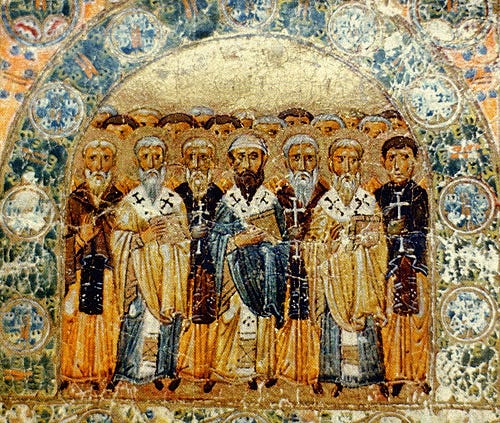
This one might surprise some people. In a lot of ways, I’m a primary source guy. I’ve been deeply shaped by my time at St. John’s College, which is famous for its exclusive use of primary sources in the curriculum. There aren’t even lectures, just conversations about influential texts ranging from Homer to Hegel. To be clear, if you want to read the Fathers, you absolutely need to read the primary sources. At its best, a call to focus on primary sources is a vote of confidence in our ability to understand difficult texts and an encouragement to form opinions of our own rather than just parroting back what others have said. I’m onboard with all of that.
However, we shouldn’t neglect the secondary sources. We’re not the first people to read the Fathers, and engaging secondary sources opens us up to the fact that, just as with Scripture, there are a range of interpretations of the Fathers. It’s not as simple as, “St. Augustine said it and that settles it.” In engaging secondary sources, the goal isn’t to become passive. Instead, it’s to avoid isolated reading. Learning should always be a communal task. Think of secondary sources as conversation partners and members of your learning community who have a bit more experience than you do. Feel free to disagree with them, but also be willing to learn from them. Most people today have an aversion to narrow, fundamentalist approaches to Scripture that fail to recognize there are many ways of reading the Bible. For those getting into patristics, don’t fall into the trap of swapping one fundamentalism for another.
On a similar note, if you’ve spent time learning about how to read the Bible well, don’t throw those lessons out when you read the Fathers. Remember that stuff about reading according to the genre and the historical-cultural context? That applies to St. Ephrem’s hymns and St. Cyprian’s sermons.
Our category of “Fathers” can be a bit reductionistic. It can make us flatten this diverse corpus of writing into one genre as though it were all the same. It’s not. These writers, like the biblical writers (indeed, more so depending on your theory of inspiration) are people whose thinking is bound up with the time and places in which they lived as well as the mediums in which they chose to communicate. That doesn’t make their writing less valuable, it just means you need to read it according to the rules of good interpretation and not as though it were all undifferentiated divine oracles with self-evident meanings.
In many ways this is a sub-point of the previous one, but good hermeneutics dictates that we read texts on their terms, not our terms. The online historical theology space is dominated by debates. Unfortunately, trying to win arguments incentivizes shortcuts. Rhetoric can trump rigor in such cases, and careful readings give way to mic-drop quotations. One of the things that I often see happening within this context is that we assume the Fathers are speaking directly to whatever our contemporary debate might be. So, if we’re having an argument about Protestantism vs. Catholicism, we ask whether St. Augustine would’ve been a Protestant without seeing the anachronism staring us in the face.
Part of being a good reader is trying to first understand what the author is trying to communicate. When we do that, we must ask, “what questions are they addressing?” not “what answers do I want them to give me for my questions?”
Of course, this does not mean that the Fathers cannot speak to contemporary questions. They most certainly can. By no means do I wish to relegate patristics to a merely academic exercise of something akin to philosophical archeological excavation. Instead, I merely want to caution that, prior to leveraging the Fathers for whatever debates we find ourselves in today, we should first try to patiently understand what they were saying in their times and places. Then, we can do the difficult work, one that’s often more art than science, of translating those ideas into our times, recognizing that much can be lost—and gained—in such acts of translation.
“Patiently” was the key word in that last section, and it’s deserving of a brief section all of its own. St. John Henry Newman’s infamous quote, “to be deep in history is to cease to be Protestant” has created in many people a sort of call to arms, a challenge, if you will. Basically, people rush to fulfill this undefined criteria of being “deep in history.” But rushing rarely leads to depth.
The fact is, most of us are not “deep in history.” Many of us never will be. We didn’t start learning Latin and Greek at 10, nor did we master five or six research langauges by the time we graduated high school. We have jobs to do and dishes to clean. Not to mention we really like that new show on Netflix. Despite all this, we want to be seen as “deep in history” (know that I’m preaching to myself here).
Whether we attain that elusive description or not, we would do well to go slow. You’re not going to be an expert in church history in a year, so you might as well pace yourself. You’ll learn more that way in any case. It’s better to really understand one book than speed-read 10 that you forget instantly.
Fr. John Behr recently said in an interview with the guys at Worse for the Facts that you can really only get to know a handful of thinkers in your life. Bear in mind, Fr. John probably fits that description of person we’re not (found two paragraphs above) better than most. So, if one of the greatest living scholars of patristics says that he can only know a few thinkers in his life, well, shoot, I’d love to even know one then.
In the vein of going slow, I recommend trying to find that person whose thought you’d like to get to know and spend a year with their writing. For me, this year is St. Augustine. Outside of my reading for videos and class, most of my research reading is dedicated just to him, and primarily just his early works at that. Will I know Augustine come December? No. Will I know more than I did previously? Absolutely.
I leave you with less of a fifth and final tip and more of a question to ponder: what is the shape of theological history? I’ve explored this a bit in my essay, “The (Protestant) Problem of History” found below:
In that piece, I survey a few different ways of thinking about how we’ve gotten where we are. One way I try to get people thinking about this is by asking, “does theology get better or worse with age?” Newman talks about this in his Essay on the Development of Christian Doctrine, wherein he states that, though many people assume theology is like a river that is clearest at its source, that is not in fact the case. Barth, somewhat similarly, talks about theology as a science that improves over time. Others disagree. Some say theology peaked in the first century, the fourth century, the 12th century, etc. That’s a hard question to answer if you’ve read deeply and widely. It’s even more difficult if you haven’t.
I’m not suggesting you should solve this question, but I do think it’s one to wrestle with as you consider how to engage with the Church Fathers. We’ve given them that title, and it bears weight for many. But it’s worth asking, “are you allowed to disagree?” I think this is especially important for Protestants who find that their theology is at odds with the Fathers in significant ways in certain areas. That might just mean you’re wrong. It might mean the Fathers were wrong. Maybe you’re both wrong. I have thoughts on that matter, but those are for another day. For now, I want you to be thinking about the long journey of history that has brought us to the present in which you hold the views that you do. What’s the shape of that journey?

Exciting news! I’ll be leading a pilgrimage along the Camino de Santiago July 8-18, 2027. We’ll be doing a shortened, easier version of the walk with luggage carried and transportation shuttling us between some of the most scenic stretches. But don’t worry, there will still be plenty of walking involved. Learn more: here.
In case you weren’t aware, my novel, The Long Road to Holy Island, is now available for pre-order. It’s a story about a grieving young man who embarks on the pilgrimage his mother always dreamed of—St. Cuthbert’s Way—despite not sharing her faith. Along the way, he meets a monk who becomes his traveling companion, and through their conversations and other people he meets, the protagonist is forced to wrestle with questions of faith in a world that so rarely makes sense. Pre-ordering is a huge help, especially for debut authors like me. So, if you’re so inclined, it would mean a lot to me if you grabbed a copy early.
If you’re looking for ways to start studying church history, I recently put together a Church History in a Year reading guide which takes you through 2,000 years of primary sources in just 52 weeks. It’s available for $15 individually or freely to all my Patrons.
Finally, paid subscribers receive access to my book club, in which we’ll be reading C.S. Lewis’s masterpiece, Till We Have Faces over the summer. We’ll meet June 22, July 20, and August 17 at 8pm EST on Zoom. Recordings are provided for those that can’t make it.
No posts
Comments
Nothing yet. Say the first thing.
Sign in to join the conversation.