
The problem of evil is the most serious objection to classical theism. Any religion that claims God is all-powerful and all-good is faced with the task of explaining how that can square with the presence of evil in the world. If God were not omnipotent, we might say that the existence of evil doesn’t threaten his omni-benevolence because, well, “He’s trying his best.” If God were not omni-benevolent, we might say that the existence of evil is not a threat to His omnipotence because, well, “He just doesn’t care.”
Neither of those options are attractive to Christians or classical theists generally. And thus, the problem of evil remains acute. For millennia, theologians and philosophers across the world have attempted to solve, or at least give a credible answer to this problem.
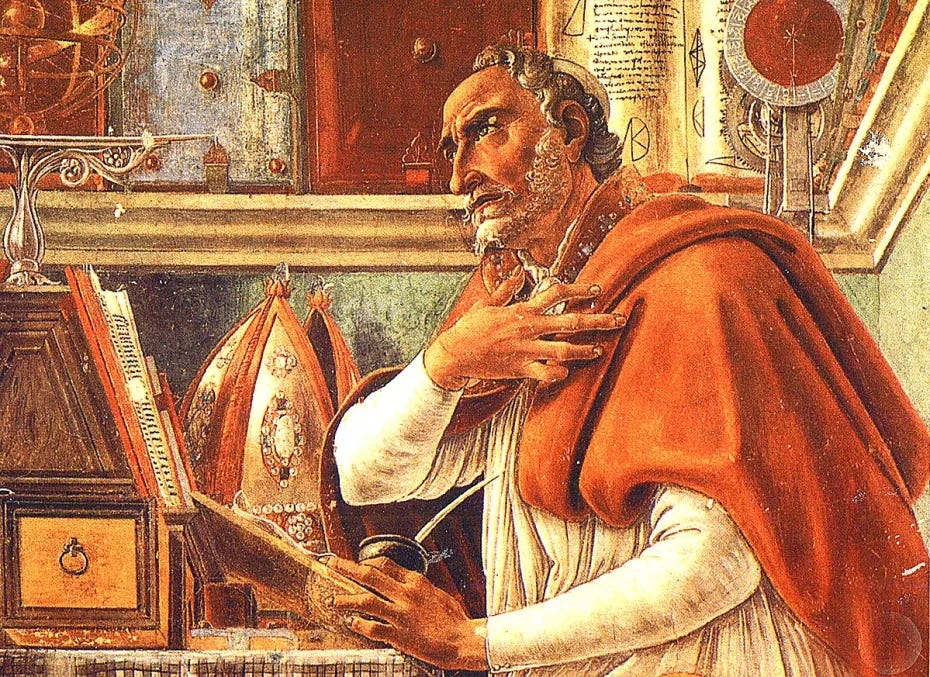
Among those theologians is St. Augustine.
In today’s essay, we’ll continue our series on Augustine’s Cassiciacum Dialogues, this time turning our attention to On Order wherein he takes up this very question. However, the way in which he does it is most likely not what you expect. Compared to Against the Academics and On the Happy Life, this third dialogue is significantly more complex. Though it deals slightly less with the history of philosophy than Against the Academics, and therefore you can get away with less background knowledge, tracing Augustine’s argument is no easy task. The dialogue appears to meander between subjects and only answers the primary question in a roundabout way. But I think that’s intentional.
First, the meandering is far more structured than you might be led to believe. In fact, the journey that Augustine takes his students on mirrors the journey of the soul trying to understand itself, which, as we’ll see, is central to his theodicy. Second, as far as answering the primary question only in part, it might not be correct to label On Order as a theodicy at all. It may be better thought of as a preliminary manual in how to be the type of person that could answer the problem of evil, rather than a direct answer to the problem itself. With those two things in mind, one can see the order—pardon the pun—within this seemingly disordered dialogue more clearly.
Like all of the preceding dialogues, On Order begins with a preface in the form of a letter to a friend to whom Augustine is dedicating and sending an early copy of the dialogue. The first thing Augustine makes clear in this preface is that the task of exploring the problem of evil is one of seeing how the parts relate to the whole. To explain this, he uses the analogy of someone looking at a mosaic. If one attends only to the individual broken shards of a mosaic, they see disorder. Likewise, when one focuses on particular events in the world, things don’t make sense. We see pain, strife, and division. In other words, we see evil. However, if that person were to step back and take in the entire mosaic, they would see harmony and beauty. So too, Augustine argues, is the case with life in this world. At a micro-level, evil is apparent, but at a macro-level, there is order, justice, and harmony. In this sense, “God is working all things together for the good.”
So far, this seems like a pretty stock answer. And while there is some truth to this, it’s unlikely to satisfy many skeptics. What we’d expect from here is for Augustine to tell us to trust that God is working things together and keep the big picture in mind.
But that’s not what he does.
Instead, Augustine argues that, if we want to understand the whole, we first have to understand ourselves. As he writes, “the greatest cause of this error [i.e., focusing on the parts instead of the whole] is that man is unknown to himself.”1
At first blush, this seems like a strange way to address the problem of evil. If Augustine explained that self-knowledge was necessary to understand evil because, in knowing ourselves we see that we are the problem, that would be one thing. Then the message would be that the problem of evil is solved by taking accountability.
But that’s not at all where Augustine goes with this.
The value of self-knowledge in addressing the problem of evil relates directly back to the mosaic analogy. The only way we’ll understand evil is if we can somehow grasp the whole. And self-knowledge is the path to that.
Here’s why.
Understanding the whole is not, for Augustine, about understanding the sum of all the parts. The whole precedes the parts. Unity is more foundational than plurality. So, the task of the philosopher is to grasp the underlying unity of all things by moving away from the distracting pluralities of the world. When we use our senses to look at the world around us, we find a dizzying array of things. This is not the stuff of true knowledge. Instead, the philosopher must turn inward and seek to know the unity of her soul by means of her own soul. The soul is the primary unity that is intelligible for humans, and only in grasping this can humans begin to understand the question of evil within a world of order guided by an all-powerful and all-good God.
If this self-knowledge is the key to unlocking one of life’s greatest mysteries, it would be helpful to know how we can achieve it. The good news is that Augustine makes that clear. The bad news is that it’s not easy.
There are two key ingredients needed to become the type of person who attains self-knowledge, which is to say, becomes a true philosopher. These ingredients are moral discipline and intellectual formation. As Augustine states, “This discipline, therefore, commands those longing to know it to follow at the same time a double order, one part of which pertains to life, the other part to education.”2 These two are intertwined. For Augustine as for many ancient philosophers, one cannot think well if one does not live well and vice versa.
This is demonstrated narratively in the dialogue during scenes in which Augustine rebukes his students for moral flaws in the midst of their intellectual formation. They must not delight in one student getting an answer wrong if they are ever to truly learn. Throughout the Cassiciacum Dialogues, Augustine insists time and again that moral and intellectual growth must go hand-in-hand.
While Augustine demonstrates and describes the value of moral formation quite elegantly, he spends most of his time focused on intellectual formation. I take it this is less to do with him thinking the latter is more important and more to do with the latter simply being harder to describe.
When it comes to intellectual formation, there are two main paths which, once again, are not mutually exclusive. These are authority and reason.
There’s a clear order for Augustine. One starts their intellectual formation with authority, but you must not end there. On the one hand, “it so happens that for those desiring to learn the good, the great, and the hidden, nothing except authority opens the door.”3 On the other hand, “those who are content with authority alone, who constantly apply themselves only to good mores and upright desires while either disdaining the best liberal disciplines or not having the capacity to be educated in them—I don’t know I can call them happy, at least while they are living among men.”4 The reason for this is that only through reason can the soul come to know itself, not through authority. Authority can teach one truths about the world, but it doesn’t reach all the way to grasping the fundamental unity that is reflected in the soul’s inner unity.
While self-knowledge is the ultimate goal, and reason is the way in which this will be attained, it’s important to realize that this isn’t reason’s first step. You’ll notice that in the quote above, Augustine speaks of “the best liberal disciplines.” This is not a throwaway line. It’s central to his argument. The liberal disciplines, we find, are the training ground for the rational soul, and only when one applies themselves to the liberal arts does the soul gain the strength it needs to understand itself. And, once again, in understanding itself, the soul is then at the doorstep of understanding the problem of evil.
The second book of On Order (the dialogue is divided into two books), takes a winding path through the liberal arts, depicting reasons journey through many disciplines and ultimately back to itself before ascending to God.
Thus, we can map the movement in terms of three steps:
The soul moves outward, recognizing rational patterns in the world and desiring to bring unity out of multiplicity.
The soul moves inward, seeing that the very rationality and unity it sees in the world is reflective of its own rational unity.
The soul moves upward, recognizing that the intelligible is distinct from the phenomenal, and that the principles recognized in intelligibility point toward a Supreme Principle that is known by not knowing since the Supreme Principle is beyond the order of things.
It’s helpful to have this big picture in mind when trying to ascertain what Augustine is up to for long stretches of this dialogue (which, by this point, has turned to a monologue). Augustine extols at length the virtues of dialectic, grammar, music, and, above all, mathematics. What he’s doing in all of this is showing how the soul applies its reasoning to make sense of patterns and find unity.
That is why he’s especially keen to talk about mathematics. Previously, I’ve written about how Schopenhauer thought math was immoral. In many ways, Augustine is the anti-Schopenhauer. While Schopenhauer thought math, or at least, Euclidean geometry, moved people away from intuition, genius, and access to Ideas, Augustine sees math as the closest that the liberal arts get to a true understanding of unity. In particular, Augustine is keen on the concept that reason itself might be mathematical, and the book ends with praise for Pythagoras. Without getting too into the details, the key contribution of mathematics for Augustine is that it can move purely into the realm of the intelligible, which is the journey the liberal arts have been on all along. For instance, music takes sounds in the world and finds harmony. Poetry takes syllables and makes meters. It’s a constant movement from things to ideas, and math is the pinnacle. Furthermore, math brings Augustine back to the idea of oneness that he’s been so keen on throughout.
For the bookish, this might all sound rather exciting. Augustine is telling us that we should spend our lives pursuing the liberal arts, and maybe, just maybe, for the first time I can justify spending thousands of dollars on a Master’s in Liberal Arts.
However, there is also a problem. Augustine’s prescription basically requires you to study these things from your youth and devote all your time to it. I mean, that sounds great, but for most of us, it’s not practical. Within the world of the dialogue, it creates a problem for his saintly mother, Monica, who, though pious, is uneducated in the Liberal Arts. What then for her?
Here, Augustine offers some good news. He insists that you don’t have to become an expert at all these disciplines. He even notes that, though he’s considered a master dialectician and rhetorician, people still give him a hard time about how he pronounces his Latin and some of his word choice. The key is to get to the heart of the disciplines, and he argues that Monica’s saintliness will make this intuitive for her. Remember, the life of the mind and the life of virtue are connected.
He then goes on to modify this even further. If you can’t learn all the Liberal Arts, or even get the core of each of them, apply yourself to one or two, and if you have to pick, he argues that math is a good one.
Within these accommodations though, it’s fascinating to me that Augustine does not say that you can bypass all this reason stuff by just having faith. In fact, he explicitly rules that out, saying, “For [the soul] leads itself step by step to mores and to the best life, not by faith alone, but by the certainty of reason.”5 For those who refuse to engage with reason, he argues that they should not be asking such difficult questions about the nature of evil. They must rest content with faith.
At first glance, that can appear harsh. However, it seems to me that Augustine is making a fairly simple point: The problem of evil is a difficult question. If you want to understand it, you must be able to think deeply. To do that, you must train your reason. If you don’t want to do that, that’s fine, but don’t assume you can understand hard things in an easy way.
And that, more or less, is the message of On Order. Admittedly, there’s much more to the dialogue than what I’ve been able to cover. This is only scratching the surface, both in terms of depth and breadth. However, I hope that it has provided you with a new angle for thinking about the problem of evil.
I can’t say that this particular work has “solved” the issue for me. In many ways, I have had to rest content with faith. What this dialogue has offered me is not so much answers as a sobering reminder that this is a difficult question that should be taken seriously, and that involves doing the hard work of training our reason through the liberal arts.
I must say, my main takeaway from this dialogue hasn’t really been connected to theodicy at all. Rather, I’ve been quite taken with Augustine’s vision that the function of the Liberal Arts is to train the soul such that it can return to itself, and in so doing, ascend to God.
The demise of the Liberal Arts is a topic much discussed here on Substack. For many, there’s an intuitive sense that the Liberal Arts are good and our neglect of them is to our detriment. But it’s often hard to express precisely why this is the case. In On Order, Augustine offers us a unique response.
Augustine, On Order, 1. 1. 3.
Augustine, On Order, 2. 8. 25.
Augustine, On Order, 2. 9. 26.
Augustine, On Order, 2. 9. 26.
Augustine, On Order, 2. 19. 50.
No posts
Comments
Nothing yet. Say the first thing.
Sign in to join the conversation.