
This week from Austin Scholar...
AI is killing student writing. Here’s how Alpha is using AI to save it
The AlphaWrite walkthrough
This is a very exciting day because it’s officially the launch of the first year of Alpha World School! I am beyond excited to meet our students later today to begin their journey and to help them prepare for their year in Kenya and Ecuador.
While I’m back in New York, I’ll also be helping out with the last few weeks of Alpha Summer in the Hamptons, so I hope to get the chance to meet any of y’all who will be attending.

I’ve been thinking a lot this week about how writing changed my life. From this very newsletter, to the essays that got me into Stanford, to the articles that landed my internship with David Perell, to even the poems written at two in the morning that helped me work through my emotions, my love of writing has made me a better, more emotionally regulated, reflective, and successful person.
However, as more and more people offload their writing to AI, I’m realizing that not only are students’ writing skills declining, but their general love of writing is also disappearing.
Furthermore, I read a piece this week by Natalie Wexler, who expressed confusion around how Alpha teaches the humanities, writing included. Thus, I felt like this would be the perfect week to talk about AlphaWrite, the AI tool that Alpha students use to learn how to write. So let’s dive in, starting with the question I’m sure all of you have: What is AlphaWrite and how does it work?
AlphaWrite is a mastery-based writing tutor built on the same evidence base as The Writing Revolution’s Hochman Method: explicit instruction from sentences to paragraphs to essays, embedded in content that matters to the students. Students work through a structured progression:
First, they learn to craft clear, varied sentences: combining, expanding, and editing until they can reliably express a single idea well.
Next, they practice turning those sentences into coherent paragraphs with topic sentences, supporting details, and logical order.
Only then do they build multi-paragraph essays, applying the same habits of outlining, revising, and editing at a larger scale.
Because the app is adaptive and mastery-based, students get far more practice and feedback than in a traditional “turn in your essay, wait two weeks” model and are able to receive at least 10x more writing reps with immediate, targeted corrections.
Here’s what a typical AlphaWrite journey looks like:
Sentence practice.
The app gives them sentence-combining, sentence-expanding, and sentence-correcting exercises all related to the topics of their choice. Research shows these exact sentence-level tasks are more effective than isolated formal grammar drills for improving writing quality.
Paragraph construction.
Once they’re fluent at sentences, AlphaWrite introduces single-paragraph outlines: topic sentence, key details, closing sentence. Students practice organizing their own thoughts clearly, not filling in someone else’s template.
Essay building.
Only after students demonstrate mastery at the paragraph level does the app unlock multi-paragraph essays, guiding them through planning, drafting, and revising in manageable chunks. This one “chunk” at a time method allows writing to become a lever for thinking instead of a panic-inducing task.
The structure of AlphaWrite mirrors what both learning science and the strongest writing programs recommend:
Explicit, structured instruction.
The Writing Revolution’s Hochman Method rests on explicit teaching of writing, starting in the early grades and focusing on sentences as the building blocks of all writing. Large research syntheses on writing instruction emphasize the same thing: students benefit from direct, structured teaching of strategies, not just “more writing time.”
Sentence-first, then complexity.
Studies of sentence-level instruction and action research on The Writing Revolution have found that starting at the sentence level and gradually increasing task complexity improves secondary students’ writing and supports multilingual learners. Sentences that are grammatically accurate and varied free up cognitive resources for planning, argument, and voice.
Grammar in context, not in isolation.
Decades of research show that teaching grammar rules in isolation doesn’t reliably improve students’ writing. What does work is teaching grammar and conventions in the context of students’ own sentences and paragraphs, with immediate feedback and revision.
Deliberate practice and feedback.
Cognitive science recommends breaking complex skills into smaller chunks, providing repeated practice in those chunks, and giving prompt, targeted feedback.
This is all great research and design, but how do you actually know it works? Well, this year’s NWEA MAP results from Alpha Schools across the nation should convince you.
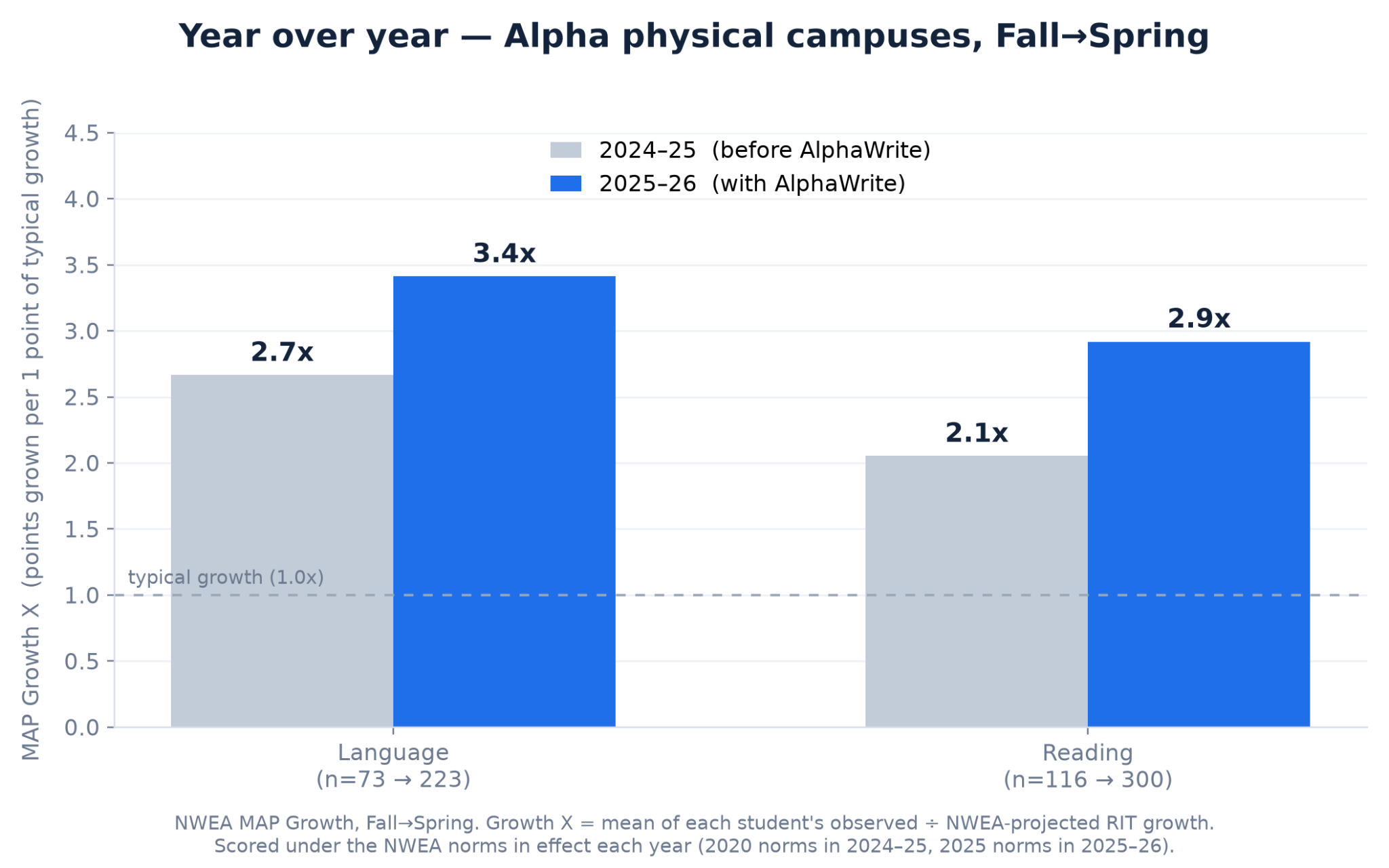
Last year, before students started using AlphaWrite, students grew 2.1x typical growth in reading and 2.7x in language.
This year, students who used AlphaWrite grew 3.6x in language and 3.3x in reading — compared with 1.8x and 2.2x for students at the same campuses who didn’t use it.
That means for every one point the average student at their grade level and percentile grew this year, our AlphaWrite students grew 3.6 points in language and 3.3 points in reading.
And in a world where most students simply type in a one-sentence prompt into a gen AI tool to write their essays for them, these results have become more and more significant.
However, despite all of my dunking on gen AI tools in this newsletter, I’m not anti-gen AI in general, but anti-gen AI as a shortcut around thinking. Alpha’s broader app stack, including AlphaWrite, is explicitly designed to use AI as a personalized tutor to scaffold their learning, not as an answer key.
In practice with AlphaWrite, that looks like:
AI surfacing targeted prompts that require students to build, fix, or improve sentences and paragraphs themselves.
AI diagnosing patterns (run-ons, weak topic sentences, vague pronouns) and coaching students through specific revisions, instead of simply rewriting their draft.
AI keeping the challenge level “just right” so students stay in that productive zone where effort turns into skill, instead of crossing into either overwhelm or coasting.
This is exactly how cognitive scientists say we should be using technology: to reduce unnecessary friction (slow feedback, inconsistent grading) while preserving the cognitive work that actually causes learning. This allows for students to have their brains activated just the right amount to keep them engaged in learning how to write, which increases their propensity to enjoy the process of writing.
The other aspect that AlphaWrite uses gen AI for is personalization. If kids only ever write five-paragraph essays about topics they don’t care about, they probably won’t be able to fall in love with writing (or, at the very least, it will be more difficult). So, Alpha pairs the sentence -> paragraph -> essay progression with both the ability to choose the topics they’re writing about and later during workshops to have creative, personally meaningful writing opportunities.
While they are working on writing mechanics, they’re able to pick the topics to write about. (For example, I love Harry Potter, Ironman, and the beach, so all of my writing lessons involve analyzing sentences about Harry, Ron, and Hermione, paragraphs about Ironman’s heroic exploits, or essays about the morality of taking seashells from the beach.)
And once students have mastered the mechanics, they use their new writing skills on things that matter to them, such as:
Social posts, scripts for videos, pitches for businesses, and even publishable articles.
Storytelling-heavy workshops where they build characters, construct narratives, and pitch ideas in non-writing contexts.
This allows their writing practice to be both strengthened grammatically and structurally in the morning, and creatively during workshops and individual projects. I believe it is that freedom to choose the topics they learn to write with and seeing the direct application that helps to build a love of writing. And once they have a love of writing, it’s easier to convince them to spend a few extra hours writing their literary analysis on their own instead of with ChatGPT.
That’s how to use AI to teach students how to write. Stay tuned for next week for my philosophy on why it’s important to know how to write when ChatGPT could write a better essay than I could in a fraction of the time.
Here’s a quick walkthrough of AlphaWrite:
Comments
Nothing yet. Say the first thing.
Sign in to join the conversation.