
This week from Austin Scholar...
The mainstream understanding of motivation is totally wrong
Scholar’s Sources: What I’ve been thinking about…
One year ago I published the most-replied-to edition of this newsletter I’ve ever written. The argument was that everyone, from educators to parents to researchers, along with basically every TED Talk from 2010 to 2020, has been telling the wrong story about motivation. Extrinsic motivation isn’t the villain. Waiting for your kid to “discover their love of learning” before giving them a real goal is a strategy for getting nothing done.
Most readers loved it, but some pushed back. And a handful sent me enough follow-up questions that I’ve spent the last few months going deeper into the research, so that’s what I want to talk about today.

Every conversation about motivation in schools eventually traces back to two experiments.
In 1971, psychologist Edward Deci had college students work on a puzzle. One group got paid $1 per session. The other didn’t. When the experimenter left the room, the paid students voluntarily spent less time on the puzzles (3.3 minutes on average, compared to 6.1 for the unpaid group). The headline: money kills motivation.
Two years later, at Stanford’s Bing Nursery School, researchers Mark Lepper, David Greene, and Richard Nisbett watched preschoolers who already loved drawing. Some were promised a “Good Player Award” (a certificate with a gold seal and red ribbon) for drawing. Others got the same award as a surprise afterward. Others got nothing. Weeks later, the kids who’d been promised the award drew for 8.59% of their free-choice time. Kids who got nothing? 16.73%.
Education saw those two numbers and ran with it. Teachers were told to avoid rewards. Programs that paid kids to read books got criticized for “corrupting” intrinsic motivation. An entire pedagogy was built on one study from 1973.
But the studies had a problem.
The expected-reward students got their prize for simply showing up, so there was no incentive to keep going once they had it. The extrinsic motivator was attached to attendance, not performance.
The reward was also a symbolic certificate, so not meaningful money or something the kid actually wanted.
This goes back to the Deci puzzle study too, which used one dollar to motivate college students. I obviously can’t speak for everyone, but as a college student myself, I wouldn’t spend a bunch of energy on a project for that ($7.50, adjusted for inflation).
Both studies tested the narrowest possible version of the question: what happens when you put a trivial, generic reward on top of something someone already does for free? That’s all the evidence the education world used to decide external motivation corrupts children.
But that conclusion didn’t hold up under any stress-testing whatsoever.
By 1994, researchers Judy Cameron and W. David Pierce reviewed 96 experimental studies and found that, across the literature, rewards don’t decrease intrinsic motivation. The only negative effect appeared under one specific condition: when expected tangible rewards were given for showing up, regardless of performance. That’s it. The problem was never “rewards.” It was lazy, participation-contingent, impersonal rewards that told a child the task was so trivial they needed to be bribed to do it.
The paper that actually settled the question came in 2014. Christopher Cerasoli, Jessica Nicklin, and Michael Ford published a meta-analysis in Psychological Bulletin covering 183 studies and 212,468 participants across school, work, and athletic domains. They asked something nobody had thought to ask: not whether extrinsic rewards replace intrinsic motivation, but whether both types work together to drive performance.
And they found that they do. Completely. Intrinsic motivation predicted performance even when extrinsic incentives were present. The two didn’t cancel each other out.
Self-Determination Theory, the most empirically validated motivation framework in psychology, developed by Deci and Ryan, is almost always summarized as “intrinsic motivation good, extrinsic bad.” That’s a misread.
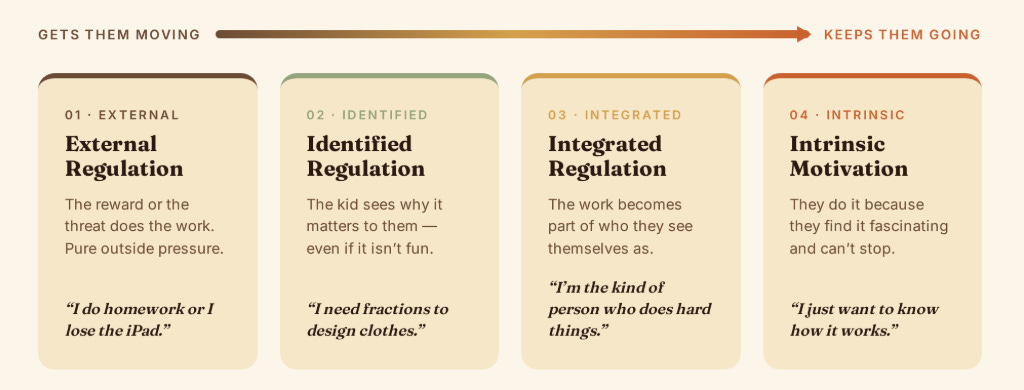
What Deci and Ryan actually argued is that motivation exists on a spectrum of internalization. On one end: pure external regulation, where your child does homework because they’ll lose the iPad if they don’t. On the other: genuine intrinsic motivation, where they do it because they find it fascinating and can’t stop.
But between those extremes are two zones most parents have never heard of. Identified regulation: the child understands why the task matters to them personally, even if it isn’t fun. “I don’t love fractions, but I need them to be a fashion designer.” That’s what my sister’s Guide told her when she was refusing to do fractions. He didn’t lecture her about the importance of math. Instead, he used what he knew about how she wanted to design clothes and made the connection in her terms.
Integrated regulation goes one step further: the work becomes part of how the kid sees themselves. “I’m the kind of person who does hard things.”
The external reward is what gets them moving, but the identity is what keeps them going. They don’t compete; one creates the conditions for the other.
David Yeager (a psychology professor at UT Austin and author of 10 to 25: The Science of Motivating Young People) takes these ideas into biology.
His research found that around age ten, puberty rewires the brain to become acutely sensitive to social rewards: status, admiration, respect. An adolescent who seems to care more about looking competent in front of peers than about the content itself isn’t being shallow. They’re being driven by a brain calibrated for social recognition.
That matters for the rewards debate in a way that doesn’t come up enough. External recognition from someone a teenager actually respects, like a Guide who knows their goals and their struggles, might be the most motivating thing that exists.
Yeager also found something he calls purpose beyond self: when students connect their work to something larger than their own grade (such as their family, a future they’re building, or people they want to help) they show stronger academic self-regulation and deeper processing of material. It’s not purely intrinsic motivation. It’s not purely extrinsic. Purpose is its own category, and it’s one of the best predictors of persistence the research has turned up.
That’s exactly what the Alpha model is built around, even if nobody there is citing Deci and Ryan by name.
Alpha School has an in-school store called the Emporium.
Students earn a school currency called Alphas for academic progress, hitting goals, showing up consistently, and performing well. Then they spend them at the Emporium on things like snacks, privileges, small prizes, and stuffed animals.
And because Alpha’s Guides spend almost no time on lesson planning, they pour that time into figuring out what each individual kid actually cares about. What would make this child want to push harder? What does this one find embarrassing to fail at? What does this one light up about? The Guides then stock that item in the Emporium, buy tickets to that experience, or talk with parents about coming to have lunch with their kid if they meet their weekly goals.
Alpha also pays students money for academic performance.
Score 100% on a grade-level test? That’s $100. Hit the 99th percentile nationwide on the MAP assessment for your grade? $1,000.
When most educators hear this, they immediately invoke the overjustification effect and claim that paying kids to learn will destroy their love of learning. The research doesn’t support that concern for performance-contingent rewards. And the lived experience at Alpha doesn’t either.
What the research actually predicts is something closer to what I’ve watched happen. My sister is the clearest example. She wasn’t drawn to academic learning the way I was. Without some kind of external pull, she’d do the minimum. But with the right incentive tied to something meaningful and a performance standard she had to hit, she accomplished things she didn’t believe were possible. The $1,000 MAP goal didn’t replace her internal drive. It brought it out of her. She worked hard enough to discover she was actually capable of high-level math. Once she knew that, the capability became part of her identity. The external motivation and the internal motivation were building on each other, exactly the way Cerasoli’s meta-analysis describes.
The Guides at Alpha understand this intuitively. They know some kids are motivated by money, some by social time with friends, some by unlocking a specific privilege, some by the challenge itself. The job of a Guide is to figure out which one, and then connect that pull to a performance standard worth reaching.
1. Purpose-linking
When your kid is resisting something, don’t argue about whether it matters. Ask them what they want to be able to do someday. Then pull the thread. Fractions lead to scaling patterns that lead to designing clothes. Fractions lead to calculating distances and understanding maps that lead to the trip they want to take. Keep going until you hit something they care about in their gut.
2. Make the reward meaningful
A sticker chart tells a kid their work is worth a sticker. A real reward tied to a real performance standard tells them their work is worth taking seriously. Think about what your child actually wants (not what you think they should want) and connect it to a specific goal they have to earn. A $100 payout for mastery looks irresponsible until you watch a kid who didn’t believe she was good at math spend six months proving otherwise.
3. Replace “good job” with something specific
“Good job” is honestly pretty meaningless. “You tried a completely different approach when the first one failed and that’s actually hard to do” is valuable. A 1999 Deci meta-analysis (separate from his 1971 puzzle study, this one looked across 128 experiments) found that positive feedback enhances intrinsic motivation by a larger effect size than most of the negative effects from tangible rewards. We’ve spent so long worrying about what not to do that we missed what actually works: telling a kid exactly what they did that was worth doing.
I read a fascinating essay on AI in mathematics this week and wanted to share it along with the original piece that inspired it:
New Mathematical Workflows & A New Consciousness of Mathematics
I’ll start by summarizing the first essay, then move to the second. The most decorated mathematician alive breaks proof-writing into three stages: generation (come up with the argument), verification (confirm it’s airtight), and digestion (turn it into something a human can understand, teach, and build on). AI is racing through the first two; digestion, he says, stays “subjective and human-paced.” He has essentially handed us a map of which thinking makes sense to outsource and which doesn’t. Generation and verification are the “did you get the right answer” steps and are increasingly automatable. Digestion is the “can you explain it, connect it, teach it to someone else” step, and that’s the one that builds a real learner.
Another Stanford math student took that and explained how AI is getting frighteningly good at the parts of math that have a clear right answer (generating a proof, checking if it’s correct), but isn’t making much progress on the part that turns an answer into understanding. This is the exact tension playing out in all math classes right now, not just the ones at university-level. She also explains how “getting it done” and “getting it” have become two different activities, and that traditional school still mostly measures the first one.
Honestly this conflicts a lot with how I think about using AI backed in learning science to teach math, but it’s interesting food for thought, and you know me, I love interesting ways of thinking about mathematics.
Thanks for reading. Go crush the week! See y’all on Sunday.
No posts
Comments
Nothing yet. Say the first thing.
Sign in to join the conversation.