
This week from Austin Scholar...
How to talk to your kid about their education
Your concrete next steps
I have an incredibly exciting announcement for y’all: I am officially working at Alpha New York! I’m so lucky to be interning under the head of all Alpha Schools (Dr. Tasha Arnold). In my role I get to do a little bit of everything: helping to create programming, talk to parents, and, of course, spend time with the kids. This past week has been one of the most exhausting yet rewarding weeks of my life and I look forward to having conversations with the kids about my favorite mathematicians, how to write a book, and everyone’s favorite type of squishy. I’m so, so, so grateful to have this job and work with the New York Guides and families for the next few months. I can’t wait to share my learnings with y’all!

When I was in middle school at Alpha and struggling to find motivation to work on math, my guides didn’t talk to me about my education the way most parents and teachers talk to kids. They didn’t say “you need to work hard so you can get into college.” They didn’t bribe me with grades. They didn’t threaten consequences if I fell behind. Instead, they’d pull up a chair next to me and ask: What do you actually want to get good at? What does your ideal life look like? What are you working toward?
Those conversations changed everything about how I showed up to learn. And I’ve spent a lot of time since then trying to understand why those questions landed so differently than the lectures I’d heard before. Turns out, there’s a lot of science behind it.
If you’ve ever tried to motivate your child to care about school and hit a wall (think: the eye rolls, the “I don’t care,” the passive compliance that disappears the second you stop watching) this one’s for you. Because the problem usually isn’t your kid. It’s the conversations you’re having.
There are two books that play a foundational role in the Alpha philosophy, and I couldn’t recommend them more. The first is The Self-Driven Child by William Stixrud and Ned Johnson. The second is 10 to 25 by David Yeager. They agree on something fundamental, which I think is critical to understand before you have any conversations about anything with your kids: the importance of autonomy.
Research on motivation has suggested that a strong sense of autonomy is the key to developing the healthy self-motivation that allows children and teens to pursue their goals with passion and to enjoy their achievements. Stixrud and Johnson found this in their work with thousands of students: the kids who were most stressed and least motivated weren’t lazy – they were kids who felt like they had no control over their own lives.
A hard thing for parents to realize is that trying to control a child has really negative effects on motivation. According to self-determination theory, humans have three basic needs: a sense of autonomy, a sense of competence, and a sense of relatedness. Autonomy is built into our wiring. When we lack this basic need, we experience decreased motivation, and the motivation that remains becomes fear-based.
In other words, every time parents push harder, nag more, or threaten consequences, they’re often making the problem worse instead of better.
Yeager adds another layer to this. Around age ten, puberty spurs the brain to crave socially rewarding experiences, such as pride, admiration, and respect, and to become highly averse to social pain, such as humiliation. Because of this, the way you talk to your child about education can be super neurologically loaded. Every conversation is being scanned, underneath the surface, for: Does this person respect me? Do they think I’m capable? Are they on my side?
Both books converge on the same solution, just from different angles. Stixrud and Johnson call it becoming a “consultant” to your child rather than a manager. Yeager calls it the mentor mindset. Understanding these approaches, and how they differ from the default approaches of “pushing your kids harder” or “cutting them some slack,” is really important if you want to have conversations with your kids that actually work.
Yeager describes a simple framework with two axes: standards and support. Most parents live in one of two problematic quadrants.
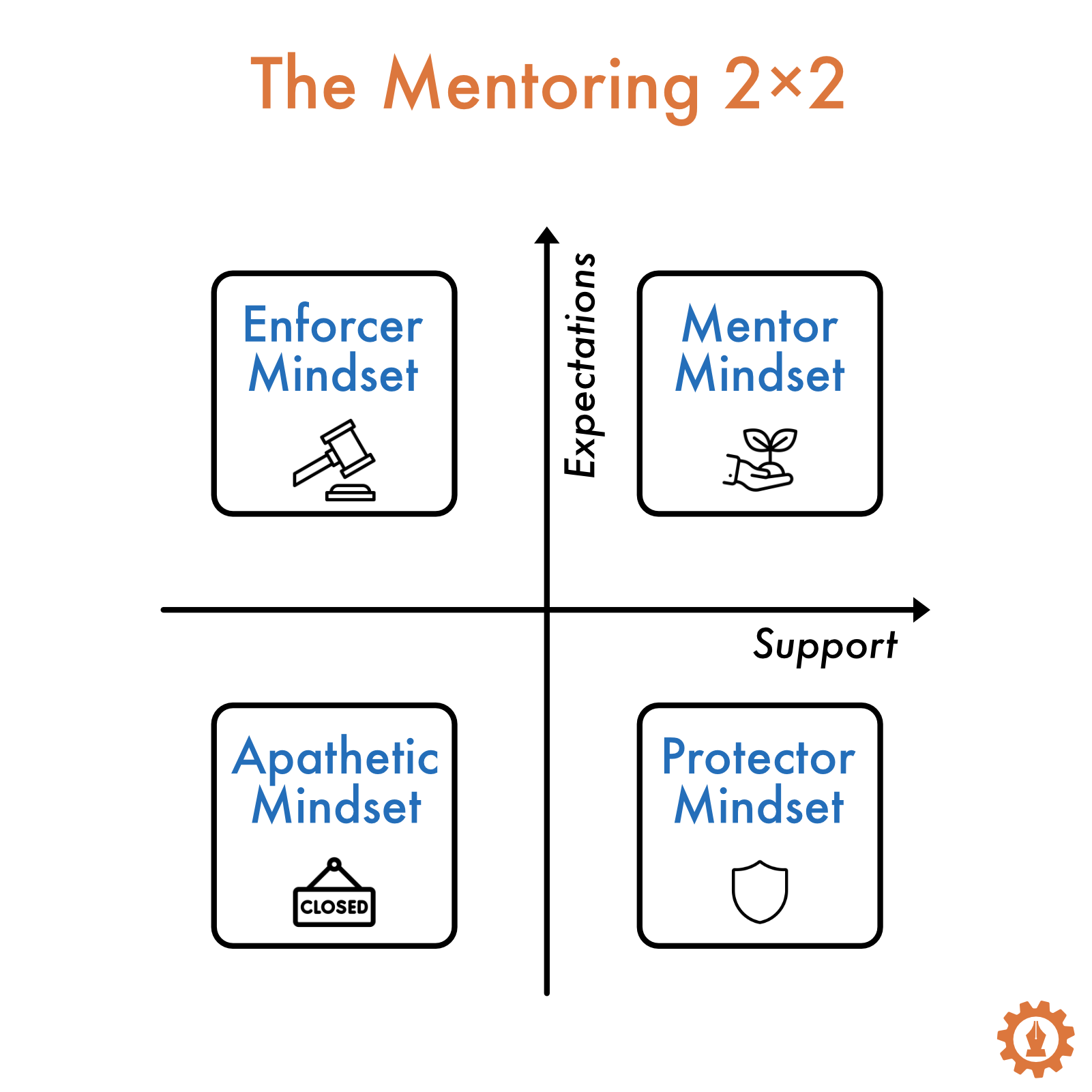
The first problematic archetype is the Enforcer Mindset (High Standards, Low Support). This is the tough coach who demands excellence but offers little guidance on how to achieve it. Enforcers believe young people respond primarily to pressure and consequences. While this approach may produce short-term compliance, it generates long-term resentment and disengagement.
Sound familiar? This is the parent who says “you need to study harder” without asking what’s actually making studying hard. It’s the parent who responds to a bad grade with frustration rather than curiosity. The enforcer isn’t wrong that high standards matter, but they need to realize that standards without support feel like a trap, not an invitation.
The other most common archetype is the opposite of the Enforcer. The Protector Mindset gives high support but has low standards. Protectors believe young people are too fragile to handle challenges. While well-intentioned, this approach communicates a fundamental lack of respect for young people’s capabilities.
This is the parent who doesn’t want to “put too much pressure” on their kid, so they stop expecting much at all. The problem is that lowered expectations send a quiet but devastating message: I don’t think you can handle this. Kids feel that. They internalize it.
The Mentor Mindset (High Standards, High Support) is the sweet spot where expectations remain challenging but are matched with the resources, guidance, and emotional backing needed to meet them. Mentors believe in young people’s potential while acknowledging their need for guidance.
This is the target. High standards and high support, together. Not one or the other.
One of the most striking studies in Yeager’s book involved middle school writers given feedback on an essay. Some students got standard teacher comments. Others got the same comments plus one additional sentence: “I’m giving you these comments because I have high standards, and I know that you can meet them.” Students were twice as likely to turn in a revised, improved essay when the comments were accompanied by this “wise feedback.” The researchers were able to address the core fear that young people have when someone who has power over them critiques their work.
One sentence changed their entire mindset: I believe you can.
The principles stay the same across K–12, but the execution shifts pretty meaningfully. Here’s how to adapt the mentor mindset to each stage of development.
Elementary School (K–5)
At this age, kids are forming their very first beliefs about whether they’re “good at school” or not. The goal isn’t to spend time lecturing them about the importance of education; instead it’s to help them associate learning with agency and curiosity, not compliance and performance.
To help children develop self-discipline and inner drive, encourage them to follow their own interests, letting them choose their own challenging activities. That means your conversations at this stage should be less about outcomes and more about process and choice.
Some conversation starters:
Instead of: “You need to read every night.” Try: “You get to pick what we read tonight. What sounds interesting to you?”
Instead of: “Why did you get that wrong?” Try: “That’s a tricky one. What did you try first? Let’s figure it out together.”
Instead of: “You have to do your homework.” Try: “What would help you focus right now: quiet, music, a snack first?”
The small transfer of control is massive for this age group. You’re building the neural association that learning is something they do, not something done to them.
Middle School (6–8)
This is where things can get pretty hard. The “10 to 25” in the title refers to the age range during which puberty-linked changes in the brain start to cause the palpable status anxiety we see in teens. Young people’s longing for prestige is a kind of social currency they gain through impressive acts.
What that means practically: your middle schooler is constantly, subconsciously asking “does caring about school make me look dumb, weak, or uncool?” Any approach that puts them in a box, or makes their self-worth contingent on academic performance, will trigger resistance. Hard.
The research on stress is particularly surprising. People are convinced that a kid’s level of stress is always a bad thing. But sometimes being a mentor means being tough and causing distress, and then helping the child interpret that stress as a sign that they’re doing something important and meaningful.
The goal at this stage is to reframe hard work as identity-affirming, not identity-threatening. I also recommend that you ask more than you tell because questions signal respect in a way that statements can’t.
Some conversation starters:
Comments
Nothing yet. Say the first thing.
Sign in to join the conversation.