
Detained immigration courtrooms are one of the least empirically studied spaces in the entire immigration enforcement system. Most of what happens inside them remains a mystery. Although these hearings are technically open to the public, physical access alone is becoming increasingly difficult, and making sense of a proceeding takes more than a warm body in a seat. It takes training and experience to identify and contextualize what you are watching. Those hurdles only grow at hearing locations embedded inside a detention facility, which adds another layer of difficulty to transparency and research.
For six months, student researchers with the University of Denver’s Court Transparency Project sat inside the detained immigration courtroom in Aurora and wrote down what they saw. They observed roughly 450 initial hearings and 111 bond hearings, turned their observations into data, and are now in the process of publishing their findings online and extending their research into the new academic year.
Their findings help us understand the unique challenges of immigrants who are in removal proceedings while also being held in civil custody. Among the people who filed for relief, not a single person won. Judges declined to set bond in nearly three out of four bond hearings the students attended. Necessary Department of Homeland Security paperwork was often missing from case files.
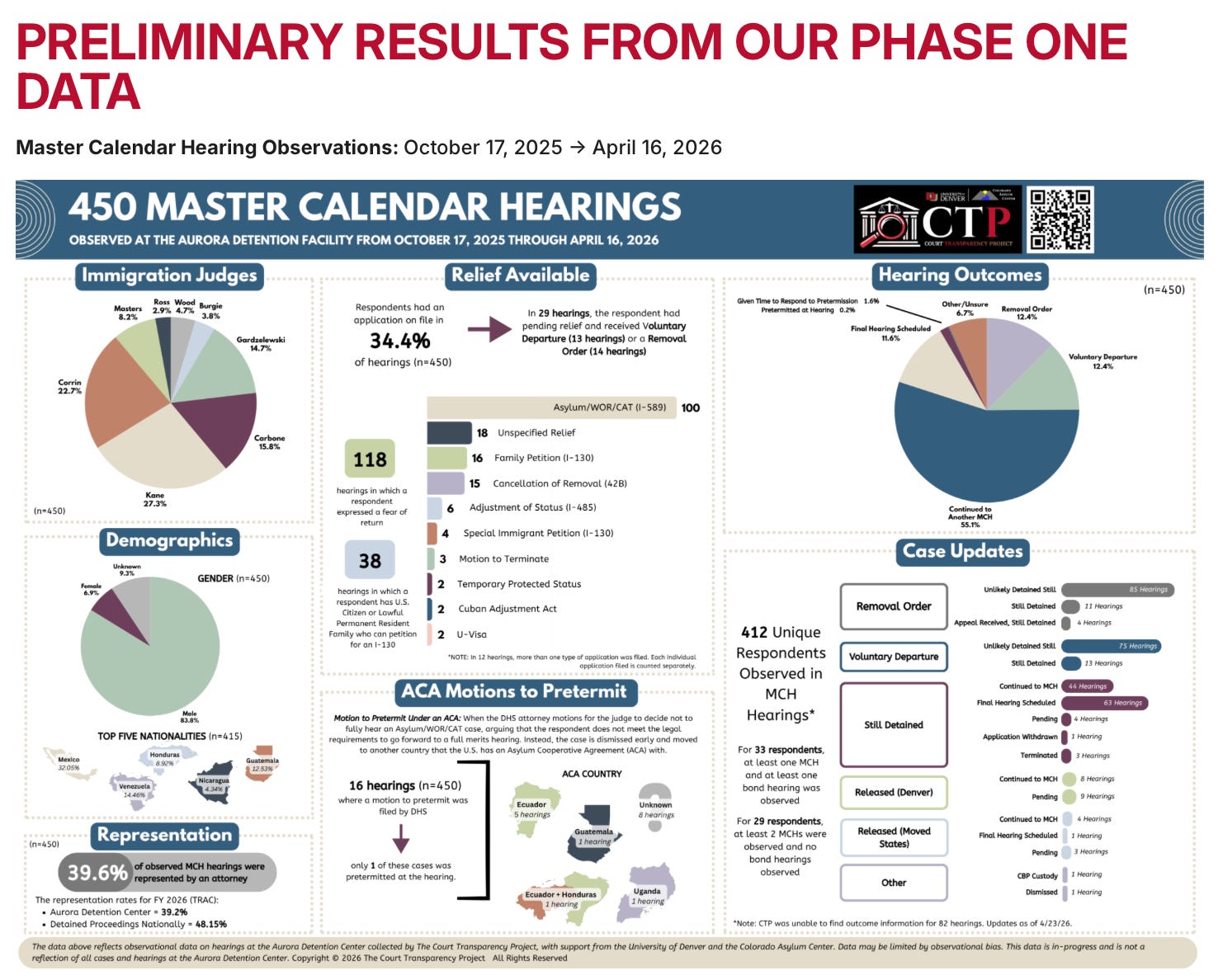
Ella Iveslätt and Rebecca Galemba already wrote about their findings in a blog post for César García Hernández’s Immigration Law Unhinged. They show how immigration judges use a finding of “no jurisdiction” to deny bond, keep people detained, and press them toward voluntary departure. The latest Tenth Circuit ruling may begin to change that calculus for people held in Colorado, which makes this a good moment to look closely at what the students have documented from inside the room.
To learn more about what they found and how they conducted the research, I’m hosting a live conversation with Dr. Rebecca Galemba, Ella Iveslätt, and members of the student research team from the DU Court Transparency Project on Tuesday, July 28 at 1:00 PM Eastern. We’ll talk about what six months of courtroom observation revealed, how mandatory detention is reshaping who gets a real hearing, and what students can contribute to public transparency around immigration enforcement. Please join us, and bring your questions!
Dr. Rebecca Galemba is a professor at the Josef Korbel School of Global and Public Affairs at the University of Denver and co-director of the DU Center for Immigration Policy and Research. She leads the Court Transparency Project and the DU Just Wages Project, and she is the author of Laboring for Justice: The Fight Against Wage Theft in an American City. Her research pairs long-term fieldwork with community partnership, and this project extends that approach into the immigration courtroom.
Ella Iveslätt is the project manager and lead research assistant for the Court Transparency Project and a graduate of the University of Denver. She built the project’s quantitative database and its public data dashboard, and she wrote an award-winning undergraduate thesis on how address errors in immigration court can derail a case.
Do you have questions for Rebecca and Ella? Leave them in the comments below and I’ll do my best to bring them into the conversation.
This newsletter, and events like this one, are only possible because of reader support. If you value independent, data-driven coverage of immigration enforcement, please consider subscribing or upgrading to a paid subscription.
Feel free to use the following social media cards to help announce and promote the event.
Comments
Nothing yet. Say the first thing.
Sign in to join the conversation.