
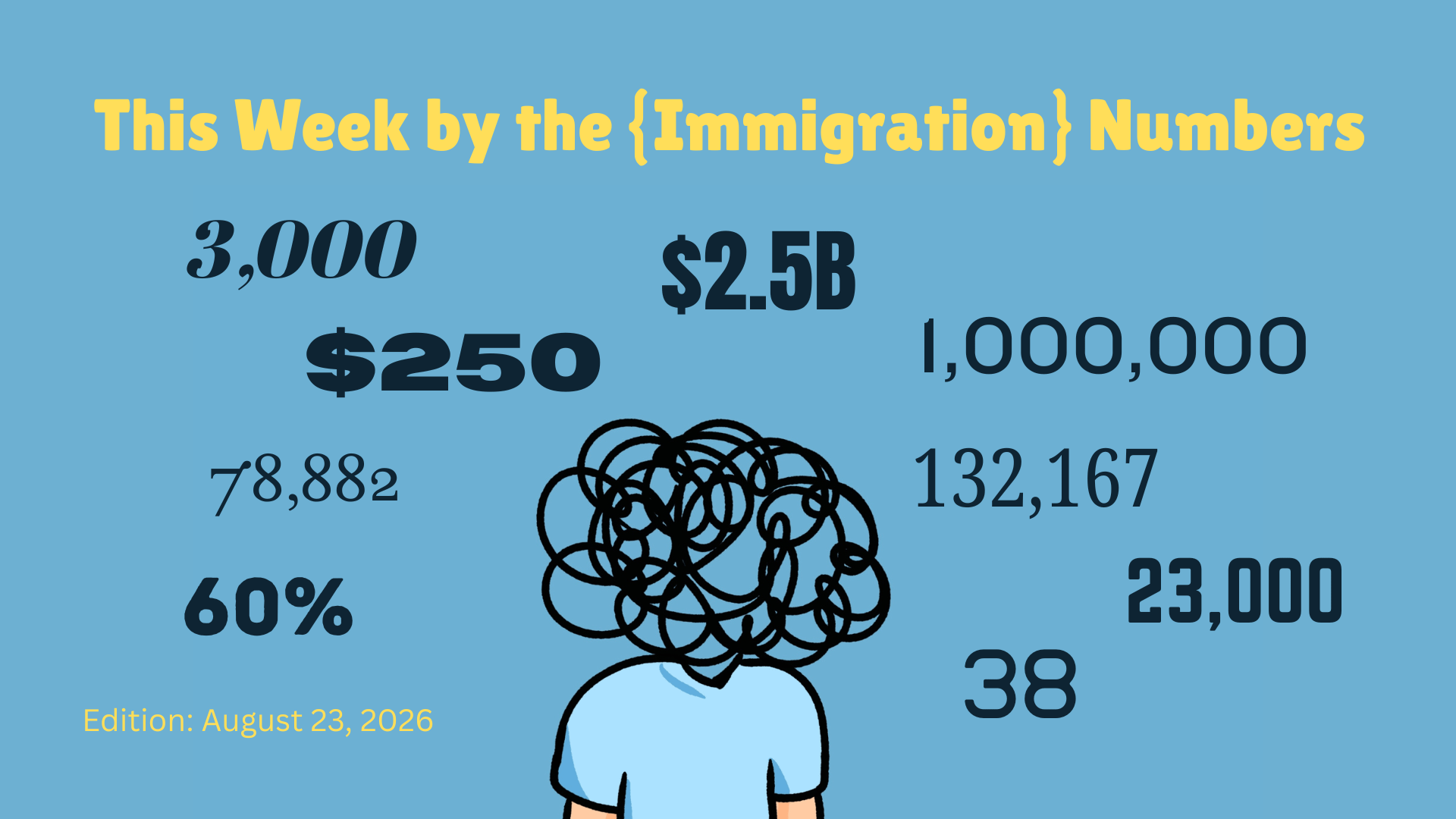
Welcome to the weekly segment called This Week by the {Immigration} Numbers. I’ll highlight some of the main takeaways from the week’s news that you might have missed, but do it in a unique way. Rather than try to summarize everything, I’ll pick a handful of figures each week that best capture where things are moving, explain why they matter, and provide a source where you can learn more. If you have a number to add to the mix or have a question about any of the numbers here, let me know in the comments.
You can keep up with the data between editions on Bluesky, X, Instagram, Threads, LinkedIn, Mastodon, and Facebook.
The number of Temporary Protected Status holders whose protection this administration has ended or moved to end, out of roughly 1.3 million who had it.
Pew counted 1,044,700 people in that position as of August 12, measured against the 1.3 million who held TPS in March 2025, the last month with public data. The tally comes from the beneficiary estimates the Department of Homeland Security publishes in its own Federal Register termination notices, covering thirteen designations. Venezuela accounts for 616,400 of them across two designations, and Haiti for 334,900. Four countries still hold a designation that is not being wound down, El Salvador, Lebanon, Sudan and Ukraine, covering about 273,200 people. Two others, Ethiopia and Somalia, were protected only by court orders, and district judges dissolved both in the week after Pew published. Losing the status strips the work permit and the protection from removal on the same day, and it orders nobody deported by itself, so what it produces first is a large population living and working without authorization.
Im, C., & Hennen, M. (2026, August 12). Second Trump administration has ended Temporary Protected Status for most immigrants who had it. Pew Research Center.
The top of the sales decline one Brooklyn restaurant owner reports since Temporary Protected Status for Haiti ended.
Wesly Simon, who owns Djon Djon in Brooklyn’s Little Caribbean neighborhood, told Documented that sales have fallen 40 to 60 percent and that the decline is accelerating, after he lost about half his staff when the Haitian designation ended in late July. Those percentages are his own estimate and not an audited figure. A second Haitian restaurant owner described the same problem to the same reporter. The Supreme Court cleared the way for the termination in June, holding that the Homeland Security secretary’s judgment about ending a designation is not subject to judicial review on non-constitutional grounds. A restaurant that loses half its kitchen cannot replace it from the same neighborhood, because the neighborhood is where the terminated status was concentrated.
Thomassaint Joseph, R. (2026, August 10). New York Restaurants Struggle to Stay Open as Haiti TPS Ends. Documented.
The number of people the United States has sent to countries that are not their own since January 2025.
Human Rights First and Refugees International count more than 23,000 forced transfers to 26 third countries between January 20, 2025 and August 15, 2026, assembled from transparency requests, on-the-ground sources, and public reporting. Nearly 20,000 of those went to Mexico, with more than 2,700 to other countries in Latin America and the Caribbean, more than 330 to countries in Africa, and more than 200 elsewhere. The transfers run on more than 35 bilateral agreements signed since January 2025, most of which have never been published, and the two organizations have traced $44 million in U.S. funding attached to them. Liberia agreed this week to accept up to 1,200 people, and the first twenty arrived on August 20. The count leaves out removals that merely stop over in a third country and ad hoc transfers on commercial flights, so this is a floor.
Human Rights First & Refugees International. (2026, August 18). Human Rights First and Refugees International Third Country Deportation Watch Details the Expanding Scope and Toll of Third Country Transfer Agreements. Human Rights First.
The top of the bed range the government is asking contractors to be ready to supply for detained migrant children.
The Office of Refugee Resettlement told vendors at a market research roundtable in mid-August that it wants emergency influx facilities, sited anywhere in the country, holding between 100 and 3,000 beds, with individual task orders likely covering about 1,000 each. No site has been chosen and no contractor named. The agency aims to award by December 31 and to have facilities operating within 90 days of the award. Reported design details include an eight-foot fence and rooms holding eight children who share one toilet, shower and sink. The plan surfaced a day after Judge Dolly Gee appointed a special master and an independent medical monitor over compliance with the Flores settlement, having found that the average detention of children exceeded twenty days for five consecutive months, with individual stays of 50, 91 and 323 days.
Billings, A. (2026, August 21). Trump administration plans new facility to house 3,000 migrant kids. Many of them lack legal representation. Reason.
The number of days Ana Kikabidze’s two children had been detained when she gave up their case and accepted deportation.
Kikabidze and her children, aged 11 and 14, held green cards the family won in the 2013 visa lottery. She was detained on arrival at Chicago O’Hare in May after 229 days abroad, roughly six weeks past the limit on time away, and the three of them were moved to the Dilley facility in Texas on May 17. An immigration judge ordered them removed during a video call and told her that appealing would mean months more in custody. She had spoken with her lawyer once, by phone, the day before that hearing. She withdrew the appeal when the children had been held 38 days, and the family was deported on July 13, 58 days after they were taken in. ICE returned their unexpired green cards on the way out. More than 66,000 parents and children have been detained and deported since 2025, and in July more than half the children at Dilley had been held past the twenty days the Flores settlement allows even during a surge.
Villagran, L. (2026, August 18). Parents are giving up green card fights to get their kids out of immigrant jail. The Marshall Project.
The number of asylum applications USCIS expects to send to immigration court each year without ever interviewing the applicant.
A rule published on July 28 allows asylum officers to refer an affirmative application straight to a judge with no interview in four situations, when the applicant is barred from applying for asylum, barred from a grant, does not merit a grant as a matter of discretion, or is not eligible on the merits. It also removes the regulatory language describing an interview as a right. USCIS estimates 132,167 such referrals a year going forward and says as many as 444,724 pending applications may be affected. On August 19, four organizations sued in federal district court in Washington to vacate the rule, arguing that the department issued it without notice and comment, and no ruling has issued. The interview is where a person explains a late filing or a gap in the record, and removing it moves that explanation into a court where most cases completed in June ended with the person not in the room.
Orozco, A. (2026, August 5). New USCIS Asylum Interview Rule Could Speed Up Deportations of Asylum Seekers. American Immigration Council.
Center for Gender & Refugee Studies. (2026, August 19). Immigrant Rights Groups Sue to Protect Due Process for Asylum Seekers. Center for Gender & Refugee Studies.
The number of removal orders immigration judges issued in June, the highest monthly total in TRAC’s records.
Judges issued 78,882 removal orders in June, up from 58,339 in May after three months of flat numbers, with voluntary departure orders adding another 7,689. Total case completions reached 100,773, the first month above 100,000. About 68 percent of June’s removal orders were entered in absentia, meaning the person was not present when the case ended, up from 53 percent in March. Removal orders accounted for roughly 78 percent of all completed cases that month. The in-absentia share rose fifteen points between March and June, so most of what this record month added was orders entered against people who were not in the room.
TRAC. (2026, July 21). Removal Orders Jump While Immigration Court Closures Top 100,000 in June 2026. Transactional Records Access Clearinghouse.
What ICE obligated in contract awards in July, its largest month of the year.
Roughly $1.5 billion of that went to buying two CoreCivic detention centers outright, the 2,560-bed California City facility in Kern County for $732.6 million and the 1,994-bed Otay Mesa center in San Diego for $739.2 million. CoreCivic keeps operating both under its existing management contracts, through August 2027 at California City and December 2029 at Otay Mesa. New GEO Group contracts for sites in Colorado and North Carolina add more than 2,500 beds between them. The agency also obligated more than $30 million on body cameras, following a $20 million appropriation in April. Owning a building the seller continues to run removes the annual question of whether to renew a lease and leaves only the operating contract to renew.
Knepp, E., Wriston, M., & m. (2026, August 14). Follow the Money - July 2026: ICE Spends Year-High $2.5 Billion, Driven by Detention Expansion. Project Salt Box.
What ICE proposes to pay each local officer per year so they can carry liability insurance for making immigration arrests.
A planning document published on August 14 outlines reimbursing participating officers up to $250 annually, roughly the expected cost of a policy covering up to $500,000 in personal liability. Officers would buy the policies themselves, and a contractor hired by ICE would handle outreach, training and reimbursement. The program attaches to 287(g), the partnership under which nearly 1,600 agencies across 32 states now carry out immigration enforcement, and where arrests have run about 3,000 a month in early 2026 against roughly 250 a month in 2024. David Bier of the Cato Institute said ICE is going above and beyond to guarantee law enforcement does not have even the slightest risk of liability for violating Americans’ rights while helping ICE arrest people.
Foley, R. J. (2026, August 17). ICE pitches legal insurance to help shield local officers who make immigration arrests. Associated Press.
I’m honored that this Substack continues to drive media reporting, research, and public debate, but it does take effort and expense. If you can pitch in a few bucks a month or year, it would help enormously. Find an option that fits your budget at austinkocher.substack.com/subscribe.
Comments
Nothing yet. Say the first thing.
Sign in to join the conversation.