
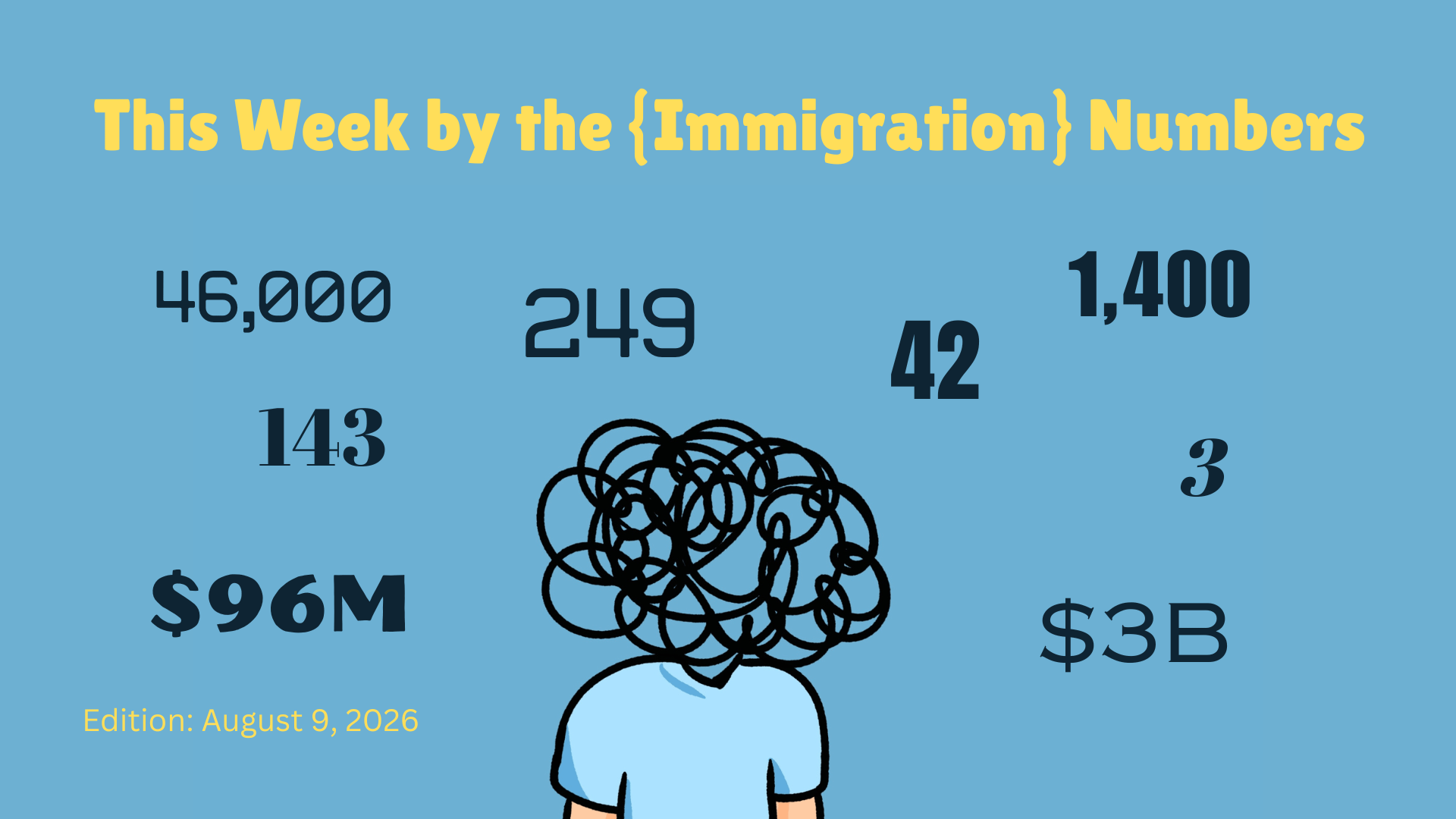
Welcome to the weekly segment called This Week by the {Immigration} Numbers. I’ll highlight some of the main takeaways from the week’s news that you might have missed, but do it in a unique way. Rather than try to summarize everything, I’ll pick a handful of figures each week that best capture where things are moving, explain why they matter, and provide a source where you can learn more. If you have a number to add to the mix or have a question about any of the numbers here, let me know in the comments.
I am including social-media-ready images and explanations for each of the data points so that you can help spread this information beyond Substack. You can keep up with the data between editions on Bluesky, X, Instagram, Threads, LinkedIn, Mastodon, and Facebook.
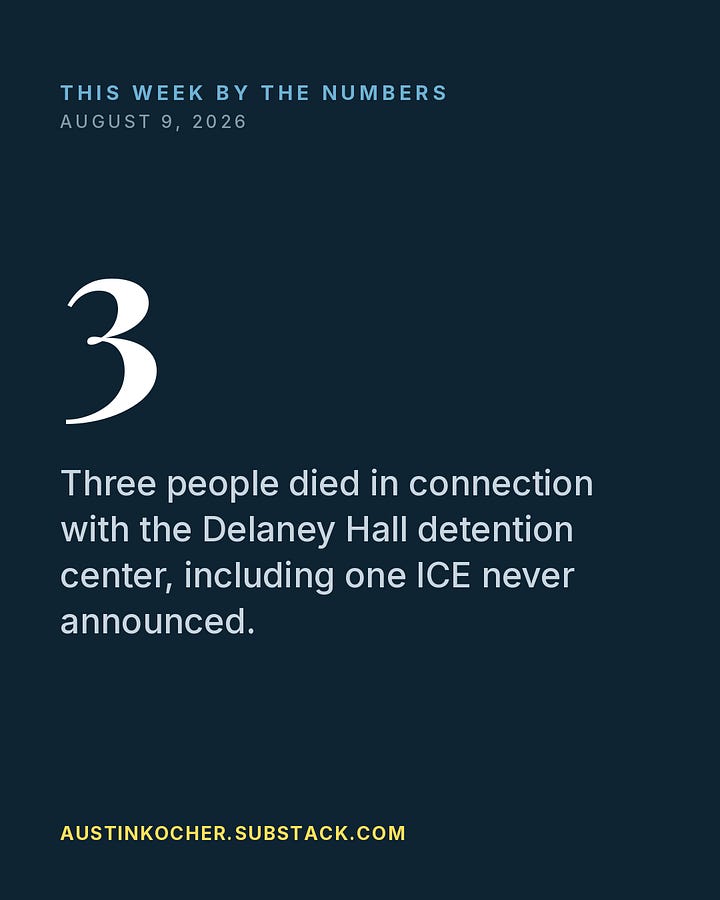
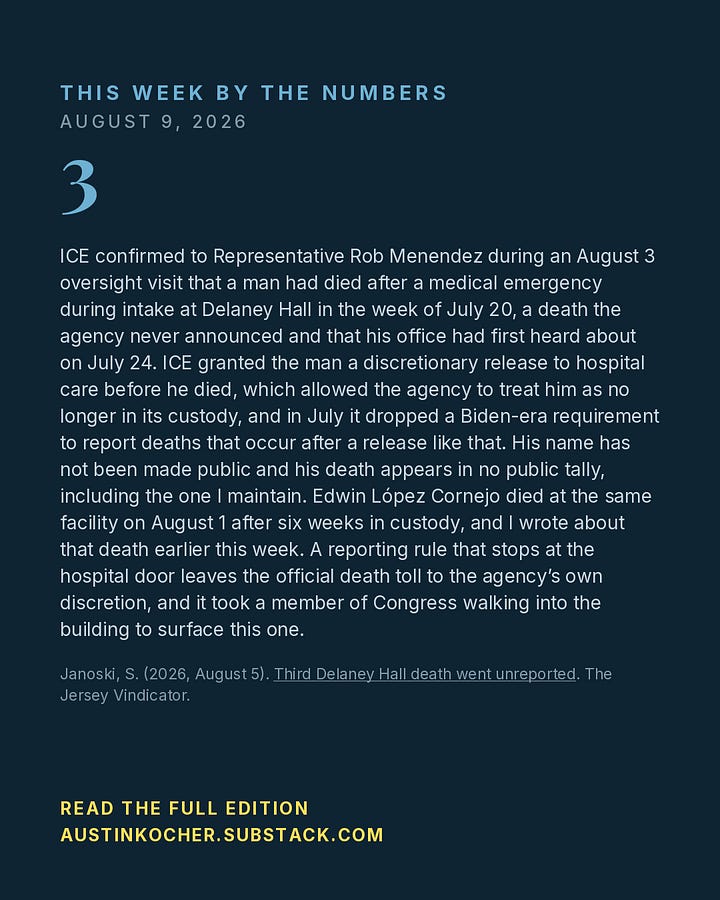
Three people died in connection with the Delaney Hall detention center, including one ICE never announced.
ICE confirmed to Representative Rob Menendez during an August 3 oversight visit that a man had died after a medical emergency during intake at Delaney Hall in the week of July 20, a death the agency never announced and that his office had first heard about on July 24. ICE granted the man a discretionary release to hospital care before he died, which allowed the agency to treat him as no longer in its custody, and in July it dropped a Biden-era requirement to report deaths that occur after a release like that. His name has not been made public and his death appears in no public tally, including the one I maintain. Edwin López Cornejo died at the same facility on August 1 after six weeks in custody, and I wrote about that death earlier this week. A reporting rule that stops at the hospital door leaves the official death toll to the agency’s own discretion, and it took a member of Congress walking into the building to surface this one.
Janoski, S. (2026, August 5). Third Delaney Hall death went unreported. The Jersey Vindicator.
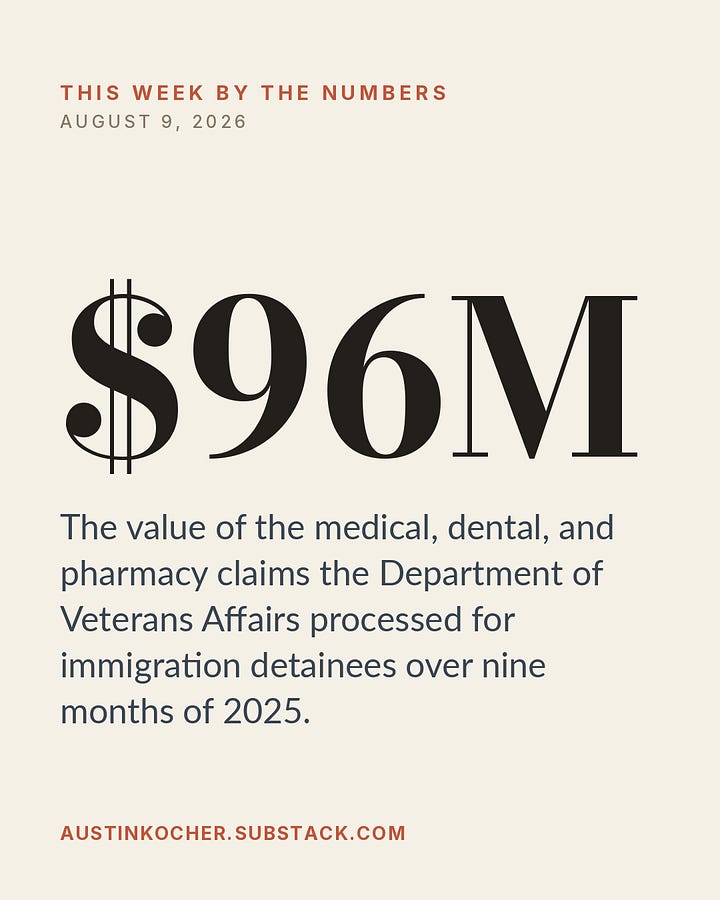
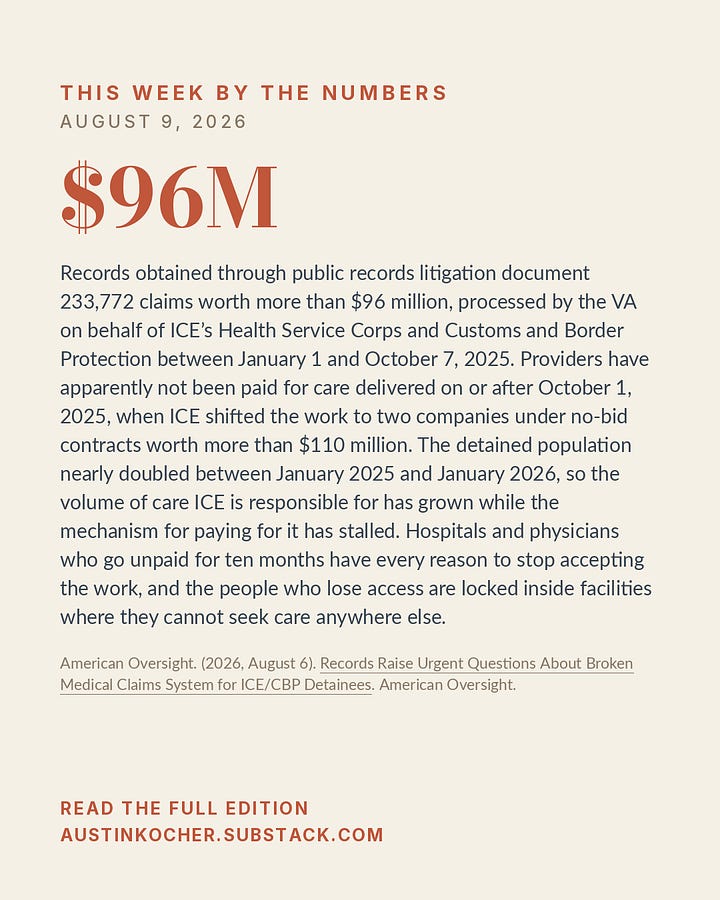
The value of the medical, dental, and pharmacy claims the Department of Veterans Affairs processed for immigration detainees over nine months of 2025.
Records obtained through public records litigation document 233,772 claims worth more than $96 million, processed by the VA on behalf of ICE’s Health Service Corps and Customs and Border Protection between January 1 and October 7, 2025. Providers have apparently not been paid for care delivered on or after October 1, 2025, when ICE shifted the work to two companies under no-bid contracts worth more than $110 million. The detained population nearly doubled between January 2025 and January 2026, so the volume of care ICE is responsible for has grown while the mechanism for paying for it has stalled. Hospitals and physicians who go unpaid for ten months have every reason to stop accepting the work, and the people who lose access are locked inside facilities where they cannot seek care anywhere else.
American Oversight. (2026, August 6). Records Raise Urgent Questions About Broken Medical Claims System for ICE/CBP Detainees. American Oversight.
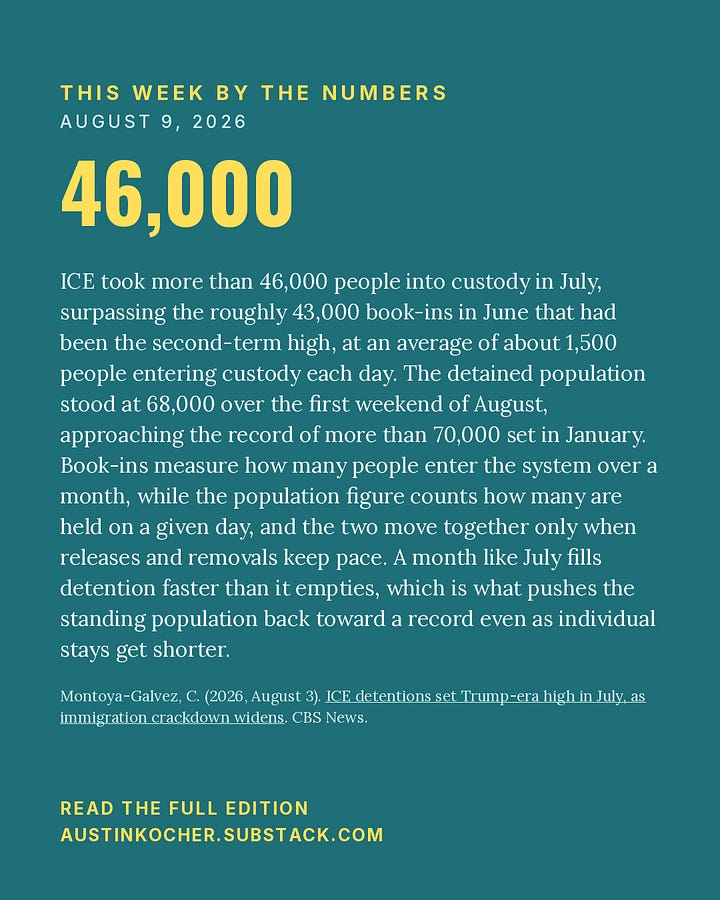
The number of people ICE booked into detention in July, the highest monthly total of this administration.
ICE took more than 46,000 people into custody in July, surpassing the roughly 43,000 book-ins in June that had been the second-term high, at an average of about 1,500 people entering custody each day. The detained population stood at 68,000 over the first weekend of August, approaching the record of more than 70,000 set in January. Book-ins measure how many people enter the system over a month, while the population figure counts how many are held on a given day, and the two move together only when releases and removals keep pace. A month like July fills detention faster than it empties, which is what pushes the standing population back toward a record even as individual stays get shorter.
Montoya-Galvez, C. (2026, August 3). ICE detentions set Trump-era high in July, as immigration crackdown widens. CBS News.

The number of beds ICE plans to create at a shuttered federal prison in North Carolina, which would make it one of the largest immigration jails on the East Coast.
Internal ICE documents show the agency intends to reopen Rivers Correctional Institution in North Carolina by the end of the year with 1,400 beds. GEO Group pitched the site months ago on the argument that its rural setting offers a secure operational environment with minimal community disruption. Reopening a prison moves faster than building a facility from scratch, and it inherits a physical plant designed for criminal punishment rather than civil detention, which is the legal category immigration detention occupies. Rural placement also puts distance between a detained person and an attorney, and that distance shapes how a case turns out long before a judge hears any of it.
Lartey, J. (2026, August 1). ICE Is Trading Warehouses for Old Prisons. The Marshall Project.


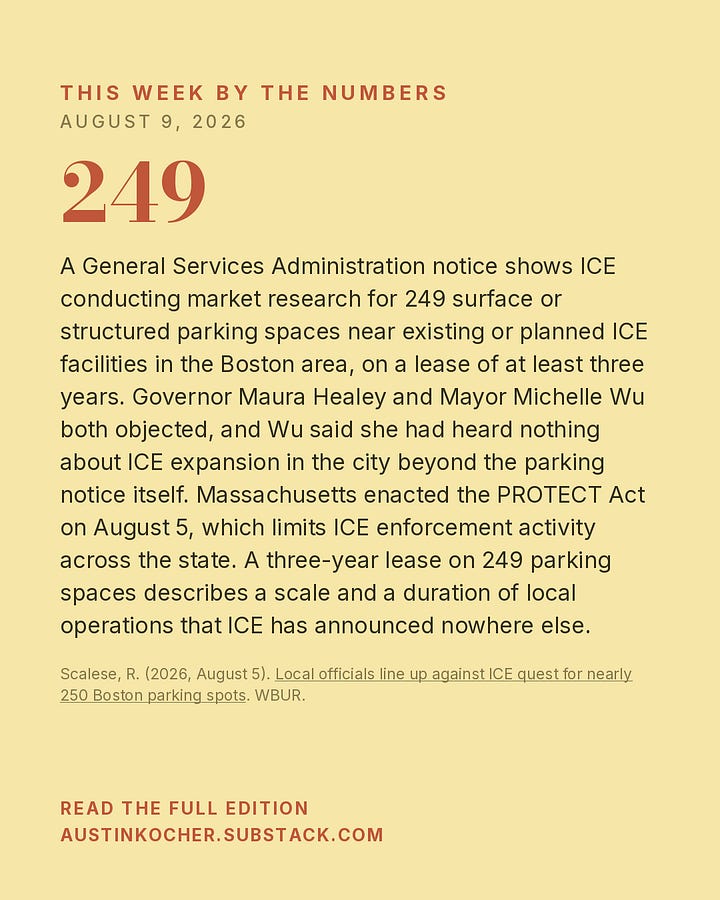
The number of parking spaces ICE is seeking in Boston, part of a solicitation covering more than a dozen cities.
A General Services Administration notice shows ICE conducting market research for 249 surface or structured parking spaces near existing or planned ICE facilities in the Boston area, on a lease of at least three years. Governor Maura Healey and Mayor Michelle Wu both objected, and Wu said she had heard nothing about ICE expansion in the city beyond the parking notice itself. Massachusetts enacted the PROTECT Act on August 5, which limits ICE enforcement activity across the state. A three-year lease on 249 parking spaces describes a scale and a duration of local operations that ICE has announced nowhere else.
Scalese, R. (2026, August 5). Local officials line up against ICE quest for nearly 250 Boston parking spots. WBUR.
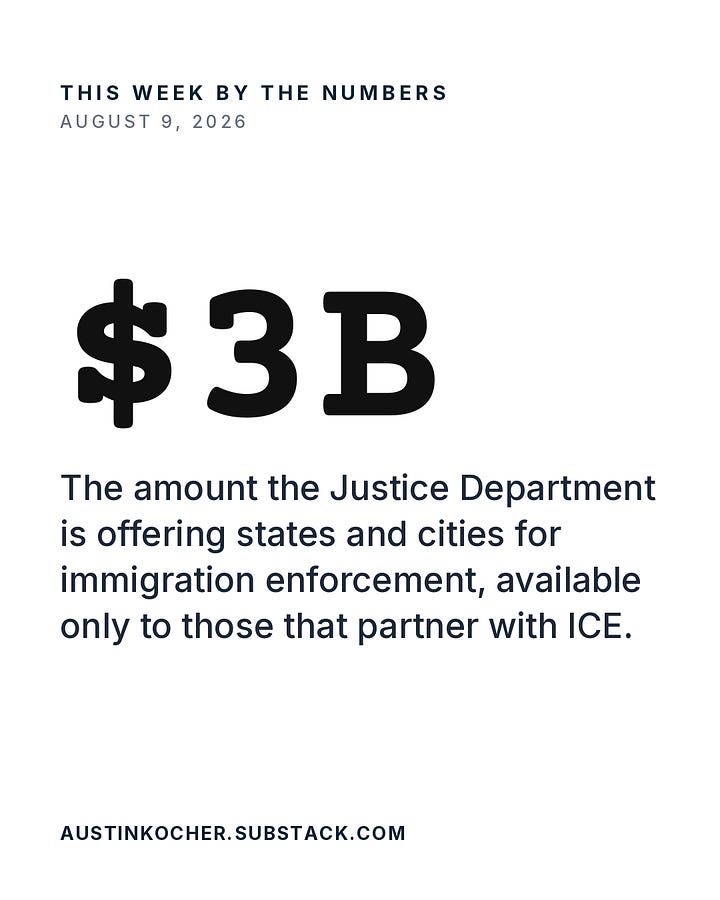
The amount the Justice Department is offering states and cities for immigration enforcement, available only to those that partner with ICE.
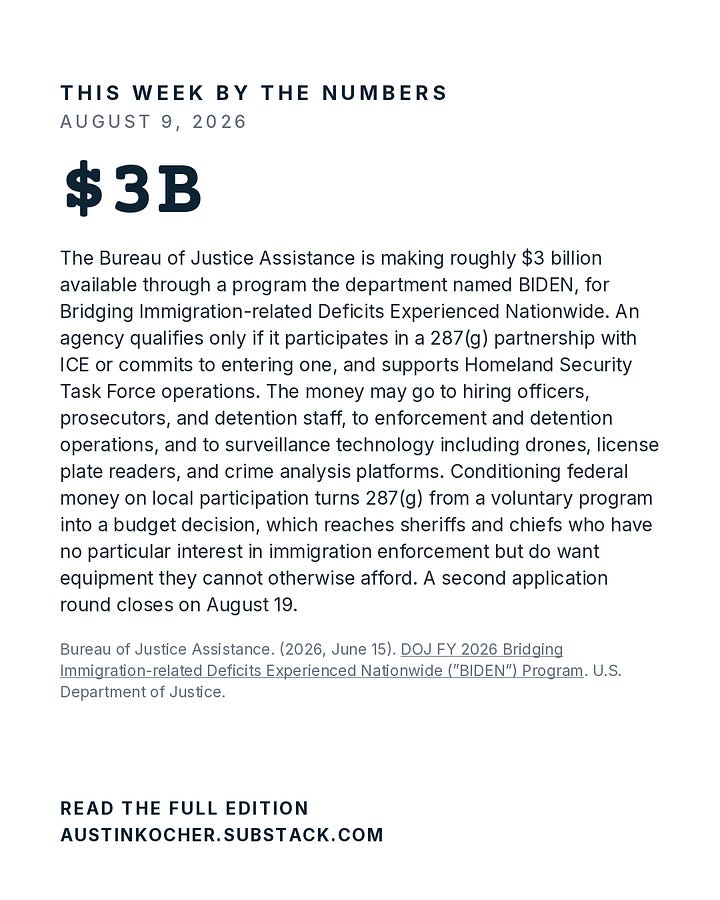
The Bureau of Justice Assistance is making roughly $3 billion available through a program the department named BIDEN, for Bridging Immigration-related Deficits Experienced Nationwide. An agency qualifies only if it participates in a 287(g) partnership with ICE or commits to entering one, and supports Homeland Security Task Force operations. The money may go to hiring officers, prosecutors, and detention staff, to enforcement and detention operations, and to surveillance technology including drones, license plate readers, and crime analysis platforms. Conditioning federal money on local participation turns 287(g) from a voluntary program into a budget decision, which reaches sheriffs and chiefs who have no particular interest in immigration enforcement but do want equipment they cannot otherwise afford. A second application round closes on August 19.
Bureau of Justice Assistance. (2026, June 15). DOJ FY 2026 Bridging Immigration-related Deficits Experienced Nationwide (”BIDEN”) Program. U.S. Department of Justice.
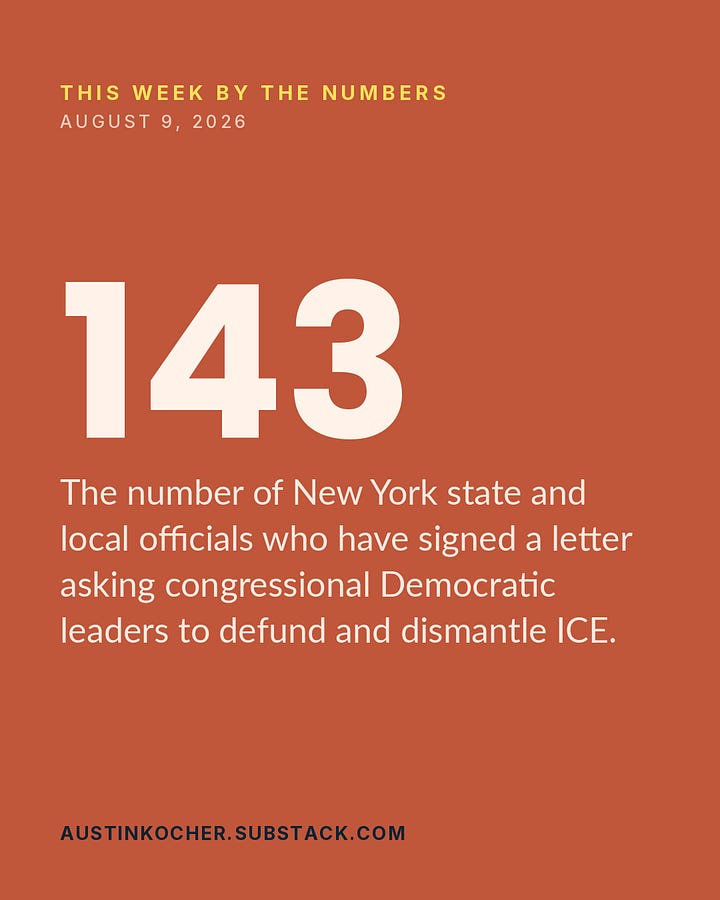
The number of New York state and local officials who have signed a letter asking congressional Democratic leaders to defund and dismantle ICE.
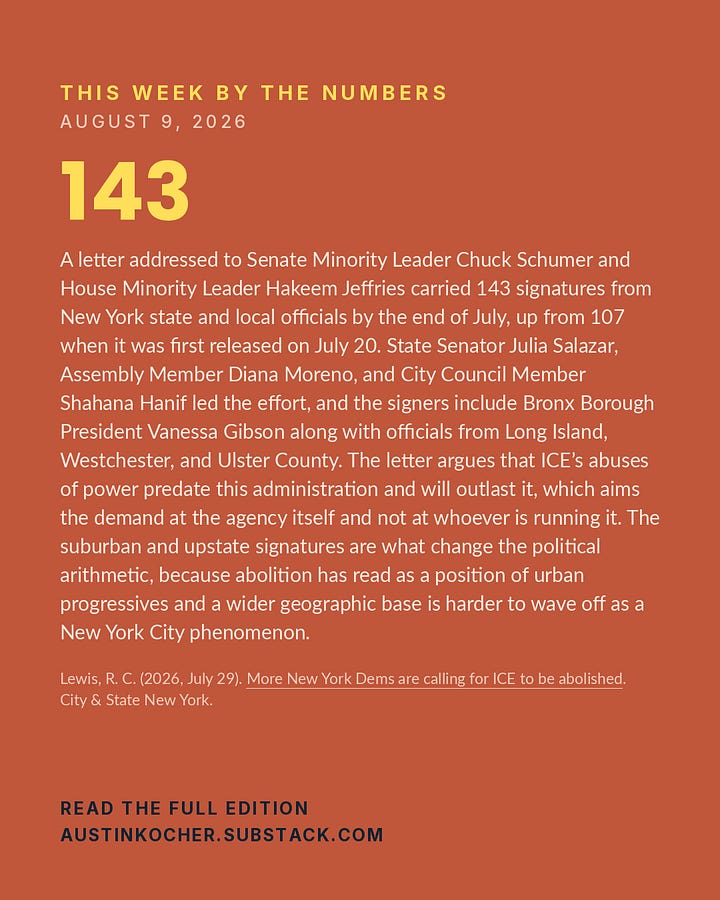
A letter addressed to Senate Minority Leader Chuck Schumer and House Minority Leader Hakeem Jeffries carried 143 signatures from New York state and local officials by the end of July, up from 107 when it was first released on July 20. State Senator Julia Salazar, Assembly Member Diana Moreno, and City Council Member Shahana Hanif led the effort, and the signers include Bronx Borough President Vanessa Gibson along with officials from Long Island, Westchester, and Ulster County. The letter argues that ICE’s abuses of power predate this administration and will outlast it, which aims the demand at the agency itself and not at whoever is running it. The suburban and upstate signatures are what change the political arithmetic, because abolition has read as a position of urban progressives and a wider geographic base is harder to wave off as a New York City phenomenon.
Lewis, R. C. (2026, July 29). More New York Dems are calling for ICE to be abolished. City & State New York.
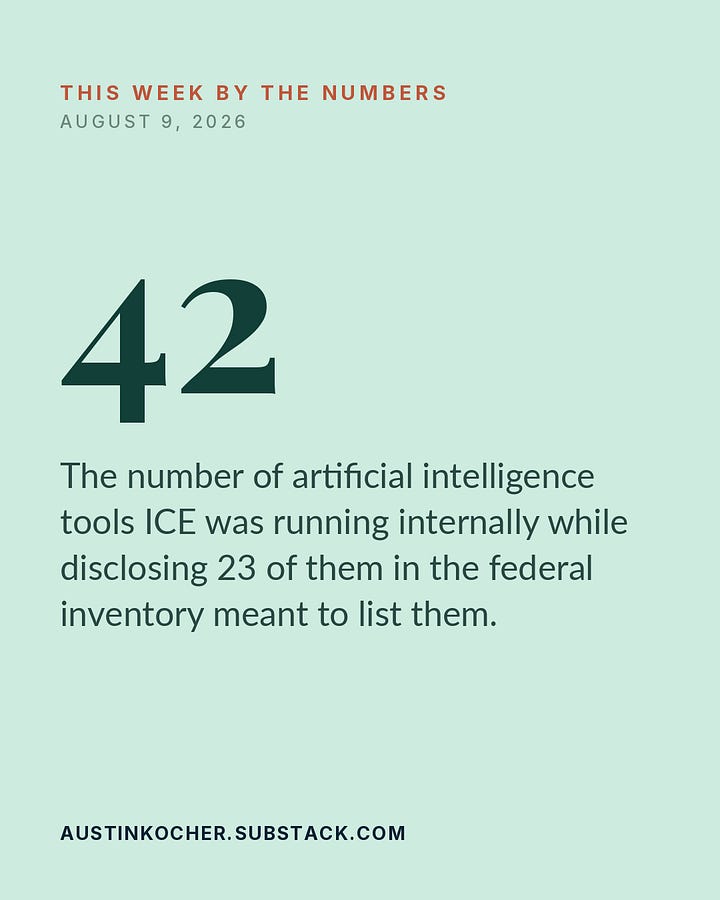
The number of artificial intelligence tools ICE was running internally while disclosing 23 of them in the federal inventory meant to list them.
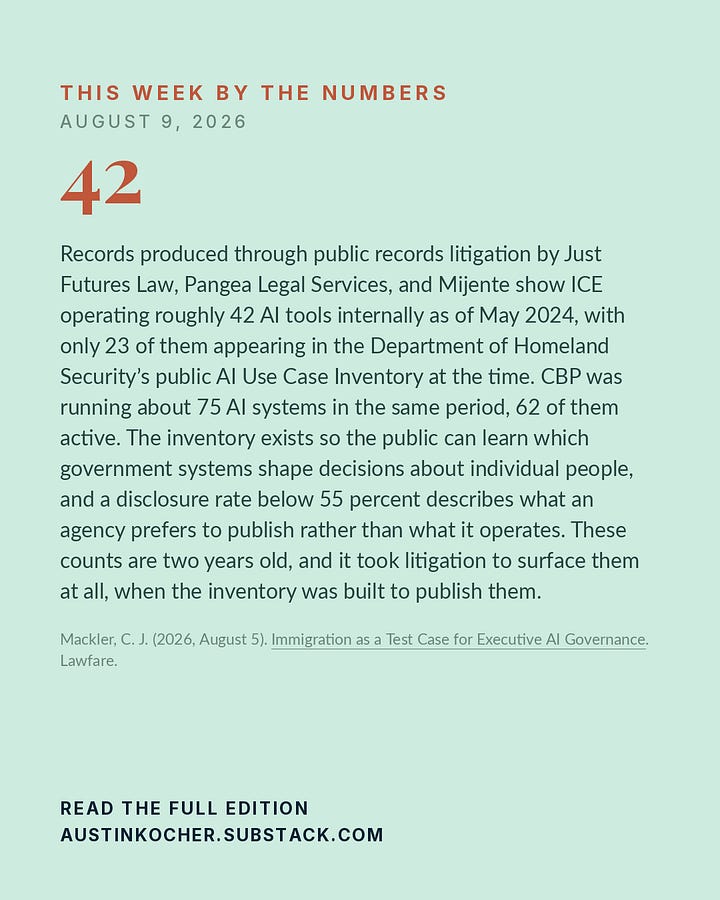
Records produced through public records litigation by Just Futures Law, Pangea Legal Services, and Mijente show ICE operating roughly 42 AI tools internally as of May 2024, with only 23 of them appearing in the Department of Homeland Security’s public AI Use Case Inventory at the time. CBP was running about 75 AI systems in the same period, 62 of them active. The inventory exists so the public can learn which government systems shape decisions about individual people, and a disclosure rate below 55 percent describes what an agency prefers to publish rather than what it operates. These counts are two years old, and it took litigation to surface them at all, when the inventory was built to publish them.
Camille J. Mackler (2026, August 5). Immigration as a Test Case for Executive AI Governance. Lawfare.
I’m honored that this Substack continues to drive media reporting, research, and public debate, but it does take effort and expense. If you can pitch in a few bucks a month or year, it would help enormously. Find an option that fits your budget at austinkocher.substack.com/subscribe.
Comments
Nothing yet. Say the first thing.
Sign in to join the conversation.