
In the past few weeks, I’ve been working on a series of posts to analyze the Trump administration’s latest tactic to manipulate the immigration courts into producing more deportation orders. As I described previously, these mega master calendar hearings—”mega-masters,” for short—weaponize the bureaucratic power of simple scheduling to cram over a hundred hearings together into a single morning or afternoon on short notice, knowing (as the research I’ve done for years repeatedly finds) that this will predispose these cases to removal orders, very many of them in absentia (i.e., without the person even being there).
Today’s post continues this ongoing research, and adds unreported findings based on qualitative research about how mega-masters are being scheduled that deepens our understanding. I am grateful for the insights from experts who helped me to fill in crucial gaps in understanding. If you have more information you would like to share with me, you can contact me on any platform or reach out to me on Signal (@austinkocher.99).
Note: I have to turn this into more than one post because there’s too much information to share, so be sure to subscribe so you get the next one when it comes out shortly.
Using Court Data Through July 30
Before we talk about new findings, I want to set the stage with a quick comparison between the predictions for June versus the reality. The data in this post reflects the latest immigration court data updated through the end of June, the first full month of mega-masters. Last month we only had the scheduled mega-masters, which means we were working with more of an estimate.
When analyzing immigration court hearings, the only thing we know for sure is what was scheduled in the past. This creates a blind spot. Even at this moment, we don’t know what was actually scheduled on July 1 yet. We won’t know that until we get more data in August. We can be fairly certain that the hearing schedule data on June 30 is mostly accurate for July 1, because it’s just one day apart. But as we extrapolate, the likelihood that the schedule for July 2 changed is higher than on July 1; the uncertainty of the July 3 schedule is higher still, and so on incrementally into the future. See my previous explanation here.
To show this more concretely, here is the comparison of total in-person non-detained morning mega-masters predicted by the May data looking into June, and the June data once the hearing schedules were locked in. Altogether, I was undercounting morning non-detained in-person mega-masters by about 15%.
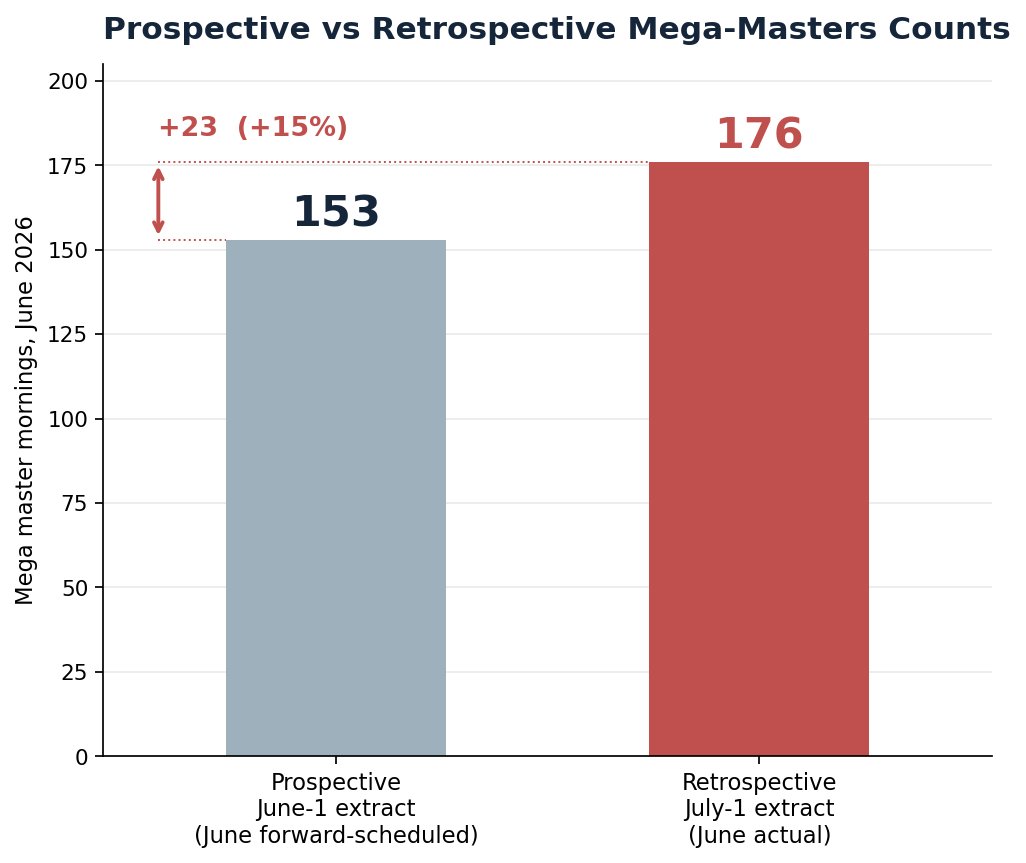
When we look at how this 15% shakes out over the month, we see an interesting trend. The first two months of June were actually over-projected while the later weeks (as expected) were far more under-projected. I won’t get into the details about why. I just wanted to illustrate the fluctuation in projected versus actual.
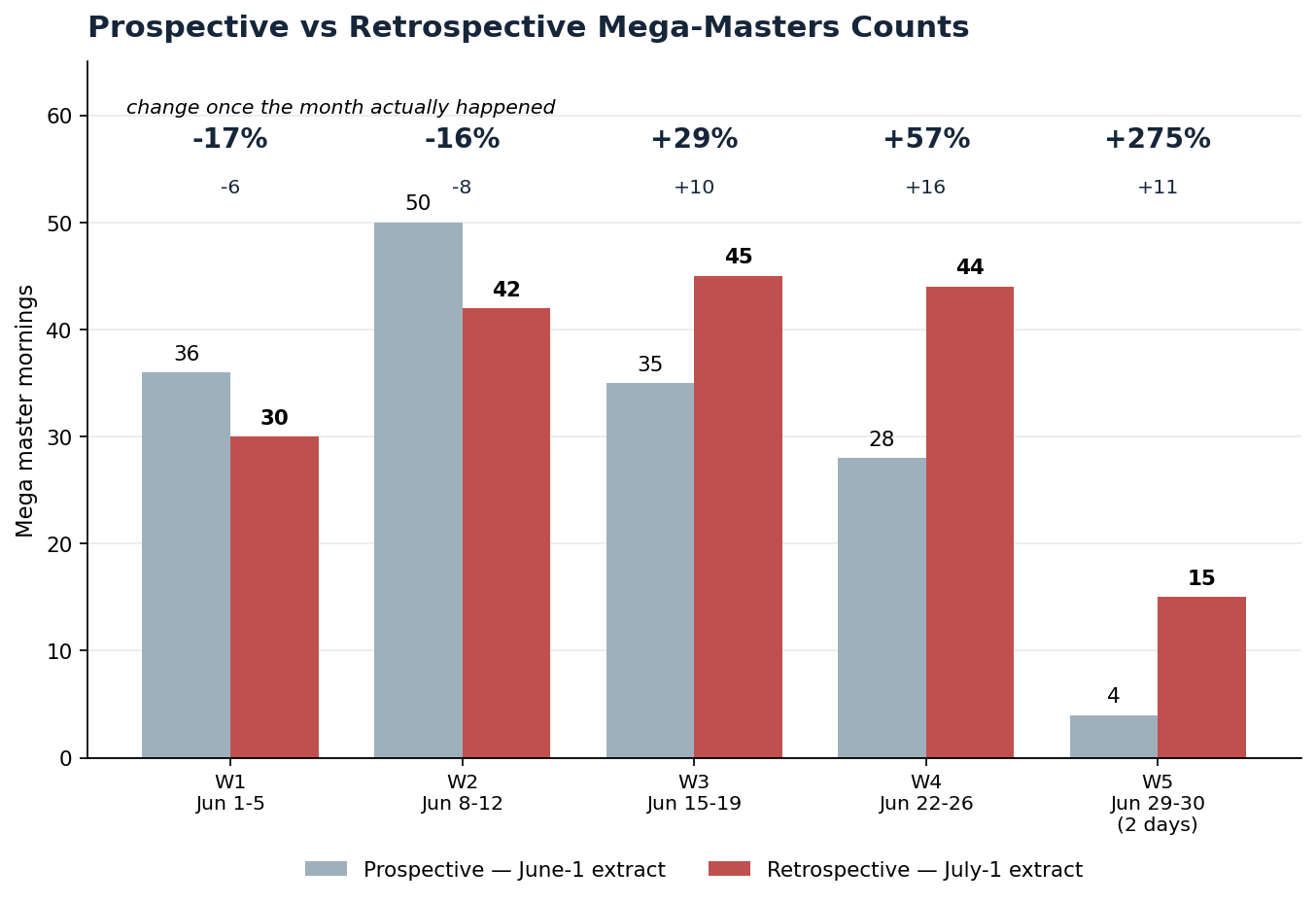
As I explained in the previous posts, I focused on morning in-person non-detained hearings to align more closely to the reporting and to sort of limit the complexity of what I was trying to explain when we were in the early days.
What Counts as a Mega-Masters?
While much of the reporting rushed ahead with assumptions about what a mega masters is, as a researcher, my first concern is with definitions. My previous posts sought to historically situate and analytically define mega-masters in a way that enables us to develop a shared critical conception of what’s going on, as well as standardize some of the language surrounding these hearings.
In those posts, I argued that when it comes to developing a threshold for how many cases constitutes a mega-masters (50? 70? 100?), we could either adopt a model of relative growth at the particular court or we could adopt the threshold that had been reported in the news so far of 100. I have been using the 100 cutoff, but was uncertain what—if any—official cutoff the EOIR had or how exactly particular mornings or afternoons were chosen as mega-masters.
We now have an answer to these and many more basic questions.
What Do We Call Mega-Masters?
If you are grammar obsessed, you may have noticed that I’ve been hyphenating these hearings as “mega-masters,” which is different than the unhyphenated “mega masters” I was using before. There’s a simple reason for this change: this is what the EOIR is calling it. So if you’re writing about a mega-master or mega-masters plural (lowercase on both), just be aware that this seems to be the EOIR’s official convention.
What is the Official Mega-Masters Threshold?
Based on conversations I’ve had and the internal documents I’ve reviewed, the answer to the official mega-masters number of hearings is unambiguous. The EOIR’s official internal goal is to have between 100 and 200 cases scheduled for each of these mega-masters. While it is possible (likely, even) that the total number of people physically in court will be under this, the agency is clear that a mega-masters is constituted through this 100-scheduled-cases threshold.
Analyses that use thresholds below 100 will overcount the number of mega-masters, and analytical thresholds above this will undercount the number of mega-masters.1 Downstream analysis from different thresholds will also reflect a different population and different findings than the official EOIR threshold. (See the next section for a caveat.)
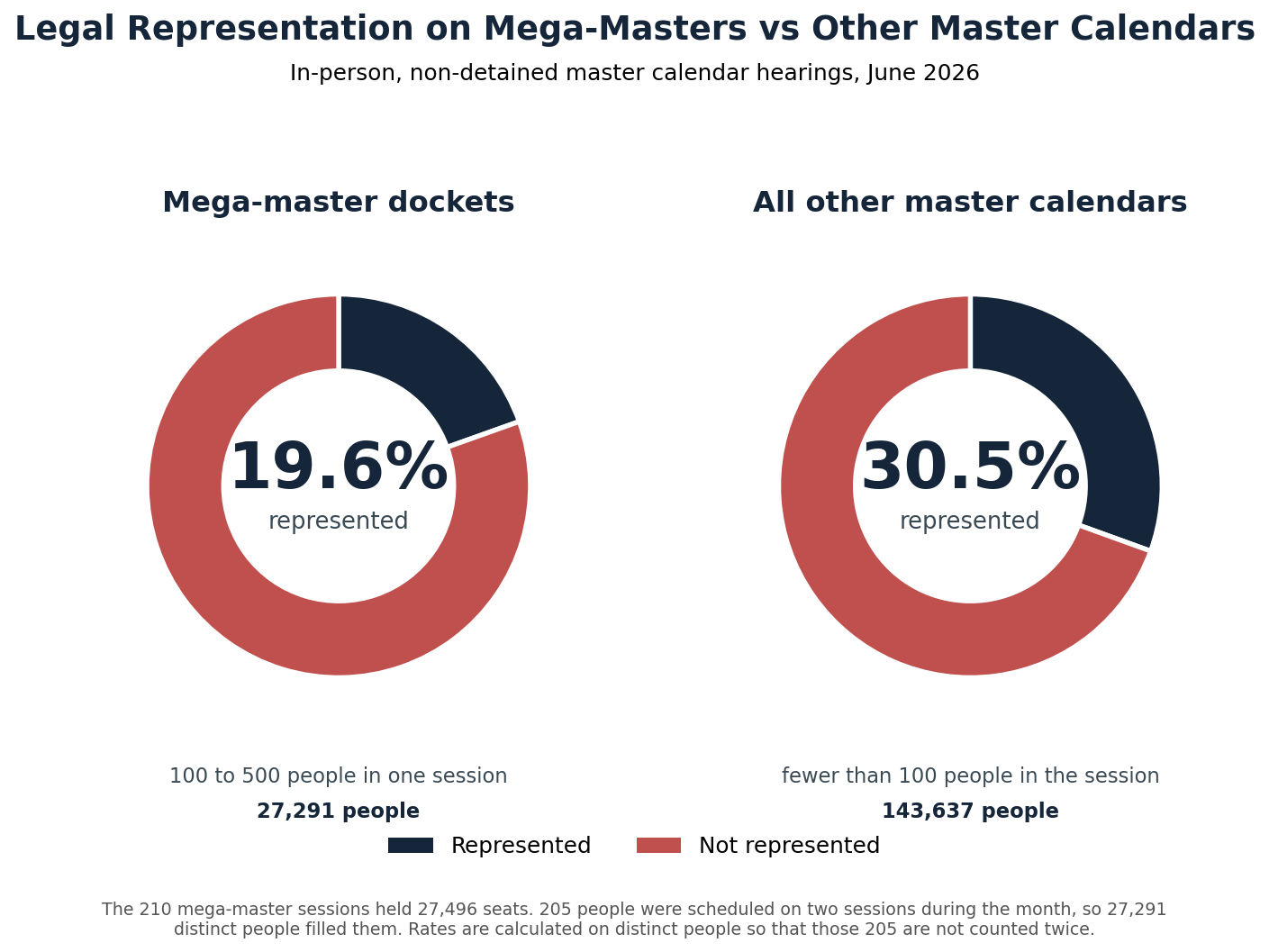
Based on this definition, and my previous discussion of focusing on mornings and afternoons, the backwards looking hearing schedule for June shows a total of 210 in-person non-detained mega-masters across 97 judges in 24 courts, which impacted 27,496 people who were scheduled for those hearings.2 (Okay, technically 205 people were in more than one mega-masters, so it’s 27,496 mega-masters people slots or seats and 27,291 total people. I’m not a stickler about this for this post, but just so you know.) In total, 15.9% of all people scheduled for a master calendar hearing in June were scheduled for mega-masters.
The official goal for mega-masters is actually more specific than just the 100 cases, however. The EOIR isn’t just aiming for 100 total people per mega-masters, but to explain I need to digress briefly. In immigration court, cases that involve family members (mostly spouses and children) typically have one person that’s a “lead” and other people that count as “riders.” For example, a parent with two children equals one lead and two riders, or three total people who are linked together in a specific way in removal proceedings.
What I’ve learned is that, for mega-masters, the agency’s goal is for mega-masters hearings to have 100 adults and leads, not counting riders, with a goal of 150 total people (i.e., 50 additional riders). Not every adult is a “lead,” of course; many are simply single adult cases. And not all children are riders; many are unaccompanied children with no adult (more on this in later posts).
Is the information I have correct? The good news is, we don’t have to take this on faith. We can test this theory.
Let’s look more closely at the 27,496 people scheduled for mega-masters in June. Of those, 18,977 were primary respondents (either solo adults or leads) and 8,519 were riders. The primary group divides further: 4,695 of them were leads with family members attached to their case, while 14,282 were adults appearing on their own with no one else linked to them (i.e., solo adults). Altogether, a little under half the people called to a mega-master in June arrived as part of a family group, and those groups averaged about 2.8 people each. The riders are overwhelmingly children, with a median age of 13, two thirds under 18, and 43 percent under 12.
To the research point in question: on average, the typical mega-master scheduled about 131 people, of whom 90 were primary respondents and 41 were riders. This isn’t quite the 100-lead/solo threshold, but as I’ll discuss later, there are good reasons why it might be hard to hit that number. In my assessment, the data supports the findings from the qualitative research. The EOIR seems to be setting a target not just of any 100 people, but specifically setting a target of 100 adults/leads plus however many riders (mostly children) come along with those leads, which then pushes the hearing schedule well over 100.
In case you’re wondering if mega-masters are “targeting” families more than other hearings, the answer so far is: not really. Around 30% of all cases (non-detained, in-person) have riders and this is fairly consistent across mega-masters and non-mega masters cases. This is the national trend; some variation may occur across time and geography so when we look closer at individual courts, those numbers tend to change.
Posts like this require a lot of effort and expertise. Please consider supporting this work with a paid subscription. Your financial support isn’t extra for me—it’s an essential part of how I keep the lights on and keep this work going.
When and How are Mega-Masters Scheduled?
Although there has been some reporting about mega-masters days in court, one research question I wanted to answer is: why on those days? Who decided when a mega-masters takes place? Based on conversations so far, it appears that working immigration judges in certain courts are required to do mega-masters, but that when they do them is up to each judge. Once a day of the week and time (morning or afternoon) is set, it’s up to the court staff to fill these mega-masters dockets with hearings. Based on the June mega-masters hearings, these are taking place any day of the week but mostly on Monday and Wednesday mornings.
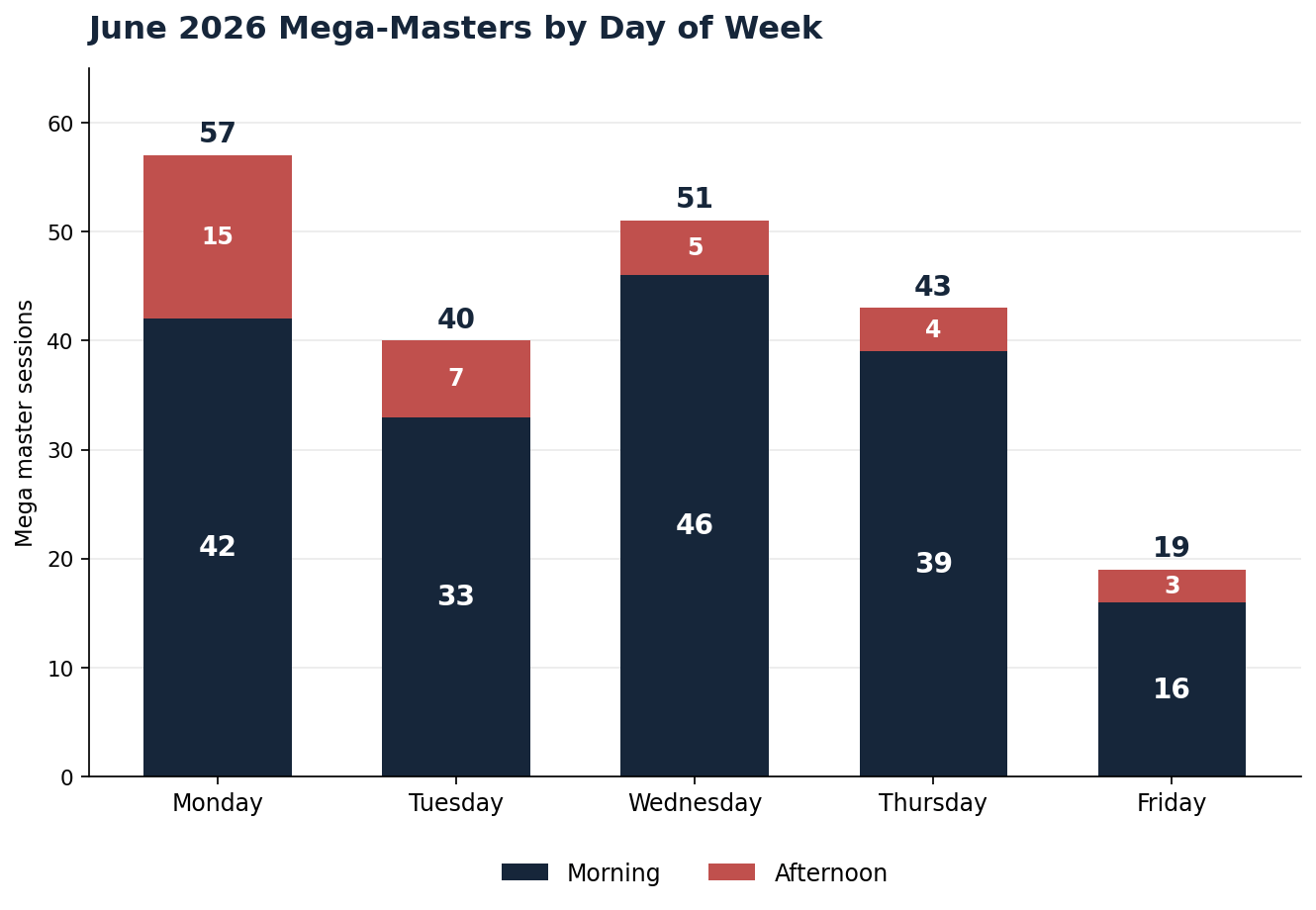
The fact that judges may be choosing their mega-masters days has one important consequence for how we think analyze mega-masters. It is technically possible that a judge would have a mega-master slot that, for some reason, never gets to 100 people scheduled and therefore doesn’t meet the required threshold. This doesn’t seem likely based on the data, but there may be edge cases.
Which Cases are Prioritized for Mega-Master Scheduling?
The definition and the thresholds above tell us what a mega-masters is, but it doesn’t tell us which cases are assigned to mega-masters. Is it just any case, or are there specific cases that the EOIR is telling each court to schedule?3 Based on what I’ve learned, the EOIR is being quite directive, indeed.
First, cases prioritized for mega-masters are being drawn as much as possible from cases where people don’t have attorneys. This is less of a new finding as it is a confirmation of what court observers, attorneys, and reporters have already documented. As many of us have written about for years, immigration attorneys are absolutely necessary for immigrants to receive any semblance of due process in the immigration courts, so choosing cases without attorneys is a way for the EOIR to cherry-pick the most vulnerable and defenseless people, assign them to a mega-master docket, and churn out in absentia removal orders.4
The data bear this out. Looking at the June master calendar hearings alone, mega-masters cases were 19.5% represented while all other master calendar hearing cases were 30.5% represented according to the court data. I will note that these numbers are a little imprecise for the simple reason that the EOIR’s record keeping isn’t great on this point and the reality of what it means to be represented is not as straightforward as you might think. Nevertheless, this method is fairly standardized at this point so the comparison holds: mega-masters cases are 11 percentage points less represented than all other master calendar cases.
Second, cases prioritized for mega-masters are also being drawn from a variety of scheduling situations, including edge cases such as cases from an IJ cancelation or a closed court day that were never rescheduled.5 Some hearings are the first-ever hearing, some are rescheduled from past hearings, some are pulled forward from future schedules, and some are active but had no future hearing scheduled. The only thing that these case types all have in common is the agency seems to believe they can close them out quickly and with as little fuss as possible.
For what it’s worth, I will say that there very likely are groups of cases that are lingering in the court system that legitimately can be closed out easier than others (that’s true for any court system or legal question, see Dworkin’s theory of easy and hard cases). And barring malice or a willful attempt to demolish due process, I’m not principally opposed to that kind of approach. The immigration court backlog is massive and I certainly don’t begrudge any dedicated civil servant who aims to find creative ways to make the courts more efficient and allow judges to focus on the most crucial and complex cases.
The problem is, by my count, most of these specific case categories are actually quite small, numerically speaking, while the general thrust of mega-masters is to scoop up an enormous range of other types of cases which may not be so easy or straightforward except for the fact that the administration has made it easier to deport legitimate humanitarian migrants and long-time residents with strong ties to the U.S. This is by design. The administration can claim that they are simply trying to “clear out the backlog,” while at the same time de facto suspending due process (or whatever version of it used to exist in the immigration courts) the same way that they tried to de facto suspend habeas corpus.
We’ll talk more in the next post about why these cases are so predisposed to negative outcomes in ways that have little to do with the individual immigrants themselves, but for now I just want to emphasize that I am not convinced that mega-masters have anything to do with “fairly, expeditiously, and uniformly interpreting and administering the Nation's immigration laws.” Expeditiously, perhaps—but this is hardly fair or uniform.
What are Mega-Masters Doing to the Immigration Courts?
We have not exhausted our exploration of the latest data on mega-masters. We still need to explore precisely how much notice is given to immigrant respondents (spoiler alert: not enough), what the outcomes of these cases are (mostly in absentia, as others have noted), and how many mega-masters are currently scheduled out for the future.
But I’ll have to address those questions in the next post because I have something more important to share, something even more important than the simple data findings above. And it’s a question that bugged me since May when I first heard of these mega-masters. To put it simply, what are the institutional prerequisites and effects of shuffling such an unprecedented number of cases around? In short, how the hell are they doing it?
Here’s how they’re doing it.
Starting in late April, the EOIR was already signaling internally that it would adopt this new scheduling strategy, and by early May, the courts were told they had to begin creating and filling mega-masters. As one person explained to me, every mega-masters you see is 100% human labor. Every single case is individually identified, selected, and scheduled by a human being who has to identify the case types handed down from the EOIR and move it onto a mega-masters docket. Those 27,500 mega-masters cases in June? Hand-picked by people at each court working under urgent instructions to fill up the calendar. And this fact has all kinds of real world consequences that are easily overlooked.
For example, apparently the EOIR rarely, if ever, permits overtime—but given the heavy lift of rescheduling so many hearings at once, overtime has suddenly become available, if not all but required, in order to perform this Sisyphean effort. Somewhat ironically, while ICE conducts arrests with the aid of expensive, advanced facial recognition software and custom-built smartphone apps, court staff seem forced to work around the clock manually clicking away on the latest directives from the administration. This is part of what mass deportation looks like in 2026: “docket politics”, as I called it the other week.
Before you equate court staff with ICE officers, please know that, in my experience, they have very little in common. Over years of immigration court research, I’ve had a full range of experiences with friendly to less-than-friendly court staff, to be sure. But I have found many court administrators, staff, attorneys, interpreters, and guards to be altogether helpful, to believe in the basic integrity of what they do, and even to see themselves as the frontline of being a welcoming and professional face to immigrants who are navigating a complex and scary system. Unlike ICE officers, court staff were not recruited with white nationalist images and job advertisements and do not see themselves in so politicized of a frame. In short, I have profound respect for the decency of the front-line workers at the EOIR in a way that I find impossible for today’s cadre of ICE officers.
All of the urgent manual work has real consequences for quality and thoroughness. The risk for mistakes is high, mistakes that could have life-altering consequences for immigrants facing deportation. And it’s not just on the front-end with scheduling. After hearings are over, record keeping for what happened at the hearings also has to be entered manually, and given that there are north of 200 cases at some of these mega-masters, there’s no way to do that in real time. From what I have seen, the urgency surrounding scheduling mega-masters comes straight from headquarters with a single-minded obsession with increasing the sheer numbers of closed cases—and that also means a scramble to enter in case outcome data by the end of every single work week so that the administration can tout its numbers on internal scoreboards that ignore quality and hyperfocus on removals, removals, removals. The EOIR is currently sending around regular emails that gamify case closures by highlighting courts and judges with the largest number of closures, and adopting racing-style language between courts and judges like an announcer at a NASCAR event.
The systemic effects are even bigger than this. With all the energy going to mega-masters, who is processing change of address forms? Do judges have any time to actually prepare for asylum cases? Are respondents able to get a copy of their file to review for appeal before the 30-day deadline is up? Is anyone looking at attorneys’ motions? While it is justifiable to be focused on the data on mega-masters, this approach risks reproducing a dangerously myopic view on what this administration is doing to the court system as a whole. The truth is, the mega-masters are not only impacting the 27,500 cases at mega-masters hearings in June — the whole mega-masters tactic could be undermining the routine functions of the court for everyone and further contributing to the delegitimization of the immigration court system as we know it.
Coming Up Next…
In the next post, I’ll continue to explore the new mega-masters trends and compare the findings of qualitative research to what the data says. We are still only scratching the surface of this new practice, so stick around. Subscribe to make sure you get the upcoming posts. And like I said, if you have more information you would like to share with me about mega-masters or the courts in general, you can contact me on any platform or reach out to me on Signal (@austinkocher.99).
There’s still an argument to be made that different thresholds or methodologies might capture trends that the 100-case threshold doesn’t, so I’m not necessarily saying that any threshold that isn’t 100 is wrong—it’s just not what the EOIR is using, so it probably shouldn’t be called a mega-masters.
As I said before, we’ll come back to the types of mega-masters I’m also leaving out. I’m not trying to generate shocking headline numbers, my goal is to unpack this new court strategy from a research perspective.
Allow me to reiterate a point I spent a whole essay on previously. The fact that political appointees in the Department of Justice can tell judges what to do with their docket calendars should not be glossed over as normal. This is just one systemic flaw with the lack of an independent immigration court system, one that allows presidents (both Democrat and Republican) to constantly meddle into court operations which leads to inefficiencies that the courts then get blamed for. Judges have complained about this to Congress for as many years as they have worn robes (and many decades before that, too) to little avail.
If you’re new to this, a quick recap. Given the complexity and capriciousness of immigration law (or law in general?), immigration attorneys are one of the biggest predicators of outcomes for immigrants in removal proceedings. For example, asylum seekers are far less likely to file asylum claims without an attorney, and less likely to win. But it’s more than that. As my own dissertation research showed, attorneys provide all kinds of other essential coordinating services given their professional networks and position in the community, from connecting immigrant respondents to additional support services (e.g., transportation), to coordinating with the court for information about scheduling changes and preparing for hearings. Attorneys are essentially the only life preserver available to keep immigrants from drowning in the sea of removal proceedings.
Edit 07/29/2026 7:41 AM - In the first version of this post, I had listed types of cases prioritized for mega-masters that included 42B and others, but this may not have been accurate. I’ll keep looking into it.
Comments
Nothing yet. Say the first thing.
Sign in to join the conversation.