
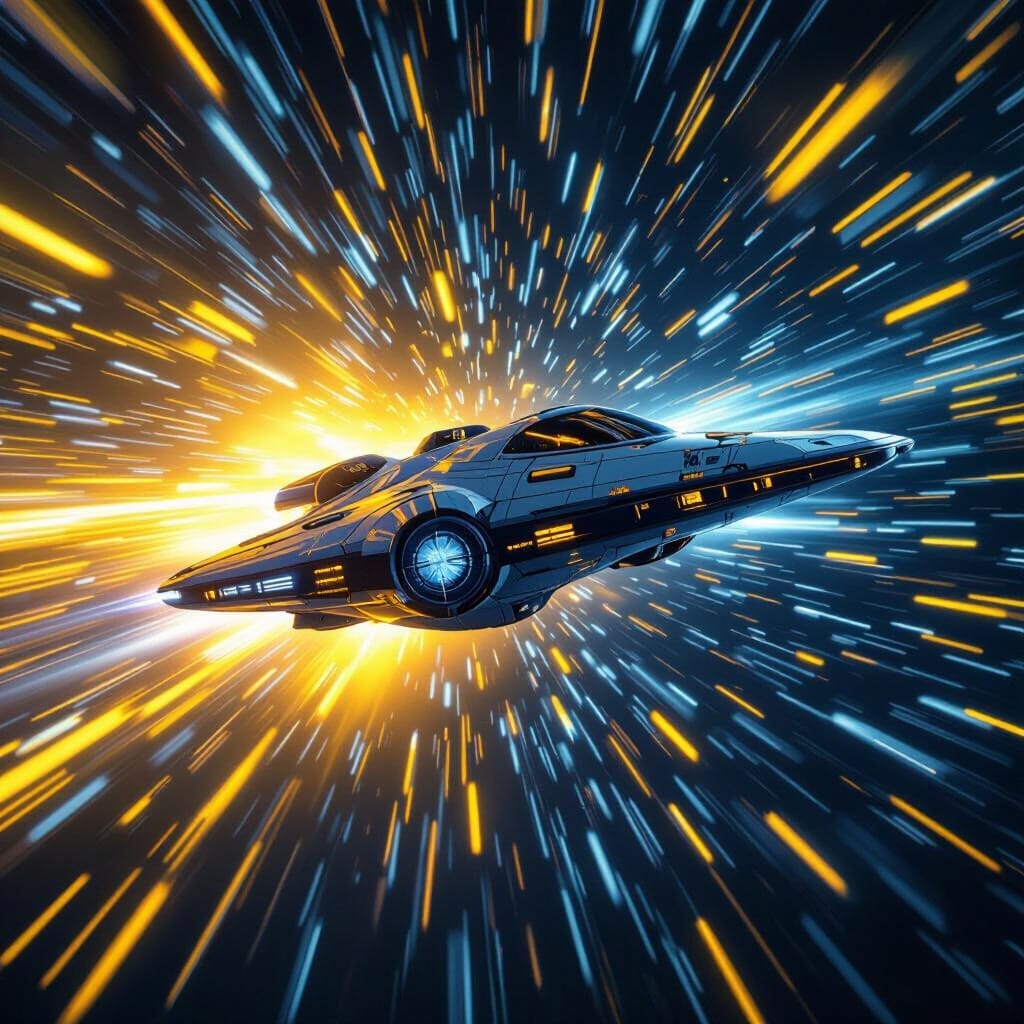
Sorry, humans, no warp drive. Why Speed is the Final Boss of Space Exploration.
Want to boldly go? Start by asking one question: how fast can we get there? Everything else comes after.
If we’re ever going to explore the galaxy, it’s not going to be aboard the USS Enterprise. Warp drive? Sorry, still pure sci-fi. We’re stuck with physics as we know it—and that means speed is the name of the game.
Thanks for reading Fiction Fantastic! This post is public so feel free to share it.
Before we pick out beachfront property on Kepler-442b, we have to face one brutal cosmic truth: space is stupidly big. So big that even our fastest spacecraft to date, NASA’s Parker Solar Probe, would take over 6,000 years to reach the nearest star outside our solar system!
WHY NO WARP DRIVE
The Cosmic Speed Limit
For a long time, scientists believed there was no upper limit to how fast something could travel. But then Einstein flipped the script.
He revealed that the universe does, in fact, have a speed limit: the speed of light in a vacuum—about 300,000 kilometers per second (or 186,000 miles per second). And here’s the kicker: nothing with mass can ever reach it. Only massless particles, like photons (the building blocks of light), can move that fast.
Why not just crank the engines harder? Because physics says no.
As an object accelerates, its mass effectively increases. That means the faster you go, the heavier you get—and the more energy it takes to keep accelerating. Try pushing an object to light speed and you'd hit an energy wall: it would require infinite energy. And no, we don’t have an infinity generator in the garage.
So even Einstein himself—who once daydreamed about chasing a beam of light as a teenager—would’ve been left in the cosmic dust.
THE RECAP
• Speed of light = universe’s hard limit on speed.
• Massless = Yes to go light speed.
• Have mass? You're out of luck.
• Infinite energy? Not happening.
• Warp drive? Still fiction.
The Real Space Race: Speed
Forget rocket size or Mars real estate. The real question isn’t where we want to go, but how fast we can get there. Without a major breakthrough in propulsion, humanity’s ambitions for deep space exploration will stay locked in our own solar system. Light speed? Out of the question (at least for now). We're bound by Einstein’s cosmic speed limit, and breaking it isn’t just illegal—it’s impossible.
The Cold Reality of Physics
So why can't you travel faster than light?
The faster an object travels, the more massive it becomes.
As an accelerating object gains mass and thus becomes heavier, it takes more and more energy to increase its speed.
It would take an infinite amount of energy to make an object reach the speed of light.
Here’s what we’re working with: chemical rockets (like the ones that took us to the Moon), ion propulsion (slower but super efficient), and a few weird science projects like nuclear thermal propulsion or laser sails. But even those "fast" concepts still take years or decades to cross even our local planetary neighborhood.
So unless someone invents a black hole slingshot or figures out how to manipulate spacetime, we need to design missions based on reality, not space opera.
Why Speed Defines Our Future
Speed isn’t just a technical problem. It shapes everything—from mission planning to astronaut lifespan, from communication lag to the economics of colonization. Want to reach Proxima Centauri in less than 100 years? We’ll need propulsion tech a thousand times faster than today’s best engines. And until we get it, the final frontier remains just that—final, and very far.
Bottom Line?
No warp drive. No teleporters. No shortcuts.
Just us, our ingenuity, and the ticking clock of propulsion tech. The good news? Humans are annoyingly good at solving impossible problems. So maybe the next Einstein is already sketching the blueprint for humanity’s first real interstellar engine. Until then, speed isn't just a challenge—it’s the mission.

In preparation of the launch (finally) of my military sci-fi series, Planet Tamers, this is the second article in a series over the next 6 weeks.
In the future time period of Planet Tamers, we are very much content with being confined to our own solar system—for now. But that doesn’t mean we can’t do big things. We’ll terraform an entire planetoid to create “Earth 2.” How’s that for one giant step for humankind!
VIP: ⭐Star
Comments
Nothing yet. Say the first thing.
Sign in to join the conversation.