
Ranking the Planets by Habitability.
Excerpt from the NASA science Article: Life in Our Solar System? Meet the Neighbors by Pat Brennan
Mars: Potentially habitable at some point
In a sense, the Red Planet tells a tale echoing that of Venus, but from the other side of the temperature scale. Investigations by orbiters, and rovers on the surface, confirm that Mars was once wet, with rivers, lakes and perhaps even oceans, and like Earth potentially habitable.
“The most exciting thing about Mars is that, at some point in time, 3.5 billion years ago, it’s clear the climate on Mars was more similar to Earth’s and had liquid water on its surface,” Voytek said. (Mary Voytek, senior scientist for astrobiology at NASA Headquarters in Washington, D.C.)
Then solar wind and radiation stripped most of its atmosphere away. Its minimally active core ceased to generate a protective magnetic field. Its surface became forbiddingly cold and dry even as it was bombarded with radiation.
Two strikes against Mars, Voytek said, are its lack of available water and the absence of plate tectonics – the process on Earth that moves continents over eons and recycles buried nutrients back up to the surface.
Thanks for reading Fiction Fantastic! This post is public so feel free to share it.
Ocean worlds: The moons of gas giants
Our solar system’s majestic giants – Jupiter, Saturn, Uranus, Neptune – and their trains of moons might almost be considered solar systems in their own right. Some of these moons could well be habitable worlds; one of them, Titan, has a thick atmosphere, rain, rivers and lakes, though composed of methane and ethane instead of water.
We first glide toward Europa, a moon of Jupiter with an icy shell. Beneath the frozen surface, however, space probes have detected evidence of a vast ocean of liquid water. Two other Jovian moons, Ganymede and Callisto, also are likely to host subsurface oceans, though these might be sandwiched between layers of ice. That makes life less likely, Cable says. (Morgan Cable, a researcher with the Astrobiology and Ocean Worlds Group at NASA’s Jet Propulsion Laboratory)
“Europa, we think, has a nice contact between the liquid water ocean and the rocky interior,” she said. “That’s important because the energy you can generate through chemistry can be utilized by life.”
A potentially more accessible example can be found among the moons of Saturn, the next planet out. Enceladus, though tiny, also hides a liquid water ocean beneath an icy shell. But in this case, scientists know the little moon is doing something extraordinary.
“Luckily, it happens to be sending free samples from its ocean into space,” Cable says. “Enceladus is the only place in the solar system with guaranteed access to a subsurface ocean without the need to dig or drill.”
NASA’s Cassini spacecraft detected convincing evidence of hydrothermal vents on its sea floor, and jets of ocean water shoot through cracks in the moon’s surface, known as tiger stripes (Europa might have similar plumes). The material from Enceladus’s jets, in fact, forms one of Saturn’s rings.
Cassini flew through the plume, and although its instruments were not designed to analyze ocean-water samples – when it was built, the nature of these distant ocean worlds was unknown – it did pick up important clues.
These include complex organic molecules, salts similar to those in Earth’s oceans, and silicate “nanograins” and other evidence indicating the presence of hydrothermal activity.
Gases detected in the plume, hydrogen and methane, suggest enough energy is present to provide fuel for life.
“If there’s that much energy, why isn’t there life eating it?” Cable asks. So far, no one knows the answer.
Then there’s Titan!
Though smaller and with lighter gravity than Earth, Titan reminds us of our own world, if perhaps reflected through a fun-house mirror. Nitrogen dominates this moon’s atmosphere, as it does Earth’s. And Titan is the only other body in the solar system with rain, lakes and rivers – a whole hydrologic cycle in fact. Its flowing lakes and rivers are made of the hydrocarbons, methane and ethane.
Flowing water is not an option; Titan is nightmarishly cold, and water is essentially rock on its surface.
Titan also possesses a subsurface ocean of water, though deep down, and it’s unknown whether the ocean makes contact with anything from the surface. If it does, mixing with complex chemistry on the surface could provide fuel for life.
If it doesn’t, there’s another possibility. The chemical brew on the surface could power life as we don’t know it: exotic forms based on completely different components and chemical reactions.
“Titan allows us to test a completely separate hypothesis of life,” Cable said. “It has a completely different liquid on its surface.”
The extreme cold on Titan’s surface, of course, means chemistry happens very slowly if at all. That could make “weird life” far less likely.
“Hopefully a future mission will journey back to Enceladus and bring today’s modern sensitive instruments to this test,” she said.

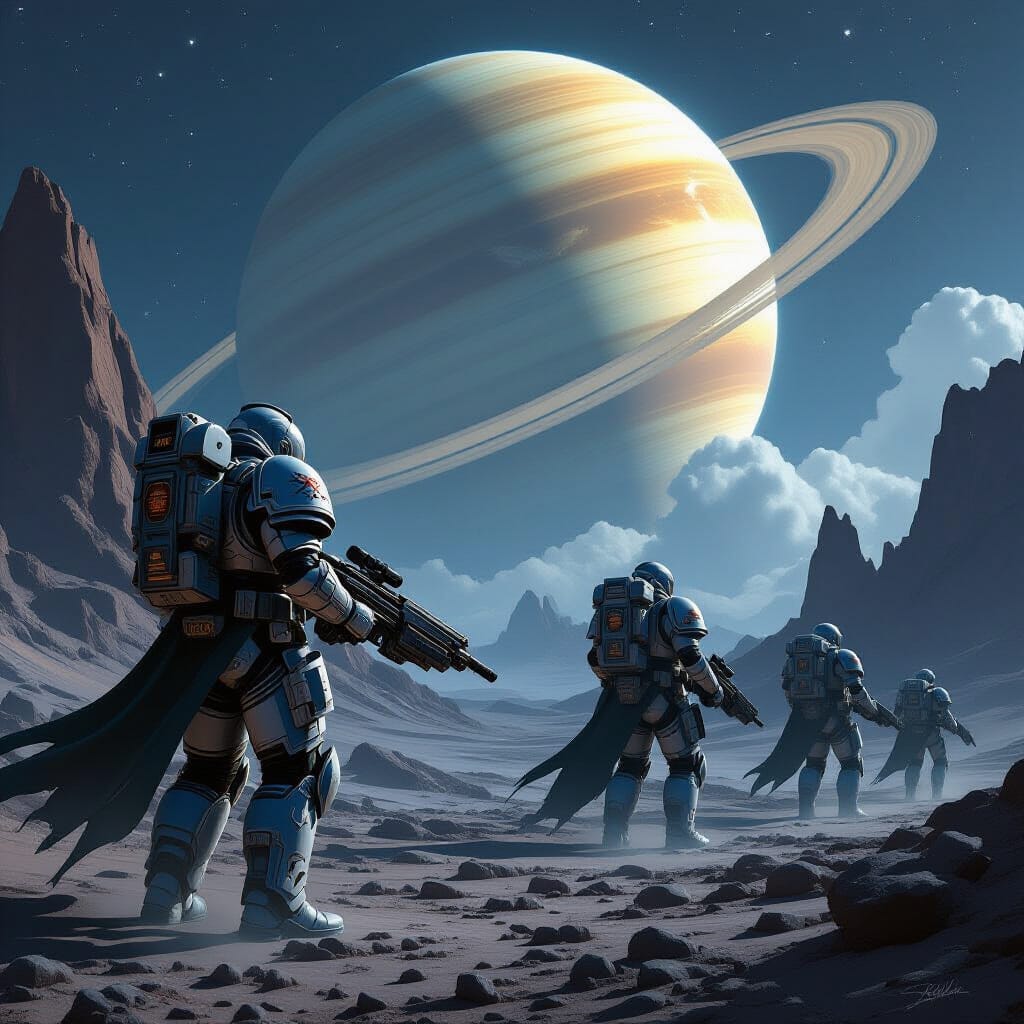
For the launch (finally) of my military sci-fi series, Planet Tamers, this is the fourth and final article in a series.
In the future time period of Planet Tamers, we are very much content with being confined to our own solar system—for now. We pick the planetoid Titan to terraform and colonize to create “Earth 2.” How’s that for one giant step for humankind!
But there’s something else there. Of course, there is. It’s never that easy.
VIP: 👽Alien
Comments
Nothing yet. Say the first thing.
Sign in to join the conversation.