
Westlake High School’s boys golf team is in the midst of a dynastic run. The Chaps have won 8 of the last 9 6A state championships and have now claimed 15 state titles in their history, more than any other sport at the successful school. After the Chaps’ 2026 championship, we sat down with longtime golf coach and current Westlake athletic director Callan Nokes, who delivered 9 state titles in his tenure, to unravel the secret to the Chaps’ success. The answer, you might expect, isn’t one small thing. In order to go fully behind the red-and-blue curtain, we’ll take a deep dive into the pillars of success one at a time with a multi-part series on Westlake’s unrivaled 6A success.
Part 1 (Thursday, July 9): Team Building, Strength Training, and a College Atmosphere
Part 2 (Monday, July 13): Practicing Competitive Golf, not ‘Golf Swing’
Part 3 (Tuesday, July 14): Creating Program Depth through Frequent Team Qualifying Chances
Part 4 (Wednesday, July 15): Embracing the Expectations and the Chaps who Delivered when it Mattered Most
Perhaps your perception of high school golf – especially at the most competitive 6A programs – is that players all have country club memberships and private coaches who have built their swings over time.
High school coaches, the prevailing assumption continues, exist more to build unity in the program, oversee qualifying events and practice range sessions, and get the team to and from matches and tournaments. And maybe that’s still the case around the state.
But not at Westlake, and not under Callan Nokes.
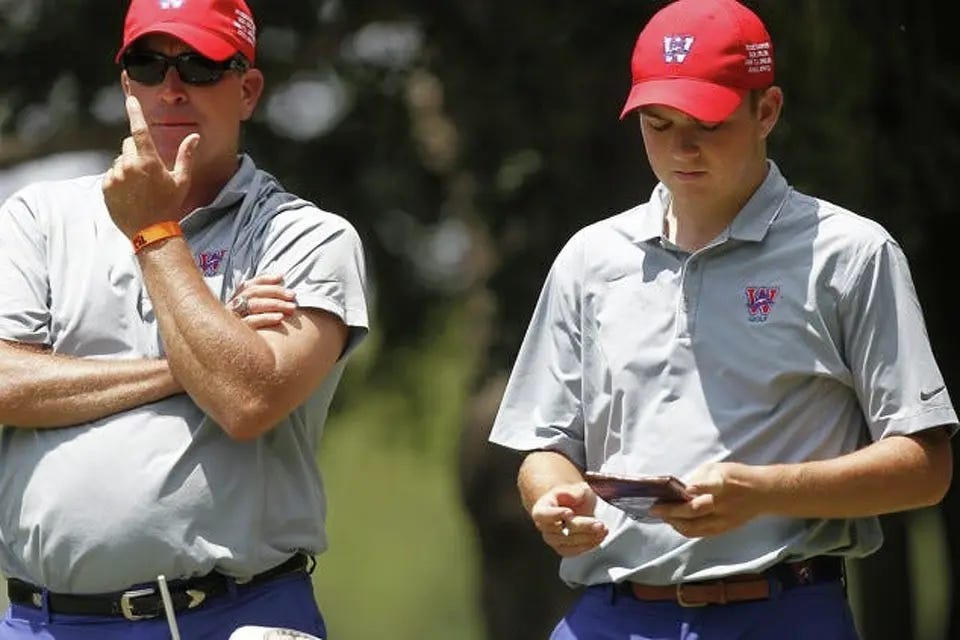
Over the years, Nokes turned himself into a very good amateur golfer who could – and still does – compete with Westlake’s top players. That gave him the credibility to deliver strategic advice and technical tips that helped players when swings went awry for a bit.
“One hundred percent,” Reid Davenport, a 2-time Westlake state champion who went on to play at Vanderbilt before turning pro, said. “He has a really good short game and is a good putter, so I could always go to him for tips when I struggled with those.”
Nokes often played alongside players during practice rounds. That gave him an up-close look at players who might have been struggling in tournament play and allowed him to fine-tune the team practice sessions that kept the team headed in the right direction. That’s how he saw his job.
“Everyone (on the outside) thinks (players) all have a private coach, and all of those stigmas about golf make me laugh,” Nokes said. “Take Reid Davenport (a 4-time state tournament participant and 2-time champion), one of the very best players I’ve ever coached. He moved from Houston when he was in 6th grade. The person he was taking lessons from in Houston, once he moved here, he only saw him about once a year. So basically, I was his only coach, and we had a lot of guys on the team like that. They didn’t have to go get private lessons.”
Full disclosure: That’s fine with Nokes. Private lessons, he says, don’t prepare players for what they’ll see on the course during tournaments.
“You stand on a driving range that’s perfectly flat, trying to groove this perfect swing,” Nokes said. “How many shots do you get like that on a golf course that aren’t on the tee box? You stand on the range for an hour and hit balls starting with a 7-iron and working up to the driver. That’s not playing golf. That’s ‘golf swing.’
“We studied it,” he continued. “You hit 32 full shots in a round on average. So that’s 32 out of 72. We’ve got 40 other shots we’ve got to be good at that aren’t even getting touched in that hour.”
Nokes modeled his coaching – and teaching – style after the legendary Harvey Penick. Practice started on the putting green and then worked back to the tee. Nokes’ primary rule: Players have to hit the ball close to the hole and be able to convert the putts. Everyone remembers how far Tiger Woods and Rory McIlroy drive the ball, but the saying “drive for show, putt for dough” exists for a reason.
“You have to be able to putt, and you have to be able to chip it close when you miss the green,” Nokes said. “Because everyone misses greens. You have to be able to chip, and you have to get those up and down. It can’t be an automatic bogey every time you miss the green.”
After putting and chipping, Nokes focused on wedge play, training players to hit the ball within 15 feet of the hole from distances stretching from 50 to 75 yards.
“If you study the PGA Tour, 15 feet is a high bar,” Nokes said.
“We hold them to a high standard,” Michael Rome, Westlake’s current coach who also won a state championship as a Westlake player, said, “but they hold themselves to a high standard too. Sometimes we have to rein that in and put it in perspective for them.”
Indeed. According to the PGA Tour’s 2026 statistics, the average distance from the hole on approaches from 50-75 yards is 17 feet, 3 inches.
Again, though, the training wasn’t hitting ball after ball from the driving range. Nokes staged players in different spots, and they’d take turns hitting to the practice green, emulating their order of play during a tournament round.
“You don’t get to sit there and hit it, rake the area, and hit it again and try to groove in,” he said. “It’s all part of making practice more like golf, learning to play the game, not how to swing the club.”
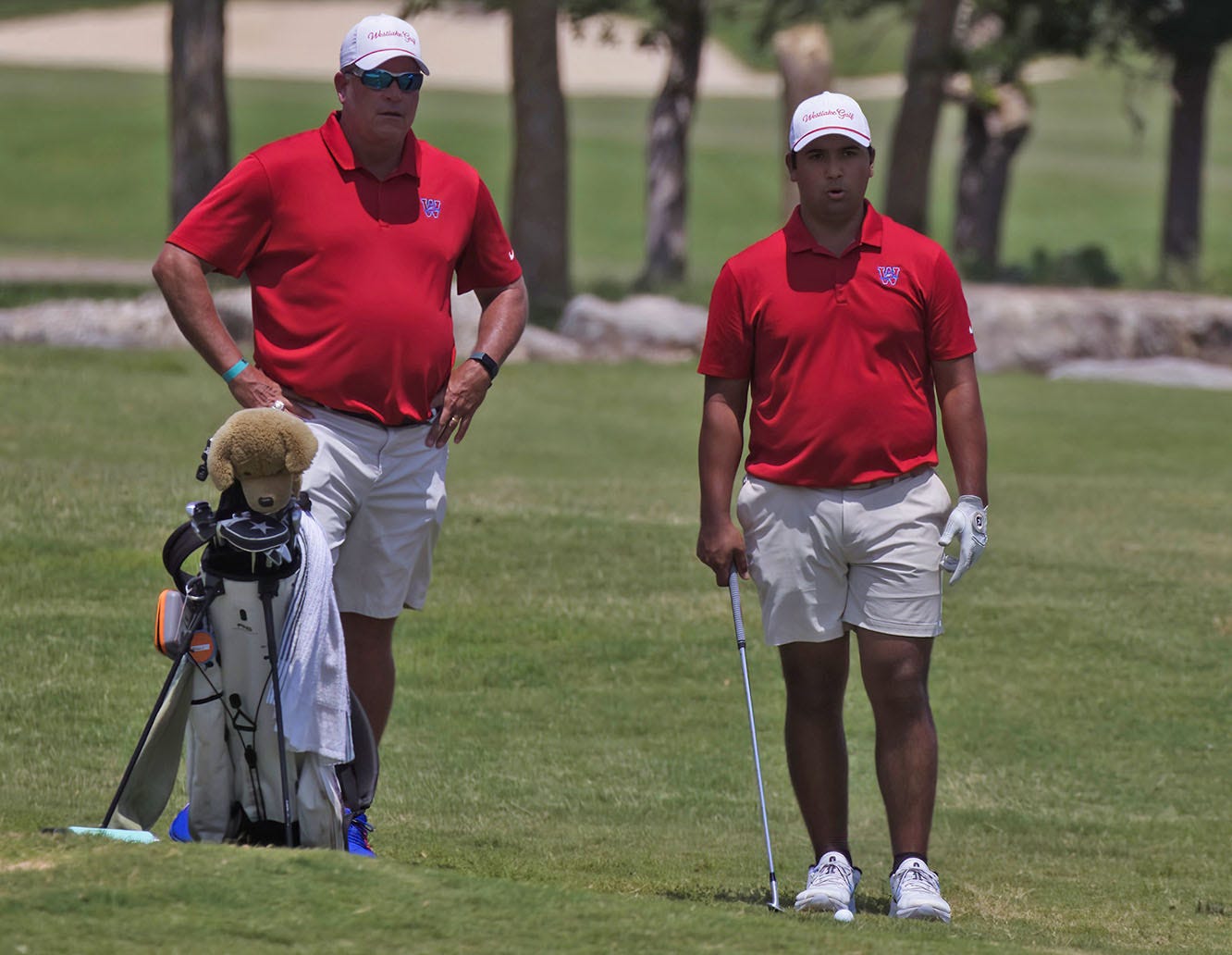
“We never beat buckets of balls on the range,” Adam Villanueva, a current Texas Longhorn who won 2 team titles as well as the individual title in 2023 while at Westlake, said. “Everything we do at practice is competition. When we practice, we get into tournament mode. We work on things other teams don’t work on.”
Looking back on the 2017 title team, Nokes said that was the year the final piece of his puzzle fell into place.
“I finally got my priorities exactly right,” Nokes said. “I knew exactly what I wanted out of a player. I want him mentally tough where nothing bothers him.”
Though he didn’t come along until later, Villanueva likens it to the big lesson he learned between 2023 and 2024: to evolve his game from what he calls “kid golf” to a mature brand of golf.
“I see kid golf as the way younger players play,” Villanueva said. “You know what you need to shoot, but when things don’t go your way, rage, frustration and mental fog get in the way.”
Nokes – as does John Fields, Villanueva’s coach at Texas – prefers a more mature approach.
“I’m fine with players making mistakes, because I know they are going to somewhere,” Nokes said. “But on the course, you have to take the approach of, ‘Okay, I just made a double (bogey), but so what? I’m going to the next tee; I’m going to stripe it down the middle and give myself a chance to make birdie.’ If they see that over and over, they start thinking that way. That’s a high priority for me.”
“As a mature player, you still need the anger and frustration, but you learn to put that back into your game in a good way,” Villaneuva said.
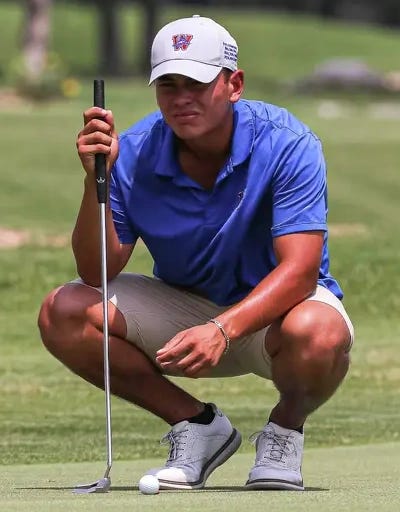
Jacob Sosa, a 3-time Westlake state champion who played college golf at Texas and Texas A&M, said that mentality, combined with Westlake’s culture, helped players minimize bad holes and taught them to do everything they could to speed their on-course recovery along.
“The coaches had a lot of trust in us,” Sosa said. “The whole thing about not getting mad was huge. It was never in my mind. We all felt like we didn’t want to do stupid things on the course because when you did that, and it didn’t work out, you felt you were letting the guys down.”
As the championships piled up, those moments seemed few and far between.
Part 3 (Tuesday, 7/14): Creating Program Depth through Frequent Team Qualifying Chances
Part 4 (Wednesday, 7/15): Embracing the Expectations and the Chaps who Delivered when it Mattered Most
Thanks for reading The Austin 6A High School Sports Report! This post is public so feel free to share it.
No posts
Comments
Nothing yet. Say the first thing.
Sign in to join the conversation.