
Happy Friday,
Since the last update I added a little new cash to the portfolio and made three small purchases: added to CBRS, added to MU, and opened a brand new speculative position in ProCap Financial (BRR).
Today I’m covering those recent trades, sharing a full portfolio update, and giving you some background on BRR.
But first, I want to share a really important lesson that helps me stay calm when things are bad (and not get too excited when they’re going well).
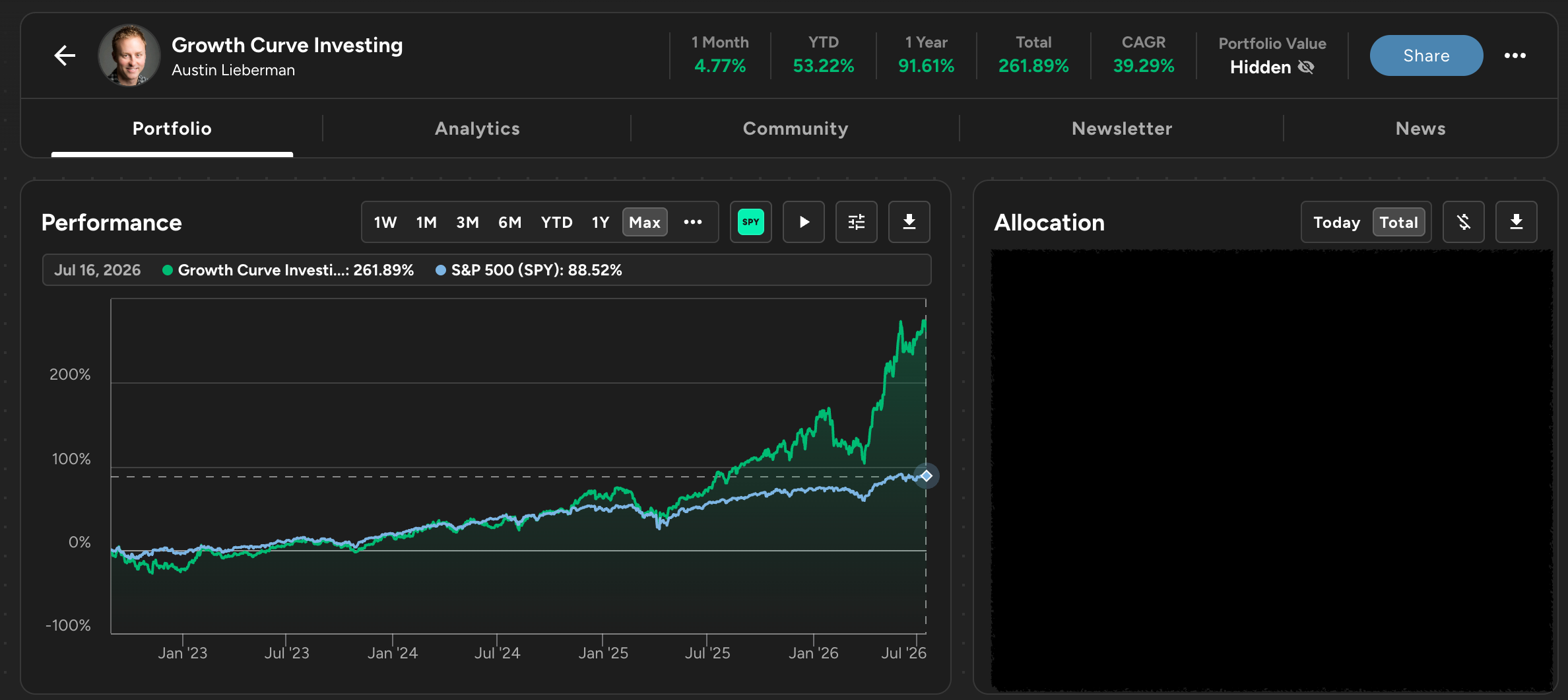
Total return since inception: +262%
CAGR: 39%
1-year return: +92%
YTD return: +53%
1-month return: +5%
S&P 500 over the same period: +89%
Roughly 173 percentage points of cumulative outperformance against the index.
I want to start with something bigger than any single position, because a week like this one (memory names whipping around 15% in days) is exactly when it matters most.
Over a decade of learning from David Gardner of the Motley Fool, I internalized one of his key observations that changed how I invest.
Stocks go up more often than they go down, but when they go down, they fall much faster than they rise. Advances are slow and grinding. Declines are sharp and violent. Anyone who lived through this past week in memory stocks just felt both halves of that truth compressed into a few sessions.
So how do I actually apply it?
The first half of the lesson says the long-term game is clear. Being invested, and staying invested, is the smart move. The market’s long climb rewards patience, and time in the market beats timing the market. If that were the whole story, you’d simply buy great companies and never look at the screen again.
But there’s a second half, and it’s the one that actually keeps you in the game: we have to survive the short term to enjoy the long term. Because declines are fast and brutal, a single bad stretch can wipe out an investor who wasn’t built to withstand it. Surviving isn’t about predicting the drops. It’s about constructing a portfolio and a mindset that can take the drops without forcing you to sell at the bottom.
For me, survival comes down to a few non-negotiable rules.
I don’t use margin. Leverage turns a temporary decline into a permanent loss, because the market can force you out at the exact moment you should be holding.
I don’t invest money I might need in the next three years. Money with a short fuse doesn’t belong in stocks, because you can’t control when the market hands you a 30% drawdown, and you never want to be a forced seller.
I don’t go all in on a single stock. Concentration is how you get rich and also how you get wiped out. My largest position is meaningful but sized so that even a brutal decline in it (and MU is testing that right now) doesn’t threaten the whole portfolio.
Those three rules are the defense. But there’s an offense to this too, and it’s just as important. When you’ve built yourself to survive, you don’t have to be ruled by fear when things get painful. In fact, the painful moments are usually when you should be most interested in building and holding positions, not running away. The best prices come attached to the worst feelings. Being able to keep buying, or at least keep holding, when a name is down and the headlines are ugly is where a lot of long-term returns are earned.
There’s one important caveat. Buying weakness only works when the thing you’re buying is genuinely good and somewhat reasonably valued. It is not a license to catch every falling knife. Some stocks got so wildly overvalued in this cycle that “it’s down 30%” still leaves them expensive, and a cheap-looking price on a broken or absurdly priced business is a trap, not an opportunity. That’s actually why I moved the portfolio toward high-quality, profitable, reasonably-valued companies in the first place. It’s much easier to hold through a scary decline (and even add to it) when you know the business is real, the balance sheet is strong, and you didn’t overpay to begin with. I’d rather avoid excessively valued short-term stories entirely than have to guess whether their drops are opportunities or warnings.
Put it all together and the philosophy is simple, even if living it isn’t. Don’t get too excited when times are good. Don’t get too scared when times are bad. Build so you can survive the fast declines, and position so you can take advantage of them. Then let the long, slow, upward grind of good businesses do the heavy lifting.
That’s the whole game. This week was a small reminder of why it matters.
Added to MU at $905.90 and again at $847.44, bringing the position to roughly 19% of the portfolio at an average cost around $987. The memory complex kept selling off and I nibbled into the weakness. The position is now down about 14%, my largest and my most underwater.
Added to CBRS at $177.93, bringing Cerebras to roughly 6% of the portfolio.
Opened BRR (ProCap Financial) at $2.01, a small 1% speculative position. More on BRR below.
I also added a little new outside cash, so despite the buys the portfolio still carries about 2% cash.
Thursday’s close:
MU at 19%. $853.20, cost basis $987.07, down 14%.
Comments
Nothing yet. Say the first thing.
Sign in to join the conversation.