
Glad you’re here! This is the main channel of the Austen Connection, where we find community through classic literature. We also host a read-along, which you can join here. Subscribe, and all our conversations will come right to your inbox. Welcome!
Hello, friends -
Today, we have a special guest post and a real treat. Tash, who writes the Substack , is staging an Austen Connection takeover today — from her headquarters in Australia! — to talk about: Sisters.
This wonderful essay arose from a conversation and I had over Substack right around the Wuthering Heights hoopla, and today she’s taken up the idea to inventory and deconstruct what’s going on in all of the sister dynamics of Austen’s stories.
This is such a lively discussion full of Tash’s usual thoughtful insights on classic literature and how it connects to our lives today. Enjoy!
Also below you’ll find ways for you to weigh in with your thoughts and join the conversation about Sisters - plus: a new podcast episode, postcards from London, and two surprises on a visit to Jane Austen’s House - all below!
And now, over to Tash!
Move over love pairings – what about the sisters!
Hello, friends of Plain Jane!
It is very nice to be in the friendly surrounds of this lively community. Thank you for having me!
I have come to share my hastily compiled well-informed observations about depictions of sisterhood in the novels of Jane Austen — in particular, the two best known and best loved sister-duos, Jane and Lizzie from Pride and Prejudice and Elinor and Marianne from Sense and Sensibility. Because though I am myself a sister, I have no sisters and so have found myself fascinated by (and envious of) sisterly relationships in literature.

Austen, perhaps thanks to her close relationship with her older sister Cassandra, seemed to understand the possibilities of this relationship for building out her female characters and creating a private world of interpersonal (female) support.
Of course, Austen gives us a rich array of sister types.
The Sister Spectrum: Which type are you?
At one end of the spectrum are the Elinors, Janes —and possibly Anne Eliots1 — of the world, those figures of goodness, sense, selflessness, and reserve. Those of you who fall in this category are the Big Sister Types. Big Sister Types are an asset to any family.
A third of the way along the sisterly spectrum is Elizabeth Bennet — spirited, of lively intelligence, funny, at times impatient and judgmental and wearing three inches of mud on her dress. Those of you here at this part of the sisterly continuum — I know I know, we all want to be here — are a little more carefree than the Big Sister Types but also benefit from the anchor they provide.
We can easily imagine Elizabeth being rather less thoughtful, kind, and patient without the moderating influence of Jane — though Jane also benefits from Elizabeth’s incisive decoding of the behaviour around them. Without Elizabeth, Jane would be more naïve; without Jane, Elizabeth would be less generous.
We can easily imagine Elizabeth being rather less thoughtful, kind, and patient without the moderating influence of Jane — though Jane also benefits from Elizabeth’s incisive decoding of the behaviour around them. Without Elizabeth, Jane would be more naïve; without Jane, Elizabeth would be less generous.
Meanwhile you Elizabeths are the Well-Adjusted Second Daughter Types — encompassing within you liveliness and intelligence with none of the flightiness of a Heedless Younger Sister (of which, more in a moment). Big Sister Types are loved by their mothers while Well-Adjusted Second Daughter Types are loved by their fathers.
A little further along on the sisterly spectrum is Marianne Dashwood. She is Elizabeth — spirited and smart — but with a lot more passion and willfulness mixed in. Mariannes are insulated from practical considerations by the competence of their sensible older sisters and are therefore allowed to grow all in one direction. These are the Romantic Sister Types.
I’m afraid we are looking at you, Marianne Dashwood:
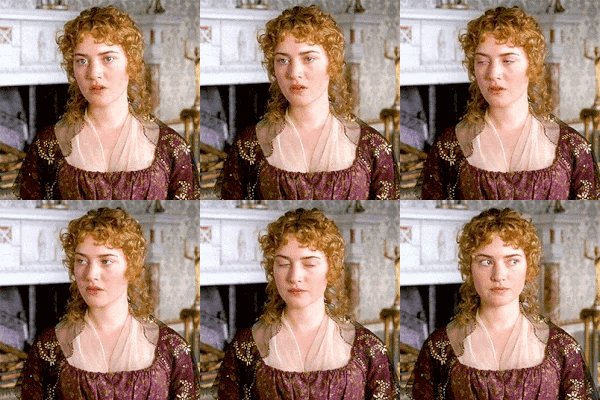
Romantic Sisters love poetry and music and being in love. They’re sometimes foolish but are beloved by all. They tend to elicit a protective instinct in Big Sister Types.
Though often self-absorbed, Romantic Sister Types are quick to leap into the fray to defend a beloved family member. They are fiercely loyal and strong-willed.
Romantic Sisters are sometimes foolish but are beloved by all. They tend to elicit a protective instinct in Big Sister Types. Though often self-absorbed, Romantic Sister Types are quick to leap into the fray to defend a beloved family member. They are fiercely loyal and strong-willed.
Not far from the Mariannes but perhaps lying orthogonal are the Emmas. Like the Mariannes and Elizabeths, Emmas are lively and intelligent. They tend to have a happy, bubbly personality and to be very social and socially oriented; they enjoy stage-managing their social world to achieve worthwhile results.
Yes — now we are looking at you, Emma Woodhouse:

But, Emmas can also be bossy and, at worse, thoughtlessly condescending. They imagine they always know best. These are the Only-Child Sister Types.
Some of the Only-Child Sisters do have a sibling — probably an older one, as does Emma Woodhouse — but the age gap is too great for that sibling to exert any moderating influence.
The great redeeming quality of Only-Child Sister Types is that they are inherently well-intentioned and — like Emma — have prickable consciences.
Only-Child Sisters do have a sibling (probably an older one, as in the case of Emma Woodhouse) but the age gap is too great for that sibling to exert any moderating influence. The great redeeming quality of Only-Child Sister Types is that they are inherently well-intentioned and have prickable consciences.
Continuing on, at the outer limits of sense and propriety are Lydias and Kittys2 — though I doubt whether anyone here would place themselves at the Lydia-Kitty pole; that would demonstrate far more self-awareness than a person at this end of the spectrum has any right to possess.
Because the people at this pole are the Heedless Younger Sister Types. They are thoroughly unserious! They are driven by “high animal spirits.”
The irony is that, while Big Sisters and Heedless Younger Sisters are poles apart, they are forced to fraternize rather a lot because the Big Sister Types are the only members of the family with enough patience and unconditional love to do the onerous emotional work of worrying about their younger siblings, reining in their excesses, and helping them when things go wrong. The Well-Adjusted Second Daughter Type might intervene for the sake of the family reputation, but the Big Sister Type will intervene for the sake of sisterly love.
Yep:
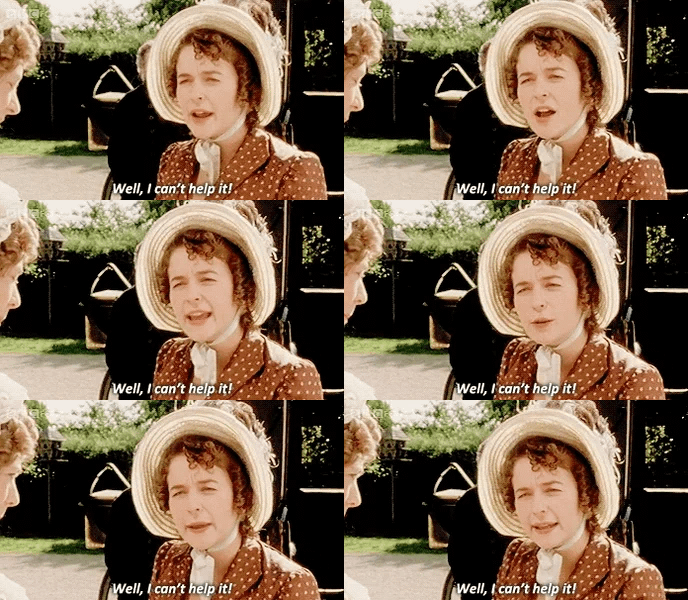
But before we dismiss this silly and folly-some type, understand that most of us had to pass through the Heedless Younger Sister doorway to access the upper echelons of sisterhood.
From Cathy to Dorothea — repeating sister archetypes
What makes Austen’s sister types so compelling is that they are so archetypal! You will now notice them everywhere. Madame Bovary, Fantine and Cathy from Wuthering Heights are all Romantic Sisters whose great tragedy is that they did not have a Big Sister Type to save them from themselves! Jane Eyre and Dorothea Brooke both have strong Big Sister energy which hides a Romantic heart.
Jane learns to hide her passionate nature during her time at Lowood School, while Dorothea’s romantic view of intellectual pursuits leads her into a bad marriage. Middlemarch’s Rosamond, on the other hand, is an Only-Child Sister, exhibiting some of the less desirable attributes of this type.
Mrs Ramsay, from To the Lighthouse, is the ultimate Big Sister Type. She is the Big Sister at the peak of her powers but with, unusually, some of the energy of an Only-Child Sister – she likes to orchestrate the social world around her without always fully understanding it.
And we see some variations on that Jane-Lizzie and Elinor-Marianne pattern in books like: We Have Always Lived in the Castle with Constance and Merricat; Little Women with Meg and Jo; and I Capture the Castle with Rose and Cassandra.
Insisting on sisters
I know what you’re thinking. This is all very well, Tash, but aren’t you just cataloguing personality types. What have ‘sisters’ to do with anything?
I am insisting on sisters because these personality types, at least in Austen, are relational. The sisters grow and develop in concert with each other. They influence each other. The society they move in is first a society of sisters, and sisters remain their closest associates and encouragers. In many of the examples above, characters run aground for want of a sister. The excesses of their natural characters are not curbed!
I am insisting on sisters because these personality types, at least in Austen, are relational. The sisters grow and develop in concert with each other. They influence each other. The society they move in is first a society of sisters, and sisters remain their closest associates and encouragers.
But also, sisterly relationships offered Austen an important space in her novels to draw out her characters, to depict a hidden female world, to allow her characters to express themselves with frankness to another person who knows and understands them better than anyone else. And drama is created in cases where that intimacy is interfered with or disturbed, as in Sense and Sensibility when Elinor is forced to keep Lucy Steele’s secret from Marianne.
Without the intimacy of the relationship between sisters, Austen’s books would lose half their depth and find themselves stuck on the societal stage without a backstage pass. Even the busy Bennet household is too ‘public’ for the venting of personal hopes and fears. This must take place in a quieter, less public realm, with a trusted sister.
Pairings, poles, and false sisters
At first blush, these sisterly pairings appear similar — a calm, sensible, reserved, older sister and a spirited, less reserved, younger sister. But, these two pairs are quite different. Jane is sweeter — her goodness is directly correlated with her generosity of spirit; her willingness to see the best in everyone. Elinor is more pragmatic — her goodness is directly correlated with her selflessness in looking after her family and putting their needs above her own.
Critically, both are very good! But Elinor demonstrates greater character development, which we see particularly in her evolving relationship with her sister.
Lizzie and Marianne are also different. Marianne is passionate and romantic where Lizzie is playful and incisive. These differences result in a different relationship between the sisters. Jane and Lizzie are closer; peers on the same level. Elinor and Marianne love each other but are, certainly at the beginning of the book, distant. Elinor’s relationship with Marianne is parental rather than sisterly.
The Austen Connection is supported by you, our community of readers. You power this project by becoming a free or paid subscriber. Thank you!
Interestingly, Sense and Sensibility shows us false sisters before it allows the true sisters to find and understand each other again. Elinor endures Lucy Steele’s misplaced sisterly intimacy. which cloaks a powerful rivalry. But Elinor’s friendship with Lucy lacks that feature which Austen’s true sisters have which is love and care without agenda.
Another false sister might be Marianne and Elinor’s mother, Mrs Dashwood. Being temperamentally similar, Marianne and her mother have a sisterly closeness. This displaces the more practical Elinor who finds herself mothering both.
In Pride and Prejudice, the Bingley sisters are also false sisters in a way, offering friendship to Jane, only to withdraw it upon finding out about the attachment of their brother. Their kindness is conditional. Georgiana, on the other hand, is not a false sister. She and Lizzie develop a close relationship without agenda and this, we find out, was Darcy’s hope.
Closed sorority
The different quality of the relationship between Lizzie and Jane and Marianne and Elinor is well demonstrated by how much time we see each pair together in the first half of the book and the nature of those interactions.
In Pride and Prejudice, Jane and Lizzie’s first scene together alone is in Chapter 4 and involves an affectionate debrief of their night at the Assembly where they’ve met Bingley and Darcy and where Bingley danced with Jane twice and Darcy insulted Lizzie.
Next, they will debrief about revelations involving Darcy’s mistreatment of Wickham. Lizzie has an even worse opinion of Darcy, while Jane is not sure. “One does not know what to think,” says Jane, who cannot believe anyone to be truly bad. “One knows exactly what to think,” retorts Lizzie.
Then at the beginning of Volume 2, Jane reports to Lizzie that Bingley has left for London without saying goodbye. They discuss the matter, Jane trying to maintain equanimity, and both are loving and affectionate to one another.
This closed sorority offers a place for the sisters to confide in each other, offer affection and reassurance and work through problems together — as equals. Through Volume 2, their private discussions will continue via letters.
In Sense and Sensibility, the relationship is different and the first private conversation among the Dashwoods (Volume 1, Chapter 3) is between Marianne and her mother (rather than Elinor) and involves a criticism of Edward Ferrars. Marianne speaks to Elinor in the following chapter and they discuss Edward. Marianne ridicules Elinor’s statement that she “esteems” Edward: “Esteem him! Like him! Cold-hearted Elinor! Oh! worse than cold-hearted! Ashamed of being otherwise. Use those words again and I will leave the room this moment.”
After this, most of Elinor’s conversations with Marianne take place with others present. In Volume 1, Chapter 8, they discuss Brandon’s age but their mother is present and when Elinor leaves the room, it is Marianne and her mother who have a private conversation. In Volume 1, Chapter 10, Elinor chides Marianne for talking too much when Willoughby visited, but again their mother is present. “I see what you mean,” says Marianne. “I have been open and sincere where I ought to have been reserved, spiritless, dull and deceitful.” Great retort!
The next discussion of Brandon between the sisters, in the same chapter, occurs with Willoughby present and Elinor playing the reproving older sister, counseling them to be kinder. Finally in Volume 1, Chapter 12, Elinor and Marianne are alone together but this is another occasion for Elinor to criticize Marianne’s acceptance of the gift of a horse from Willoughby and to demand that she turn it down.
Unlike Jane and Lizzie, Elinor and Marianne are not on equal footing but are instead caught, perhaps unwillingly, in the roles of disapproving mother and dismissive daughter. So the novel’s major character development involves the sisters recognizing and freeing themselves from this pattern of interaction.
Elinor’s major leap forward is to trust and lean on her sister rather than always hold herself back behind a fortress of reserve — to give up some of the power of parental authority and act more like a sister, deserving of care and support in her own right. Marianne’s major leap forward is to understand that she too has sisterly responsibilities — she must give, not only take — and that she had a wrong impression of the depth of Elinor’s feelings for Edward due to Elinor’s natural reserve.
Elinor’s major leap forward is to trust and lean on her sister rather than always hold herself back behind a fortress of reserve — to give up some of the power of parental authority and act more like a sister, deserving of care and support in her own right.
At the end of Pride and Prejudice, Darcy has changed, Lizzie has changed a little (mostly in her opinions rather than her core character) and Jane has changed not at all. In Sense and Sensibility, Brandon and Ferrars change hardly at all – they are grave and good throughout.
But Elinor and Marianne have changed significantly – and their biggest change is in relation to each other.
Sisterly affection for a Happily-Ever-After
In all of Austen’s novels and particularly Pride and Prejudice and Sense and Sensibility sisterly affection is a sign of good character. The foundation of Elinor’s goodness is her devotion to Marianne whom she places above care or attention towards herself, even when deeply unhappy.
In fact, she uses this sisterly love to drive away her own worries. She has borne her unhappiness “as much as possible without spreading it further” and would not have Marianne and her family suffer on her account.
When Marianne finds out that Elinor has been burdened with the secret of Edward’s engagement for four months, she cries: “Oh! Elinor, […] you have made me hate myself for ever. — How barbarous I have been to you! — you, who have been my only comfort, who have borne with me in all my misery, who have seemed to be only suffering for me! — Is this my gratitude? — Is this the only return I can make you? — Because your merit cries out upon myself, I have been trying to do it away.” (Volume 3, Chapter 1.)
In Pride and Prejudice, although there are other reasons for turning down Mr Darcy, it is loyalty to a beloved sister that easily outranks an extremely advantageous offer of marriage. Mr Darcy destroyed the happiness of Jane so Mr Darcy shall be turned down by Lizzie. Indeed, a major aspect of Darcy’s rehabilitating his standing in Lizzie’s eyes will be services to her sisters — rescuing Lydia and addressing the injury done to Jane.
Near the end of the book, Lizzie teases Darcy and says that it was her impertinence that he fell for. Darcy corrects her that it was the liveliness of her mind. No, says Lizzie, he was just sick of civility, deference and officious attention and refreshed by her offering the opposite, despite her otherwise being no good at all. Darcy replies:
‘Was there no good in your affectionate behaviour to Jane, while she was ill at Netherfield.’
‘Dearest Jane! who could have done less for her? But make a virtue of it by all means. My good qualities are under your protection…
But in Jane Austen’s world, sisterly affection is a virtue – a foundational virtue which makes obvious which characters are noble and good.
Wow - thank you, Tash, for this dynamic breakdown of the many aspects of sisterhood in the stories of Jane Austen. I especially love your highlighting the ways that sisters are a key part of the famous Happily-Ever-After and resolution of Pride and Prejudice.
Check out more of Tash’s insightful essays and conversation at - see you there! And now, readers — over to you!
Take the mic, readers 🎤
Let us know:
First of all, which of these Sister Types that Tash outlines here cause you to see a heroine or an Austen character differently? Did this layer of Sister Dynamics bring any new ways of seeing an Austen story for you?
What sister dynamics play out in your family? What dynamics do you see around you? Any resonances to what we see playing out in Austen?
Are you new here — if so, welcome! We have new subscribers all the time, and many of you are just starting to get in to Austen novels or films. If so, let us know which sisters you’ve encountered so far in the books or films, and what those dynamics bring to the story for you?
Are you like Tash and sister-less so far (so far, because if you’re lucky you can acquire sisters and sisters-in-law throughout your life, not to mention sister dynamics in daughters and nieces!) and so fasincated with all the fictional sisters? Which ones?
Speaking of which, are there any sisters outside of Austen like Tash mentions here — from Wuthering Heights, or Middlemarch or other classic novels — that appeal to you or fascinate? Weigh in — chances are Tash and I have some theories on your fave literary sisters!
Brothers, anyone? Is this for another post? What about those formidable Knightley brothers?!
And what are we missing? Let us know the answer to the question you wish we’d asked, and any other thoughts on this post!
Share and over-share here!:
Coming up!
We’re always reading All of Austen - over at the Great Jane Austen Readalong, we’re making our way through Mansfield Park. You can jump on or off the readalong train any time — it’s a lively, friendly community of readers. Next up: On September 6th, we start Emma. It might be Jane Austen’s most fun novel. Join us! All you have to do is Subscribe.
Here’s more info:
Thank you!
Meanwhile, thank you for being here, friends and readers. As we always say, just by being here you’re supporting dialogue, connection, community, discourse and a lot of good things that we need in our world right now, wherever we are. Subscribers — both free and paid — power this project and keep it free and accessible for all. And if you are able to support with a paid subscription, you’re absolutely the best and perhaps almost as good as that Star Sister, Elinor Dashwood.
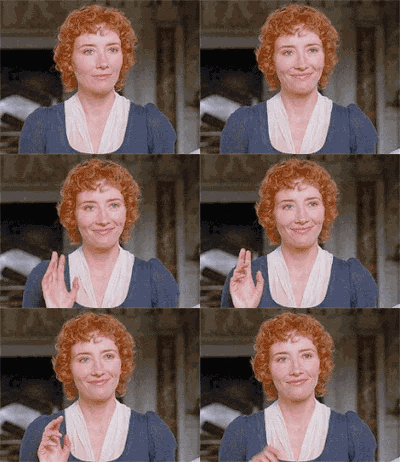
Hope you find some well-adjusted sisterhood, some Big Romantic Feelings, some sorority and solidarity, and some sisterly affection in your world this week. Whatever the week brings you, happy reading. Stay well and stay in touch.
Yours affectionately,
Plain Jane
Cool links and community
A new podcast episode, with JASNA’s Austen Chat!
What?! How did Plain Jane get behind the mic of the amazing Austen Chat podcast produced by the Jane Austen Society of North America?! Mainly because awesome host Breckyn Wood took a brief summer break, and they gave me the honor of stepping in for the August episode. And what an episode! It’s a conversation with director Laura Piani, whose indy film Jane Austen Wrecked My Life is an outright beautiful meditation on art and love, and one of my fave romcoms of all time.
Here’s the conversation for Austen Chat - enjoy!
And here’s the trailer to the film, which itself will cheer you up - enjoy!
London postcards, from the Absolute Dream Department
The dream of the London Summer continues, and if you follow the Austen Connection on Substack Notes, you already know with the rest of Substack book-nerds that this week I went — for the very first time! — to Chawton to see Jane Austen’s House. Thanks to my friend Allie for the company and the photography. Have you been there? If so, please share your experience in the comments above. And keep scrolling to see a couple of surprises I encountered on the visit:
Surprise at Chawton and Jane Austen’s House Number 1:
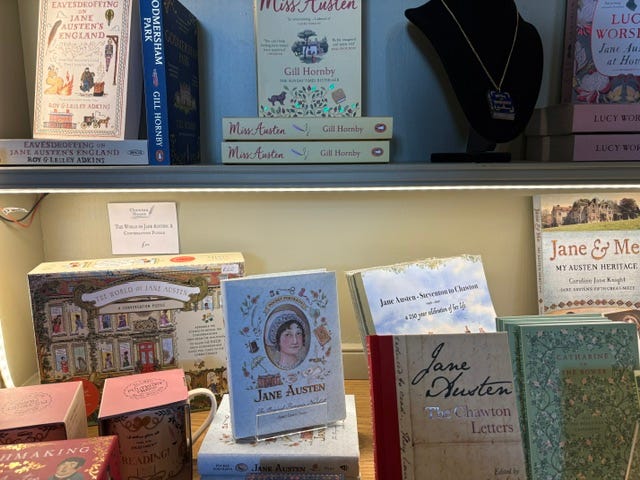
Having paid a visit to the beautiful Chawton cottage, where Jane Austen revised, wrote and published her novels, my friend Allie and I walked the grounds of Chawton House, the estate of Jane Austen’s brother, Edward Knight. Reluctant at first to go in — the entrance is imposing, that is the point! — I followed a visitor inside and when she was waved forward to browse at the gift shop, I followed her there too. And my surprise was to find my book among the lovely selection on the shelves! It was such a surprise that I blurted out my delight to the bookseller, and ended up posing for photos and signing a reader’s copy, and engaging in lovely conversation while there! Here’s the book among great company such as , Gill Hornsby, and Kathryn Sutherland, as well as Substacker who grew up at Chawton House:
Surprise at Chawton and Jane Austen’s House Number 2:
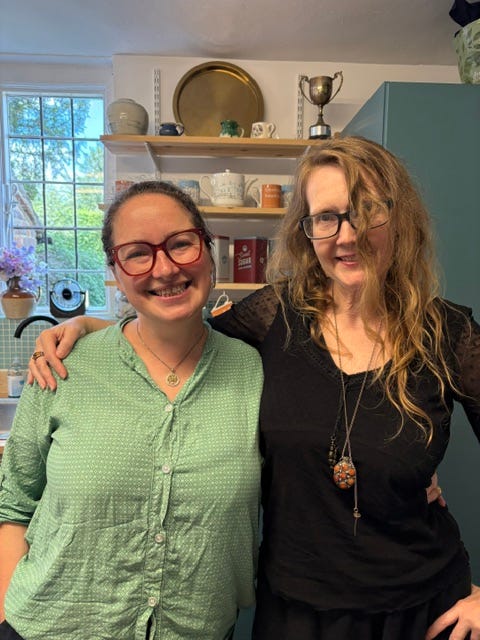
This was hastily planned but not at all a given, that the vivacious, brilliant director of Jane Austen’s House, Lizzie Dunford, would be on site when I managed to get myself on the premises. She was there, so we were able to have a cuppa and chat about her fascinating research. She is planning to do and Austen Connection takeover coming up soon, to share with us some insights into her research on Austen and Fairy-Tales. It’s groundbreaking, and so much fun. Stay tuned! Meanwhile, here we are and yes that is me somewhere behind the hair. Thanks to my amazing friend Allie for the photo.
Jane Austen and the Future of Humanities is a project by Lehigh University’s Michael Kramp, an Austen scholar who has written about masculinity in Jane Austen among many other topics. He’s also an excellent media producer so his project features amazing videos and a podcast. Check it out, and stay tuned for more as Plain Jane features in these conversations Professor Kramp so expertly produces! If you watch, come back and let us know your thoughts!
If you enjoyed this edition of the Austen Connection, invite a friend to join us!
Despite Anne being a second rather than eldest daughter.
I realize I am overlooking many Austen sisters in this brief rundown: There is of course Mary Bennet — much rehabilitated in the recent the recent TV series, The Other Bennet Sister, and based on the book by Janice Hadlow, but silly and priggish in Pride and Prejudice. There’s also Fanny Price and the Bertram sisters from Mansfield Park and the Elliot daughters from Persuasion and Catherine Morland from Northanger Abbey. I wonder where you would place them in the sisterly spectrum of types.
Comments
Nothing yet. Say the first thing.
Sign in to join the conversation.