
With the release of the QLD and NSW budgets earlier this week, Australia’s budget season is now over, and it’s time to make some judgements.
The bad news is that not a single jurisdiction has managed to achieve a fiscal surplus for 2026/27. Several states (WA, SA, VIC) have reported an operating surplus, and have convinced the gullible media to focus on that metric… but the operating balance does not include net capital spending, and all of those states have continued to rack up more debt.
To be fair to WA, they did achieve a fiscal surplus last year, and are expected to return to surplus next year, and have the lowest debt levels in the nation, so when it comes to debt and deficits they once again are leading the pack. This earns WA Treasurer Rita Saffioti an honourable mention, but the ATA Treasurer ranking is not based on the size of the deficit.
For our ranking we look at which government is able to keep their spending under control. The structural problem at the heart of Australian politics is that our politicians are addicted to spending taxpayer money. This is the underlying cause of our high taxes and rising debt. Tax rates and budget deficits may get the headlines, but the key to a responsible budget is spending restraint. Specifically, we are looking at the rate of real per-capita spending growth in the budget year (2026/27), while also factoring in the last year (2025/26) and the coming years.
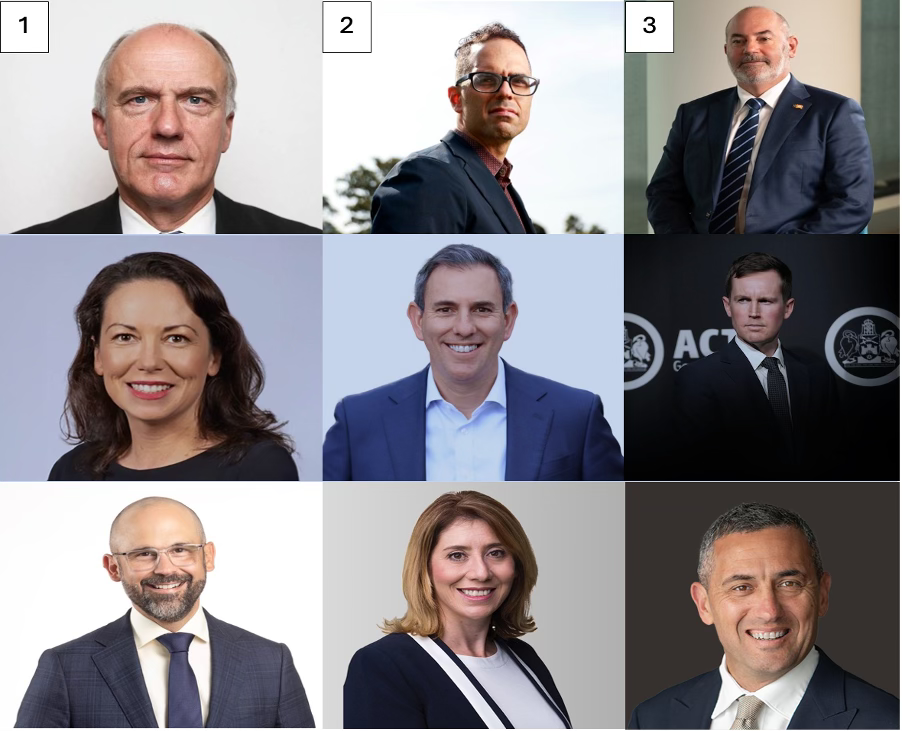
This is how the Treasurers compare:
Eric Abetz (Tasmania) = the most spending restraint in 2026/27, and continuing spending restraint expected into the future.
Daniel Mookhey (NSW) = 2nd best spending restraint in 2026/27, though he doesn’t keep it up in the forward estimates.
Bill Yan (NT) = Not quite as good as TAS, NSW & VIC in the budget year, but showed the best spending restraint in the year just gone (2025/26) and has the highest forecast spending restraint into the future… if those come true, then he’ll go up the pecking order.
Jaclyn Symes (VIC) = 3rd best spending restraint in 2026/27, though was let down by over-spending in the year just gone.
Jim Chalmers (Federal) = Middle of the pack is not good enough for a federal Treasurer, but at least he’s not the worst.
Chris Steel (ACT) = Actually the 2nd worst performer in the budget year, but makes up for it somewhat with good spending restraint in the year just gone.
David Janetzki (QLD) = 7th place in the budget year (2026/27), 7th place in the year just gone (2025/26), and 7th place into the future (2027/28).
Rita Saffioti (WA) = Perhaps because the WA budget was already in relatively good health, Rita has let herself slip with the highest spending growth expected in the budget year. Though she partially makes up for this with lower spending in future years.
Tom Koutsantonis (SA) = While not the worst offender in the budget year, if we look at their average over a two or three-year period then SA government spending is rising the fastest in the nation.
It should be noted that the above scorecard is obviously a relative measure of performance. By any objective measure, all of our Treasurers are taxing too much, spending too much, borrowing too much, and regulating too much. Australia is sleepwalking into an uninspiring future of stagnant productivity and suffocating debt, and we desperately need a new bread of bold economic reformers.
Nonetheless, congratulations to Eric Abetz on being Australia’s best Treasurer for 2026, kudos to Daniel Mookhey and Bill Yan for podium finishes, and hopefully the other Treasurers are inspired to improve for next year.
P.S. Tonight on the “Death & Taxes” podcast, Gene & John will be joined by economist & trader Derek Francis, who has recently made waves by pointing out a serious unintended problem with the government’s CGT changes. You can watch live on YouTube, X/Twitter & Facebook tonight at 8pm AEST.
Comments
Nothing yet. Say the first thing.
Sign in to join the conversation.