
Twenty years ago this week, after years of budget surpluses, the then-Treasurer Peter Costello announced that Australia had finally reduced national net debt to zero. He declared the 21st of April 2006 as “zero net debt” day. The Howard/Costello years had their ups and downs, but paying off the national debt was one of the positives.
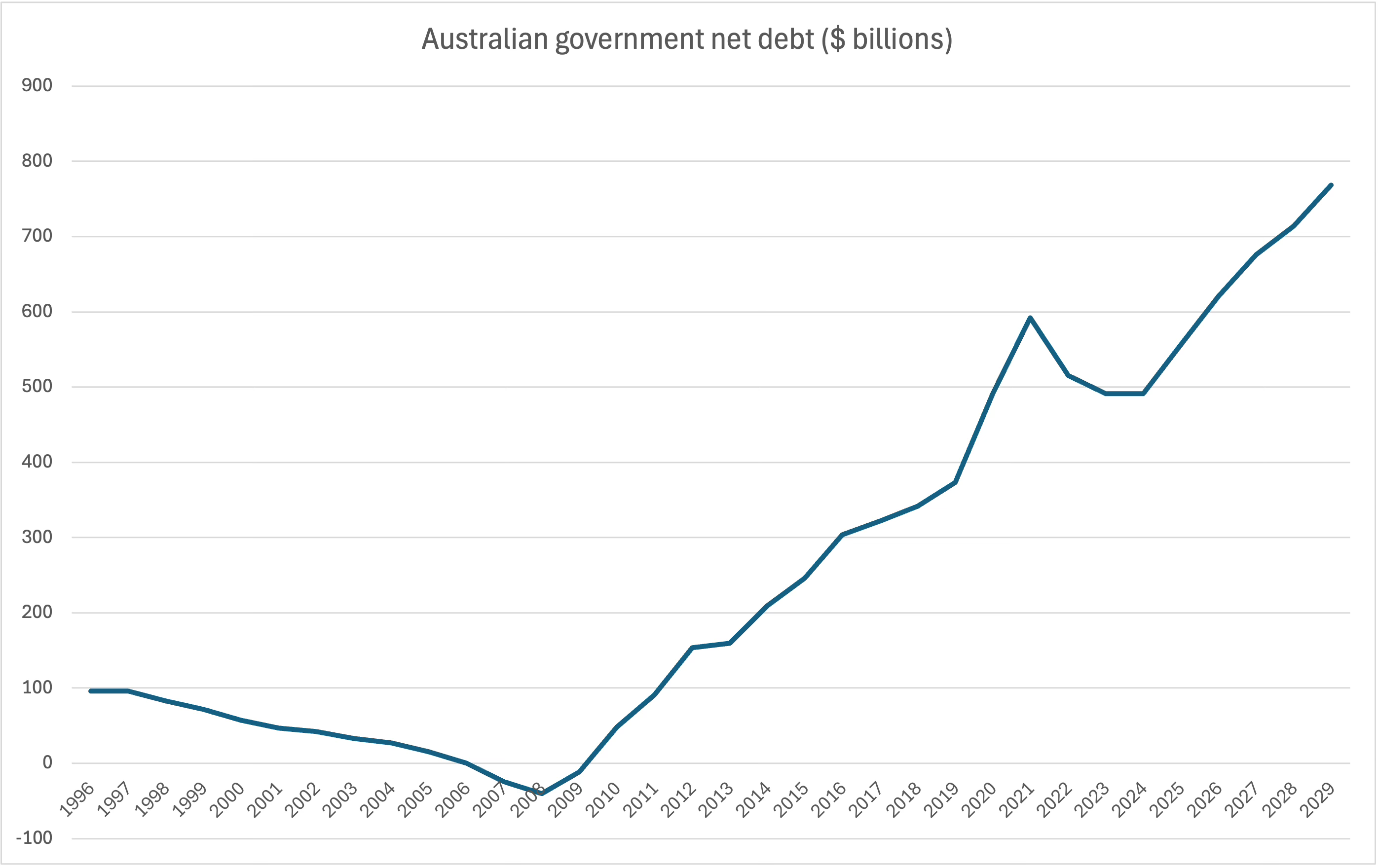
At the time Costello warned that “if we lose focus and discipline we could easily go backwards”. A year later the Howard/Costello government lost power, and there has been a steady decline in Australia’s fiscal position under all subsequent governments, with net debt now over $600 billion and rising fast.
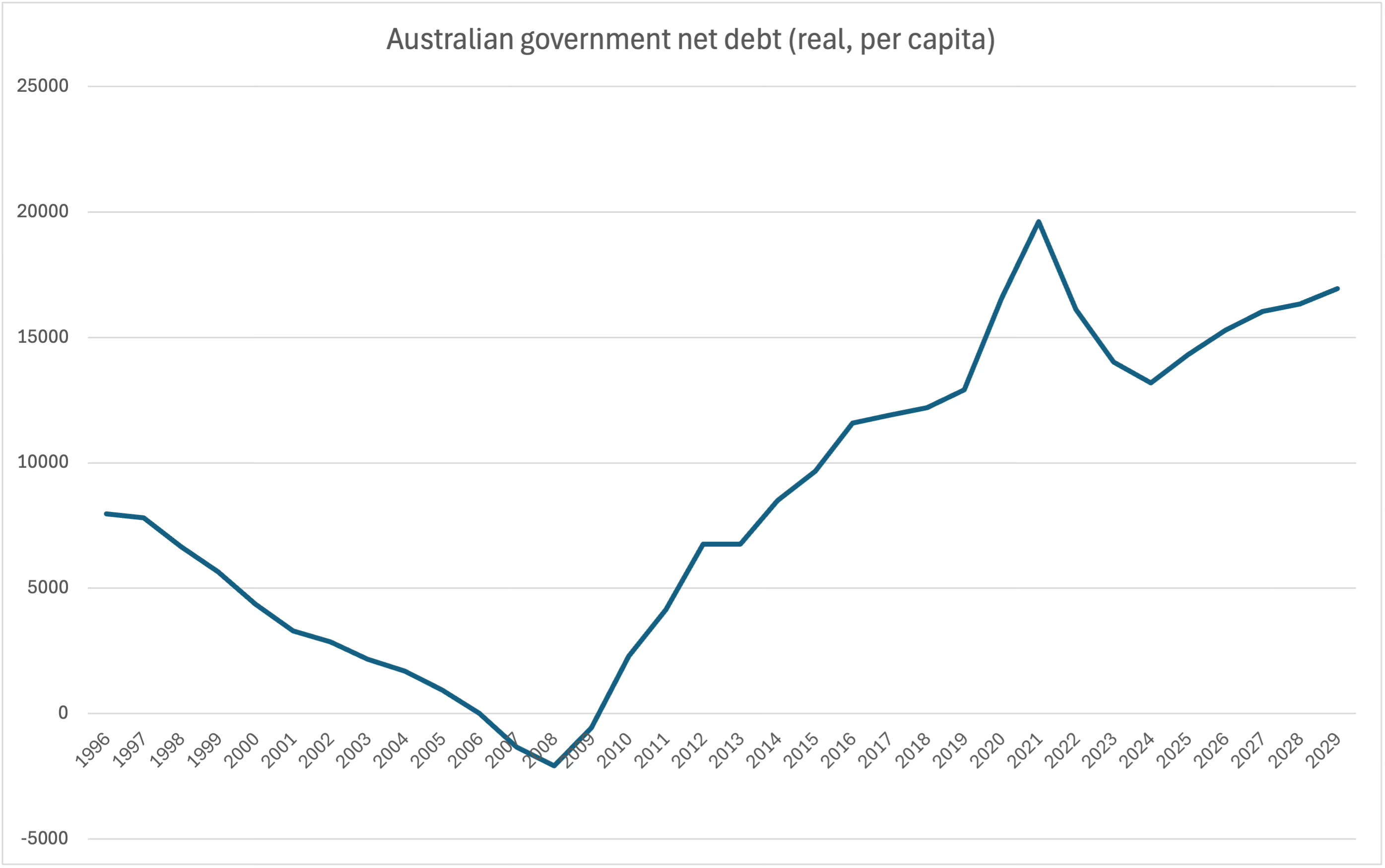
Debt doves will object that the above graph tells an exaggerated story because it does not factor in inflation or population growth. Fair enough, but even if we adjust for prices and population it’s still clear that Australian net debt is trending in the wrong direction.
How much does this really matter? It is clear that Australian politics has moved on from the debt debate, with both major parties embracing deficit spending, and most academics insisting that Australian debt is not a problem. Everyday Australians quite rightly ask themselves why they should care about a government graph going in the wrong direction when they’re struggling with high costs and stagnant wages.
Government debt is a tricky problem because it is important but not urgent. The debt doves are right that current debt levels are sustainable, and the public are right when they say that cost-of-living is a more urgent concern. Politicians tend to focus on the urgent, and so the debt situation continues to deteriorate.
The analogy I like to use is a person walking towards the edge of a cliff. Walking off the edge would be disastrous, but each step before the edge appears harmless. The debt doves argue that we are not near the edge, so we shouldn’t be worried about taking a few more steps in that direction.
The problem with that argument is that it assumes we can easily stop just before the edge. To continue with the debt cliff analogy, the truth is that we can never know exactly what level of debt is unsustainable, so we are stumbling towards the cliff edge blindfolded. Further, the government of the day does not have perfect control over debt fluctuations, so we are stumbling towards the cliff edge both blindfolded and drunk. It may be true that we are not yet at the edge, but obviously we would be wise to stop stumbling in that direction.
The situation is made worse by the consequences of an ageing population. Our low fertility rate is creating a future with fewer working-age people being asked to fund the health care, aged care, and pensions of a fast-growing older population. As the Intergenerational Report outlines, this will push up real government spending per person by roughly 70% over the coming decades. Unless the government can find a way to get that spending under control, then debt and deficits will keep rising.
This is a fixable problem. There is still time for a responsible government to emerge, get government spending under control, and stop sleepwalking towards the debt cliff. Costello showed us 20 years ago that it is possible to balance a budget and pay down debt. With a bit of political courage we can do it again, but we will much more courageous and forward-thinking politicians.
P.S. Tonight on the “Death & Taxes” podcast, Gene & John will be joined by Professor Sinclair Davidson from RMIT. You can watch live on YouTube, X/Twitter & Facebook tonight at 8pm AEST.
Comments
Nothing yet. Say the first thing.
Sign in to join the conversation.