
Editor’s Note
This week’s Dispatch comes off the back of one of the most important weeks yet for Australia’s digital economy conversation.
Between the Digital Economy Conference, our Australian Blockchain & AI Network Sydney meetup and the broader global news cycle around frontier AI, stablecoins and digital asset infrastructure, the same theme kept appearing from different directions: these technologies are no longer moving in separate lanes.
AI is becoming a question of governance, access and economic agency. Stablecoins are becoming a question of settlement, payments and sovereignty. Tokenisation is becoming a question of institutional infrastructure. And increasingly, the most interesting work is happening where those systems meet.
At DECA, this was clear across the discussions on agentic commerce, strategic digital asset reserves, future payment rails, custody, compliance and whether AI can be trusted with money. These are no longer abstract ideas. They are live design questions for governments, financial institutions, technology providers and builders.
That is also what we saw at our Sydney meetup on 16 June, where Armina Rosenberg, Arturo Rodriguez and Sophie Bowler each approached the AI and blockchain intersection from a different angle: investment research, programmable settlement, agentic transactions, custody, compliance and responsible deployment.
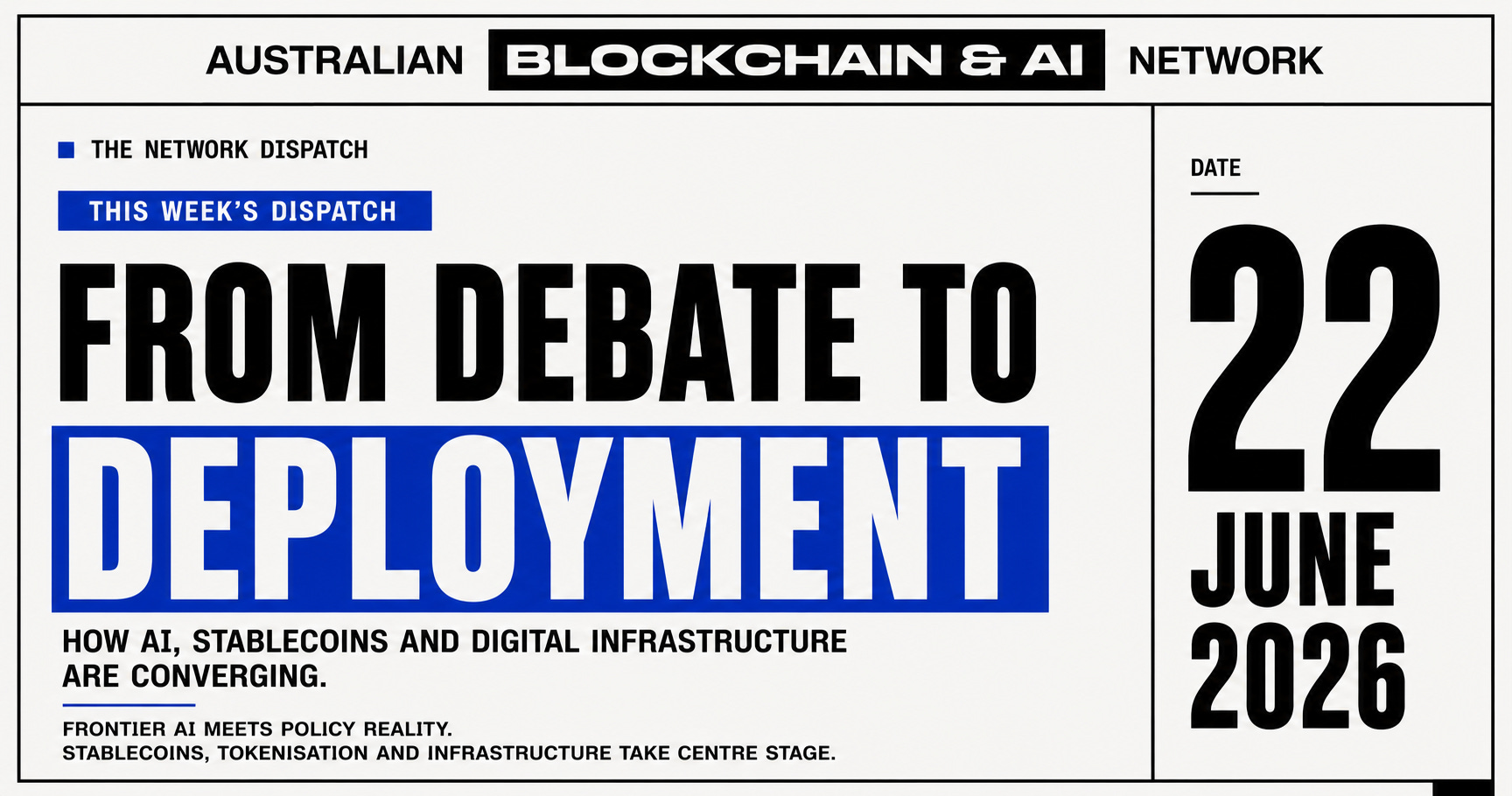
So this week’s issue is less about treating AI and blockchain as separate sectors and more about the infrastructure layer forming between them.
Because if there was one clear message from the week, it was this:
The digital economy is not something arriving later.
It is being designed now.
Thanks for reading The Network Dispatch! Subscribe for free to receive new posts and support my work.
THIS WEEK IN AI
Anthropic’s Fable 5 Shutdown Becomes Global AI Story
The fallout from the US government’s order restricting access to Anthropic’s Fable 5 and Mythos 5 models continued this week, with the White House signalling it may revisit its position following discussions with Anthropic. What started as a model launch quickly became a global debate about AI sovereignty, export controls, and who ultimately controls access to frontier intelligence. For many organisations, it has been a wake-up call that access to advanced AI models is becoming a governance and geopolitical issue, not just a technology issue.
AI Sovereignty Moves From Theory to Reality
One of the most interesting consequences of the Anthropic situation has been the renewed focus on sovereign AI. Governments, banks, and major enterprises across Europe and the UK are increasingly questioning whether critical AI infrastructure should depend entirely on models controlled by another jurisdiction. The discussion mirrors earlier debates around cloud computing, semiconductors, and digital infrastructure.
Cybersecurity Experts Push Back Against Fable Restrictions
A coalition of cybersecurity experts publicly criticised the US government’s restrictions on Fable 5 and Mythos 5, arguing that limiting access to advanced defensive AI tools could ultimately weaken security outcomes. The debate highlights a growing tension between national security concerns and the need for defenders to access increasingly capable AI systems.
Claude Community Australia Takes the Global Stage
Rye Smith represented Claude Community Australia at Anthropic’s Code with Claude event in Tokyo, sharing the work being done across Australia and New Zealand while connecting with AI builders from Japan, India and the broader APAC region. The event highlighted both the growing Claude ecosystem and the increasingly global nature of AI communities.
OpenAI Continues Positioning for Public Markets
https://techcrunch.com/2026/06/18/openai-is-bringing-on-some-big-guns-in-the-lead-up-to-its-ipo/
Reports this week suggest OpenAI continues strengthening its executive bench and strategic leadership ahead of an anticipated IPO. As AI companies mature from research labs into major infrastructure providers, attention is increasingly shifting toward governance, commercialisation and long-term market positioning.
Brands using AI-generated influencers to promote products on social media
Brands promoting their products online are quietly deploying AI-generated influencers on social media, an investigation has found, prompting calls for greater transparency.
The findings suggest companies are increasingly turning to AI-generated content that purports to show genuine customer experiences while giving no obvious indication that the people featured are not real.
THIS WEEK IN DIGITAL ASSETS
While stablecoins have been discussed for years, DECA 2026 demonstrated how much the conversation has changed. Whether discussing strategic digital asset reserves, future payment rails, agentic commerce, or tokenised markets, stablecoins were consistently positioned as emerging financial infrastructure rather than simply another crypto asset class.
Strategic Digital Asset Reserve Debate Gains Momentum
One of the standout conversations from DECA focused on the concept of an Australian Strategic Digital Asset Reserve (ASDAR). Discussions covered sovereign custody, national resilience, regulated AUD stablecoins, and Australia’s role in emerging digital trade and settlement systems throughout the Asia-Pacific region. The topic reflects a growing international trend as governments consider how digital assets fit within broader economic and strategic policy frameworks.
Agentic Commerce Moves Beyond Theory
https://www.linkedin.com/feed/update/urn:li:activity:7472407594700021760/
A recurring theme throughout DECA was the emergence of agentic commerce and what happens when AI systems begin participating directly in economic activity. Discussions explored payments, identity, custody, permissions, liability, wallet infrastructure and governance, reinforcing that the future of autonomous transactions is as much about trust and regulation as it is about technology.
Institutional Stablecoin Adoption Accelerates
https://stablecoininsider.org/top-institutional-stablecoins-in-june-2026/
The institutional stablecoin market continues expanding rapidly, with major banks, asset managers, payment providers and infrastructure firms increasing participation. As the sector grows beyond US$300 billion globally, attention is shifting toward interoperability, settlement infrastructure, compliance frameworks and integration with traditional financial systems.
How crypto criminals stole $700 million from people - often using age-old tricks
https://www.bbc.com/news/articles/c93w30gl5jno
Crypto theft increasingly targets individuals through familiar methods such as hacked cloud accounts, phishing, stolen personal data, impersonation and even physical coercion. Chainalysis estimates that criminals stole more than US$3.4 billion in cryptocurrency during 2025 with this article highlighting the painful reality of self-custody: blockchain transactions remain publicly visible, yet stolen assets can be almost impossible to recover because wallet owners may be anonymous and victims often lack the protections available through banks or card providers.
Closing Note
If there was one takeaway from this week, it is that the future digital economy will not be built by any single technology.
AI alone is not the answer.
Blockchain alone is not the answer.
The opportunity lies in how these technologies combine with trusted institutions, effective governance, modern payment infrastructure, clear regulation, and thoughtful human oversight.
Throughout the Digital Economy Conference, one theme kept resurfacing. The most important questions are no longer about what the technology can do. They are about how we choose to deploy it.
How do we build trust in autonomous systems?
How do we ensure Australia remains competitive as digital trade, tokenised assets, stablecoins and AI-native businesses emerge?
How do we create the rails, rules and safeguards that allow innovation to flourish without compromising resilience, security or consumer confidence?
These are not questions for the future.
They are questions being answered right now by policymakers, regulators, entrepreneurs, financial institutions, technologists and communities across Australia.
That is why organisations like DECA and communities like the Australian Blockchain & AI Network matter. They create the space for those conversations to happen, for ideas to be challenged, and for builders to connect with the people shaping the future of our digital economy.
As always, thank you for being part of the journey.
We’ll see many of you at upcoming events, meetups and discussions in the weeks ahead.
Until next time, keep building.
The Network Dispatch
The weekly signal for what’s actually happening at the intersection of blockchain, AI and real-world systems.
Thanks for reading The Network Dispatch! Subscribe for free to receive new posts and support my work.
ABOUT AUSTRALIAN BLOCKCHAIN & AI NETWORK
The Australian Blockchain & AI Network (ABAI Network) is a non-profit community organisation dedicated to increasing education and awareness of blockchain technology, specifically blockchain and AI-based projects. Their goal is to empower the Australian community with the knowledge and tools to participate in the digital economy, and to promote the adoption and growth of emerging technology in Australia and beyond.
SPONSORS
This newsletter is brought to you by the following sponsors:
Comments
Nothing yet. Say the first thing.
Sign in to join the conversation.