
The following AI summary is for those who don’t have the time to read this post by Claire Berlinski. The others are encouraged to skip this summary and click or tap on this link.
1. The Farmer’s Dilemma
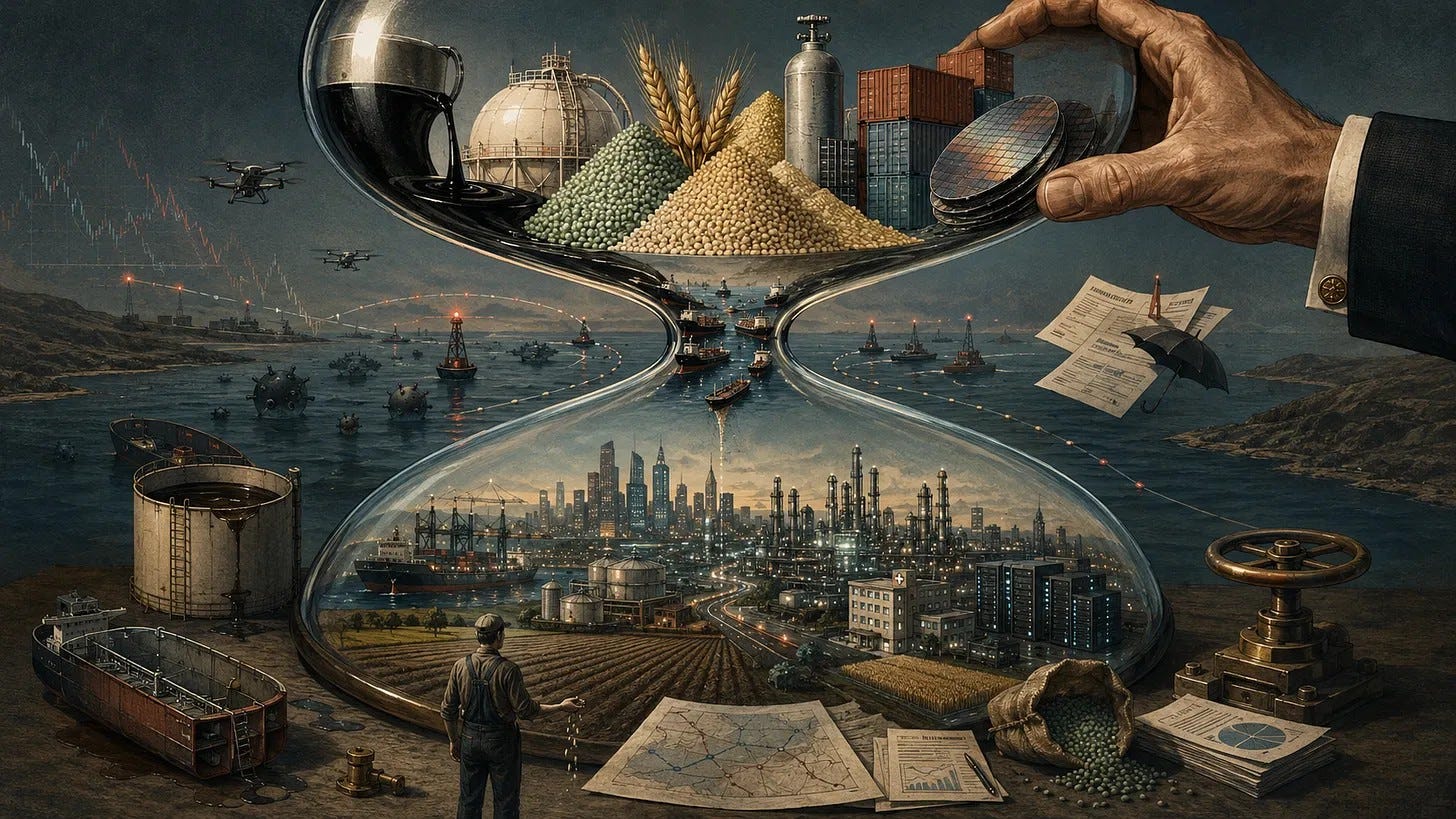
In the spring of 2026, a farmer in Northeast England, just south of the Scottish border, found himself paralyzed by a choice that was once routine but had become existential. Leaving a comment on Peter Zeihan’s site, he articulated the exact anxiety of a system in failure: Should he plant his spring crop? If he did, would he have enough fertilizer? And even if the crop grew, would the skyrocketing price of diesel make it impossible to ferry that harvest to market? This farmer was not a marginal anecdote; he was a leading indicator. His paralysis represents the breakdown of the fundamental confidence required for a modern economy to function. The loadings collapse we saw in early July 2026 is merely the physical manifestation of a deeper crisis: the transition from a world of manageable market fluctuations to one of cascading, nonlinear failures in a tightly coupled system.
2. The “Everything” Chokepoint: It’s Not Just About Oil
Conventional analysts treat the Strait of Hormuz as a simple volume-and-price problem for crude oil. This misunderstands the geography of modern production. Hormuz is the primary conduit for the specialized inputs that maintain the physical world. In 2025, more than 110 billion cubic meters of LNG passed through the Strait—nearly one-fifth of the world’s supply—with no realistic alternative route. Historically, a third of all internationally traded fertilizer passes through this single point of failure. When daily flows dropped from 20 million barrels to just 2.7 million between March and May 2026, the results were not parallel; they were recursive. We are seeing a network of “order effects”:
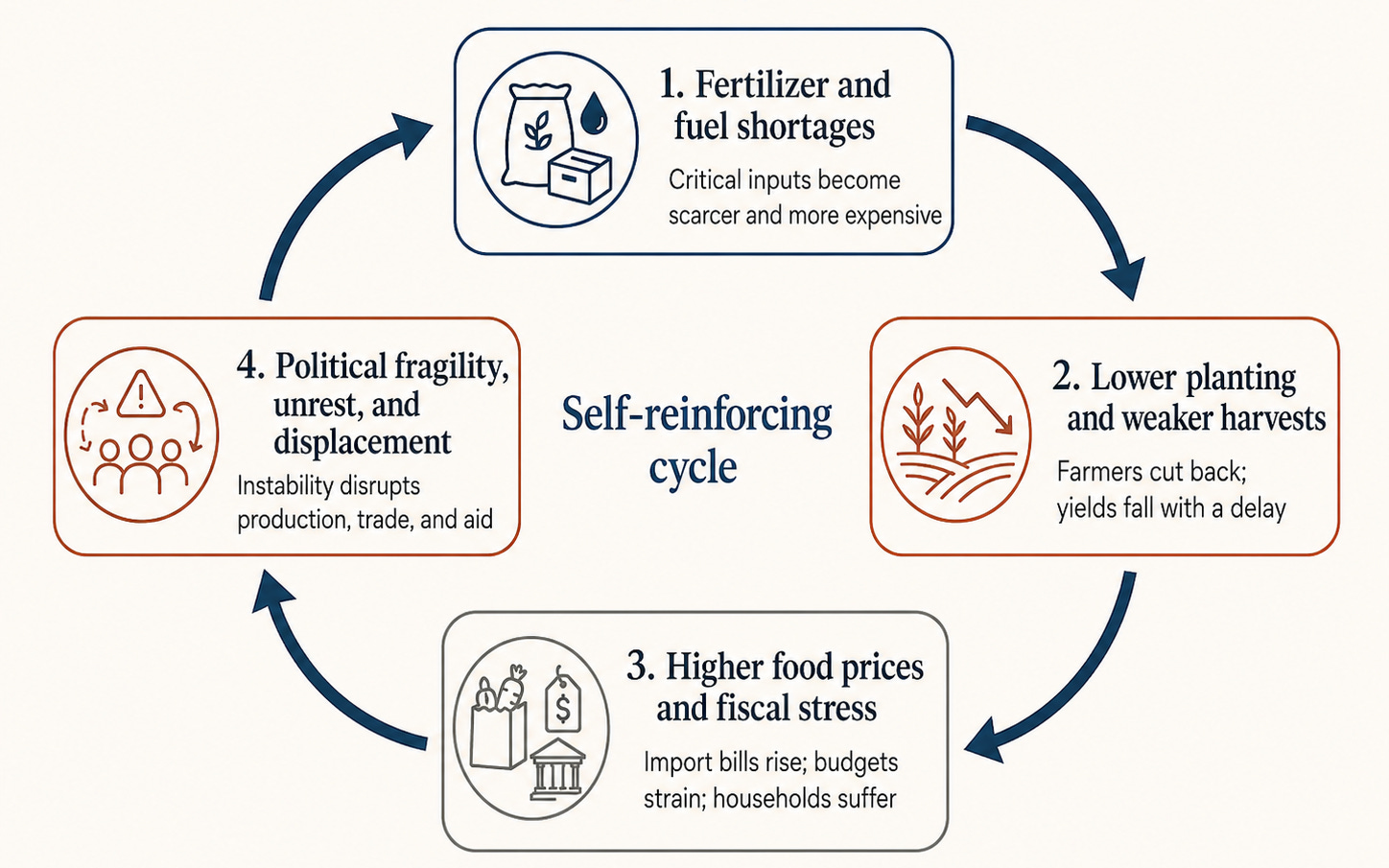
First-Order: Spike in fertilizer costs and diesel scarcity.
Second-Order: Farmers planting less or hedging poorly due to price volatility.
Third-Order: Falling yields, higher food prices, and a tightening of global credit.
Fourth-Order: Government hoarding, export bans, and the erosion of liberal democratic legitimacy. “The global economy was built for an age of abundance. It assumed cheap energy, cheap capital, cheap fertilizer, cheap transport, and geopolitical predictability. That system is breaking. If the Strait of Hormuz stays closed, it just might be the final straw.”
3. The Diesel Trap: Why Molecules in the Ground Won’t Save Us
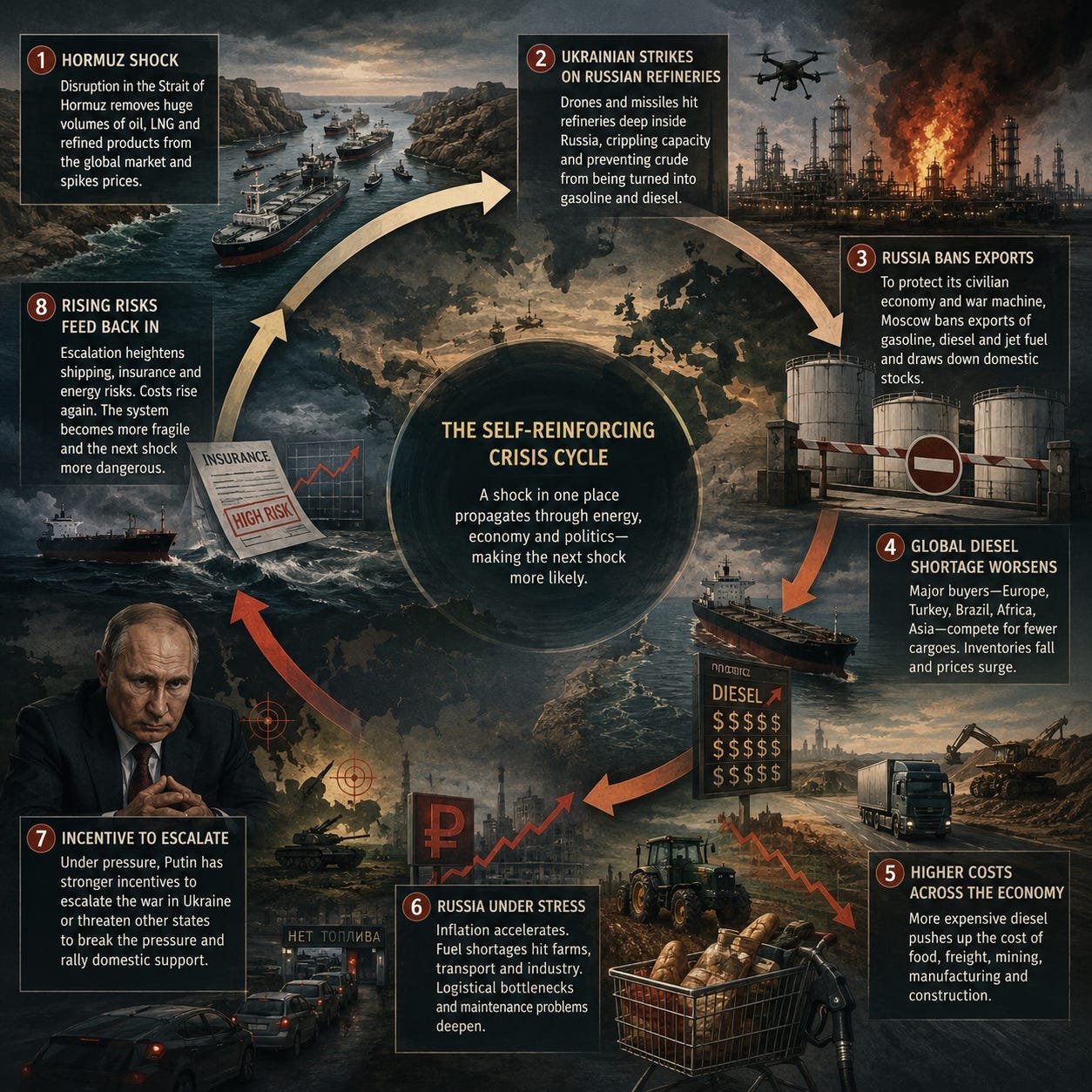
There is a counter-intuitive truth that the “muddle-through” school of thought often ignores: a shortage of crude molecules is far less dangerous than the shortage of refined products. As the saying goes, “crude in the ground isn’t gasoline in Novosibirsk or diesel in a tractor.” The world is currently caught in a refinery trap, exacerbated by the crisis in Russia. Despite its vast reserves, Russia’s gasoline output has dropped to about 65 percent of domestic demand following successful strikes on its infrastructure. The global diesel market abruptly lost approximately 600,000 barrels a day just as Gulf exports were disrupted. On July 8, US diesel futures jumped 11 percent, and European gasoil’s1 premium over Brent reached a record $60.77 a barrel. This is where the energy crisis becomes a food crisis. The strategist must understand a crucial biological reality: late fertilizer is not the same as fertilizer. Because fertilizer must be applied at specific growth stages, supply chain delays are biologically final. You cannot retroactively feed a plant’s childhood. When diesel prices prevent the movement of bulk fertilizer—which moves in 50,000-tonne shiploads, not “artisanal caravans of trucks”—the yields are lost forever.
4. The Ghost of Resilience: We Are Currently Burning the Padding
My colleague Dan argues that modern markets are adaptive and that we will muddle through. This optimism is based on an illusion: we have deferred the shock by exhausting our “Hidden Buffers.” We are practicing “armored globalization”—a sandbagged, state-managed version of trade that feels resilient only because we are liquidating our security. The “brutal arithmetic” of the IEA and EIA data reveals the depth of this exhaustion:
The Global Draw: Inventories have been drawing at an average of 3.8 million barrels per day since the conflict began.
OECD Depletion: Government inventories are down 163 million barrels, reaching their lowest level since December 1990.
The US SPR: The Strategic Petroleum Reserve has fallen to 319.5 million barrels—its lowest level since 1983.While IEA rules mandate 90 days of net imports, the US SPR now represents roughly sixteen days of supply. We are not just running out of molecules; we are running out of “cheap reassurance.” If a renewed disruption hits the earlier peak loss of 14 million barrels per day, our remaining cushion contracts to approximately 71 days.
5. The High-Tech Achilles Heel: Qatari Helium and the Chip Crisis
The most dangerous bottlenecks are “vascular insults” to markets too technical for mainstream notice. Advanced chipmaking (TSMC) and modern medicine depend on a cluster of fragile inputs—neon, argon, and semiconductor-grade helium. Qatar is home to one of only two plants in the world capable of producing helium at the required purity. The helium market is small, opaque, and non-negotiable. Unlike oil, if the cooling systems for superconducting magnets in MRI machines or NMR systems fail due to a lack of helium, the physical equipment damage is often catastrophic. Recovery for such high-purity supply chains could take a year or more. We are counting on AI to offset the energy shock, yet the very chips required for AI are hostage to the same chokepoint.
6. The “Omnishambles” Multiplier: Leadership as a Feedback Loop
In complexity theory, a “polycrisis” (Tooze) occurs when disparate crises interact. This is compounded by the “omnishambles” (Farrell)—a state of governmental disorder where policy-making becomes an endogenous source of uncertainty. The Trump administration’s erratic signaling acts as a contaminant in the system. We are facing three distinct layers of uncertainty:
Physical: Will the cargo arrive?
Price: At what cost?
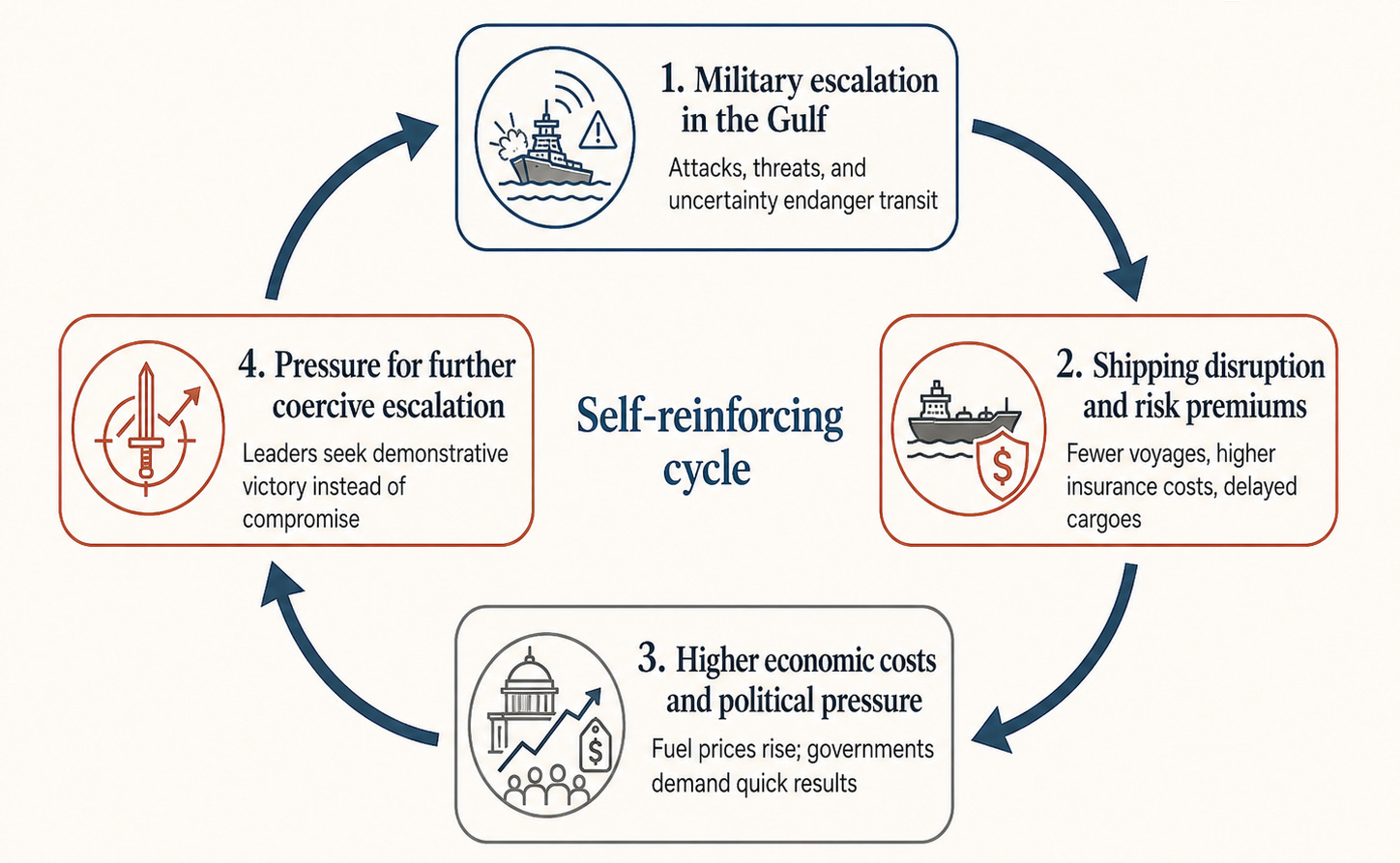
Rule: What is permitted or sanctioned?”Rule Uncertainty” is the most toxic; it prevents insurers from pricing risk, which stops ships even if the water is technically “open.” This creates a War-Market Feedback Loop: military escalation leads to shipping risk premiums, which drive up fuel prices, creating political pressure for even more coercive—and potentially catastrophic—escalation. This is mirrored by the Economic-Political Feedback Loop, where domestic subsidies and export bans meant to soothe public anger actually deepen the aggregate international shortage.
7. Conclusion: The Historian’s Perspective
As we look toward the winter of 2026-27, the system is operating entirely on nerves. We face three distinct futures:
Force: Attempting to smash Iranian capacity to restore transit, a task easier started than finished.
Mediation: A narrow maritime deconfliction arrangement. We see the first signs of this in Oman, which has recently floated a “voluntary fee system” for navigation services—effectively a mediated toll.
Full Economic Warfare: Strikes on civilian infrastructure and the end of the Gulf’s role as a shock absorber. The modern economy depends on the confidence that scarcity is a temporary, priceable problem. If Hormuz remains unusable, that confidence evaporates. A historian in 2040 may well look back at July 2026 as the “perishing of the old order”—the moment the system ran out of the slack necessary to survive its own complexity. Can a global order survive when its primary coordinator has become its primary source of disorder?
Gasoil is a petroleum middle distillate obtained from the fractional distillation of crude oil, primarily used as diesel fuel for vehicles or as heating oil.
No posts
Comments
Nothing yet. Say the first thing.
Sign in to join the conversation.