
There is obviously a Secret, and all the traditions bear witness to it — the Rishis, the Mages of Iran, the priests of Chaldea or Memphis or Yucatan. . .
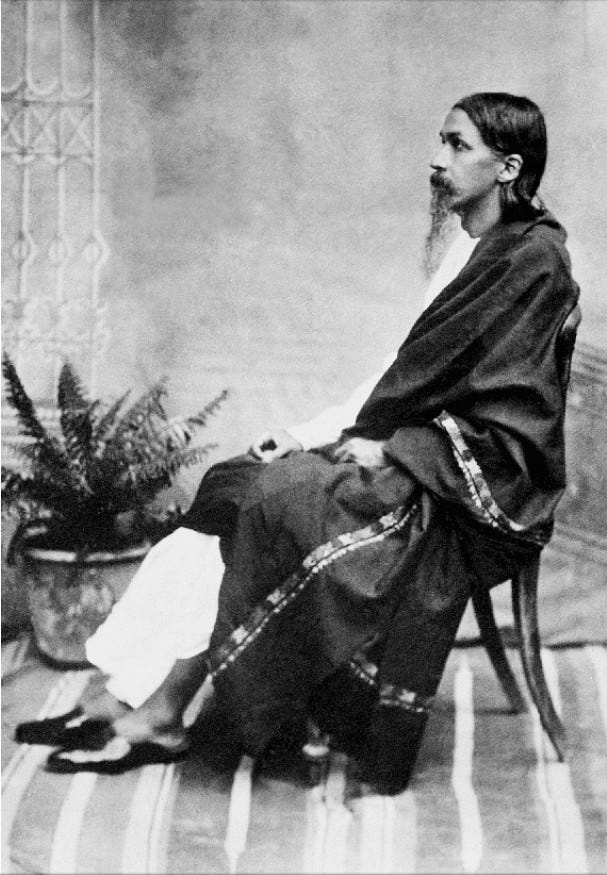
When he first read the Vedas — translated by Western Sanskritists or Indian pandits — they appeared to Sri Aurobindo as “an important document of [Indian] history, but seemed of scant value or importance for the history of thought or for a living spiritual experience.”1 Fifteen years later, however, Sri Aurobindo would re-read the Vedas in the original Sanskrit and find there “a constant vein of the richest gold of thought and spiritual experience.”2 Meanwhile, Sri Aurobindo had had certain “psychological experiences of my own for which I had found no sufficient explanation either in European psychology or in the teachings of Yoga or of Vedanta,” and which “the mantras of the Veda illuminated with a clear and exact light. . .”3 And it was through these experiences of his “own” that Sri Aurobindo came to discover, from within, the true meaning of the Vedas (and especially the most ancient of the four, the Rig-veda, which he studied with special care). What the Vedas brought him was no more than a confirmation of what he had received directly. But didn’t the Rishis themselves speak of “Secret words, clairvoyant wisdoms, that reveal their inner meaning to the seer” (Rig-veda IV, 3.16)?
It is not surprising, therefore, that exegetes have seen the Vedas primarily as a collection of propitiatory rites centered around sacrificial fires and obscure incantations to Nature divinities (water, fire, dawn, the moon, the sun, etc.), for bringing rain and rich harvests to the tribes, male progeny, blessings upon their journeys or protection against the “thieves of the sun” — as though these shepherds were barbarous enough to fear that one inauspicious day their sun might no longer rise, stolen away once and for all. Only here and there, in a few of the more “modern” hymns, was there the apparently inadvertent intrusion of a few luminous passages that might have justified — just barely — the respect which the Upanishads, at the beginning of recorded history, accorded to the Veda. In Indian tradition, the Upanishads had become the real Veda, the “Book of Knowledge,” while the Veda, product of a still stammering humanity, was a “Book of Works” — acclaimed by everyone, to be sure, as the venerable Authority, but no longer listened to. With Sri Aurobindo we might ask why the Upanishads, whose depth of wisdom the whole world has acknowledged, could claim to take inspiration from the Veda if the latter contained no more than a tapestry of primitive rites; or how it happened that humanity could pass so abruptly from these so-called stammerings to the manifold richness of the Upanishadic Age; or how we in the West were able to evolve from the simplicity of Arcadian shepherds to the wisdom of Greek philosophers. We cannot assume that there was “nothing between the early savage and Plato or the Upanishads”.4. . .
Nor was it insignificant that fire, Agni, was the core of the Vedic mysteries: Agni, the inner flame, the soul within us (for who can deny that the soul is fire?), the innate aspiration drawing man towards the heights; Agni, the ardent will within us that sees, always and forever, and remembers; Agni, “the priest of the sacrifice,” the “divine worker,” the “envoy between earth and heaven” (Rig-veda III, 3.2) “he is there in the middle of his house” (1.70.2). “The Fathers who have divine vision set him within as a child that is to be born” (IX.83.3). He is “the boy suppressed in the secret cavern” (V.2.1). “He is as if life and the breath of our existence, he is as if our eternal child” (I.66.1). “O Son of the body” (III.4.2), “O Fire, thou art the son of heaven by the body of the earth” (III.25. 1). “Immortal in mortals” (IV.2. 1), “old and outworn he grows young again and again” (11.4.5). “When he is born he becomes one who voices the godhead: when as life who grows in the mother he has been fashioned in the mother he becomes a gallop of wind in his movement” (III.29.11). “O Fire, when thou art well borne by us thou becomest the supreme growth and expansion of our being, all glory and beauty are in thy desirable hue and thy perfect vision. O Vastness, thou art the plenitude that carries us to the end of our way; thou art a multitude of riches spread out on every side” (II. 1. 12). “O Fire. . . brilliant ocean of light in which is divine vision” (III.22.2), “the Flame with his hundred treasures. . . O knower of all things born” (I.59).
But the divine fire is not our exclusive privilege — Agni exists not only in man: “He is the child of the waters, the child of the forests, the child of things stable and the child of things that move. Even in the stone he is there. . .” (I.70.2). . .
But we have not yet reached the heart of the Vedic secret. The birth of Agni, the soul (and so many men are still unborn) is merely the start of the voyage. This inner flame seeks, it is the seeker within us, for it is a spark of the great primordial Fire and will never be satisfied until it has recovered its solar totality, “the lost sun” of which the Veda incessantly speaks. Yet even when we have risen from plane to plane and the Flame has taken successive births in the triple world of our lower existence (the physical, vital and mental world), it will still remain unsatisfied — it wants to ascend, ascend further. And soon we reach a mental frontier where there seems to be nothing to grasp any longer, nor even to see, and nothing remains but to abolish everything and leap into the ecstasy of a great Light. At this point, we feel almost painfully the imprisoning carapace of matter all around us, preventing that apotheosis of the Flame; then we understand the cry, “My kingdom is not of this world,” and the insistence of India’s Vedantic sages — and perhaps the sages of all worlds and all religions — that we must abandon this body to embrace the Eternal. Will our flame thus forever be truncated here below and our quest always end in disappointment? Shall we always have to choose one or the other, to renounce earth to gain heaven? Yet beyond the lower triple world, the Rishis had discovered “a certain fourth,” turīaṁ svid; they found “the vast dwelling place,” “the solar world,” Swar: “I have arisen from earth to the mid-world [life], I have arisen from the mid-world to heaven [mind], from the level of the firmament of heaven I have gone to the Sun-world, the Light” (Yajur-veda 17.67). And it is said, “Mortals, they achieved immortality” (Rig-veda 1. 110.4). What then was their secret? How did they pass from a “heaven of mind” to the “great heaven” without leaving the body, without, as it were, going off into ecstasies?
The secret lies in matter. Because Agni is imprisoned in matter and we ourselves are imprisoned there. It is said that Agni is “without head or feet,” that it “conceals its two extremities”: above, it disappears into the “great heaven” of the supraconscient (which the Rishis also called “the great ocean”), and below, it sinks into the “formless ocean” of the inconscient (which they also called “the rock”). We are truncated. But the Rishis were men of a solid realism, a true realism resting upon the Spirit; and since the summits of mind opened out upon a lacuna of light — ecstatic, to be sure, but with no hold over the world – they set upon the downward way.
Thus begins the quest for the “lost sun,” the long “pilgrimage” of descent into the inconscient and the merciless fight against the dark forces, the “thieves of the sun,” the panis and vritras, pythons and giants, hidden in the “dark lair” with the whole cohort of usurpers: the dualizers, the confiners, the tearers, the coverers. But the “divine worker,” Agni, is helped by the gods, and in his quest he is led by the “intuitive ray,” Sarama, the heavenly hound with the subtle sense of smell who sets Agni on the track of the “stolen herds” (strange, “shining” herds). Now and again there comes the sudden glimmer of a fugitive dawn. . . then all grows dim. One must advance step by step, “digging, digging,” fighting every inch of the way against “the wolves” whose savage fury increases the nearer one draws to their den — Agni is a warrior. Agni grows through his difficulties, his flame burns more brilliantly with each blow from the Adversary; for, as the Rishis said, “Night and Day both suckled the divine Child”; they even said that Night and Day are the “two sisters, Immortal, with a common lover [the sun]. . . common they, though different their forms” (1. 113.2,3). These alternations of night and brightness accelerate until Day breaks at last and the “herds of Dawn” surge upward awakening “someone who was dead” (1. 113.8). “The infinite rock” of the inconscient is shattered, the seeker uncovers “the Sun dwelling in the darkness” (111.39.5), the divine consciousness in the heart of Matter. . . In the very depths of Matter, that is to say, in the body, on earth, the Rishis found themselves cast up into Light — that same Light which others sought on the heights, without their bodies and without the earth, in ecstasy. And this is what the Rishis would call “the Great Passage.” Without abandoning the earth they found “the vast dwelling place,” that “dwelling place of the gods,” Swar, the original Sun-world that Sri Aurobindo calls the Supramental World: “Human beings slaying the Coverer have crossed beyond both earth and heaven [matter and mind] and made the wide world their dwelling place” (1.36.8). They have entered “the True, the Right, the Vast,” Satyam, Ritam, Brihat, the “unbroken light,” the “fearless light,” where there is no longer suffering nor falsehood nor death: it is immortality, amṛtaṁ. . . .
All is reconciled. The Rishi is “the son of two mothers”: son of Aditi, the luminous cow, Mother of infinite Light, creatrix of the worlds; and son as well of Diti, the black cow, Mother of “the tenebrous infinite” and divided existence — for when Diti at last reaches the end of her apparent Night, she gives us divine birth and the milk of heaven. All is fulfilled, The Rishi “sets flowing in one movement human strengths and things divine” (IX.70.3), he has realized the universal in the individual, become the Infinite in the finite: “Then shall thy humanity become as if the workings of these gods; it is as if the visible heaven of light were founded in thee” (V.66.2). Far from spurning the earth, he prays: “O Godhead, guard for us the Infinite and lavish the finite” (IV.2.1 1).
The voyage draws to its close. Agni has recovered its solar totality, its two concealed extremities. “The inviolable work” is fulfilled. For Agni is the place where high meets low — and in truth, there is no longer high nor low, but a single Sun everywhere: “O Flame, thou goest to the ocean of Heaven, towards the gods; thou makest to meet together the godheads of the planes, the waters that are in the realm of light above the sun and the waters that abide below” (111.22.3). “O Fire. . . O universal Godhead, thou art the navel-knot of the earths and their inhabitants; all men born thou controllest and supportest like a pillar” (1.59.1). “O Flame, thou foundest the mortal in a supreme immortality. . . thou createst divine bliss and human joy” (1.31.7). For the world’s heart is Joy, Joy dwells in the depths of all things, “the well of honey covered by the rock” (11.24.4).
About the Author
Satprem passed away on April 9th, 2007 at the age of 84. Through his books, and particularly through his role in the publication of the 13 volumes of Mother’s Agenda, Satprem played a key role not only in introducing many people to the works of Sri Aurobindo and The Mother, but also in explaining the scope and significance of the great endeavor They had undertaken. The following brief biography is from Beyond the Human Species (Chapter 23, pp. 370–373) by Georges van Vrekhem.
Satprem, formerly named Bernard Enginger, is a Frenchman who was born in Paris in 1923, but who has always nostalgically remembered his youth on the coast of Brittany. In the Second World War he became a member of the Resistance. He had just turned twenty when the Gestapo arrested him; he spent one and a half years in German concentration camps. After the war, and deeply branded by those experiences, he became an exponent of the problematics and the life-view of Existentialism, although not Sartre and Camus but Gide and Malraux were the main sources of his inspiration. In 1946, he wrote in a letter to André Gide:
I loved you, and certain passages from your books have helped me to survive in the concentration camps. From you I got the force to break away from a bourgeois and material comfort. Together with you, I have been seeking “not so much for possession as for love.” I have made a clean sweep to stand completely new before the new law. I have made myself free. . . Finally, I have broken away from you, but I have found no new masters and life keeps suffocating me. The terrible absurdity of the likes of Sartre and Camus has solved nothing and only opens the gates to suicide. (André Gide, Journal 1942-1949).5
Satprem worked briefly as a functionary in the colonial administration of Pondicherry, but he felt dissatisfied and unfulfilled everywhere and went in search of adventure in French Guyana, Brazil and Africa.
However, when in Pondicherry he had had the darshan6 of Sri Aurobindo and the Mother, and he carried The Life Divine with him even in the rain forests of the Amazon. In 1953, after those wanderings, he returned to Pondicherry to meet the Mother and settle in the Ashram against his individualistic and rebellions nature.
Satprem’s first years in the [Sri Aurobindo] Ashram were a period of dissatisfaction, restlessness, doubts, and sometimes loudly voiced revolt. Time and again he imagined he had to find his inner fulfillment in adventure. There is not an exotic place on Earth he did not feel impelled to go to; the Congo, Brazil (again), Afghanistan, the Himalayas, New Zealand, the Gobi desert, a journey around the globe in a sailing boat — all that and more is dreamed of in his letters. But the Mother knew what was really prompting him and she let him become, in 1959, the disciple of a very able tantric yogi who was also the head priest of the big temple in Rameshwaram. Then, guided by another yogi, Satprem wandered during six months as a sannyāsī (mendicant monk) through India and received the initiation of the sannyāsīs. His novel By the Body of the Earth, or The Sannyasi is based on these experiences.
But “the bird always returned to the nest,” to the Ashram in Pondicherry, to the Mother. She started inviting him from time to time to her room, at first apparently for some literary chores in connection with the Bulletin.7 He became more and more spellbound by her. “At first, she had me called, and there was that big chair in which she was sitting, and I sat down on the carpet on the floor and listened to her. Truly, she knew so much. It was wonderful to listen to her. But most important, little by little she began telling her experience.”
The Mother had so much to communicate, to share, her knowledge and experience were so broad in all essential domains where the human being is confronted with “the great questions,” but so little was asked of her. “I am a little bell that is not sounded,” she said. Here now was a man with an analytical mind, a poignant life-experience and a thirst for knowledge — the ideal instrument to communicate to others a glimpse of her unbelievable adventure. Satprem started realizing the importance of those conversations with the Mother and took a tape-recorder to her room. Thus the Agenda came about.
Agenda, October 30, 1961
The day before and at the beginning of this conversation with The Mother, Satprem read aloud the above passages of his manuscript.
I had an experience while listening to you read; it was as if I heard, “The beginning of the legend. . . the beginning of the legend. . .”
It’s rather strange.
He [Sri Aurobindo] is there and the atmosphere is full of a sort of concentration of force, and there are these two things: “This is how legends come into being. . . how legends begin. . . The beginning of the legend. . .” I hear this. And there is also a kind of analogy to the old stories of Buddha, of Christ. . . It’s strange.
I seemed to be looking back into the present from some thousands of years ahead (it’s no longer now, but as if I were propelled somewhere several thousand years ahead, looking backwards) and it’s the beginning of the legend. [. . .]
Curious, this impression — the feeling of the body and the atmosphere when I was propelled into the future. It’s something more. . . more compact, denser than the physical: the New Creation. One always tends to think of it as something more ethereal, but it’s not! [. . .]
I got the impression of there being the same difference between the physical fact of Christ or the physical fact of Buddha — and everything we know and say and think and feel about them today — as there is between what we now know of Sri Aurobindo and what will be known of him in the time I was propelled into. This book was like the initiator of the legend.
Sri Aurobindo, The Secret of the Veda (Pondicherry: Sri Aurobindo Ashram, 1971), p. 34.
Ibid., p. 38.
Ibid., p. 37.
Ibid., p. 25.
From Gide’s answering letter: “The world will only be saved, supposing it can be saved, by the unsubmitted. Without them, our civilization, our culture would be finished together with everything we love and which renders to our presence on earth a hidden justification. They are, those unsubmitted, “the salt of the earth” and those responsible before God. For I have got the conviction that God does not yet exist and that we have to deserve him. Can one think of a more noble, admirable and worthy task for our endeavors?”
Darśana, audience.
The Bulletin of Sri Aurobindo International Centre of Education, a bilingual/trilingual quarterly (English/French and English/French/Hindi).
Comments
Nothing yet. Say the first thing.
Sign in to join the conversation.