
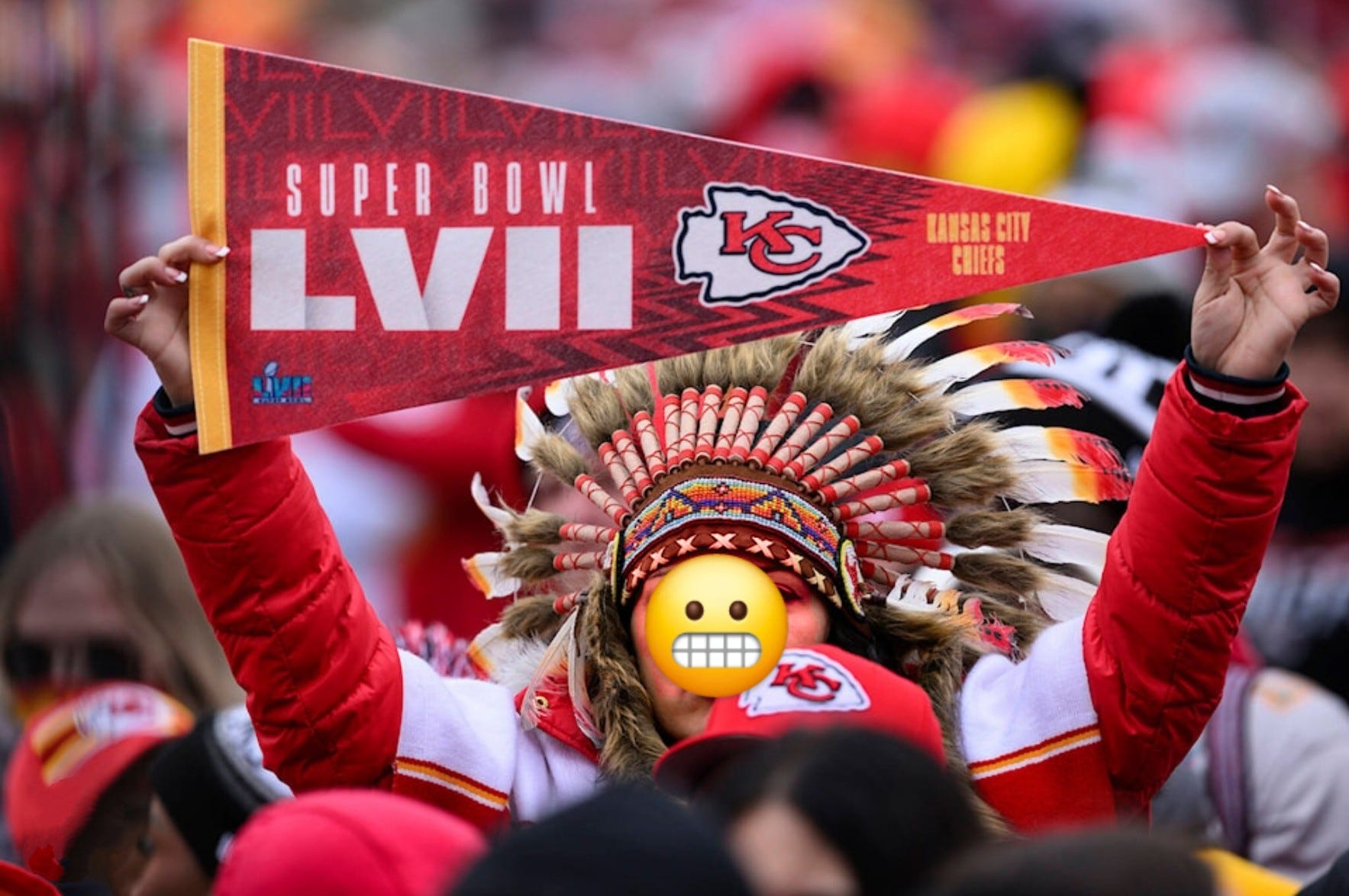
Today's piece is an update to one I wrote for The Big Picture in May of 2023.
Since the early 1900s, the use of Indigenous American and First Nations names and images by sports teams as mascots has been the subject of increasing public scrutiny in both the United States and Canada.
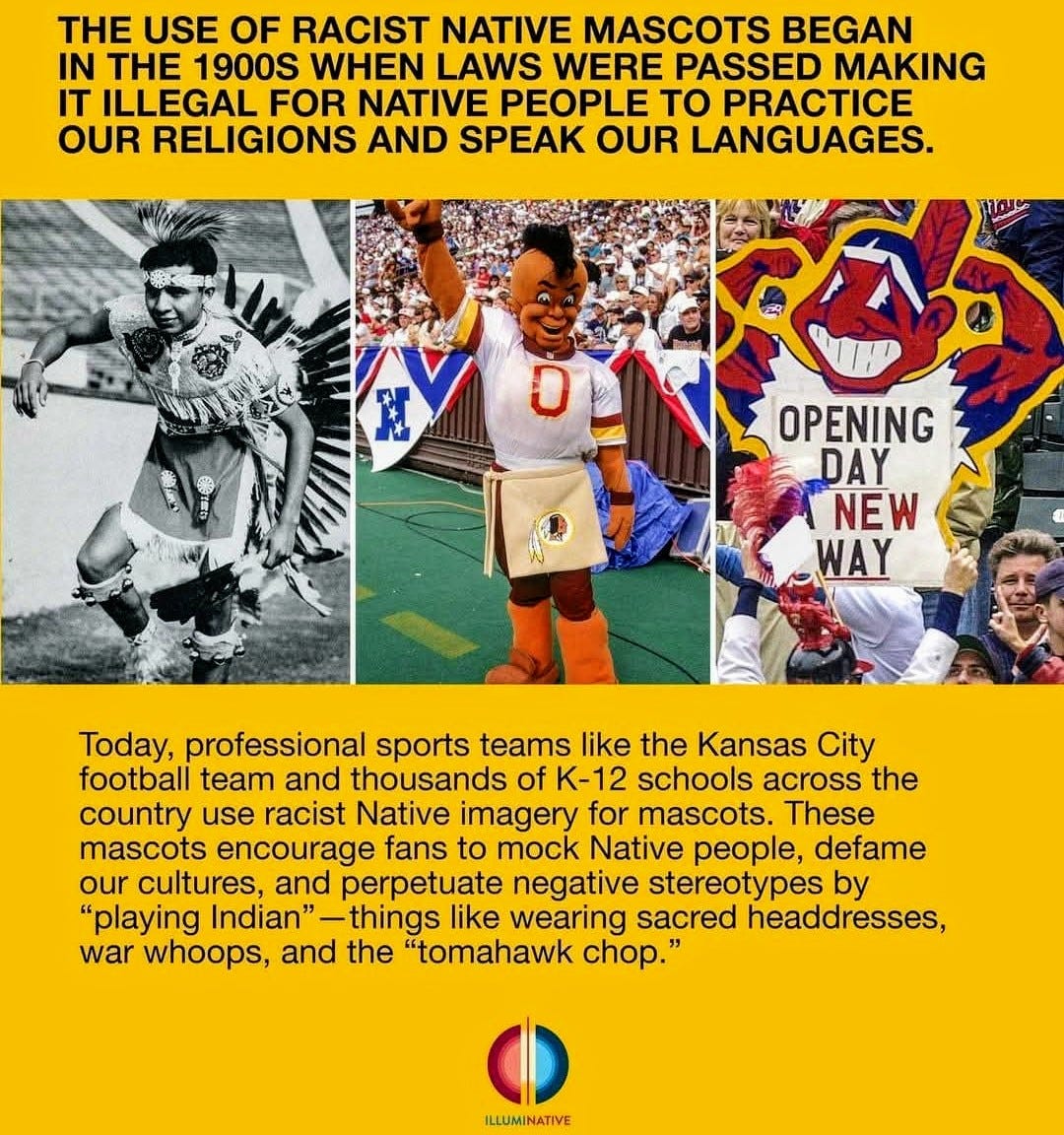
But the issue is reported in mainstream media only in terms of Indigenous peoples being offended.
It’s similar to the way issues with vulgar, profane words like squaw—which means whore or c*nt—being used for public spaces is reported by the media.
If we just translate the word to English, then almost everyone would be offended by a place called Big Whore or C*nt Valley.
This misrepresents the problem as one of just feelings and personal opinions held only by the targets and not tangible harm.
It also ignores the impact on non-Natives.
So what's the real issue with Indigenous peoples used as sports mascots?
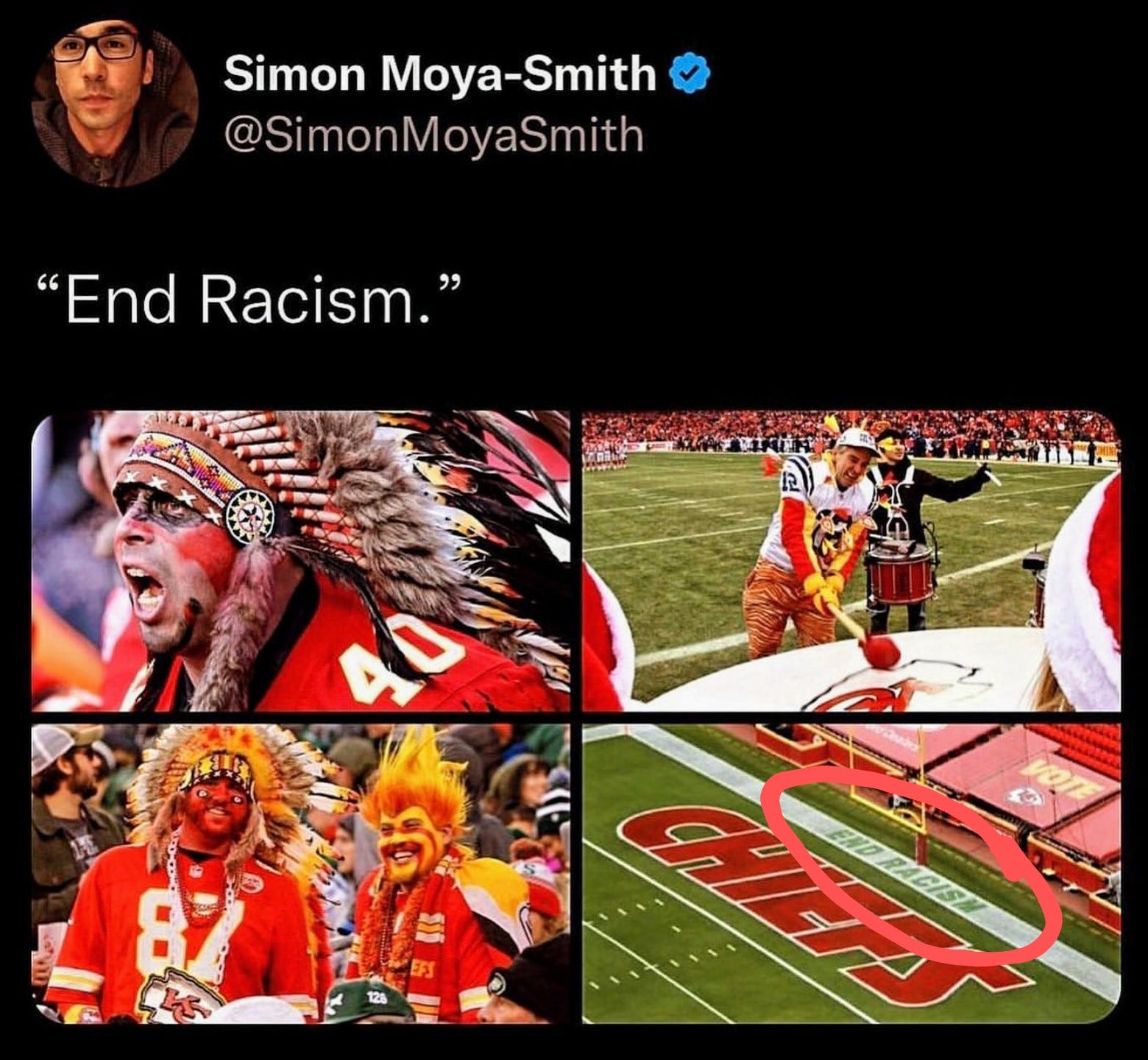
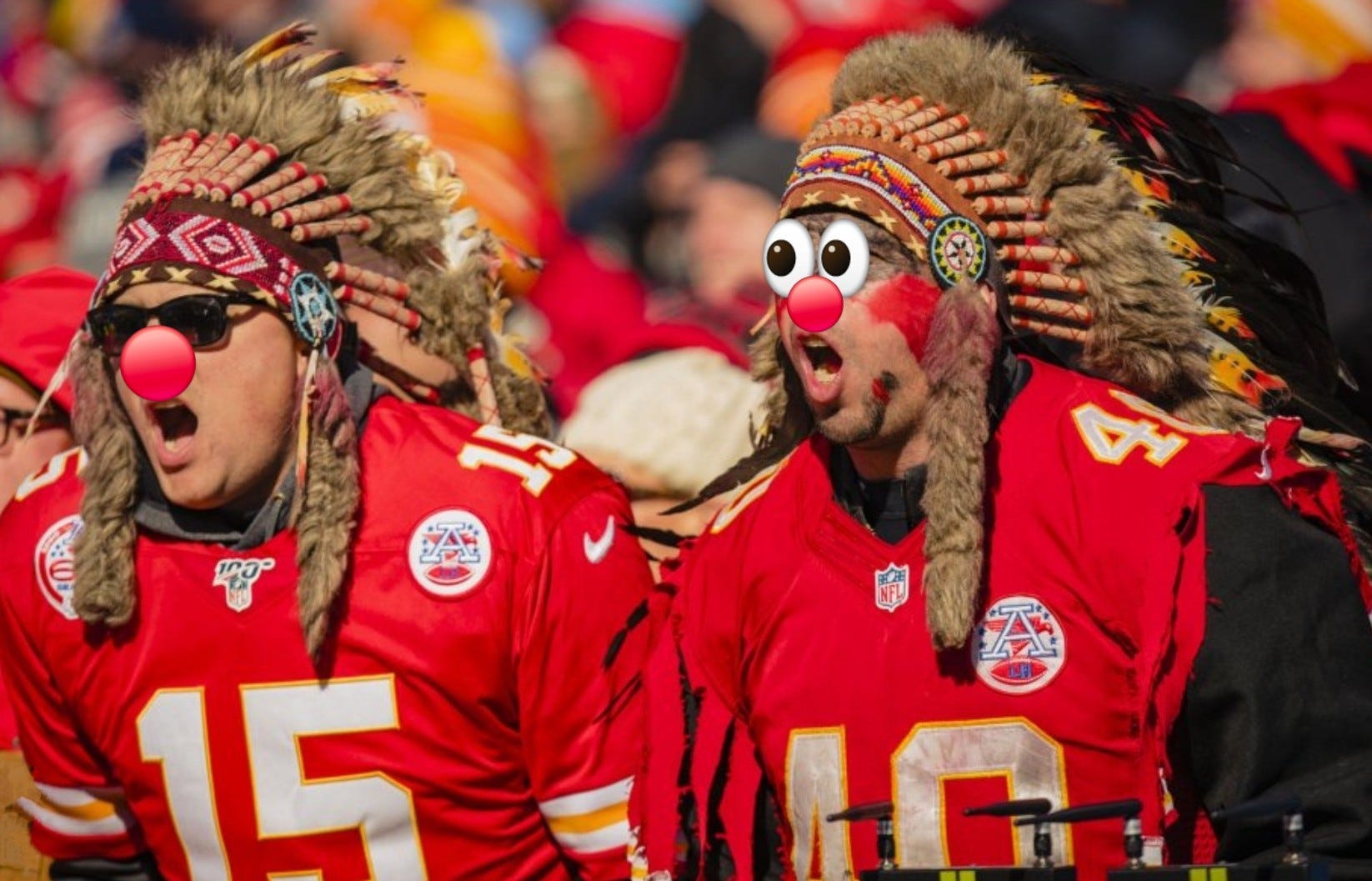
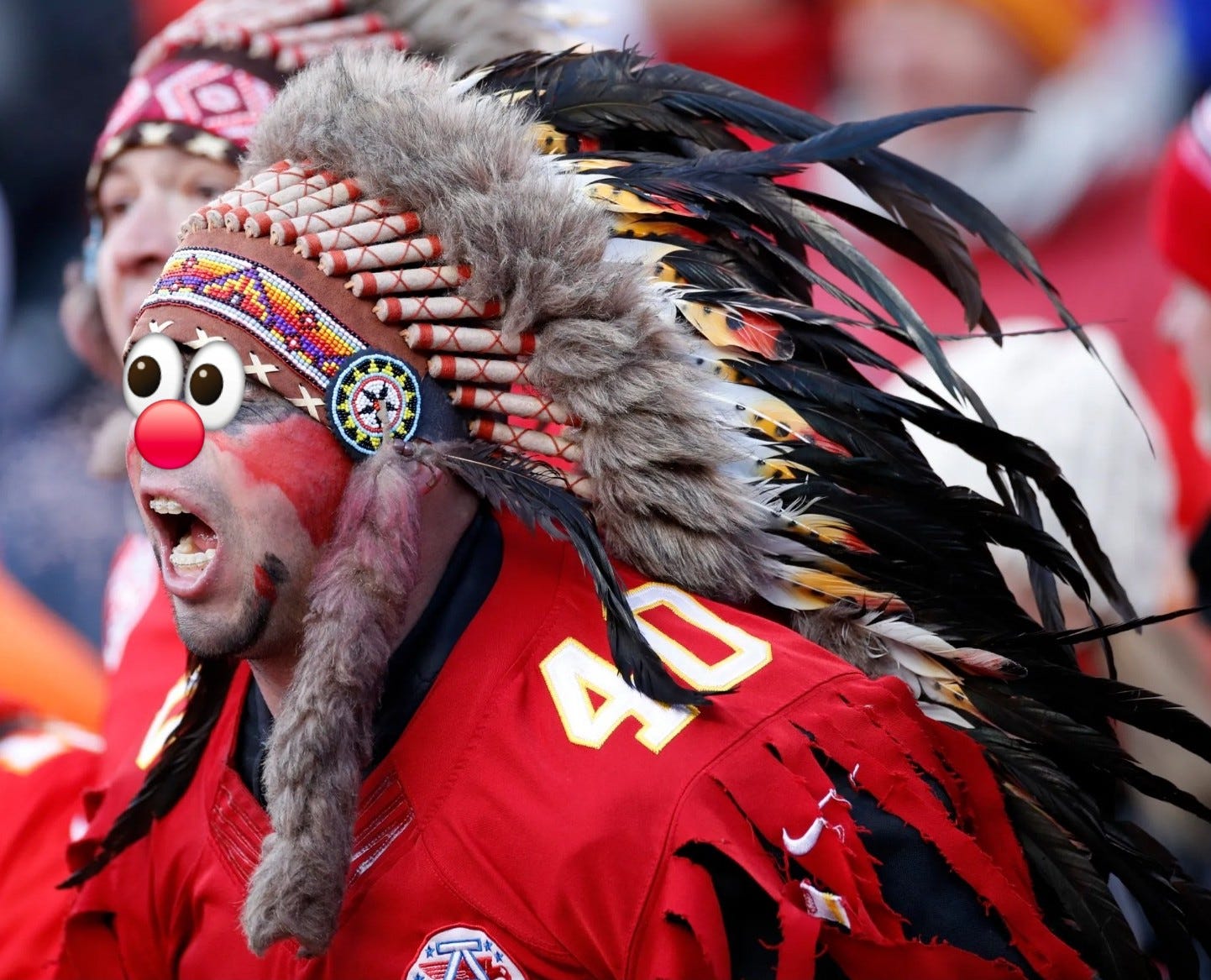
Aren't Indigenous peoples being honored when fans dress up like this?
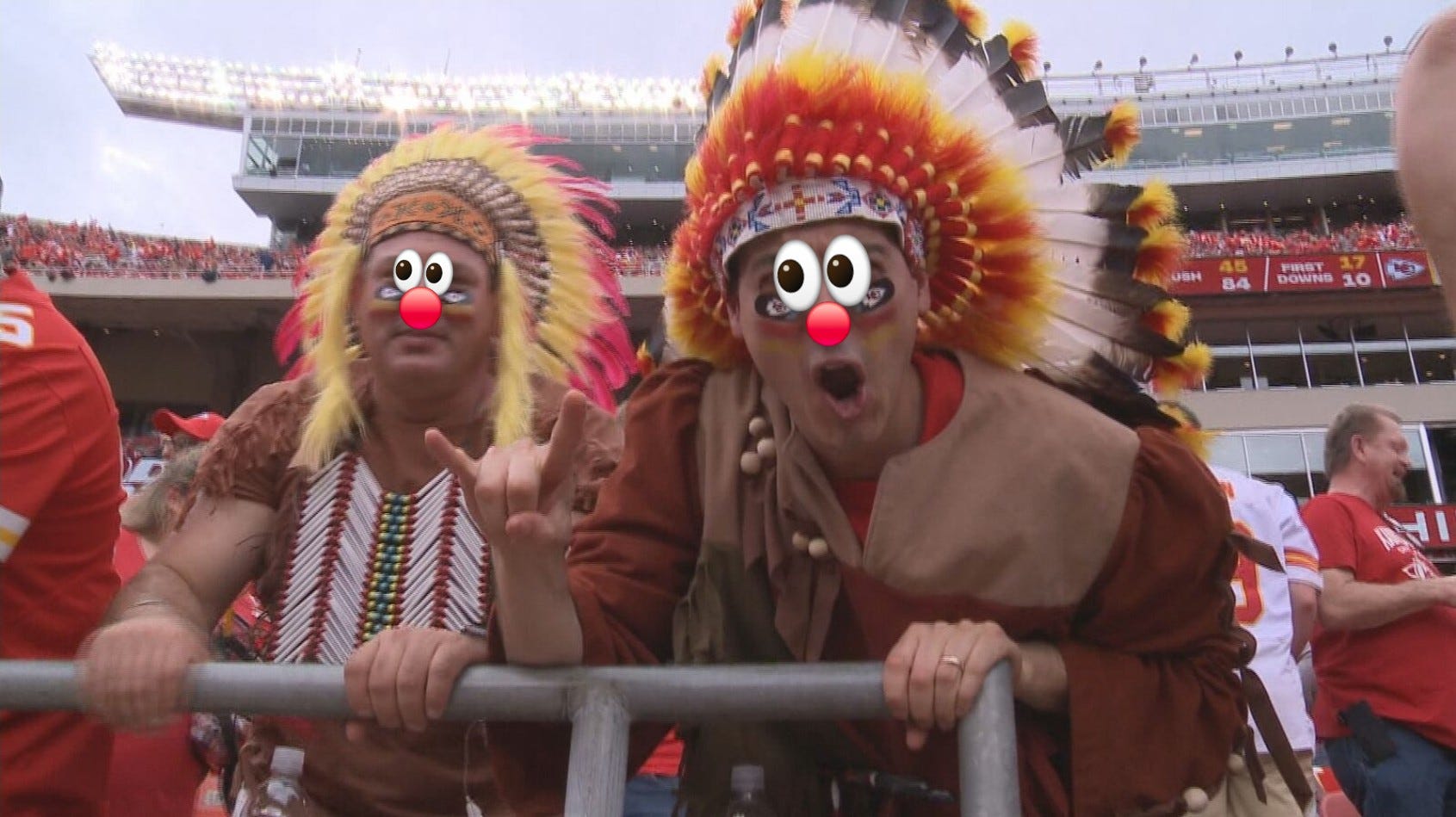
Or when teams have mascots like this?
The Cleveland MLB team finally decided this honored no one and scrapped Chief Wahoo and replaced their racist mascot with the Cleveland Guardians.
And no one died because of it.
The Kansas City team finally vowed to stop officially performing the “tomahawk chop”—something cheerleaders and the stadium sound system participated in—but it still happens routinely in the stands and outside the stadium.
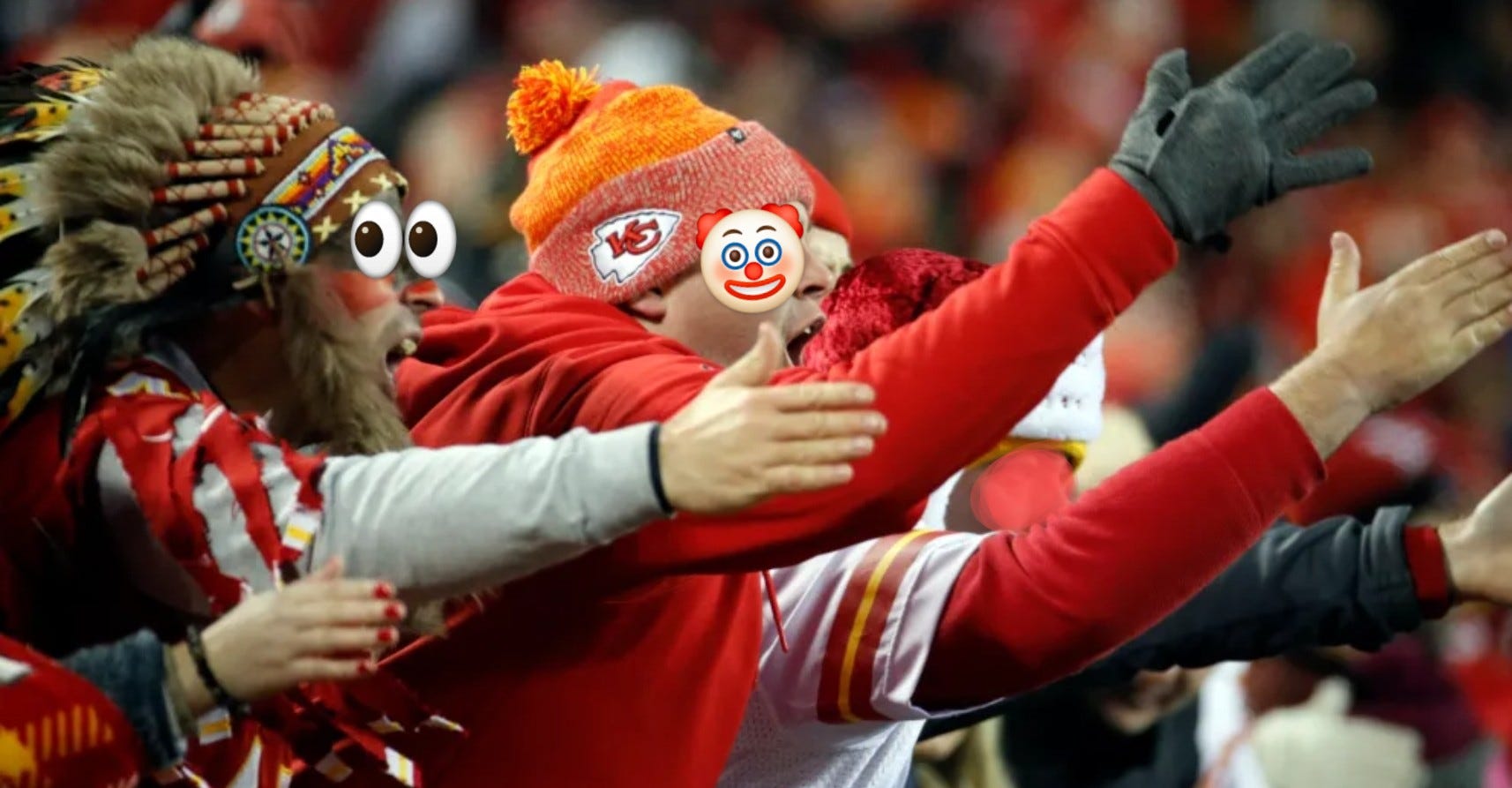
They also pledged to eliminate racist caricatures and headdresses on fans, but that only applies to home games, inside their own stadium, and is enforced only upon entry or if in stadium use is “caught.”
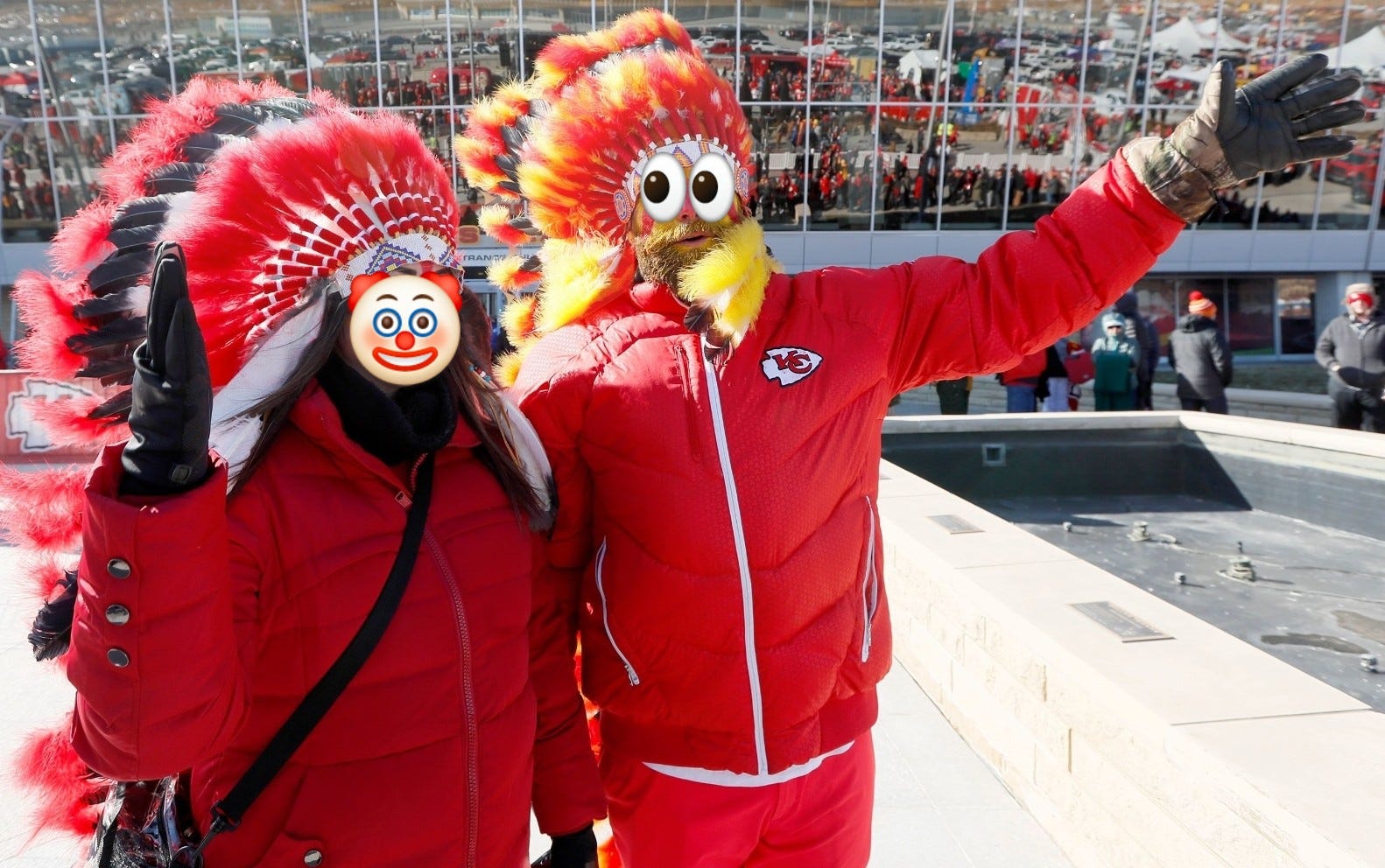
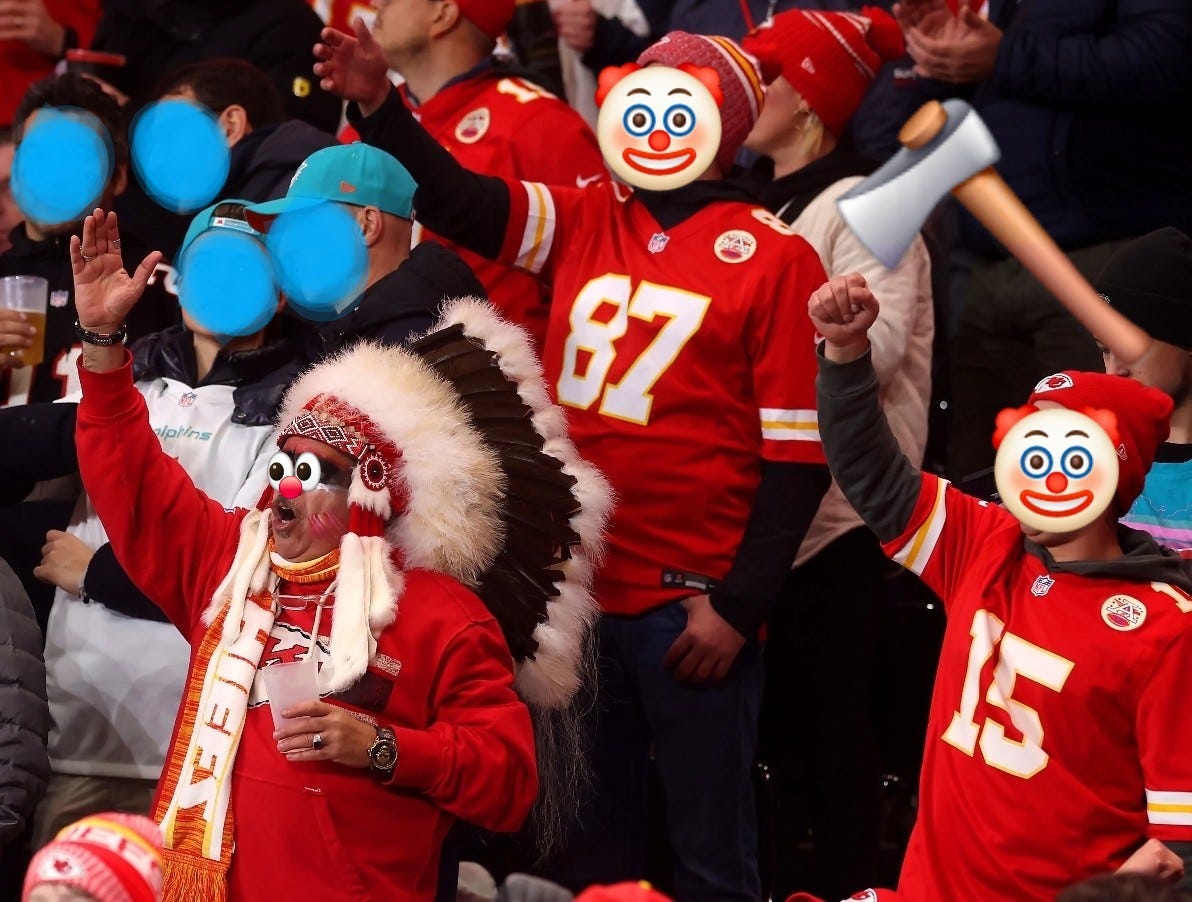
The Kansas City NFL team also adapted their mascot from the typical “wild Indian”…
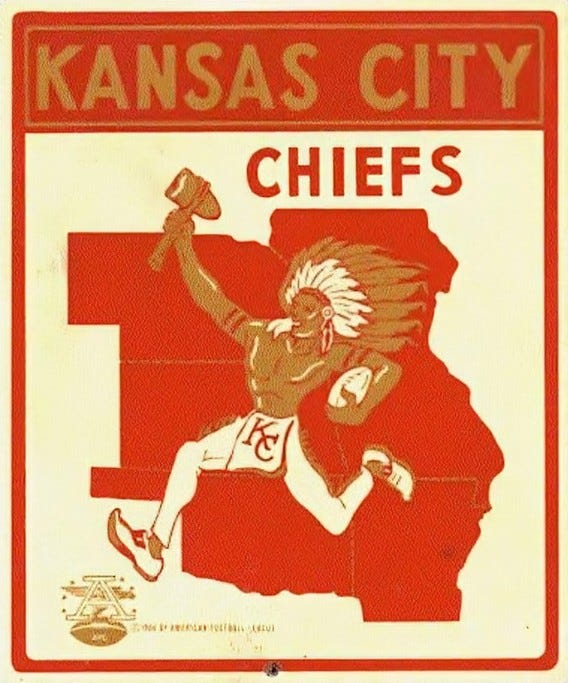
…to a succession of horses named “Warpaint” with a White man wearing a headdress while riding the horse…
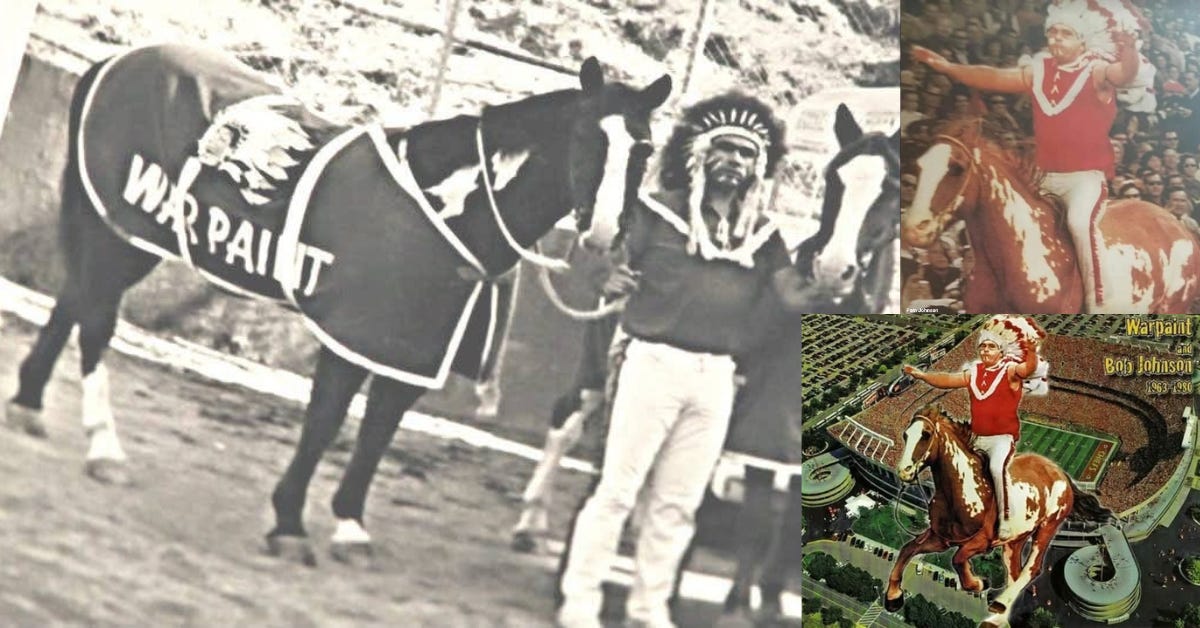
…to a cheerleader riding the horse, then finally to a wolf—no stereotype there—named KC.
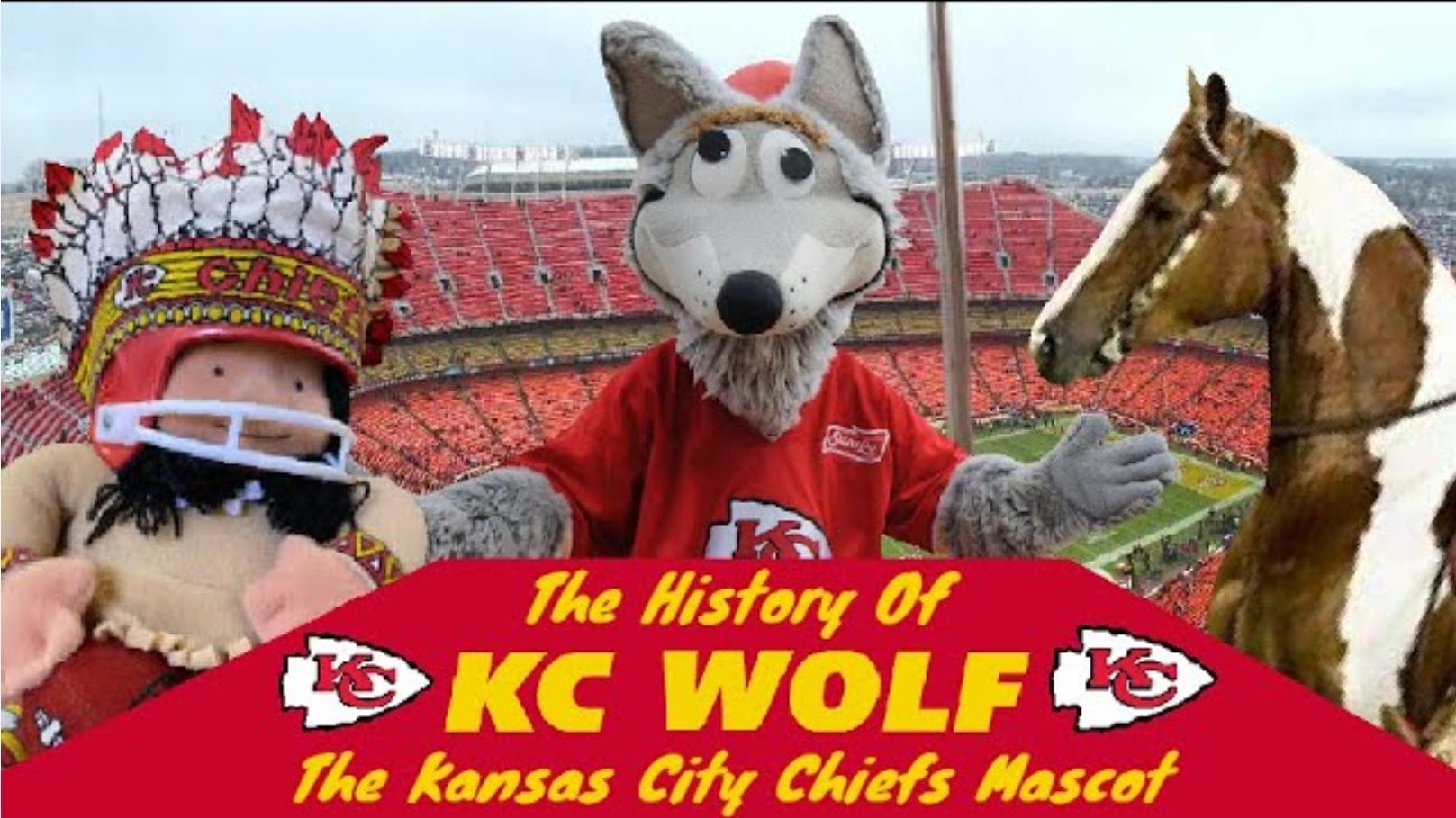
But the faux Indigenous references remain.
And headdresses are an entire issue unto themselves, which I cover in my piece On Why You Can't Wear A Native American Headdress—or—They're Not Hats People.
The second thing we hear when we address our use as mascots is indignation that banning Indigenous mascots is taking a school or community’s traditions and heritage from them.
In the United States, Indigenous culture—including language, dance, song, clothing, art, and religion—was illegal until the late 1970s—less than 50 years ago.
But in the 1920s, a surge in schools and professional sports teams adopting Indigenous identities as mascots took place. The romanticized “Noble Savage” had replaced the “Godless Heathen” perception in pop culture, while the government was still actively engaged in cultural and physical genocide.
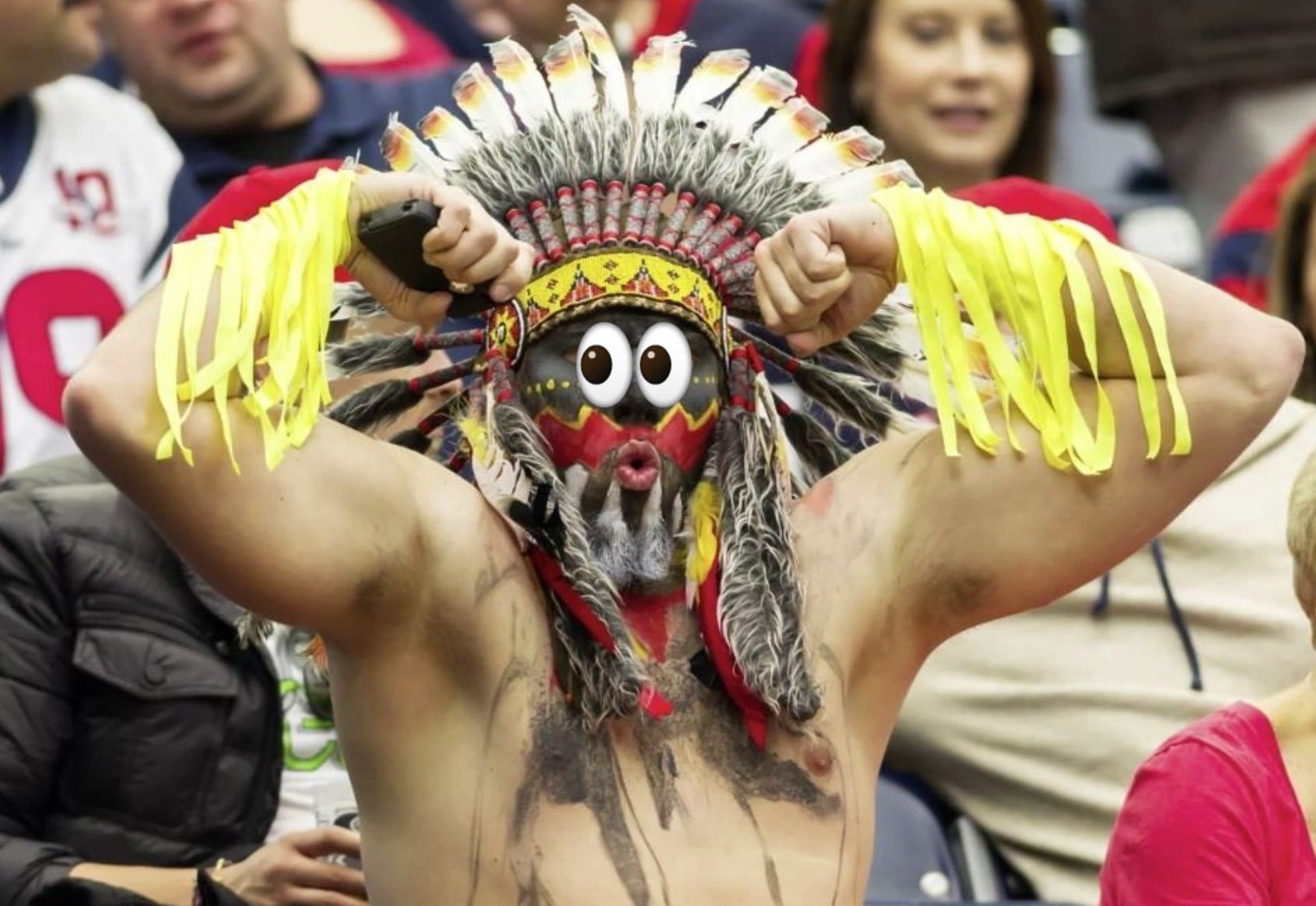
During a period when the official government policy for Indigenous peoples was described as "kill the Indian, save the man," non-Natives were playing Indian using everything that had been stripped away from us.
Yet when New York state decided to ban the use of Indigenous mascots, this was one Long Island school's response.
In my piece ‘But Where Are You Really From,’ I touched on listening to marginalized people.
I wrote:
“One tool I find helpful is to ask myself what I lose by stopping the behavior that was called out. Even if the person is being overly sensitive, what happens if I just acquiesce?”
“Do I really suffer any harm by agreeing with their request or does my ego just get bruised?”
“If it's just a bruised ego, I need to get over myself.”
The third thing we usually hear from proponents of Indigenous mascots is that they know someone who claims Indigenous identity and says they don't care.
You can find people in any culture unbothered by slurs against them.
But knowing one person doesn't negate the majority of people who are hurt by the racist stereotypes and degrading imagery.
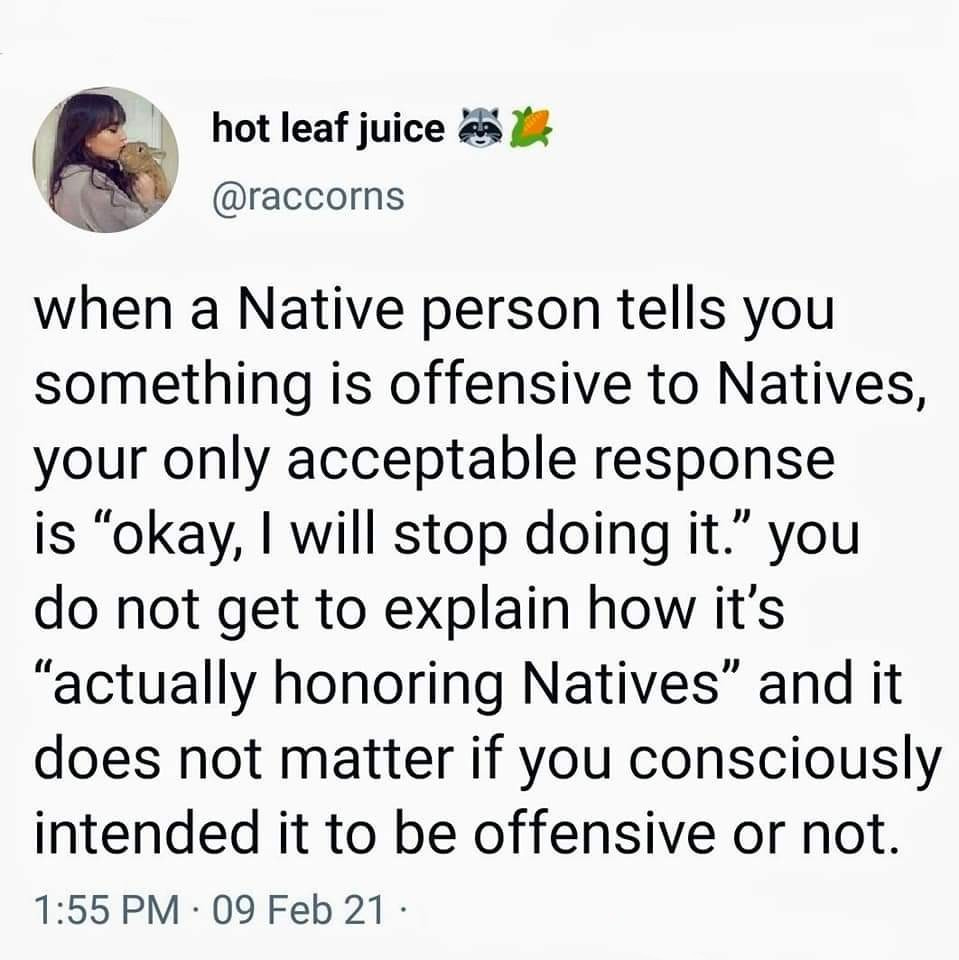
Along with “my Indian friend said it's OK” comes the “we got permission from the tribe” excuse.
But invariably, one of two things happened. The school or organization bought permission from one family willing to publicly say it was OK. or the school or organization offered compensation for compliance.
I'm not going to condemn or deny an Indigenous family or tribe the funds they need to survive or the opportunity of a free education—a common bribe used by schools to get permission to use a tribe as their mascot.
Yes, I'm looking at you Florida and North Dakota.
But the bribers are still doing something wrong by using racist stereotypes and living cultures as mascots.
Indigenous author and professor of Ojibwe Dr. Anton Treuer explained this well.
The National Congress of American Indians (NCAI) has a standing resolution—first adopted in 1998—opposing the use of Indigenous mascots.
NCAI is the oldest and largest national organization of American Indigenous tribes and nations and Alaska Natives. NCAI has campaigned since 1968 to end the use of Indigenous mascots.
Their resolution states:
“[T]he use of Native American mascots, logos and symbols depicting American Indian people are offensive to us, and such depictions are inaccurate, unauthentic representations of the rich diversity and complex history of the more than 560 Indian Tribes in the United States and perpetuate cultural and racial stereotypes[.]”
The NCAI added in 2005:
“The ‘warrior savage’ myth has plagued this country’s relationships with the Indian people, as it reinforces the racist view that Indians are uncivilized and uneducated and it has been used to justify policies of forced assimilation and destruction of the Indian culture.”
NCAI was established in 1944 “in response to the termination and assimilation policies the US government forced upon tribal governments in contradiction of their treaty rights and status as sovereign nations.”
I live in Northern Maine where—just like the Massapequa, New York school shown above—Indigenous mascots all wear feathered headdresses.
No tribe on Long Island or in Maine ever wore the style of regalia used by their schools’ Indigenous mascots.
A majority of Native mascots appropriate their overall look from the tribes of the Great Plains like the Lakota or Omaha—buckskins, beading, feathered headdresses. But then they borrow most of their design work from Southwest tribes like the Navajo or Pueblo or Pacific Northwest tribes like the Coast Salish or Haida.
Such homogenization leads to a subconscious belief that Indigenous peoples all look the same and we share a single culture and identity.
One need only think of how people in the United States view European countries like Italy, Spain, and Germany as having rich, diverse cultures while lumping the Indigenous peoples of the United States into a single identity to recognize the bias this creates.
Studies show using Indigenous mascots lowers "the self-esteem of American Indian students."
The U.S. Commission on Civil Rights has "called for an end to the use of Native American mascots in non-Native schools because they teach all students that stereotyping of minority students is acceptable."
The American Psychological Association publicly called for "the immediate retirement of all American Indian mascots," saying these "mascots are teaching misleading, and too often, insulting images of American Indians. These negative lessons are not just affecting American Indian students; they are sending the wrong message to all students."
When students and community members view Indigenous peoples in a cartoonish way, it enables the erasure of authentic historic and current Native culture.
It also validates bigoted speech or actions by adults and young people.
Indigenous-themed mascots are also opposed by the National Indian Education Association, National Education Association, American Sociological Association, American Counseling Association, NAACP, United Methodist Church, and the National Collegiate Athletic Association to name only a few of the many organizations who read the studies or did the research.
The National Congress of American Indians reported as of April 5, 2023, there were 1,901 schools in 966 school districts that use Indigenous mascots.
The Departments of Education or legislatures in Kansas (2022), Colorado (2021), Washington (2021), Nevada (2021), California (2015), Michigan (2012) and Oregon (2012) took steps to eliminate Indigenous mascots in public schools and state funded colleges and universities, but allow for exemptions which include “getting permission” from a federally recognized tribe.
To date, Maine (2019) and New York (effective 2025) are the only states to completely ban Native American-themed mascots in public or state funded schools.
Is your state on this list? If not, contact your state legislators and ask them to take action.
Is a school in your area still using Indigenous peoples as mascots? If so, contact your school board or district administration and ask why.
And when the debate over Indigenous mascots occurs, please, speak out.
And please, share this message.
Philámayaye, Niawen'kó:wa, Merci, Thank you,
Šung'mánitu Ápé, Nikakwaho'tá':'ah Wá’tsik, Auntie Mavis, Amelia
Thanks for reading Auntie Mavis’ Musings! All posts are public, so feel free to share!
Comments
Nothing yet. Say the first thing.
Sign in to join the conversation.