
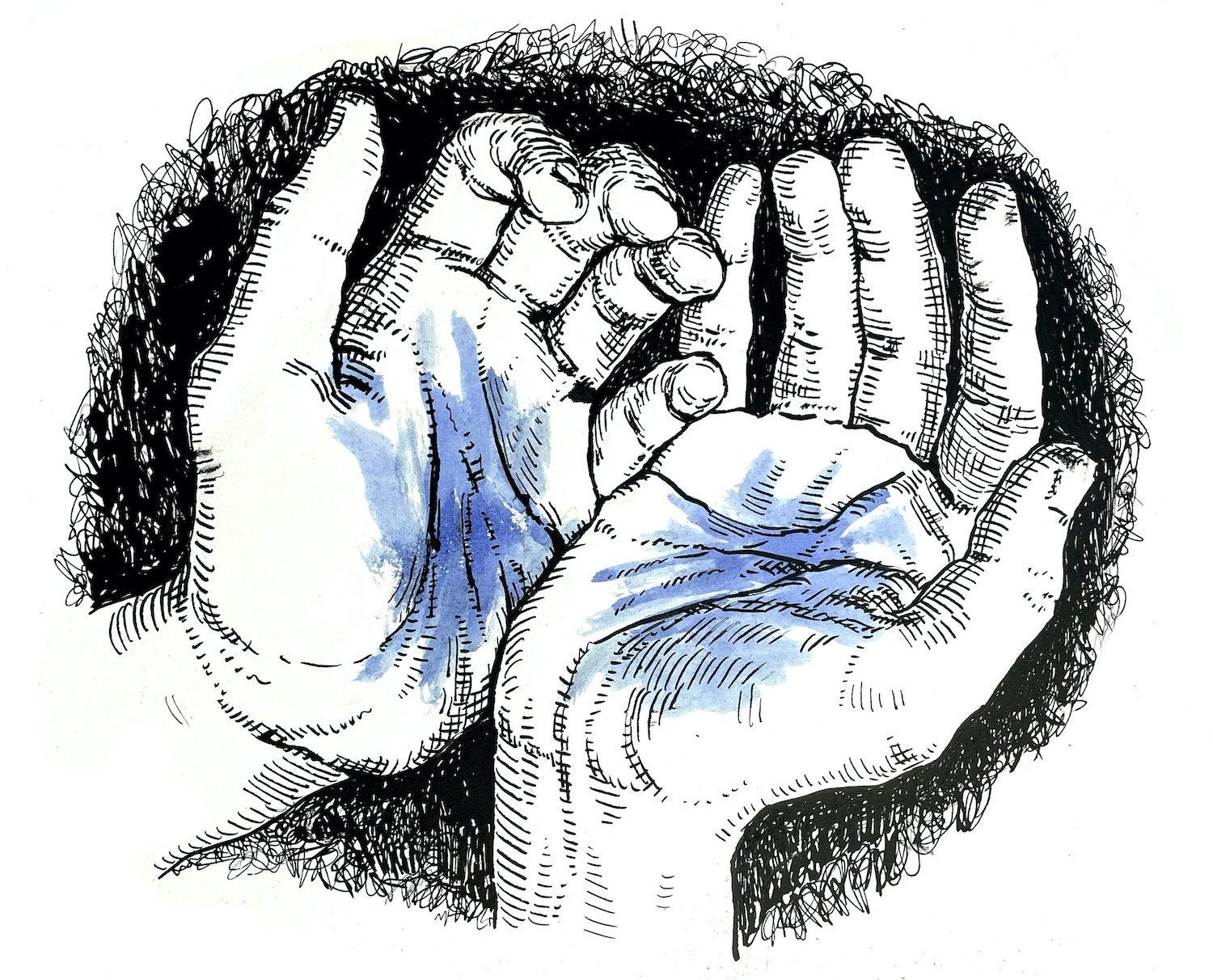
I wasn’t left-handed, but I wanted to be. I needed to be. My right hand was too painful to use: a spinal disease limited blood flow and nerve function, leaving the hand cold, discolored, and slow to react. As a painter, I was uniquely reliant on fine motor skills. To maintain my livelihood, I would need to reverse my dominance.
At the time, I was living in London and painting at a studio near Hackney Downs, a public park I mostly recall as a sloping meadow shrouded in low-hanging fog. There were occasional sunny days, too, but they didn’t make an impression. I’d seen plenty of sun back home in America.
Every morning, I would bike along the footpath to reach my studio. At that hour, the park was full of people pushing strollers, or doing pushups on the wet grass, or carrying little white coffee cups with brand names stamped on the side, or bending over to collect pebbly poops from toy dogs.
The studio, which I shared with a dozen other artists, was full of chatter when I arrived: spirited greetings, offers of tea and coffee, talk of new projects and difficult clients and first dates and breakups and vacation plans. Some days, there was so much chatter that I could drift from coffee break to lunch break to after-work drinks, accomplishing no work at all. But other days, rainy days or public holidays, everyone else stayed home, leaving me alone in the studio.
Those were the days when I did my best work. Untouched by distraction, I stood for hours at the easel, watching images develop. My hands moved while the rest of my body seemed to retreat from view, like a tactful waiter leaving me to my meal. I loved it, but I didn’t feel love in the moment. There was no feeling at all as I worked, just action. One little decision after another. Time was a radio playing in another room: it did not involve me.
Such a state is a rare privilege. I got to experience it every day. It was my job.
I was a portrait artist. For money, I painted children and couples and dogs. Between commissions, I could paint anything I wanted. I always returned to the same subject: my father.
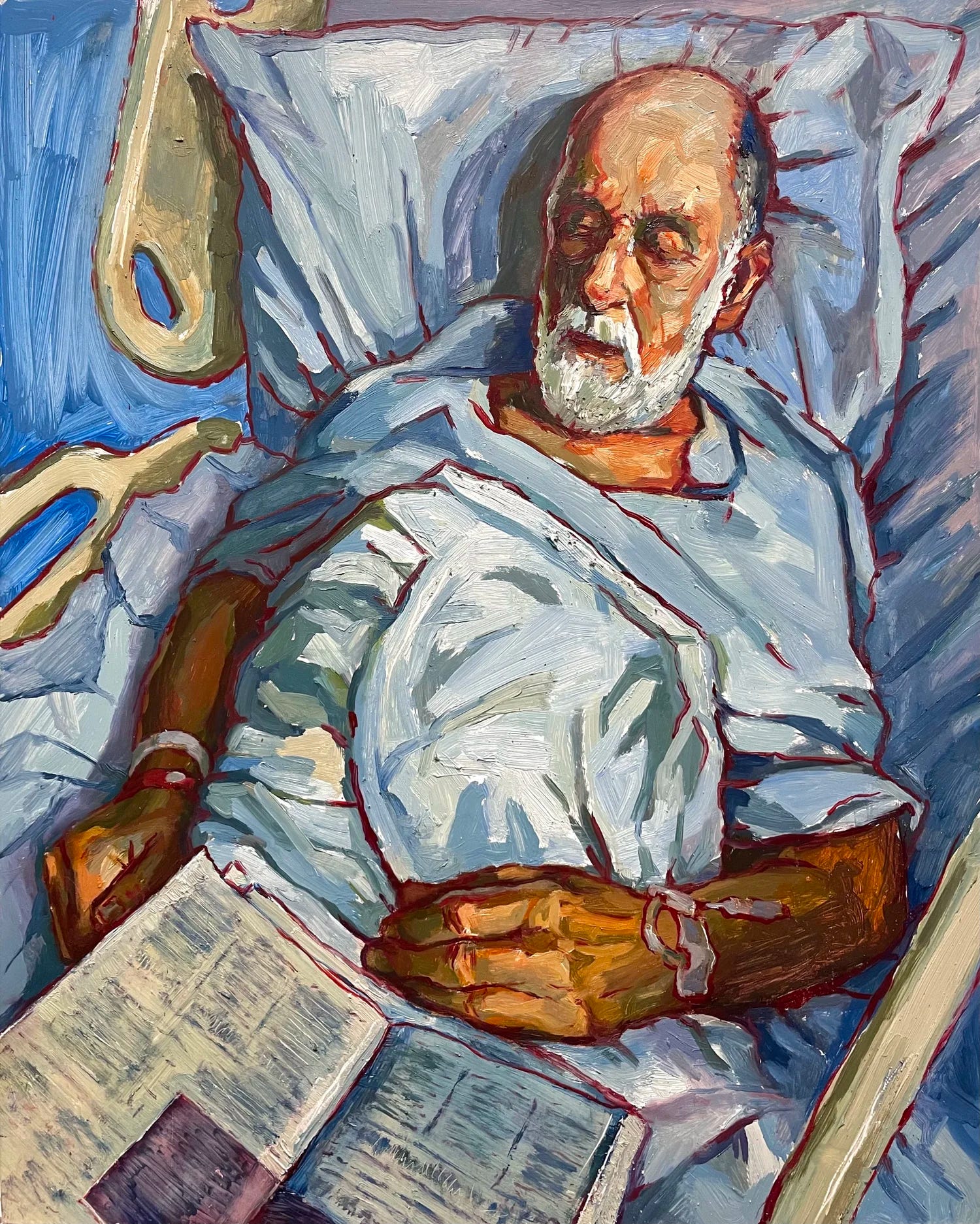
The few photos I had of my father—taken on family vacations or in the nursing home where he now lived—became reference photos for paintings. Some photos were used more than once, at different scales, with different palettes. Unlike commissioned portraits, the ones of my dad never left the studio. They hung on my walls for months, years, the only constants in an ever-changing grid of faces.
In my early twenties, when art became my livelihood, it provided the first clear identity I’d ever had. After that point, I no longer asked myself who I was. Why would I? Art was my permanent answer.
The clarity only lasted a few years. I didn’t know it then, but it all depended on my health. When my spinal disease was diagnosed at age 23, I became aware of my body for the first time: its existence, its components, its gradual decline.
Physical therapy helped, and for a while I was able to continue drawing and painting full-time. But the disease progressed until one day, as I stood painting in my London studio, I became conscious of a throbbing pain in my right hand, and looked down to find the skin purple and cold to the touch.
I left the studio early that day and biked home, holding the handlebars with my left hand, letting my right hand sit warm and limp in my coat pocket.
Over the following weeks, my right hand declined to the point where I could no longer paint at all. I stopped visiting the studio. I felt trapped in my own body. Brushing my teeth or cutting a vegetable could bring me to tears. I abandoned projects, ignored emails, walked around daytime London watching the city shift with every hour. I was not a part of anything, not even myself.
Was it possible to become left-handed? Online, the consensus was discouraging: handedness, it seemed, was hard-wired in the brain, reinforced through decades of habit. We use our hands hundreds, possibly thousands of times a day. And each time, we make an unconscious choice between left and right—picking up a water glass, pressing an elevator button, waving hello, scratching an itch, unlocking a door, turning a knob, using a mousepad, holding a fork. Every gesture is determined by dominance. Every gesture leaves one hand stronger, smarter, more precise, and more essential than the other.
Switching hand dominance entails more than just transferring these abilities to the non-dominant hand; the dominant hand, too, learns to play a new role—for example, to hold the fruit while the other hand peels, to hold the paper while the other hand cuts, and so on. These helper tasks, though less demanding than their counterparts, still require subtle angling and timing that can only be learned through repetition.
When I began reversing my dominance, no gesture went smoothly. Practice was slow and tedious: one hand demonstrated the movement, as if to a child, and the other hand replicated it in the opposite direction. It became apparent that I did not actually know how to do anything. The knowledge resided in my hands, not my brain. I could not explain any gesture in words. These were things I did automatically. Like a servant, my right hand had taken care of things without relaying the details.
Even once I’d retrained my hands, I still could not remember at the crucial moment to choose my left. Automatically, and irrespective of pain, my right hand reached out to help. It refused to surrender.
Online, people suggested wearing a mitten on the dominant hand, or restraining it in a sling. My own solution was to hold it against my back. Contorted like this, I performed my tasks inelegantly, unhappily, at half speed.
I decided to write an essay about my hands, mostly to feel what I felt while painting. In other words, to feel nothing.
I told a lot of people about the essay. I announced it online. It would, I was sure, be a turning point in my career. The more I talked about it, the grander the scope became. The essay would become a multi-part series. Or a full-length book. Maybe even a documentary.
In reality, it never amounted to more than a Word document full of copy-pasted excerpts, in varying fonts, from magazine articles and scientific papers and history websites. At the time, that was all I could do. Typing at length was out of the question: my hand hurt too much.
Still, I was confident that the essay would come together someday, advancing my career, paying my bills, reintroducing me to the world. I needed a new identity now: I wasn’t a painter anymore.
I started collecting the stories of other people who’d switched hand dominance after a stroke, a fracture, a bad case of carpal tunnel. I learned that a friend’s brother had lost an arm in a car accident.
“Do you think he’d talk to me?” I asked.
“I doubt it,” my friend said. “He tries not to think about it.”
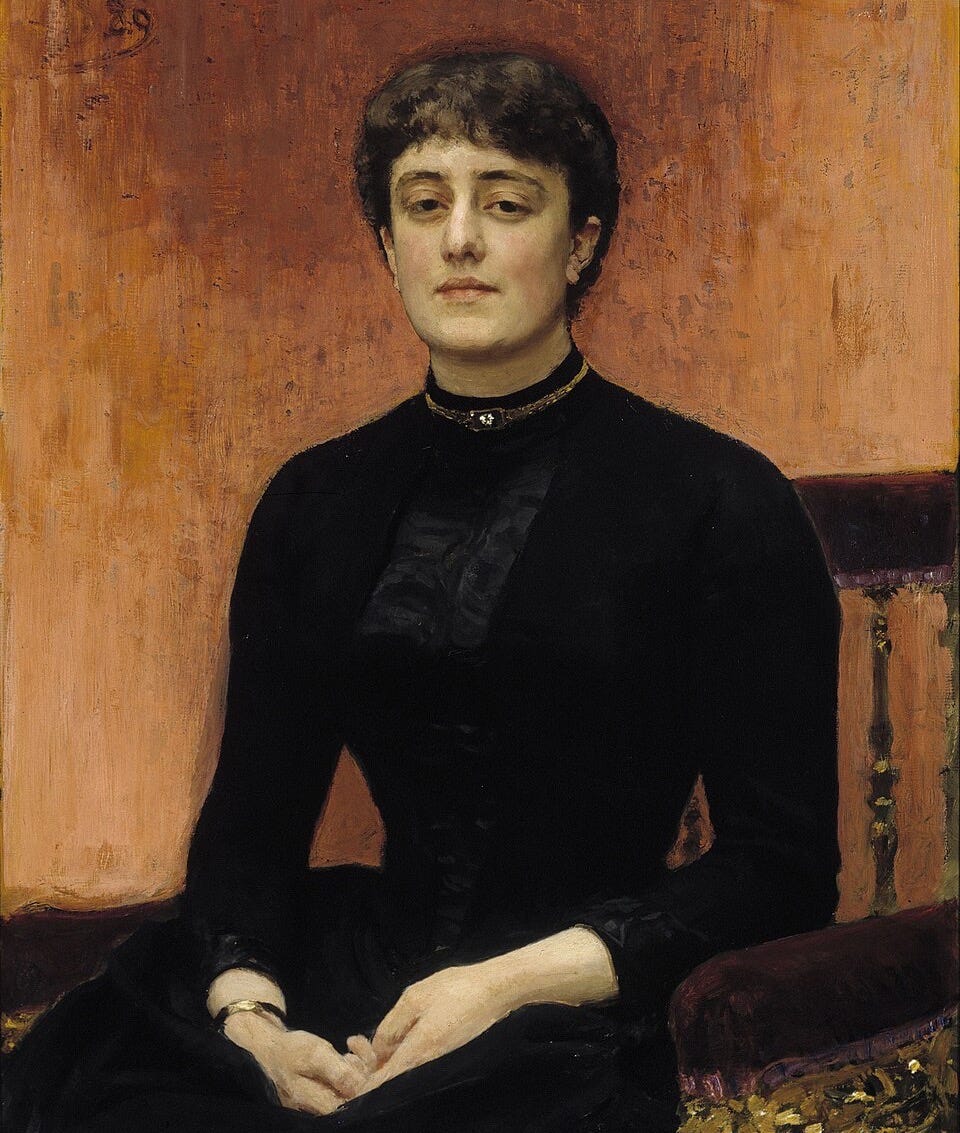
I turned my focus to historical figures, people whose lives were already in the public domain. The most relevant one I could find was a 19th century Russian painter named Ilya Repin who, after his right hand became paralyzed, learned to paint with his left.
Repin’s left-handed paintings appeared equally accomplished to me. I wasn’t really sure what this proved. That dominance-transfer was possible? That it mattered? Often, when I surveyed my essay document, dense with anecdotes and statistics, I struggled to remember what the point was.
A new wellness studio arrived in my neighborhood, with generous promotional offers for the first month. “You should try yoga,” people were always saying, “it totally fixed my back.” I had ignored these people, because none of them had spinal diseases. But now desperation had rendered me vulnerable to the promises of expensive group exercise. I signed up for an early-morning Vinyasa Flow class and spent the hour crying in the back row because my right hand prevented me from doing downward dog.
My left hand, meanwhile, was improving. I could brush my hair with it. I could chop an apple without drawing blood. I could use the computer trackpad to do my essay research. Furthermore, new instincts were taking hold: it was no longer necessary for me to keep my right hand pinned behind my back. Like an older generation ceding power to the next, my right hand had finally accepted its secondary status.
My father was a lifelong left-hander. I thought about him a lot in those days, as my left hand grew stronger. It felt odd to be intentionally cultivating a condition once stigmatized, actively discouraged by American schools through the 20th century. But times had changed, and people were superstitious in different ways now.
I called my father occasionally, not mentioning my hands or the paintings. The calls were tense and unsatisfying. He was in his eighties and stuck in a hospital bed. Anything I said about my expat existence felt like a taunt. It was simpler just to paint him.
When a new commission came in—a life-sized portrait of a toddler—I tried painting it with my left hand. I was surprised at how well it turned out. Sure, it took twice as long as usual, but it still looked like my style. Only when the painting was done, packed up in cardboard and bubble wrap, did the realization hit: my left hand was in pain.
It was happening all over again, in the opposite direction. My right hand was better; my left hand was worse. It was not clear what I should do. Should I switch back to my right? Or try a hybrid, ambidextrous approach? I conducted more research. I asked around. I pasted new studies into my document. And in the middle of all this, my father died.
I flew back to the U.S. and forgot about my hands. Like most things I had previously considered important—my thigh circumference and dating prospects—the handedness project now seemed a trivial endeavor rooted in narcissism, just another excuse to look at myself.
My father was born in the thirties, a bad time to grow up left-handed. Forced to favor his right hand over his left, he never learned to write legibly with either. As an adult, he struggled to communicate without a typewriter. His checks were impossible to cash, his envelopes returned to sender. His handwriting was strange, inimitable, almost foreign-looking, with its inconsistent spacing and capitalization. It was a system of his own invention, and it didn’t work.
Even more damning was his stutter. Phone calls could be slow, stilted. Ordering at restaurants was a nightmare. My father was considered mentally challenged until his teenage years, after which everyone forgot, moved on, except him.
The last time I visited him, a few months before he died, he sat in his wheelchair drinking orange juice and eating a tuna sandwich, wearing a blue terrycloth bib to catch the spills. He told me about his childhood, about being sent to a reform camp for his stutter. “It was awful,” he said, shaking his head at scenes only he could remember.
I was tired that day, or bored, or struggling to pick out his words. I didn’t ask many questions. The nursing home was a tough place to visit, and a worse place to live. Alarms rang out day and night. The air was foul, the windows closed. He was telling me something important. I wasn’t listening.
When he died, I felt released from all responsibilities, even ones I’d inflicted upon myself. I never revisited the essay. I never even opened the document. And in the end, I never switched my hand dominance; I switched my career instead.
I’m a writer now, which hurts far less. I still paint the occasional portrait with my right hand, but only if I’m feeling up to it. The portraits of my dad hang around my apartment. Sometimes when I look at them I feel a deep grief. Sometimes I feel a disloyal urge to take them down, put them in storage. Sometimes I feel pleased with my abilities, sometimes I feel critical, noting mistakes. But mostly I feel nothing. They’re just things I live with. I hardly see them anymore.
Updates: I’m reading at a launch for the press I co-founded, Loose Tooth, on August 31 in Brooklyn; applications are closing soon for my new low-tech residency in upstate NY; you can now pre-order my forthcoming book.
No posts
Comments
Nothing yet. Say the first thing.
Sign in to join the conversation.