
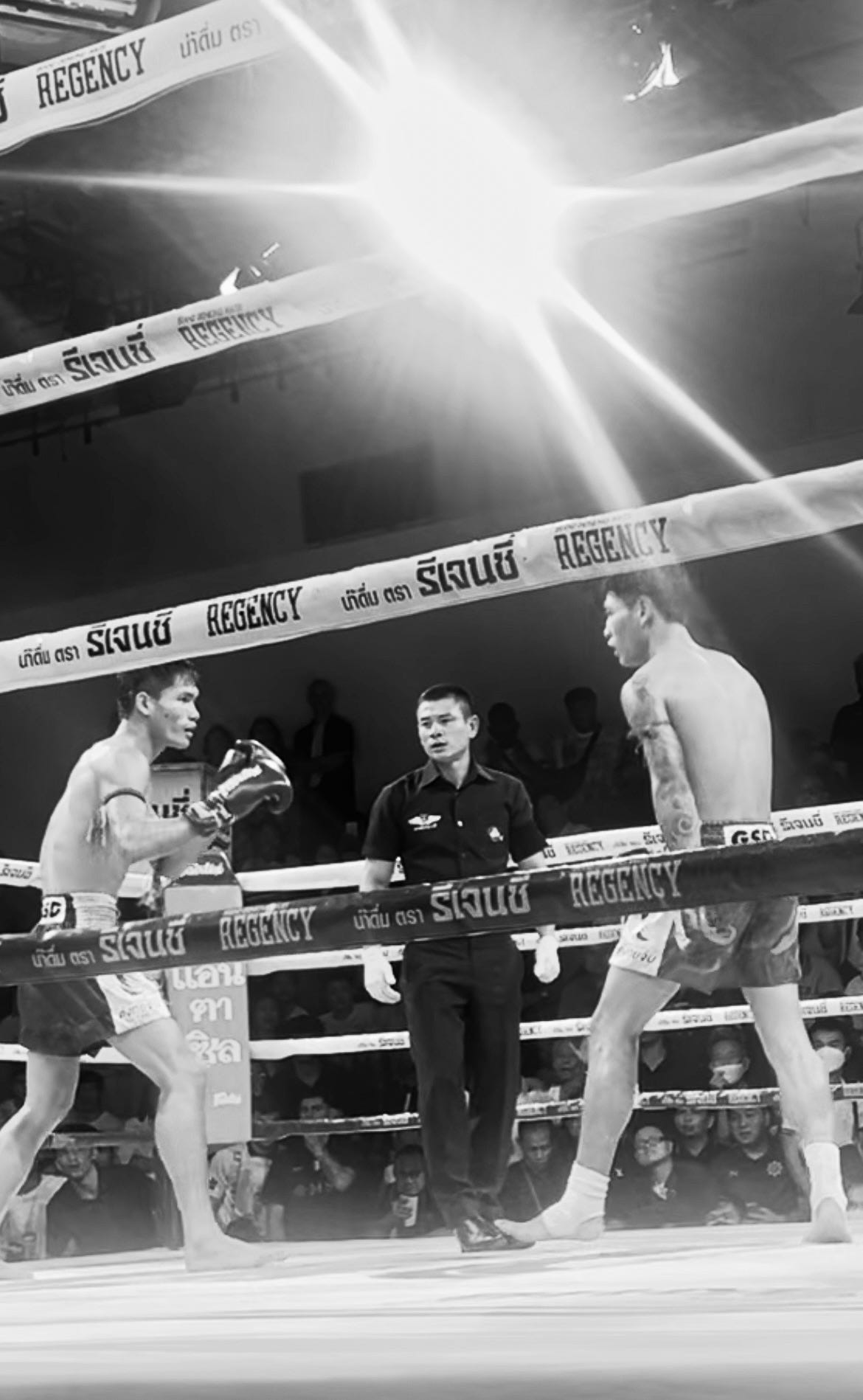
It is not an original observation that every medium of entertainment has devolved and become shitified. Even combat sports, an activity with possible existential consequences, has sold itself to the lowest common consumer. I may be original in positing that the last remnant of the ancient virtues of sports can be witnessed in a warehouse in uptown Bangkok. At Channel 7 Headquarters on Sunday afternoons one can attend for free, granted they are properly attired in plain collared shirt and pants, the last display of human excellence in sports. Here you will see the national sport of Thailand, Muay Thai, an ancient martial art developed through combat between the Thai people and their neighbors over ancient territorial disputes. This contest is shaped by the interaction between the fighters, the crowd, and most importantly the gamblers. These faithful gamblers perched on footstools and bleachers dictate the plot just as much as the fighters. They shape the setting and conflict as equal characters, the resolution not being relegated to a single match but carrying over throughout the event. It is unlike any live sporting I have attended in that it provides the ability to participate in a collective human energy that only existential stakes can conceive.
The ancient accounts of personal valor through sports can be found among the western classics such as Xenophon and Homer—as a medium for personal ascension through simulation of warlike activities. Cross culturally war was inextricable from religion: as a people marched into battle they carried their gods with them, the survival of a people was not just at stake in battle but the survival of their gods. To die in battle in defense of ones gods was seen as the most supreme ways for spiritual ascendency. In times of peace these opportunities for individual ascension manifested themselves in sport and gladiatorial games. In modernity, these vestigial impulses for ascension still remain albeit either channeled into other pursuits or derided for its incompatibility with modern morality. To an athlete this ascendent impulse manifests in the willingness to sacrifice a great deal for a moment of personal valor. To a combat sports athlete, the nature of the sport carries with it possible existential consequences—if not in the ring then perhaps decades later. Perhaps because of these existential consequences humans have been fascinated by combat sports, likely being the oldest form of sport we as a species have engaged in. Combat sports has also been the domain of the elite, as the separation between those who fight and those who lead cultures being a recent phenomena. Today combat sports are ubiquitous globally, whether amateur fight promotion or nationally recognized sport —people can compete and watch humans fight anywhere.
Thailand is special. Muay Thai is special. In the last 10 years it has attracted attention internationally with people from every country imaginable visiting Thailand to train in outdoor gyms usually reserved for the poorest Thai people. Fights are held almost constantly everywhere from major urban areas to the middle of nowhere farm communities. Stylistically this is a far cry from the international recognition of the UFC, where Russians and Brazilians in sterile synthetic shorts compete to calf kick and tie up with each other for belts that stay uncontested for years leaving fans helpless for resolution. Thai fighters are often reserved or exuberant personalities that arrive to do the job, perform, and go back home to spend their earnings on their family. Contrast this with the status quo of UFC press conferences that rhetorically resembles a shakedown by the local drunk at a bus stop somewhere in the Balkans. Likewise the combat itself is strategic enough yet does not become mired in some kind of distance control or grappling stalemate, the referees of Thailand are adamant on forcing contact. Overall, promotions from rural village tournaments to ONE Championship allow for the art to be transmitted with the very real consequences intact.
Thais and foreigners alike are drawn to the spectacle, and while high ticket prices of ONE Lumpinee or Rajadamnern stadium may restrict the average Thai from attending, the free admission and televised nature of Channel 7 democratizes the sport. Though ONE Championship may possess incredible talent and an immense budget, Channel 7 is the apex for the average Thai. The five round fights on Sunday afternoon—the traditional rest day in Muay Thai and Thailand more broadly—have been televised free into living rooms and bars around Thailand for over 50 years. For an institution so embedded into national identity the building these fights are housed in is modest. The Channel 7 studio is across from Chatuchak park, inside of a flat sleepy neighborhood fenced in by large office buildings that were jostled by the earthquake of 2025. The venue is essentially a warehouse with wooden bleachers and a concrete standing room with footstools strewn about for the regulars to achieve some place of vantage. The large cameras are ensconced above the crowd on a small outcropping weaving in and out above the crowd with the hosts and judges absent from the view of the live audience their existence is only recognized when a fight goes to decision.
On this particular Sunday I was told there would be a championship belt on the line. Given that all the promotional material was in Thai I did not recognize names of the fighters, I knew that if they had made it to Channel 7 they were vetted at the highest level. The fighters and their respective gym entourage can be seen outside preparing and scrolling on phones outside the entrance. Upon squeezing through the small dark opening to the warehouse, depending on your time of arrival, you will be ushered to either side of the ring to a multi-tiered bleacher by emaciated Thai men who’s teeth bear the marks of years of methamphetamine use. If you are late you will have to squeeze between the other bodies occupying the concrete floor beneath the cameras. I was seated directly opposite the blue corner on the ground floor, close enough to lean over the short metal gate and start coaching a fighter as some gamblers find they are qualified to do. The gamblers arrive early enough to occupy their seats as if designated for them, this is work for these people. Many carry at least two phones and a tablet in addition to hordes of colorful Thai Bhat. The mix of smart phones, flip phones connected to analog headphones, touch screen tablets, and any other device capable of computation and instant communication is employed among these men weighed down with amulets depicting buddhist monks dead for millennia. They communicate with bookmakers in locations unknown and take bets from individuals around the world watching online, they provide updates on the fights second by second using emojis with coded meanings. They communicate with each other via hand signals that have been established long ago seemingly impenetrable to outsiders. This is the usual dynamic, the TV crew and anything involved in telecommunications are barely noticeable, the place is given life by the fighters, their entourage and the gamblers who consider this place their office.
More people file in, foreigners seem to arrive late. The foreign crowd is split between the tacky corpulent type with stick and poke tattoos seemingly lost but drawn in by the curiosity of foreign violence, and Muay Thai enthusiasts and practitioners contrasted by their darker tattoo subject matter and lower body fat percentage. Knowing the seat I occupy is prime I head out of the warehouse to the bathroom before anything interesting begins. The bathroom is in a trailer. I see one of the trainers from my old gym, a clinch specialist, escorting a shorter fighter through the steps leading up the trailer. The clinch specialist posts guard on the fighter as he uses the urinal, facing outward with his arms crossed he looks at the rest of us occupying the tiny space. This act confirms that something is at stake as I think back to the stories of the past of athletes being drugged or athletes being assaulted on their way to the venue in an attempt to sway the outcome—it is only pragmatic that these guys are followed unwaveringly by someone capable of violence who knows the game.
The involvement of organized crime in sports is not the subject of my focus, but I digress and remind everyone there was a time in the U.S. where its prevalence was inescapable. Numbers running, or sports bookkeeping is almost a classic trope of bygone American culture—everyone bet on sports and the American mob, spread out over cities throughout the country took a piece of any competition you could bet on. The prohibition on sports gambling was in part an effort to cut off the financial wealth of the American mob, with the extinction of our own native organized crime the U.S. Government seemed to find it appropriate to allow sports gambling again—the consequences speak for themself. But here in Thailand this possibility of malfeasance on the part of a lone actor or even the threat from some organized crime outfit with enough of an interest in influencing the outcome of a fight adds to the gravity of the experience. We all inhale the distinct only found in toilets in developing world countries of scented rocks with congealed piss as the fighter and his escort depart the trailer. The path back to the arena is lined with more fight teams on standby with their athletes, massaging each other, wrapping hands, and generally looking indifferent.
On my way back I encounter a man who does not communicate verbally, rather he grabs you and positions his body in accordance with the message he wishes to convey. The man looks like Homer Simpsons father, his head like a prune with a small wisp of white hair. He does not work for Channel 7, but he acts like he does, ushering people in and directing them to seating. He has a small wooden footstool he positions as he sees fit, shifting regularly within the standing crowd—irrespective of anyones space or vision. He has likely been there for decades, he has certainly developed a permanence recognized by those in attendance.
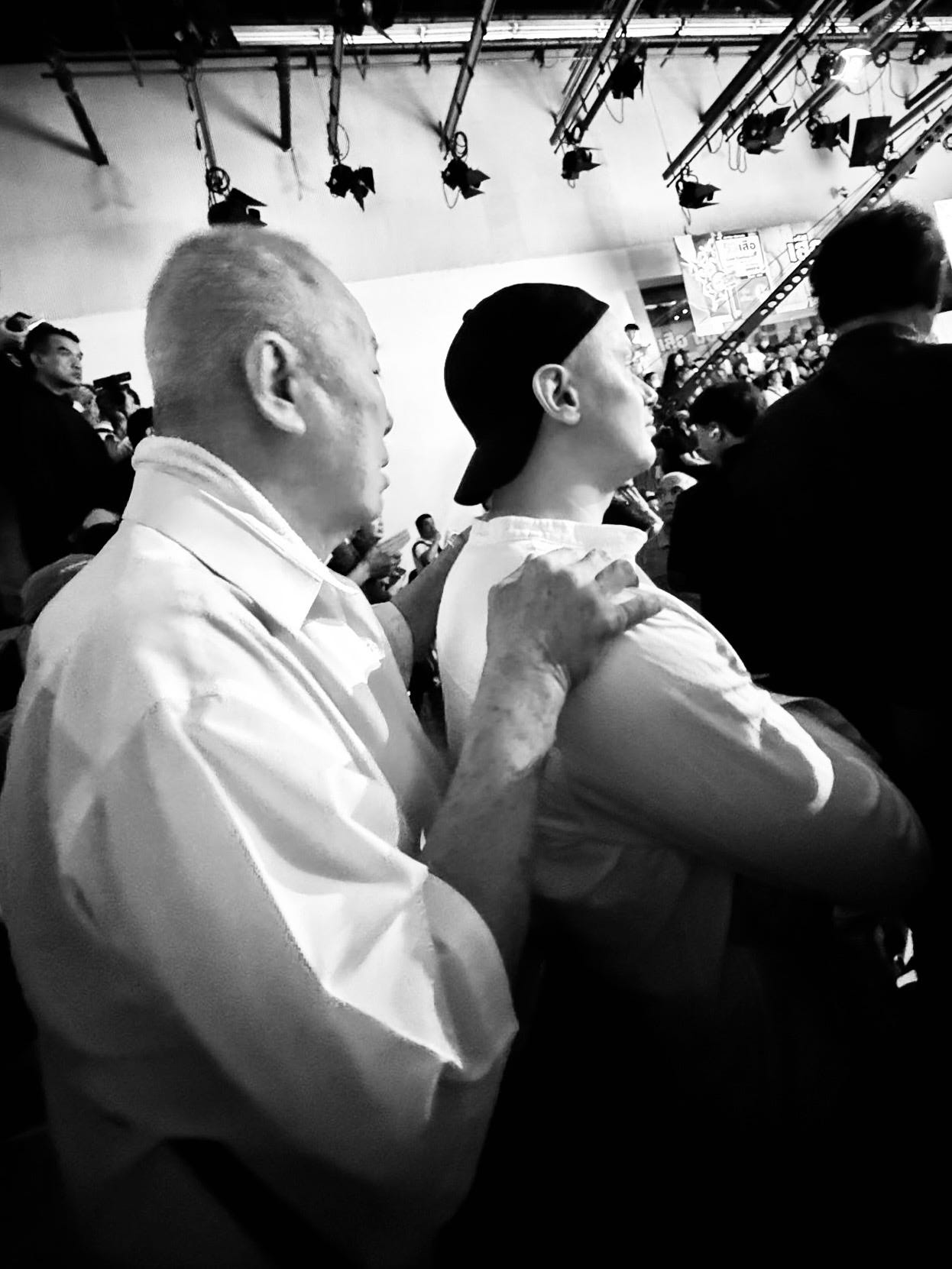
The ancient one
I ignore the ancient ones directions and regain the seat opposite the blue corner. Sure enough the fight that begins is one with the short fighter from the gym I have attended. I was last at this gym maybe 7 months prior and I have never seen this fighter, he must be newly added to the stable that this gym possesses which include some of the biggest names in Muay Thai. I use the word stable because paintings of horses are everywhere in Thailand but also the owners of these gyms often have pictures of themselves at horse races or at a minimum there is one degree of separation between a wealthy Thai man and a horse race. But in reality the business practices of some of these gyms resemble animal trading more than an employee employer relationship. These people, often from rural Thailand, are expected to fight and win on a regular basis and failure to deliver is a liability that some gyms can afford but some ambitious ones can not. If you track a fighters career you may notice they may stay at one gym their entire career or they move up and down to fight in bigger promotions or demoted to more provincial locales. This particular gym has fighters in the biggest promotions in Thailand, and today the fighter is led to the ring by several coaches including one of the most highly regarded Muay Thai trainers in the game, trailing behind at the very end is the gym owner who’s public persona is an intimidating mix of mafia boss, Rick Ross, and an NFL team owner.
The gamblers begin to flash their hand signals to each other and speak into phones as the fighters take their corners. The bell sounds, the fighters initiate the Channel 7 style of Muay Thai which is a slower first round of feeling each other out through the long range weapon of the kick. Nobody expects anything earth shattering in the first couple of rounds, unlike the three round version of Muay Thai which has become the standard. Three rounds forces engagement to appease those with smaller attention spans, five rounds allows for a narrative structure to form. The feeling out phase, the kinetic phase where the points are scored and the contest is decided, and a last round of exhibitionism where the fighter who believes he has won demonstrates his lack of concern by dancing around and taunting his opponent. In this match things escalate quickly as the red corner fighter begins to pick apart the smaller blue corner fighter. Red is scoring effective kicks and countering blues attempts to throw punches, but most obvious is reds dominance of the clinch for the initial rounds. A palpable feeling of surprise is emerges as we all observe blue giving up vital points during the third round. Round 3 ends and the fighters exhaustedly walk to their corners, everyone is aware of the dire situation for the shorter fighter in blue especially the trainers.
The lead trainer slaps the small fighter in blue, with tears in his eyes, the man voted best trainer in Thailand exclaims consternation that transcends language. It is apparent that there is shock in the blue corner that this fighter has given his opponent so many uncontested points. The level of seriousness is palpable, this fighter—who, again, must be newer to the roster—is likely at risk of being cut for this error. Do I know this for certain? No. Is the lead trainer undoubtedly displaying a level of extreme concern for all to see? Yes. Is the absolute coldness of the gym owner apparent by his alternating between checking one of his phones and staring off into the distance with his arms crossed? Absolutely. I am witnessing a situation in which with simple inferences about the course of events and my previous knowledge of the people involved I understand this is not just a self contained 5 round fight but a business transaction, a performance evaluation, and the future of an institution all on display. It did not end well for the small Thai fighter from the blue corner seemingly no older than 25, as he suffers a loss by decision. The corners retreat leaving no trace of what we have just witnessed and make way for the next fight.
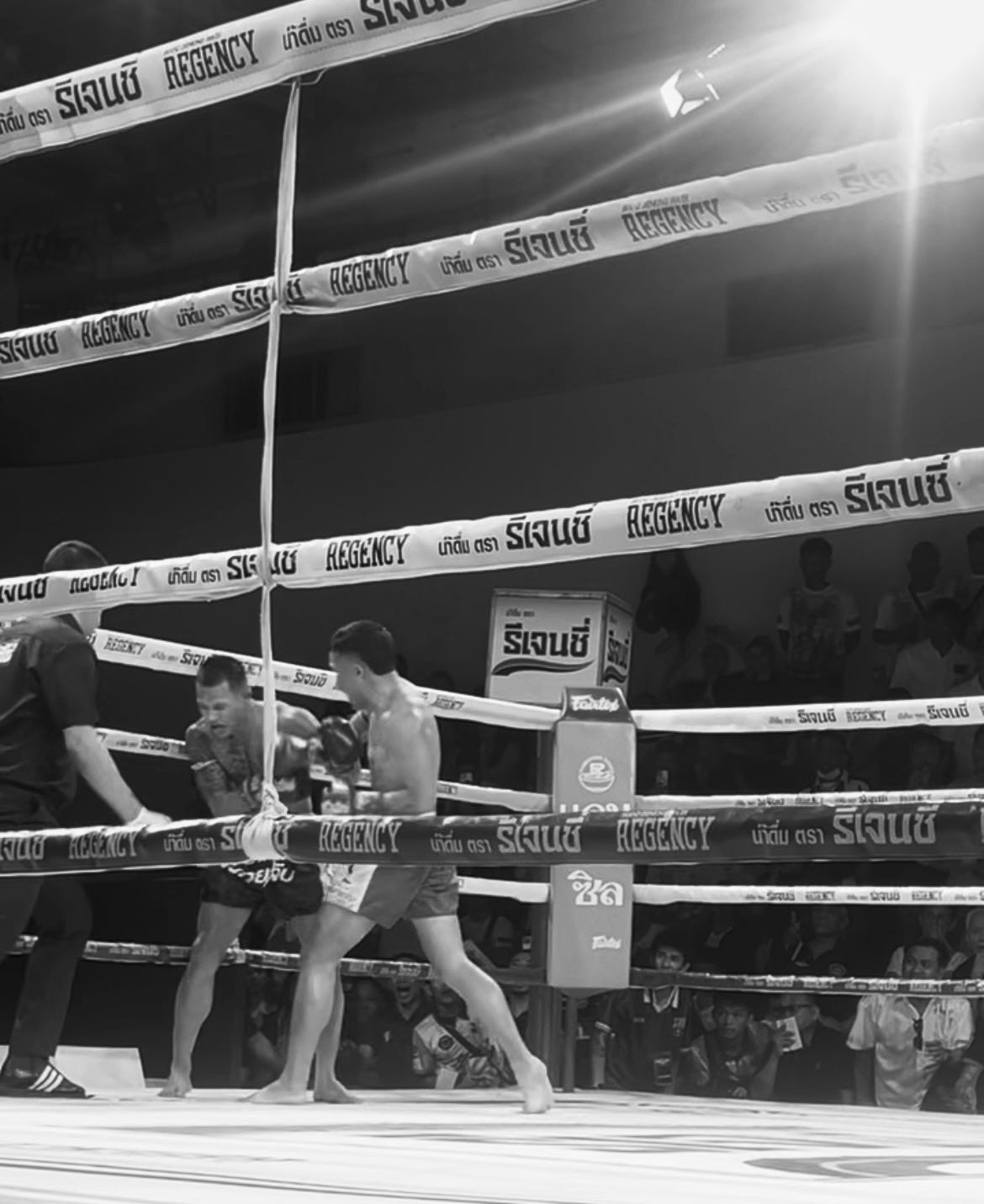
The championship belt for a very competitive heavier weight class is about to be contested. The type of fighter who occupies this weight class is not only often taller but can deliver more power than his smaller counterparts. The reigning champion possesses the facial features of a classical Thai statue, any ethnographic study of Siam from the 19th century would have included a daguerreotype of someone who looks like this. His opponent in contrast is younger and looks like a pop idol, he has a retinue of female fans who scream for him in the bleachers behind me. His retinue cannot be older than 19 on average, I have never seen a Muay Thai fighter accumulate a young female audience like this which further contrasts the two. The older, tanned and tattooed statuesque champion versus the young flashy challenger, their demeanor mimics these archetypes from the very beginning. As they square off against each other I notice the younger challenger in the blue corner is a southpaw, further endearing me to this underdog as a fellow practitioner who leads with his right.
The crowd is screaming before the bell rings, at this point all of the gamblers in the far back of the bleachers are on their feet illuminated by phones and tablet screens. The shift in seriousness is palpable as the fight begins and everyone in attendance participates in escalating the stakes. As they move towards each other the rhythm is quickly established, first they measure with jabs and then launch their kicks to either be checked or find their targets. The southpaw seems to have the advantage in this game, his left kick can find the opponents liver and ribs in a noticeably more effective way. The champion attempts to answer back but is repeatedly checked, his jabs and longer limbs do seem to prevent any attempts at a clinch but the effectiveness of his attacks are stifled. I take notice of the man who cleans this corner of the ring after every round. He is invisible as his job requires, until he grabs a large metal tray filled with water expelled by the fighters corner in between rounds and dumps the contents into a trash can. He has a seat right at the foot of the ring allowing for him to gaze at the fighters ankles. He is in his 50s, wearing a mask and black latex gloves, in a simple uniform with a mandarin collar and the channel 7 logo, he has no distinguishing features besides looking like he has worked here all his life. All of us, the cleaning man included, can’t look away as the two trade kicks that do not waver in intensity. At some point the southpaw begins to overtake the champion in accuracy and effectiveness. Something is altered unseen, only the fighters can discern what variable shifted towards the southpaw.
The southpaw begins to walk down the champion, smiling the entire time. There is discernible fear on the champions face, he realizes he is losing it as he backs up taking repeated kicks to the ribs. The eyes of the incumbent champion look twice the size they were when the match began, this is not a look that portrays confidence— in this moment any gambler or amateur body language analyst would be betting it all on the southpaw. As the southpaw moves forward he is smiling, he looks cool, this man recognizes he is enveloping the champion in the corner of the ring, turning it into an inescapable cauldron. The challenger continues to beat on the liver with his left kick, by this point the champions entire side is red. By contrast, the southpaw looks untouched, he is the only fighter on the card with a real hairstyle, looking the part of a cartoon protagonist vanquishing some axiomatic evil. It is plain for all to see that we are witnessing the champion lose his belt, the confidence shown by the southpaw has won the crowd. The entire world seems to have favored this man as the usually silent gym owner from the famous gym returns to the ring just to offer advice to the southpaws corner. I see the gym owner in his track suit jacket motioning his hands in the signal I’ve only seen from older trainers indicating the repetition of the kick. It is clear that the owner of an elite gym, a shaping force in the Muay Thai status quo wants to see the status quo change—he probably has money on the challenger as his cellphone never leaves his hand.
The luminosity of the two men in the center attracts every eye as the energy of both reach their pinnacle. The combination of light and body heat have given each of the fighters a radiant outline that is visible when they pause before striking. The two men appear to have pushed into the depths of human capability and are sustained by something otherworldly.
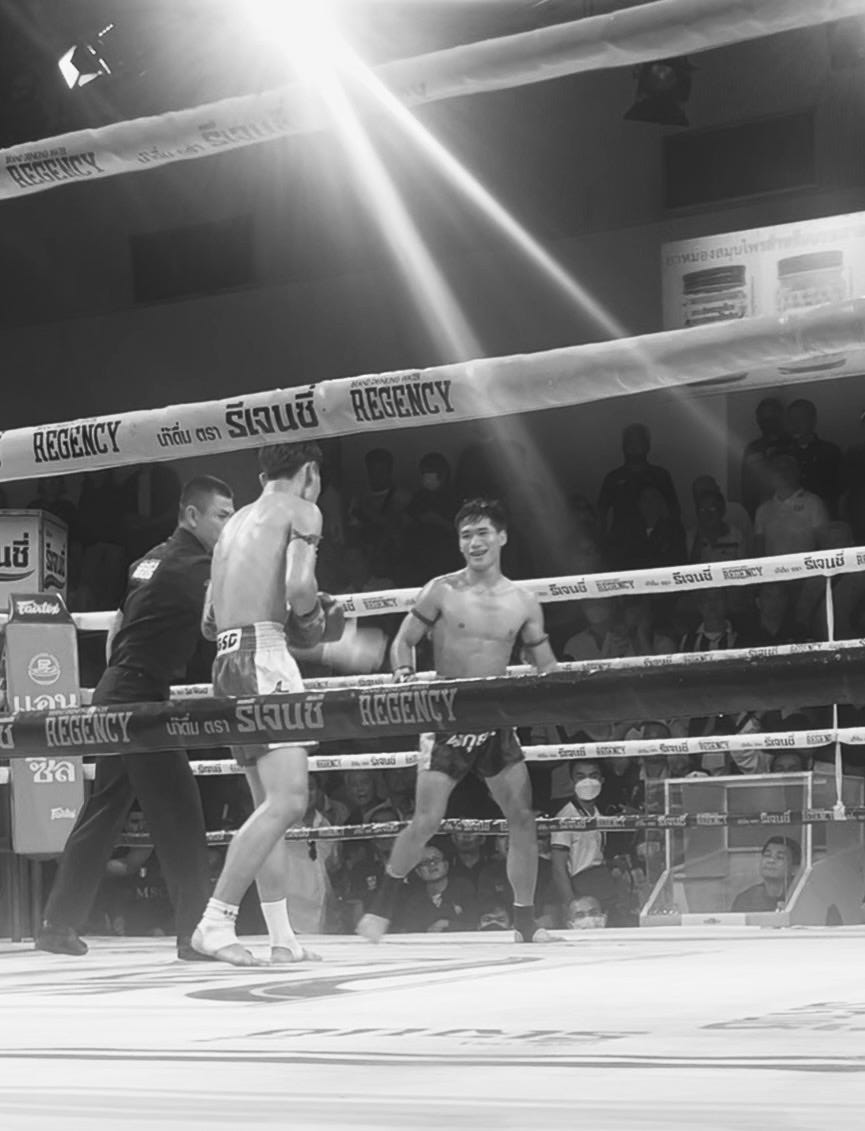
The final round passes with the southpaw displaying his confidence in his victory by waving his arms as the champion tries to land kicks— the bell sounds, it will now go to the judges. There is no doubt that all who witnessed this event saw the challenger defeat the incumbent in the metric that matters—appearances. We will witness the Channel 7 belt go to a new man, one who earned it with a dominant performance over a widely respected famous champion. But this doesn’t happen. The judges have called the fight for the incumbent. Everyone is confused, the southpaw has a poker face for the advertisers but it is plain to anyone this is not what was expected.
As the advertisers pose with the two fighters, both men stare off into the cameras beaming disappointment back to living rooms and bars across the country. Both men seem to have formed a thousand yard stare after this battle, displaying recognition of their shared reality being subverted by the judges. The next fight is between teenagers or juveniles, nobody cares, there’s no recovery after that. We are all energetically spent after what we have experienced, a great many people file out to recover for the rest of the day. I do not suggest this fight was “rigged” but clearly something appears to have been decided behind the scenes. Clearly there is a disconnect between what everyone saw and the result the people deciding this contest deemed appropriate. Did this add to the drama? Absolutely, while the action I described occurred in front of us some unseen force was working underneath the surface to reveal itself in destroying our expectations. What this force is we can only speculate. This fight has remained on my mind ever since. It had everything—no other sporting event I recall can compare. The kayfabe of the WWE or faux prison yard monologues of the UFC press conferences can not contend with such rawness. That is why if you find yourself in Bangkok you could potentially experience real human drama before it may be altered for streaming platforms or purchased by a private equity firm as the advertisement vehicle for an enema subscription service as is the fate of most life affirming products.
The activity outside is placid, juxtaposed with the constant drone of the crowd in the warehouse. Aside from a few white Toyota vans and haggard leathery men in Channel 7 polo shirts milling about the place is vacant. The results of the fights have made no difference here. Everyone resumes where they left off until the next Sunday where the events will be refashioned anew with the same red and blue trunks with the past having no place in the events that will take place as they have for decades in a seemingly timeless way every Sunday in a warehouse in Bangkok.
No posts
Comments
Nothing yet. Say the first thing.
Sign in to join the conversation.