
Be warned: The next quarter century will be overrun with cyborgs. Most likely, we’ll choose to become them.
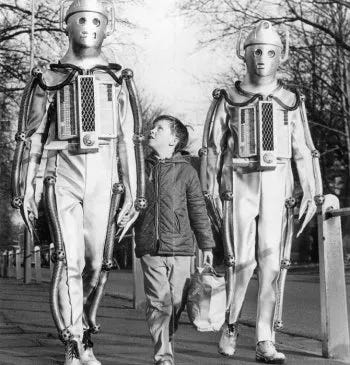
Dr Who, Boy With Cybermen, February 25, 1967.
Playful hysterics aside, the truth is that many of us will elect to enhance our bodies and thought processes to such a radical extent that it will splinter the notion of what we consider a human being to be. As “hybrids of machine and organism,1” we could tap into memories from a computer, see with non-human eyes (researchers are already restoring vision through brain-computer interfaces) and interact with the physical world by thought alone. But this transition from the purely organic human into whatever it is that some of us will become should not only be seen through the lens of dystopian sci-fi or technophilic fantasy. We should claim agency over our potential and build for ourselves whatever it is that we will become.
The term cyborg was first coined in 1960 in an article for Astronautics2, which argued that it would be preferable to modify the human body for alien conditions than adapt the alien environment to what our human bodies can withstand. The popular conception of a cyborg remains stuck in the sci-fi of the 1960s (see image above), as a half human half robot. But defining ourselves only by our physical bodies misses the point. Instead consider how technology changes our lived experience: how we see the world around us, how we engage in everyday life. From this perspective, a cyborg is an organism whose lived experience has been changed by technology. And yes, people have argued that those with pacemakers are cyborgs. The term is useful precisely because some of us are transitioning from purely human to human-plus-technology; it gives us language for that difference.
For those of us who use AI regularly, we’ve begun to recognize the potential of enhancing our cognitive capabilities, and the appeal of a life as a cyborg. We do not just ask AI for information, we build with the new tools that AI provides as if they were our own. We create artworks, we write software, and we take our half-formed ideas to AI and ask: can you help me do this? There is a phenomenon amongst new AI adopters that researchers at UC Berkeley’s Haas School of Business have documented as “workload creep,” a fevered state where, because AI makes doing more feel possible and accessible, people voluntarily take on broader tasks, work faster, and extend their efforts into more hours of the day, often without anyone asking them to.3 The pattern isn’t new, economists call it Jevons Paradox4, based on an 1865 finding that a more efficient steam engine did not reduce coal consumption, but increased it.
The result of people suddenly doing more themselves has been highly disruptive to those formerly employed to do so. As more people without tech backgrounds are now writing software, those with tech backgrounds are frantically trying to “10x” their skills to stay relevant. Within the span of three years, AI has produced an existential threat to entire industries, creating a desperation among workers to adapt or die.
Many fear that this trend is only going to increase, where expensive enhancements mean only those rich enough to pay can keep up. As historian Yuval Harari warns, “For the first time in history, the rich will be a different species from the poor.”5 It is a distinct possibility, and for those made redundant by AI, it does not feel far-fetched. However, this dystopia is just one of many possible outcomes - and the ones we build ourselves may look nothing like it.
I have no doubt that some of us will choose to become cyborgs, but the kind of cyborg we decide to be (or not), and the access we provide to each other in how we enhance ourselves technologically, is still incredibly open. By turning down the fear and hype, by making time to play and think about what we want to become, we gain agency over our options and can build a more equitable and resilient future.
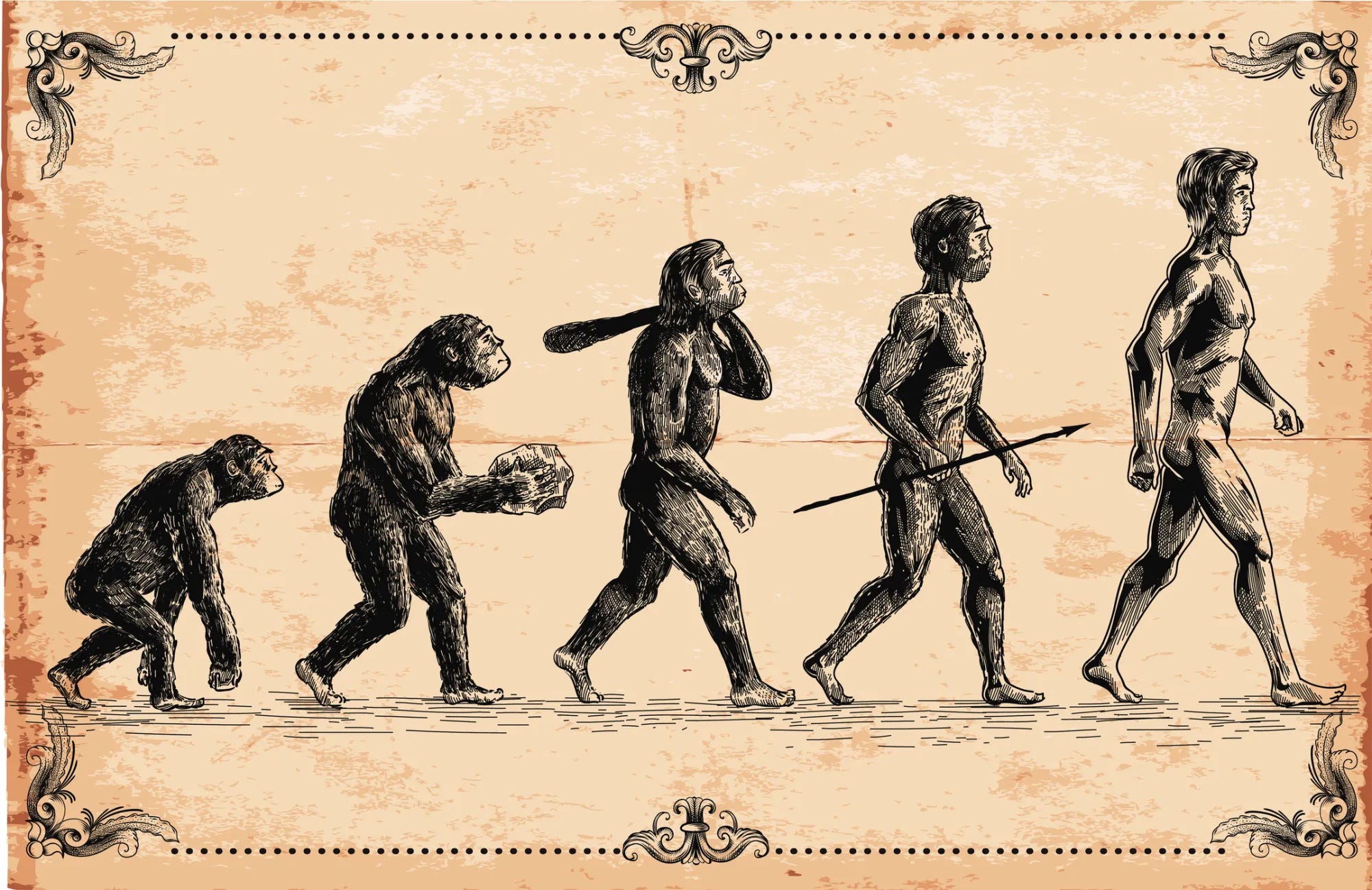
The popular depiction of evolution as a linear ascent, amoeba to ape to business-casual human, is wrong. Nature does not change in a linear path but explodes with variations, some which thrive and others which die off. The Cambrian explosion is the most dramatic example: roughly 540 million years ago, nearly all major animal body plans appeared in a geologically rapid burst of diversification, filling ecological niches that had never existed before. This process of adaptive radiation6 allows life to adapt quickly by running multiple evolutionary paths at the same time, with the best adapted of those options (sometimes) winning out. The most important distinction from the linear myth is that there isn’t one final winner to the evolutionary competition. There are dozens.
Adaptive radiation occurs culturally as well. Evolutionary anthropologist Charles Perreault argues that humans were only able to expand across such different climates on Earth in a relatively short period of time by evolving their cultures.7 These ancestral groups experimented quickly, developing new material tools, social behaviors, and survival strategies that allowed them to thrive in radically different environments.
Even as some human groups evolve culturally, others have continued to survive along paths that diverged from ours long ago. In the Brazilian Amazon, Survival International’s 2025 report found evidence of 196 uncontacted peoples, maintaining pre-industrial ways of life that predate European colonization.8 National Geographic describes the Svan people of Georgia’s Caucasus Mountains as “one of the last living medieval cultures,” where animal sacrifices, ritual traditions, and stone tower-houses have been carried on for more than a thousand years9. I like to think of this like the save point in a video game, where, if our civilization collapses, Nature has these other societies to still going.
Dispelling the narrative of linear evolution is essential to understanding our current situation. If humanity (or at least our cultural branch of it) is evolving, it is doing so in a pattern of adaptive radiation: everything all at once. That means YES, there are elites trying to become superhuman masters of the universe and dominate the rest of us (or Morlocks, as H.G. Wells termed it).10 But there are also grinders implanting magnets in their fingers, open-source communities building brain-computer interfaces in garages, and small teams running local AI models off the grid entirely. We have the option to choose how we want to adapt, and in fact that is the real survival imperative. Our ancestors didn’t scroll the internet for the best approach to build their cultures. They didn’t know or care what others were doing halfway around the globe. They figured it out through their unique lived experiences. They spent time reflecting on what the world at hand could provide to them and made the most of it. We need this approach of figuring it out ourselves. The challenge is how.
When our ancestors culturally adapted, they could use the tools ready-at-hand; they were the materials of the land around them. Technology complicates this for us, due to the difficulties in building from scratch, or paying corporations for the rights to use their AI models or lease their hardwares. Even purchased technologies are often illegal to modify.
If we know that adaptive radiation is the best evolutionary path to survival, and adaptive radiation requires experimentation, then our tools must be open and accessible. You can’t support diversification on a proprietary platform.

Still from Hackers (1995)
Most consider becoming a cyborg as something they would buy (or rent) from a tech company and apply to themselves. Historically for most, that has been the experience. We pay per usage for AI access rather than run our own models, we submit to the draconian laws restricting our rights to repair the technology we bought, and we await corporate release schedules for software rather than adding a patch ourselves. This lack of control over the technologies we rely upon is intentional. Tech rulers like Peter Thiel intentionally use monopolies over technology as a method for concentrating power11.
As common workers, we are in the challenging position of realizing our prospects for future employability demand we invest personal time and finances to improve our capabilities and access. And yet this investment furthers our dependence on the tech companies that own monopolistic rights to those same tools. It should be no surprise that many find the migration of technologies from our offices, to our homes, and now our bodies and minds to be alarming.
The desire to have free access to software has been in conflict with corporate interests for over half a century. In his 1976 letter to hobbyists, Bill Gates claimed that without paying for software, lessons and manuals would cease to be made.12 Now the largest repository of shared software, GitHub, is owned by Microsoft. The irony speaks for itself.
Donna Haraway saw this tension coming. In her 1983 Cyborg Manifesto, she argued that the cyborg was not inherently a figure of corporate control or military dominance, it was a figure of resistance. The cyborg, for Haraway, was dangerous precisely because it refused the boundaries others tried to impose on it: “The main trouble with cyborgs, of course, is that they are the illegitimate offspring of militarism and patriarchal capitalism, not to mention state socialism. But illegitimate offspring are often exceedingly unfaithful to their origins.”13 The technology may come from DARPA and Silicon Valley, but what people do with it doesn’t have to serve those masters.
Open source and other forms of hacker and hobbyist culture are stronger than ever. In the cyborg sector alone, OpenBCI is making sure brain-computer interfaces remain open to small research groups and independent researchers. Open models in AI are allowing people to work unconstrained by corporate terms of service. And transhumanist communities, what Jacob Boss calls the “punks” of the movement14, are experimenting with technologies inserted into their own bodies. I know because I’m one of them: I received my own bio-implant through Dangerous Things, a biohacking company based in my city of Bellingham, Washington. In 2004, I worked on DARPA’s Augmented Cognition program as a graduate student. Twenty-two years later, the technology I once studied in a government lab is something I can put under my skin at a shop down the street.
Their approach (and to an extent, mine) is a bit of a wild science in its lawlessness and self-experimentation. But amidst the chaos is an important lesson I believe can apply to everyone: technological progress belongs to all of us. We can actively participate in finding and testing approaches that work for us. And by focusing on developing knowledge in the public domain rather than privately owned, we can help assure a more accessible future, which is likely the only future most of us are going to survive in.
There is no clear answer for what kind of cyborg to become, or even whether to be one at all. To me it is a deeply personal decision. As someone actively building my own AI assistants, and with custom hardware implanted in my hand, I’ve made my choice. Yet, that should be like being happy with a tattoo. It doesn’t mean everyone else should get the same one.
At present, it feels like our society is being squeezed into a rather obvious corporate trap: reverse centaurs15, human bodies enslaved to AI. Or think of it another way, repossessed cyborgs, a new form of indentured servitude where the technology you depend on can be revoked, updated, or priced out from under you. However, we have many other options. The more people who become involved in inventing these options for themselves, the more diversity we will have in choices, the greater autonomy dictate how we use them, and the better off we will all be.
Cyborg adaptation reminds me of my teen years, trying on identities that didn’t fit, confident one week and mortified the next. We are continually stumbling through bad choices, such falling for the new hot trend in AI, to trying to make Augmented Reality glasses cool, to wearing watches that spy on our biometrics. We are making decisions that will seem cringeworthy in a few years - again, like a tattoo. But I believe it’s only more trial and error that will help us discover what the right path forward is.
For myself, adaptation has come to mean reading, thinking, writing. Trying to have reflective space outside of technology so that I can best think of how to apply it. More than ever, writing feels slow and sludgy. I’m constantly tempted to use AI just a little bit more. But I think pushing into that friction is important for me. It helps me delineate the parts of myself that I want to strengthen, and those I’m comfortable relinquishing to the machine.
To keep up with my cyborg adventures, or talk about your own … hit reply
.
Ranganathan, Aruna, and Xingqi Maggie Ye. “AI Doesn’t Reduce Work — It Intensifies It.” Harvard Business Review, 9 Feb. 2026 hbr.org.
Harari, Yuval Noah. Quoted in “Yuval Noah Harari Talks Politics, Technology and Migration.” Euronews, 14 May 2019 euronews.com.
Perreault, Charles. “Cultural Evolution Accelerated Human Range Expansion by More than Two Orders of Magnitude.” Proceedings of the National Academy of Sciences, vol. 123, no. 11, Mar. 2026. doi.org.
Haraway, Donna, and A. Cyborg Manifesto. “Science, Technology, and Socialist-Feminism in the Late Twentieth Century.” The Cybercultures Reader, 2000, p. 291. Google Scholar, http://books.google.com/books?hl=en&lr=&id=MKtr_svfY1kC&oi=fnd&pg=PA291&dq=%22unalienated+labour,+or+other+seductions+to+organic+wholeness+through+a%22+%22Marxism+and+psychoanalysis,+in+their+concepts+of+labour+and+of+individuation+and%22+%22in+the+oikos,+the+household.+Nature+and+culture+are+reworked%3B+the+one+can+no+longer%22+&ots=9eADkU5dEG&sig=JCjvyb2wQc6cRhBJutBWpTOxJls.
Boss, Jacob A. “Punks and Profiteers in the War on Death.” Body and Religion, vol. 5, no. 2, 2021, pp. 135–59. doi.org.
Doctorow, Cory. “The Reverse-Centaur’s Guide to Criticizing AI.” Medium, 5 Dec. 2025. medium.com.
No posts
Comments
Nothing yet. Say the first thing.
Sign in to join the conversation.