
Days at the Lazy K (WDC&S #59, August 1945) is the second and last 8-page, 12-panel-per-page story. The claustrophobia isn’t as pronounced as it was in Taming the Rapids because this story isn’t set in the Grand Canyon, but there’s still too much text and not enough space.
The story, however, is tight and effective compared to the bizarreness of Taming the Rapids, and in a first, it’s the nephews who get a comeuppance this time. It’s another Barks story that only gets darker on close examination: sanctimony, hypocrisy, and animal torture make for an unsettling mix, and the result is a very loose “Western” story that lets no one off.
Growing up on a farm, Barks had an acute sense of the difference between the romantic ideal of the Wild West and the dismal reality, and he had touched on it in The Limber W Guest Ranch, where Donald’s claimed expertise fell short against impassive nature.
In comparison, this story is a major advance in theme and complexity. In eight pages, Barks spins a very tight story with several layers and reversals. Here we actually see Donald and the nephews watch “Wonderhead: Son of Ticka,” a schmaltzy flick that has Donald claiming he could easily tame a colt.
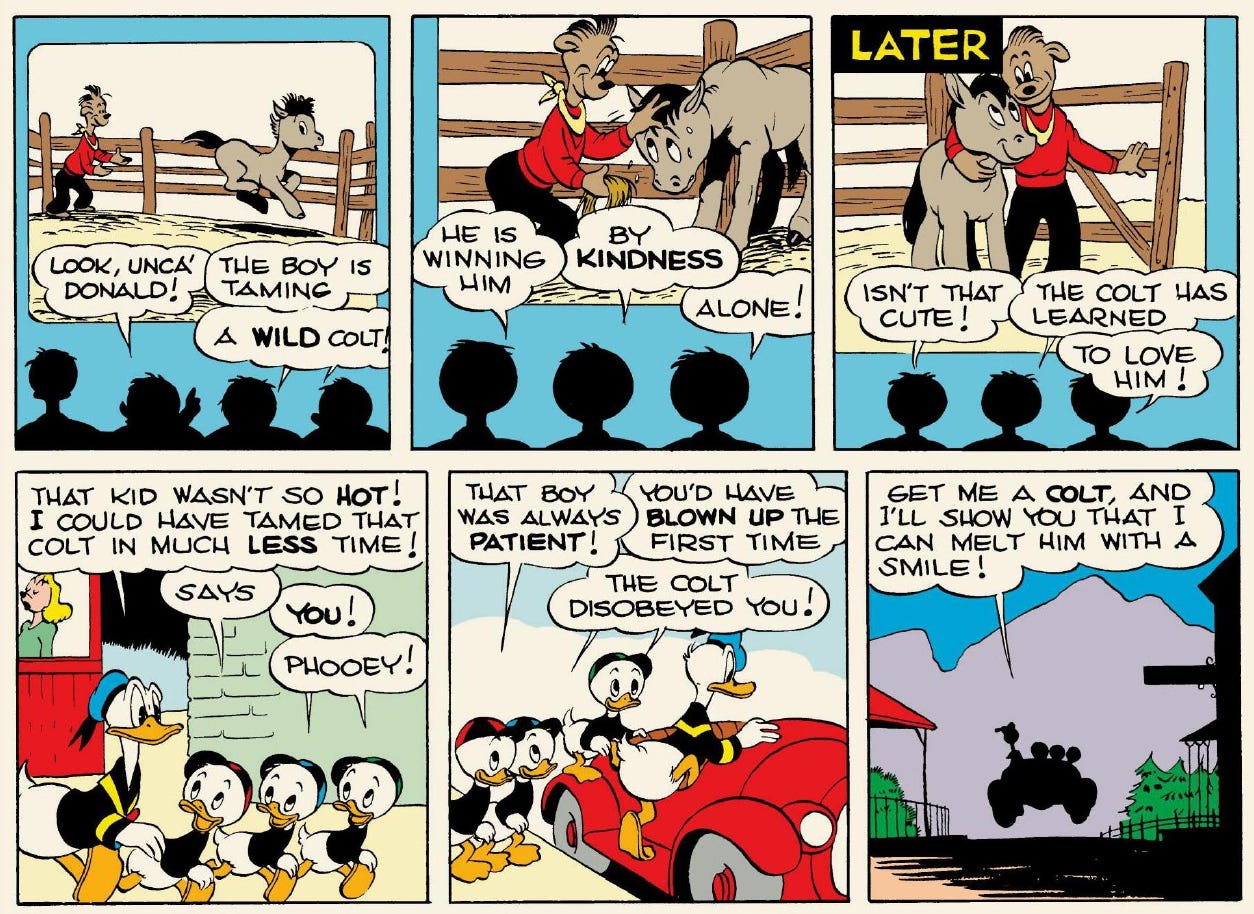
The first row shows the fantasy, with Donald and the nephews in silhouette. The second row is the reality, as the nephews reject Donald’s bragging. They return to silhouette in the last panel, emphasizing the fantasy of Donald’s hope.
At the Lazy K, they get a colt, who of course turns out to be a complete hellion.
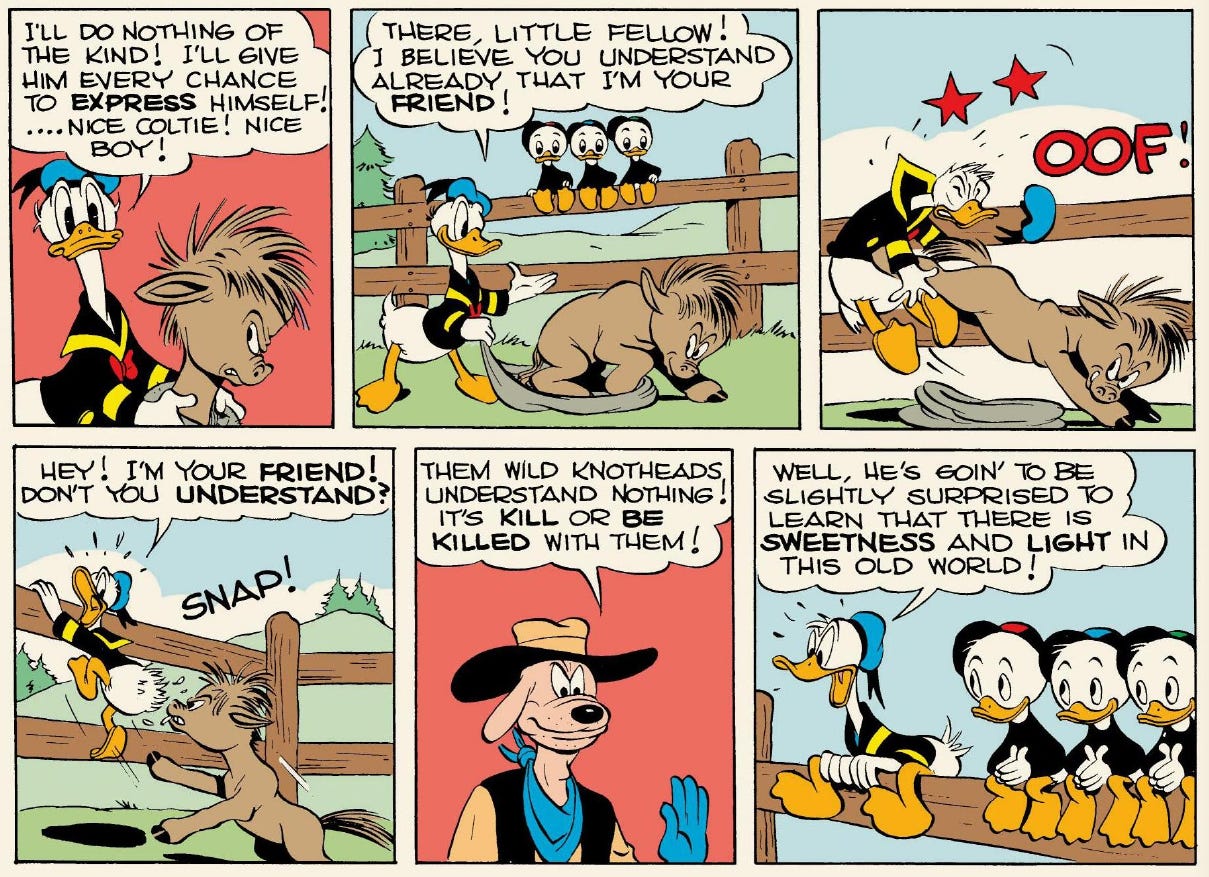
The ranchhand is the callous voice of wisdom, calmly letting Donald learn the way of the world. “Kill or be killed” is a fairly brutal one. Right before this, we saw that the ranchhand thinks the colt is completely hopeless, telling Donald it’s good for nothing but glue.
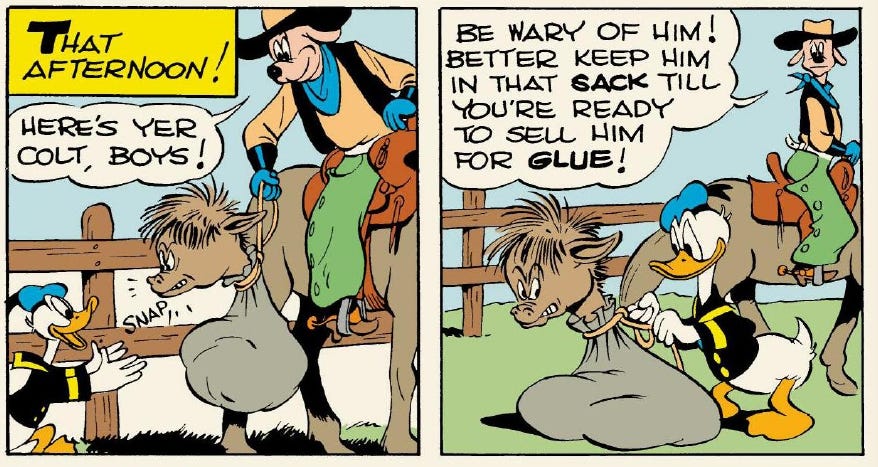
As contrasts go, this is stark. Instead of the cute, lovable horse of the movie, we’ve got a snarling animal whose only purpose is to be euthanized so its hooves and bones can be turned into glue. The irony is that the colt understands too much: “Kill or be killed” is the situation he’s in.
Donald’s insistence on humanizing the colt rather than seeing it in coldly utilitarian terms is a disaster. The colt isn’t just feral but gleefully sadistic:
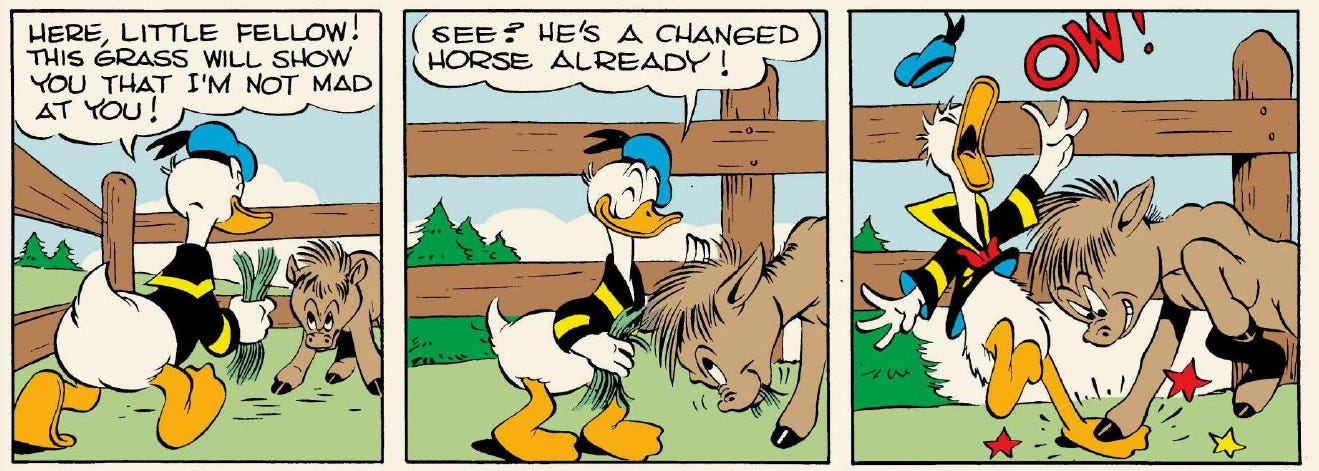
Donald’s value system is out of whack. After a few more assaults, Donald’s ready to give up, but the nephews goad him to continue:
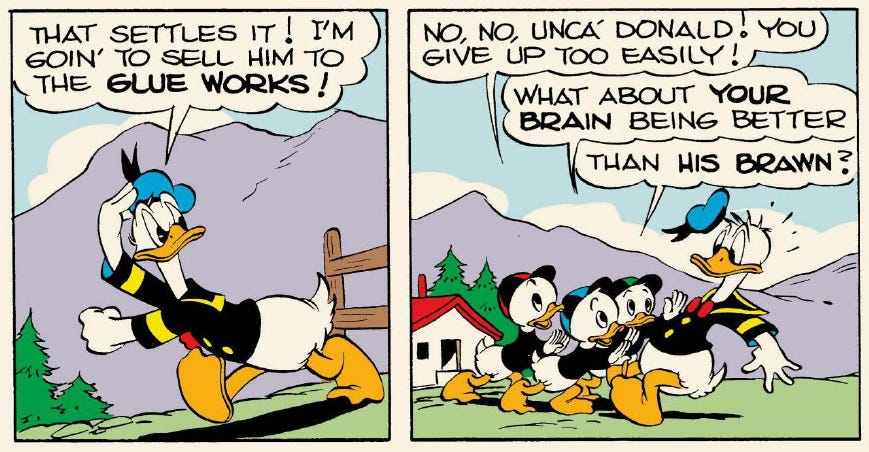
This is the first indication that the nephews aren’t quite the innocents of the past here, since they’ve already seen Donald get pummeled and are sending him back for more. Likewise, the references to killing the colt for glue and “Kill or be killed” go well beyond the disenchantments of The Limber W Guest Ranch, but their significance is unclear.
Spurred by the nephews, Donald uses his “brains” by trying to hypnotize the colt, except that the colt has stronger brains:
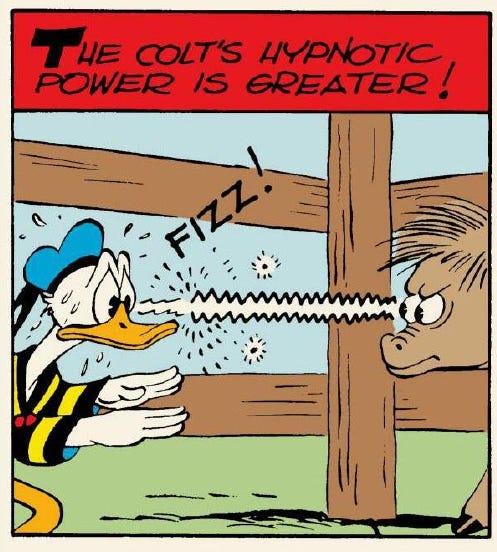
This turns out to be a key turning point in the story, putting the colt on a par with humans (i.e., the ducks) rather than beneath them. This is a sentient creature with emotions and motives, not a feral monster, and in that light, it begins to provoke some sympathy and curiosity as to its agenda.
Moving from violence to humiliation, the colt makes Donald act like a pig, a chicken, and a wild horse under hypnosis. But we also get to see the colt’s real goal:
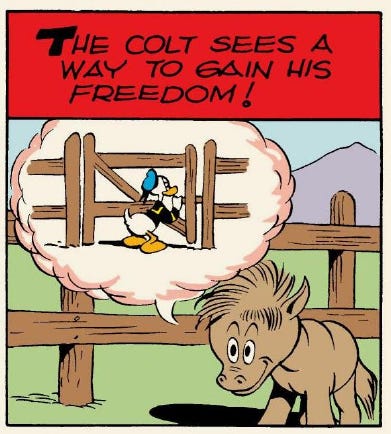
Not violence or humiliation, but freedom. That changes the context significantly. If this is a captured, near-sentient animal in service, of course it would have nothing but contempt for some yokel trying to be its friend, especially when the most likely outcome is the glue factory. Barks doesn’t shy from showing the colt to be viciously sadistic, but it’s no longer a mindless monster.
The cowboy, on the other hand, now comes off as heartless rather than just a mellow voice of wisdom. He sees animals in financial terms and will readily capture one for no purpose but the folly of a city slicker.
When the nephews foil the escape attempt, the colt goes right back to causing havoc:
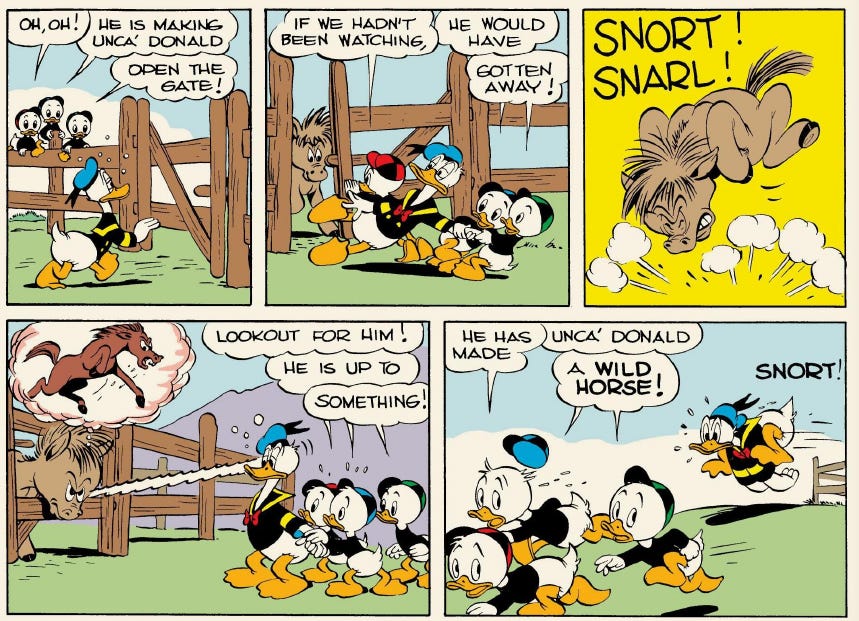
The nephews tie Donald up, taking him out of the story for a bit, and here the true turn comes. The nephews take over as protagonists, and we see the defects in their own moral stance.
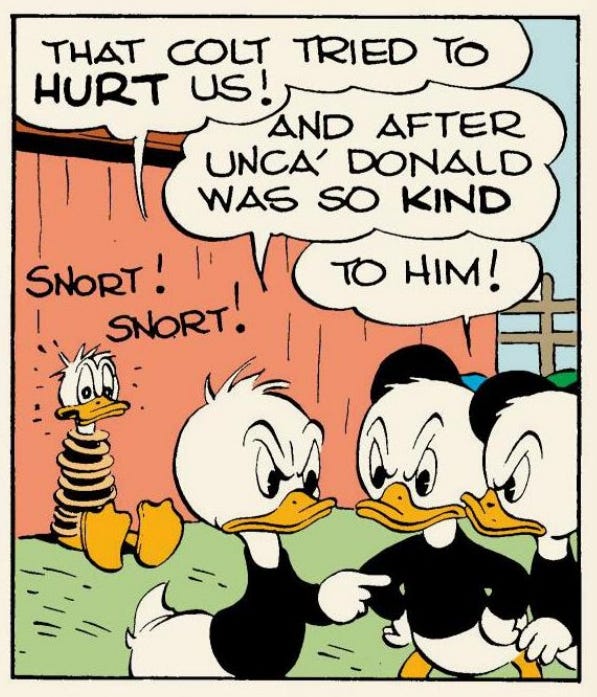
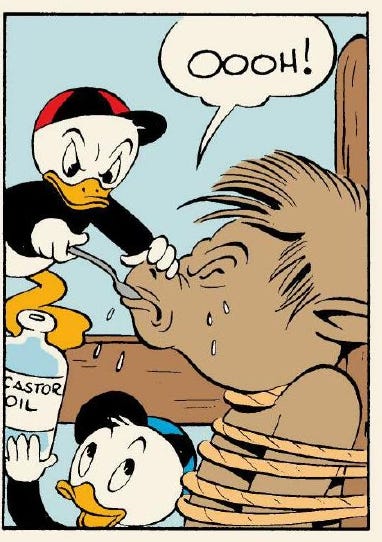
The nephews turn out to be far less kind than Donald, successfully subduing the colt and tying him up to feed him castor oil:
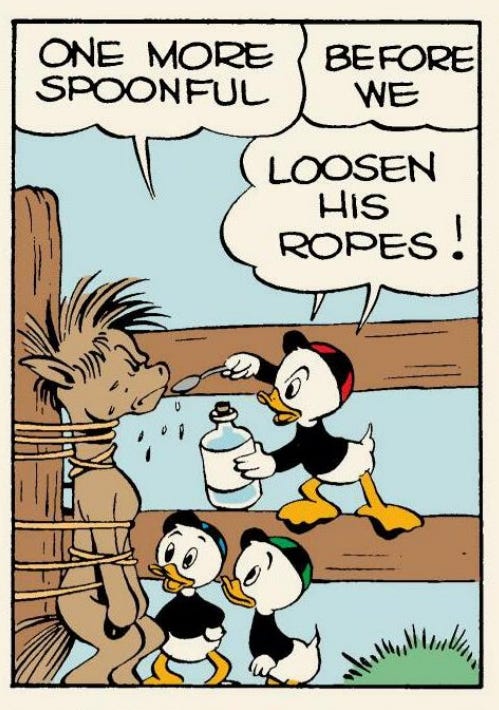
Upright, the colt looks nearly human, especially next to anthropomorphized ducks, and the whole thing feels vaguely like torture, fueled by the self-righteous certainty of the nephews that the colt “needs to be taught respect for law and order!”
And it works—or seems to. The colt turns into a near-replica of Wonderhead in the movie.
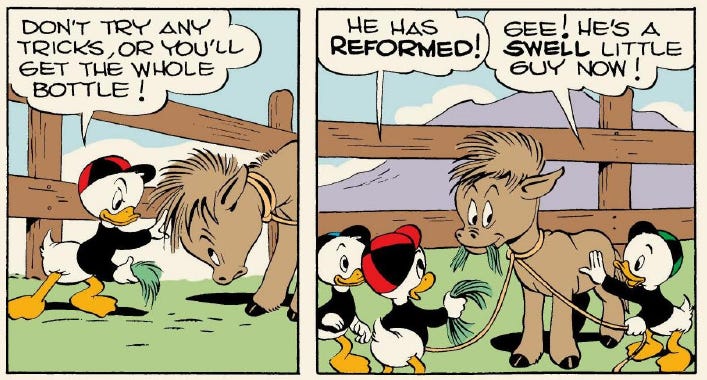
Donald isn’t convinced and says he’ll sending the colt to the glue works the next day, just as the ranchhand advised, but the nephews are convinced they’ve tamed their colt. Once more, we go to silhouette to see a romantic tale of a mother looking for her lost son.
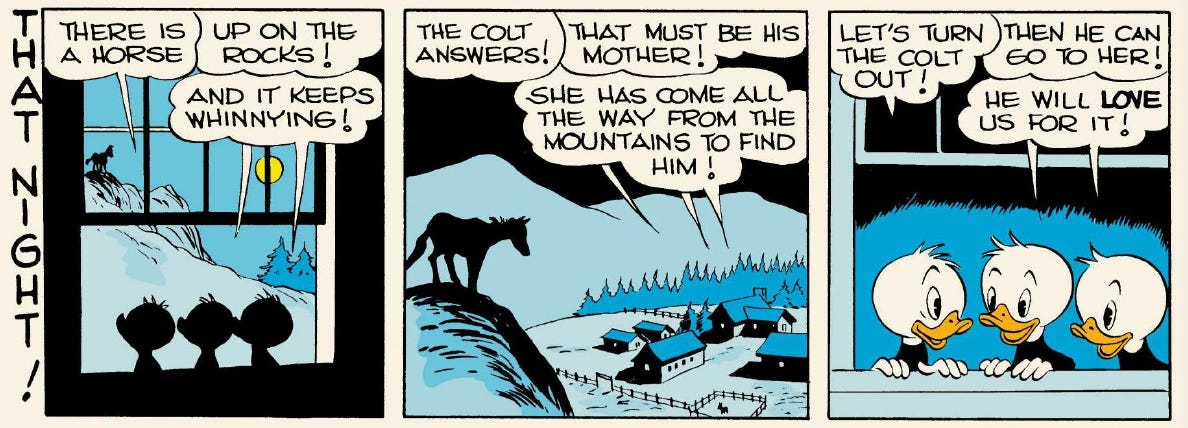
Now it’s the nephews’ turn to buy into the fairy tale. To summarize, the nephews are going to save the colt from the glue factory by returning it to the situation it started in before the ranchers caught it—and they expect the colt will feel gratitude for this because they’ve civilized him. This doesn’t really make sense, but it does follow movie logic. The nephews thought the problem was in Donald’s approach, but it’s actually that what he and the nephews think is incoherent movie-driven nonsense.
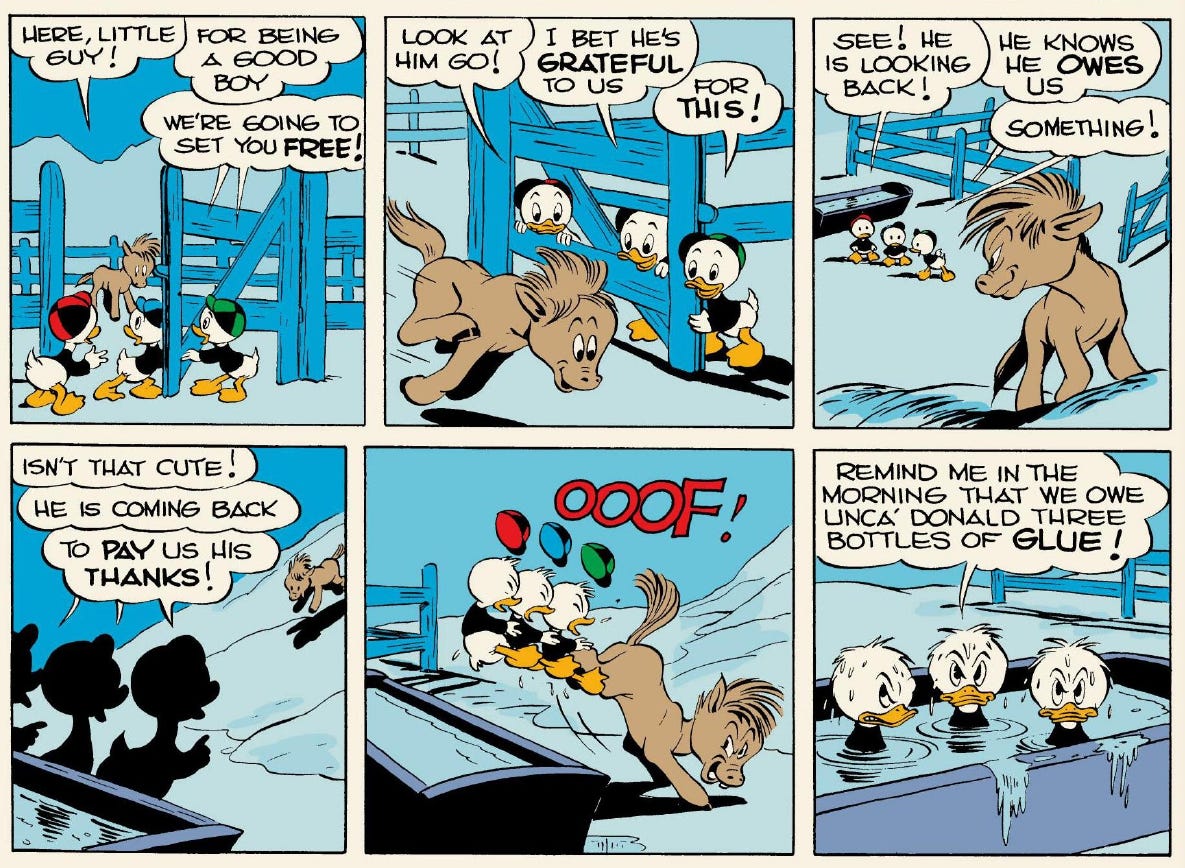
Once more, we go to silhouette for the nephews’ final excursion into romantic delusion—Barks’s structural care on display again. More subtly, Barks highlights two words in particular—OWES and PAY—that undercut any notion that the nephews were appealing to or representing goodness. They’re just expecting their compensation in good feeling rather than the glue money Donald was going to get. Once the colt disabuses them that they’d tamed him at all, the nephews go completely sour. The colt’s lack of gratitude erases whatever good feeling they had toward the colt and its mother, and they essentially say they should have let Donald kill it.
No one comes off well. The ranchhand is mercenary, the colt is vicious and manipulative, Donald is a foolish braggart, and the nephews are sanctimonious hypocrites. This time, though, it’s the nephews that come off the worst, since for all of Donald’s ideals, he was prisoner to a movie ideal of “sweetness and light” rather than to the more unsettling and more real ideal of law and order. As usual, Barks disguises the more disturbing aspects of the story, but the cruelty on all sides is too apparent and too structured not to be intentional.
We’ve seen the nephews be both troublemakers and perfect children before, but they’ve never taken on the role of moral protagonist like they do here, and certainly not with such a dark outcome. Their final expressions are straight out of Donald’s most vexed moments.
More generally, putting the nephews into play as moral protagonists gives Barks a much bigger canvas for his stories. Giving the nephews flaws and comeuppance makes the stories less predictable and allows for a tug of war between two viewpoints (Donald’s and the nephews’) where one isn’t obviously superior to the other. The nephews aren’t fixed points any longer, but can be counterweights or correlates to Donald’s positions as needed. And Barks can use them to show when the outcome of a story is uniquely due to Donald’s way of being versus here, when it is a product of the way the world and society is—which is to say, dismal.
Comments
Nothing yet. Say the first thing.
Sign in to join the conversation.