
Singapore Joe (WDC&S 65, February 1946) is not monumental in the way that Silent Night was, but it’s a significant step in Barks’s period of refinement. The first few years of stories I’ve been covering have thrown out tons of ideas both effective and ineffective, but by this point he was starting to step back and analyze the material he was using. This is one of those cases.
Barks had already given Donald a pet from hell with the sadistic falcon Farragut. Farragut had no redeeming features, wasn’t cute, and lacked any clear motivation beyond wreaking havoc and inflicting pain. The story carried the weight of total calamity, but there wasn’t much subtlety.
“A guy named Joe from Singapore,” an extremely mouthy parrot, is a different story. It’s another pet from hell, but Joe remains mysterious for a long time before being revealed as a fairly sarcastic and vicious trickster figure.
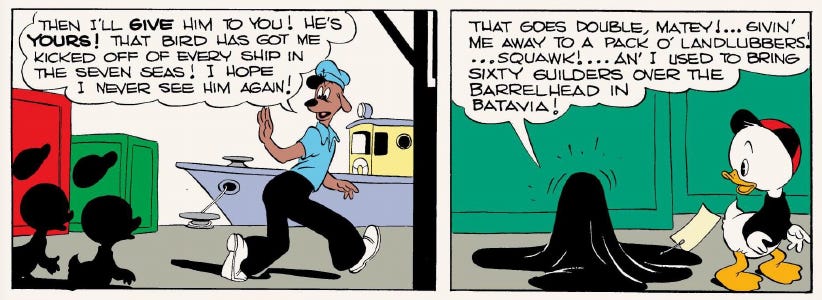
The nephews first find Joe at the docks under a blanket, where despite being bitten and never so much as seeing him, they decide to take him on as a pet:
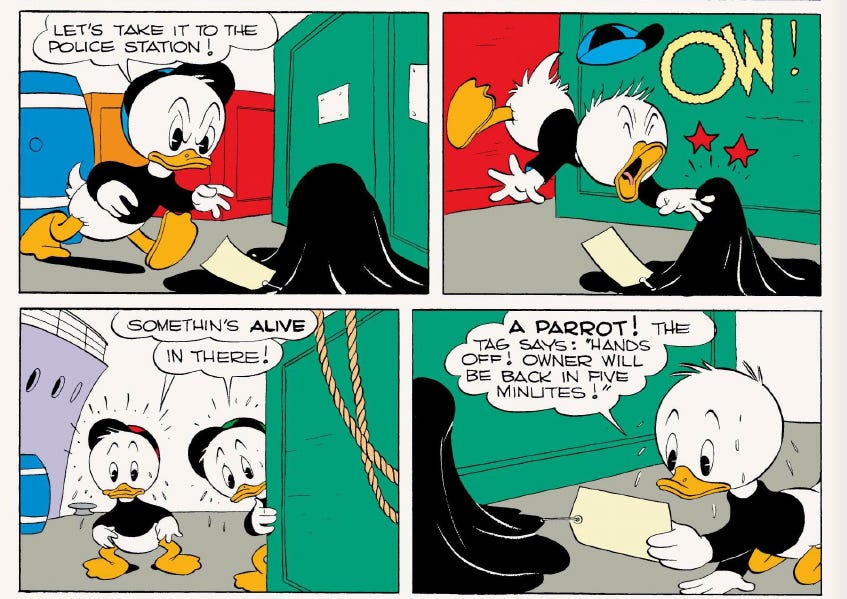
Barks keeps Joe’s appearance completely hidden for half the story. We know it’s a parrot, but not much else, so we ask: is this thing more pet or more human? It fits with the choice of parrot, since we also aren’t quite clear whether Joe is just mimicking obnoxious human behavior or if there’s some reasoning behind the chaos he foments. Since we’re in a world where animals already slide between human and non-human roles, Joe and his sailor patois are very hard to pin down.
Again, without even seeing Joe, the nephews beg Donald to keep him:
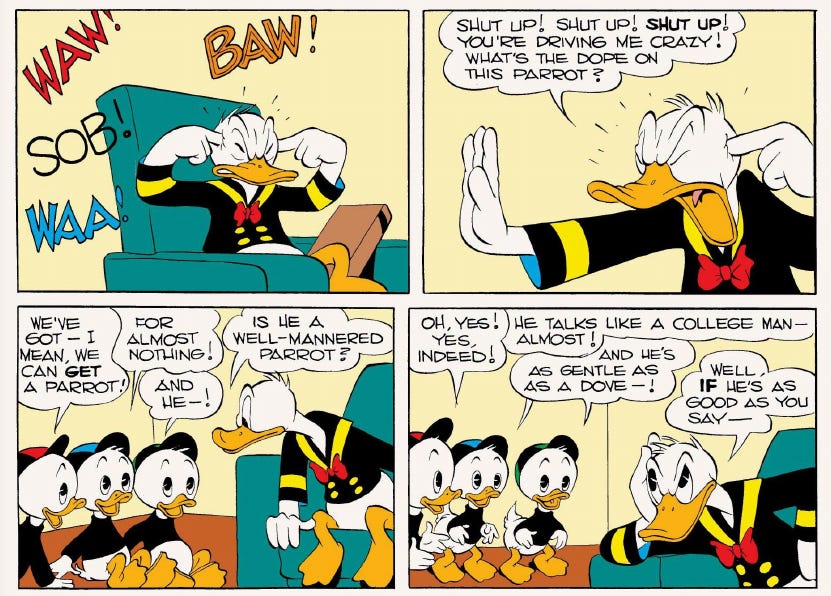
This would tend to lead to an actual introduction, but Barks derails that progression by having Joe escape into hiding, ejecting the nephews from the story and leaving Joe and Donald in a very oblique battle.
With the nephews gone, we finally see Joe: a foul-tempered, malicious, very expressive, and vaguely cute bird.
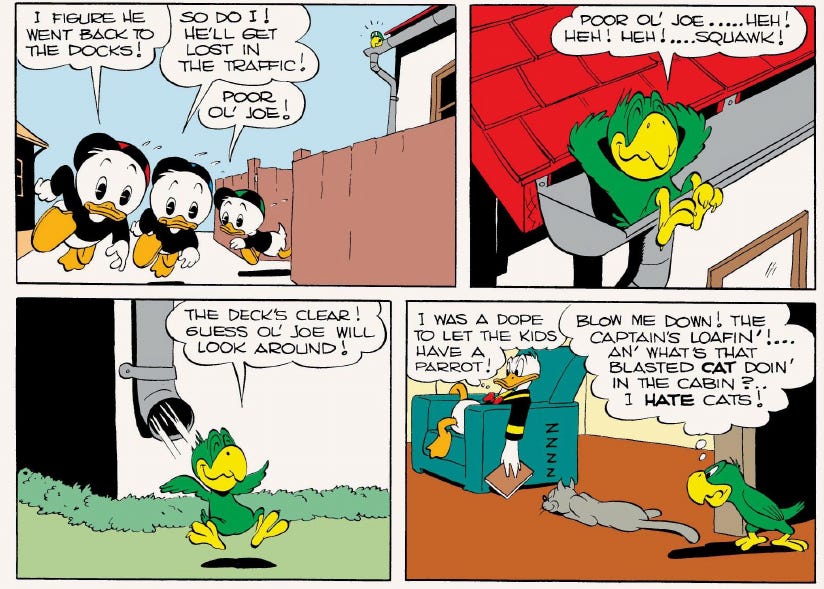
The reveal is that Joe is indeed very anthropomorphic, just as sentient and personality-filled as any “human” (duck, dog, etc.) in Barks’s stories. He gets thought bubbles, sophisticated expressions of smugness and satisfaction, and clear motivations. His motivations, however, are petty and fairly sadistic, even approaching Farragut’s level at times.
In hiding, Joe overhears Donald refer to that “confounded parrot,” and that’s enough to doom him in Joe’s eyes.
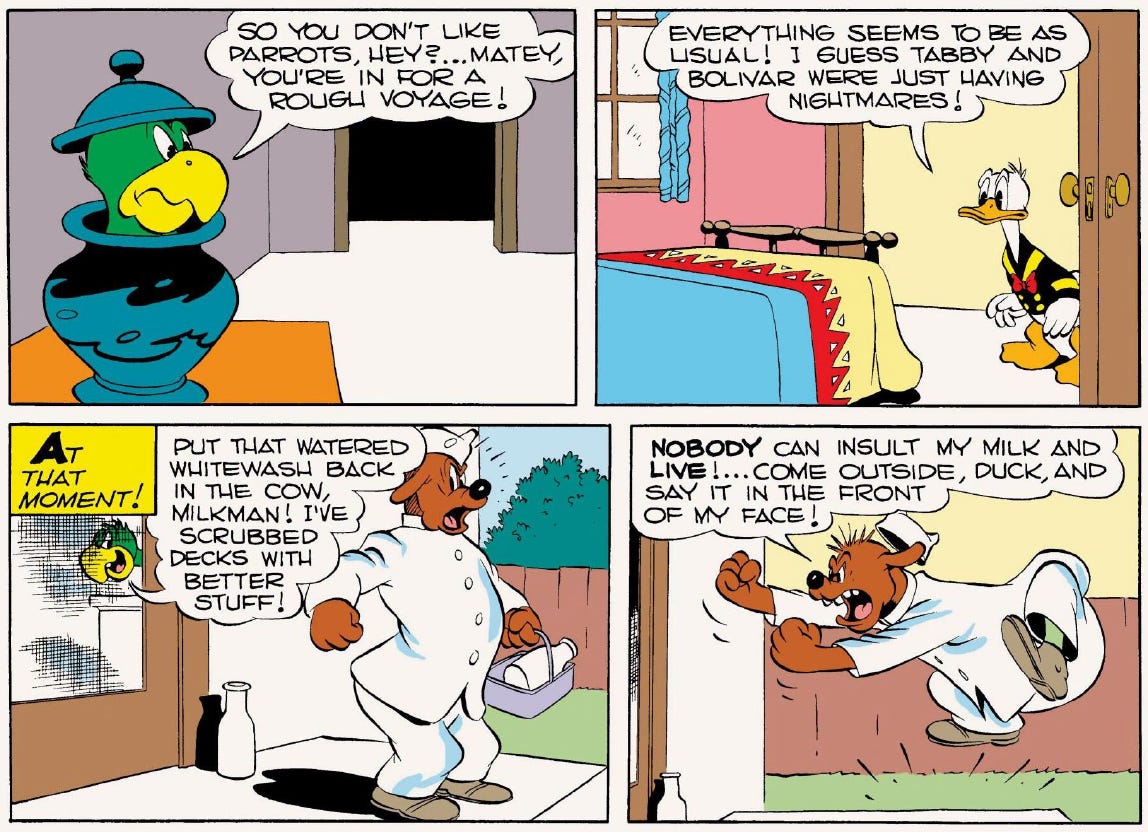
Joe turns his rage against Donald indirectly, pretending to speak as Donald while insulting everyone around.
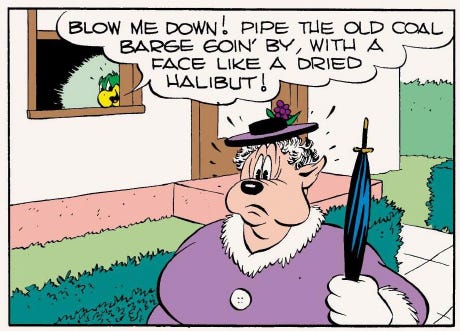
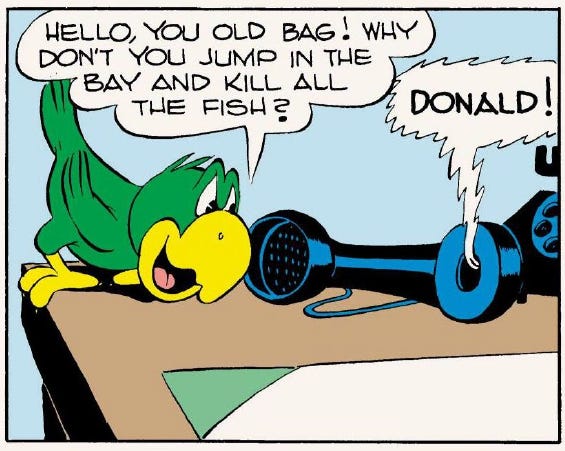
Unlike Farragut, his attacks are only rarely physical. The physical violence comes from the old lady and the milkman who Joe insults, who batter Donald without a second thought. Joe has in essence stolen Donald’s voice, speaking as him to wreck his life—very trickster, and more paranoia-inducing than anything Farragut ever pulled.
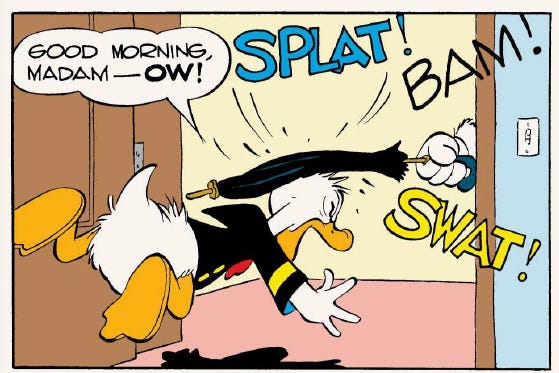
Donald, for his part, doesn’t connect the dots, and has no idea that the mysterious parrot (who he still hasn’t seen) has anything to do with why the world is suddenly persecuting him. Donald’s paranoia isn’t part of Joe’s strategy. Joe isn’t nearly that sophisticated. Joe wants Donald to get beaten up and Joe isn’t big enough to do the job on his own, so he has to manipulate others into doing it for him, but Donald’s ensuing anxiety was not part of Joe’s plan.
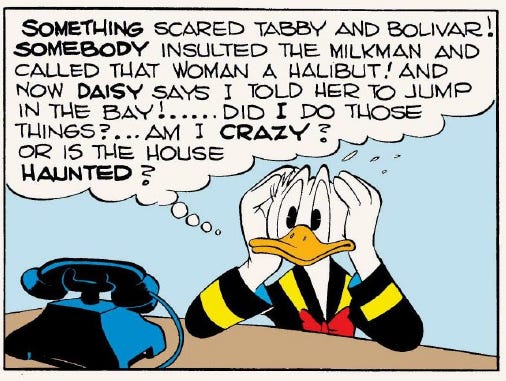
The innovation of this story is Donald mistaking one form of persecution (cosmic fate) for another (a sadistic enemy). Donald’s misfortunes seem catastrophic to him, a sudden run of bad luck that is inexplicable but not exactly shocking. It’s a shame the story didn’t devote more time to Donald’s sheer bafflement, because it’s the most interesting part of it—how totally obscured Joe has been, first to us and the nephews and then to Donald.
But the story is only ten pages, so Donald quickly finds the culprit:
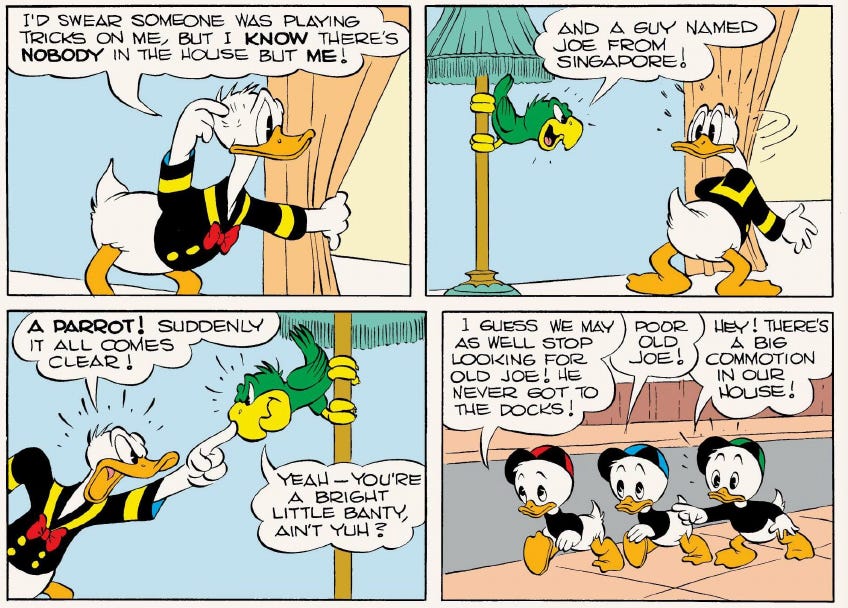
Until Donald knows there’s an agent (a very human agent in fact) behind his persecution, he is baffled and scared. Once he discovers the truth, he immediately regains his composure—and his rage. Donald’s reaction isn’t just to throw Joe out, but to physically pummel him. (This happens offscreen, perhaps because it would have been hard to depict Donald beating up a small parrot.) We don’t see Donald for the remainder of the story, but Joe is battered in the last panel.
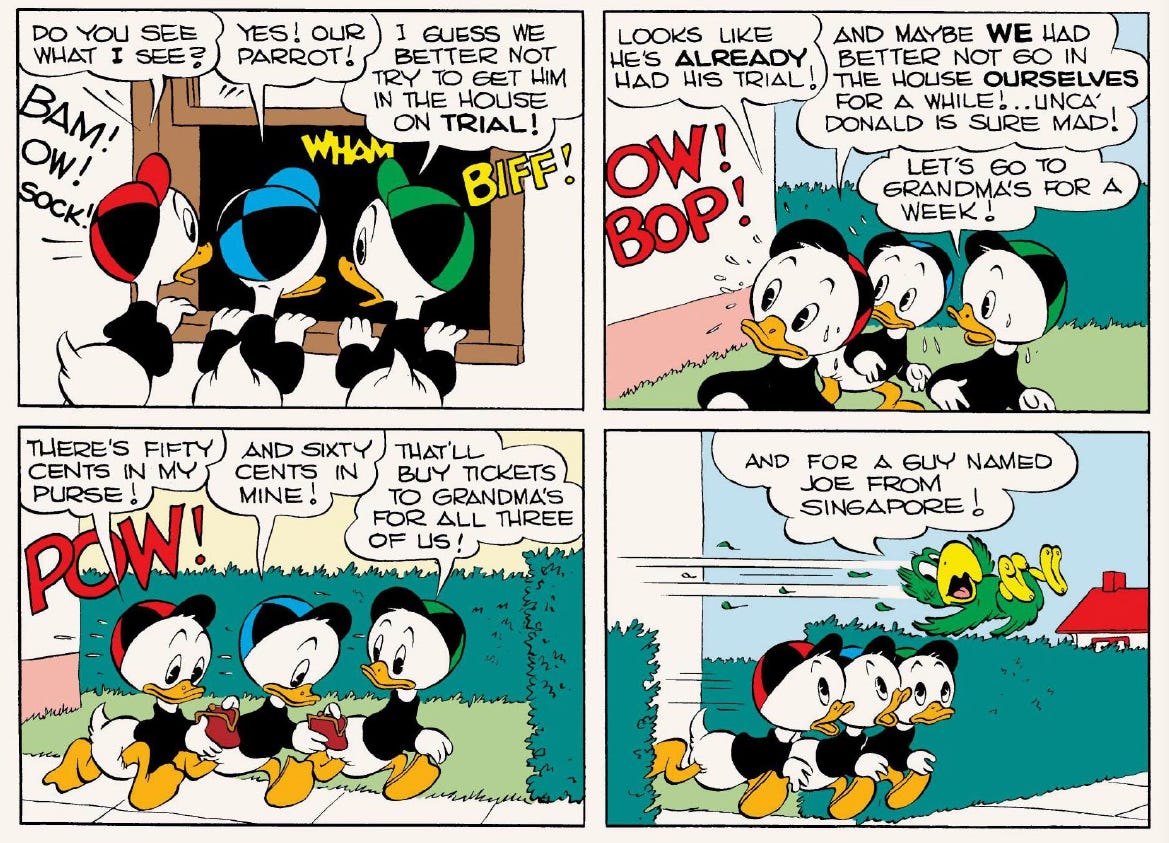
What the story leaves you with isn’t a strong picture of Joe, who remains more plot device than character, but the looming specter of uncertainty. We didn’t learn what Joe was until halfway through, just as Donald doesn’t learn until the very end. The physical violence came almost completely from the “human” characters, while Joe’s sadism was primarily verbal. Everything seems jumbled, and even what could be comprehended is revealed late.
That is the direction Barks was heading in: rather than portraying various specific threats, he’s starting to move the threat to being anxiety itself. He’s laid out a world in which catastrophe can unpredictably strike and people can be unpredictably vicious, but so far Donald has always faced clear threats. Here, we start to see a second layer where Donald’s suffering is also generated by his own fear of fate, uncertainty, and persecution, as well as anxiety over his lack of knowledge of where he stands with regard to them. Joe is defanged the moment Donald sees him and identifies the threat and what he can do about it. The not knowing, however, is capable of driving him crazy.
Comments
Nothing yet. Say the first thing.
Sign in to join the conversation.