
I received a lot of feedback about the December poetry advent prompt list and felt very encouraged to do it again, so here you go! A list of prompts for January.
Set the tone for your creative practice. Build some routine. Explore.
For some, following prompt calendars could feel like flexing a generative muscle. For others, it could feel like a challenge or a really big deal—committing to something, doing it every day, battling the imposter syndrome and the “failure” thoughts that creep in…
William Stafford wrote every single day. A poem, a scrap of a poem; he’s known for it. Not all of us can achieve that. I know I can’t, but I know that because I’ve tried.
I invite you to try. Who knows, you might surprise yourself by turning out to be one of those people who can write every day.
Or you might be one of those people who loves and values a container, a start date and an end date for a project (a 31-day challenge, for example).
Either way, I hope you and this list find each other.
And if you desire a community or an accountability group to develop a daily writing practice, check out and consider joining The Stafford Challenge. It’s a big group of people who write a poem every day for a year starting January 17th. Some of these folks have been at it since January 2024. You could be one of them.
If you’re a person who thrives with accountability and a container this could be for you. If you want poetry community, if you want to feel excited about poetry, if you want to feel connected to people with myriad writing backgrounds (including, outside of this challenge, no writing background at all), this could be for you. There are monthly craft talks and readings with established poets, writing groups with other participants, and a Facebook group that acts as a message board and poetry center.
All of this to say… you might love it. And these prompts will come in handy!
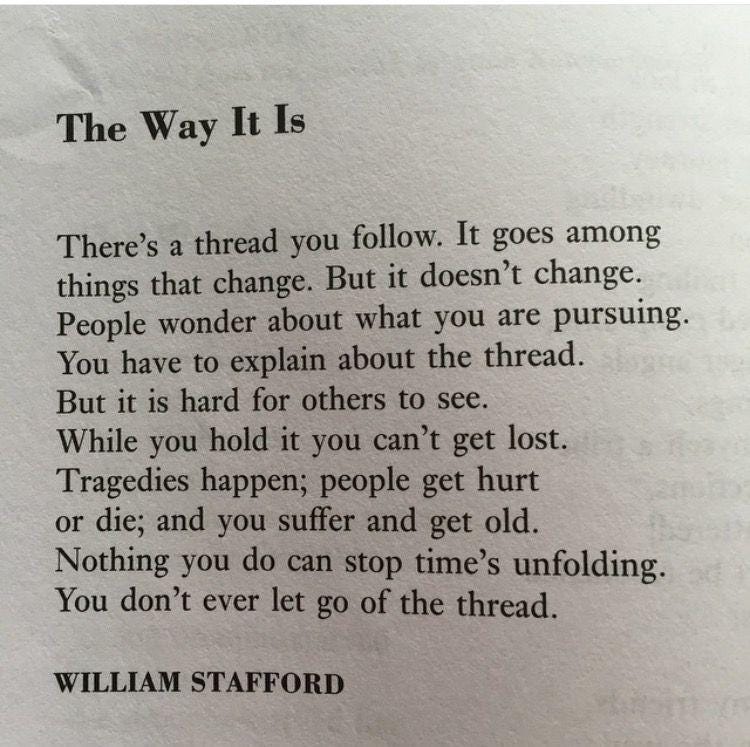
Write about the thread in the above Stafford poem, “The Way It Is”. You may want to read the poem a few times to let it sink into your body a little, because the body knows about the thread.
Read three poems. Read them again. Write. This is a prompt taught to me by the poet Fran Quinn (you may remember it from the December prompt list). He says to allow the thing that becomes alive between all three poems to be channeled into your own poem, which becomes the fourth poem. Here are three poems for your consideration: “The Facts of Art” by Natalie Diaz, “A New National Anthem” by Ada Limon, and “Eagle Poem” by Joy Harjo.
Write a poem about a time in your life when you felt brave.
Write a poem about something ordinary. A trip to the grocery store, your morning coffee, a walk down the street, taking out the trash, going to the post office, a magnet on the refrigerator, a small stone you notice in the parking lot on your way back to your car—something unremarkable. See where it takes you.
In a similar vein to yesterday, write a poem about washing the dishes. Focus on the details of this particular chore. The warm water, the rinsing, the circular motions of the sponge, the resistance of stuck residue, the shape of the sink—whatever you notice. Describe the details and see what emerges between the details. When we wash the dishes, we think. What do you think about?
Write a poem with the title “I Hoped for It”.
Write a poem about the meaning of life using the metaphor of picking raspberries. Use the metaphor like a looking glass to really hone a big, broad, vague topic into a digestible poem. Challenge yourself to not veer from the metaphor. Think of the thorns, the juice on your hands, the vessel you’re dropping berries into—do you eat them right off the bush or do you save them for later? Every part of the plant and the activity can serve a purpose in the poem if you want it to.
An ode is a benediction, a proclamation, a celebration of a specific person, place, or thing that means something important to the speaker. You may remember the prompt from December to write an ode to a part of your body. This time, write an ode to something that you wouldn’t necessarily think to be excited about or grateful for—maybe something you don’t like or something that isn’t often considered a good thing. Let this challenge you. Find the value in the thing you choose. Some forms of odes require certain rules for meter and stanzas, but we won’t worry about any of that. A couple of odes I love: “Ode to Gossips” by Safia Elhillo and “Ode to Dirt” by Sharon Olds.
Write a ghazal. This Arabic form is traditionally an ode with an AA BA CA DA EA etc. repeating word scheme. It is made up of couplets with each couplet consisting of a statement (line 1) and proof or support of that statement (line 2). Each couplet should be able to stand on its own, yet the poem as a whole is connected. The final couplet contains a statement of identity, most often including the name of the writer. Some examples: “Where did the handsome beloved go?” by Rumi tr. Brad Gooch and Maryam Mortaz, “Deus ex Machina: A Ghazal” by Mag Gabbert, and “It Is with Words as It Is with People” by Anthony Madrid. If you want to do a deep dive, this Wikipedia page actually does a really great job of providing background and in-depth information about the form.
Write a poem using these words: tear, tender, fur, twinkle, fire, and fir.
Write a poem about a time you lost power during a storm.
The Poetry Lab characterizes the aubade this way: “From the French meaning ‘dawn’, the aubade is a poem or song announcing the arrival of the morning and usually, but not always, lamenting leaving or being left behind by a lover.” Write an aubade. This could involve the departing of a lover, or it could just be a poem that has to do with daybreak/the morning after something. An example of an aubade about a lover: “Aubade” by Amy Lowell. An example of an aubade that is a morning poem: “Aubade” by Camille Rankine. Two very different poems with the same title.
Write a poem in which you, somehow, are weather.
Ezra Pound’s “In a Station in the Metro” is a poem that almost anyone who has ever explicitly studied poetry has been exposed to. This tiny, tiny poem is a classic because of what it achieves in just those two lines: it paints a complete, intact picture. The title sets the scene by giving it a location. The first line makes something emerge. It’s more than a plain statement because the word “apparition” is used dynamically, which makes the moment active—the faces are appearing. The second line is an unrelated image (we can presume there are no branches inside the metro, we can presume it isn’t wet inside the metro) that shows us what the faces looked like inside of the metro. The contrast of a darkened branch with petals stuck to it—we’ve seen that, we’ve seen a flowering tree in the rain, we can connect to it. Try to write a couplet with this formula: title including location, first line an active statement, second line an unattached image that conveys what the first line physically looks (or feels) like. You may leave it as a couplet (add the epigraph “after Ezra Pound”) or expand it into a longer poem.
Write a poem in which each stanza is just one line, alternating between something you are grateful for and something you are afraid of. Line one: I am grateful for… Hit tab. Line two: I am afraid of… Hit tab. You can begin each line literally this way, like a list, or each line can be an image or a statement that speaks for itself. Think of the couplets in the ghazal (from day 9) and what they achieve as standalone islands unto themselves—perhaps they will inform this.
We’re jumping off of yesterday’s prompt here. Write two short, separate poems, 4-5 lines each. One describing a bird outside your window. One about a relative—a parent, a sibling, a child, or another relative (alternately, a person very dear to you—a lover, chosen family etc.) Once complete, stack the poems so the first line of one of the poems is first on the page, then the first line of the second poem is second. Weave them together in this way until you have one poem that contains two poems. Notice what happens. You may use the same spacing method as yesterday or keep the lines together or insert stanza breaks. You may consider weaving the poems the other way as well, to see which version you like best.
Write a poem using these words: bridge, soil, crow, notice, chrysanthemum, and cinder.
Thich Nhat Hanh said, “Walking meditation is really to enjoy the walking—walking not in order to arrive, but just to walk.” Consider this quote. Take a walk. Come home and write.
Write a poem about food—cooking it, growing it, peeling it, chopping it, eating it, tasting it, touching it, smelling it, preparing it alone or with others, preparing it for yourself or for others.
Write a poem with the title “If I Had Been a Different Animal”.
Write a poem about the physical recovery period of something—a surgery, an injury, an illness, or something else that takes time to heal from, something difficult, challenging, and probably unpleasant. Note: this could be something as small as the common cold or a papercut, there’s no need to dive into a Big Event today unless you feel prepared to do so.
Write a poem with the image of an old photograph found in an antique shop. There might be something written on the back of it or there might not be. Let it take you somewhere.
Go to thesaurus.com. Type in the first word that comes to your mind. Choose a synonym for that word. Do the same for another word. Type in “cage”. Choose a synonym. Type in “lantern”. Choose a synonym. Write a short poem incorporating those four words.
Write an ekphrastic poem. Choose a piece of artwork in your home—a photograph, a painting, a print, a postcard or greeting card, and describe it. An example: “Winter Landscape” by John Berryman.
Write a poem about yourself as though you are a stranger.
Set a timer for 8 minutes. Don’t lift your pen from the paper (or stop typing, whatever is most comfortable for you) until the timer goes off. Don’t think. Your starting phrase is “Someday it’s going to be like this: …”.
Write a poem with the image of lifting a bucket and finding a mouse underneath it. The mouse is a metaphor for something you have a complicated relationship with. Some examples might be a parent, self-image, health, or winter depression. Describe the mouse. Tell us about the mouse.
Write down a question. That’s your title. Write a poem in which each line is an answer to the question.
Write a poem about the word “no”.
Read Jack Gilbert’s “I Imagine the Gods”. Write a poem in which you are having a conversation with the Gods. (My favorite line in the poem is “Let me at least fail at my life.”)
Write a gratitude letter to the person you were yesterday.
Derecho Ghazal by Luisa A. Igloria
River of Milk by Kaveh Akbar
Goodtime Jesus by James Tate
Winter Poem by Nikki Giovanni
Sudden Hymn in Winter by Joseph Fasano
Dear Life by Maya C. Popa
In an Urban School by Toi Derricotte
I don’t ever want to gatekeep what I share in my Substack, but these postings do take time to compile—sometimes quite a bit of time—so I decided that this may be a good alternative. If you would like to “tip” me for any of the time it took to write this, if you felt moved or supported by it, you can buy me a coffee <3
No posts
Comments
Nothing yet. Say the first thing.
Sign in to join the conversation.