
Y2K panic had fizzled out. Hanging chads had just entered the national vocabulary. And the presidency? Hanging by 537 votes in the state of Florida.
The recount that followed was a mess of magnifying glasses, voter intent debates, and ballots that couldn’t quite make up their minds. Counties were left to invent their own rules. And then, just like that, the U.S. Supreme Court brought it all to a stop.
This isn’t about politics. This is about process, what failed, and what might’ve gone differently if a little audit thinking had been in the room.
Because from where I sit, this wasn’t a mystery. It was a system under pressure.
And when a system’s under pressure, that’s when the Five Pillars show their worth. No courtroom required. Just sharper questions.
Ask: What is this recount here to do?
Florida law aimed to count every legal vote. But there was no universal standard. Some counties counted only fully punched chads. Others included dimples, partial holes, even pregnant chads (Gilder-Lehrman Archive).
Zooming out early and asking “Are we even agreeing on what counts?” could’ve flagged a major misalignment before ballots were handled.
Ask: Who’s calling a chad good or bad?
This wasn’t a small technicality, it was the entire recount framework. Each county applied its own subjective standard for voter intent, under no unified rule.
A quick field audit? Request the written chad standard from each county: dated, signed, transparent. No standard? No trust.
Ask: How did ballots move and who touched them?
Ballots passed through machines, canvassing boards, judges, and nobody tracked that journey. That’s a missing chain of custody.
A one-page recount log could’ve looked like this:
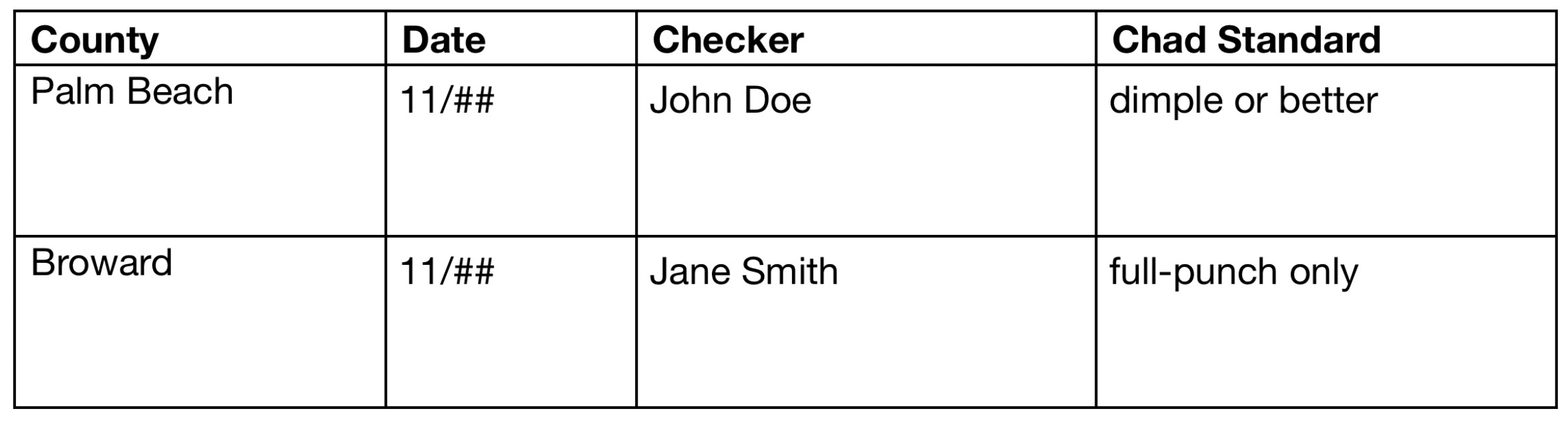
That single sheet could’ve created accountability and slowed the slide into confusion.
Ask: What biases are we bringing into this?
Florida’s recount process assumed undervotes were voter error or machine failure. But what if those assumptions were wrong? What if they reflected systemic flaws like faulty machinery or the confusing butterfly ballot* in Palm Beach? This confused voters, likely costing Gore over 2,000 votes (jsekhon.com). Yet nobody questioned the ballot’s design early on.
A portable audit, grounded in the Five Pillars, would’ve paused to ask:
Am I blaming the voter when the system might be at fault?
Have I checked the hardware or ballot design?
Before jumping to conclusions, I would pause—with those exact questions. It’s the simplest way to avoid blaming people for a broken process.
* The infamous butterfly ballot was used in Palm Beach County in 2000. It presented candidate names on two facing pages with punch holes in the center. Voters frequently selected the wrong hole, accidentally voting for a different candidate, most notably Pat Buchanan, instead of their intended choice, Al Gore.
So what happened?
Thousands of voters in certain counties faced different rules.
Legitimate votes were left uncounted or misrecorded.
The country was left questioning whether our democracy even counted.
Inconsistent chad rules meant votes weren’t treated equally. That’s not a recount, it’s a coin toss on democracy.
That’s Translate the Impact, turning audit into action. It’s not about blame. It’s about clarity, accountability, and what could have been saved.
Mini‑Tool: Recount Standards Checklist
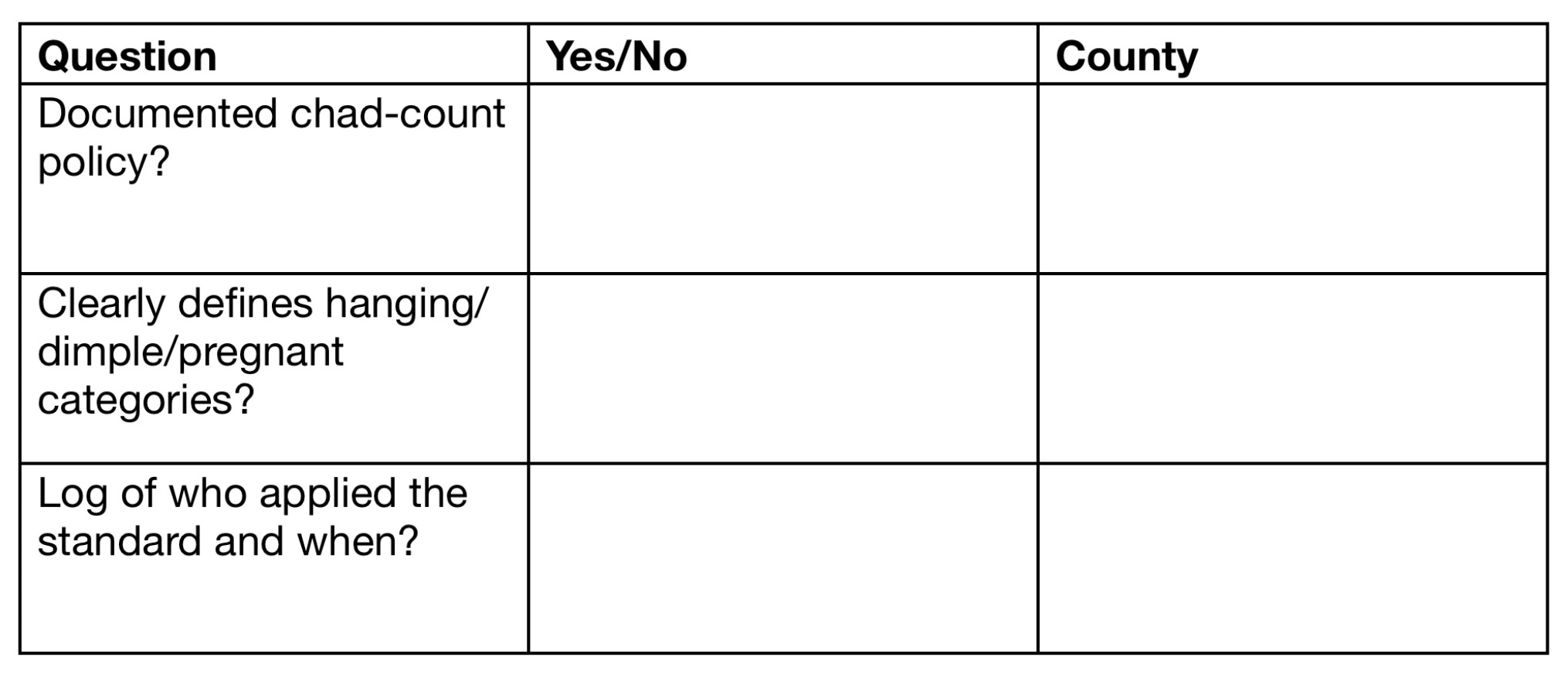
Carry this worksheet to any high-stakes decision. If it’s blank, red flag.
This wasn’t a partisan battle. It was a systems failure under pressure.
Each of the Five Pillars provides a small, portable, and powerful way to avoid similar mistakes in elections, businesses, or nonprofits.
The cost of skipping these questions? Trust, clarity, and real human impact.
What major decision in your work or community could benefit from a quick Check Yourself moment before moving ahead?
Have you seen a process break, not because people wanted it to, but because nobody asked, “How are we defining success?”
Could a one-page checklist, like our Recount Standards one, bring clarity to the next big election challenge?
Reflections welcomed. Share what keeps your systems honest.
No posts
Comments
Nothing yet. Say the first thing.
Sign in to join the conversation.