
Ever wondered…
Why the snack box is always empty before lunch?
Who really forgot to feed the class hamster?
Or why your team’s project didn’t get turned in on time, when everyone said they “did their part”?
If yes, congrats. You’re already thinking like an auditor.
Audit Thinking is about asking smart questions, solving puzzles, and noticing what other people ignore.
And I’m going to teach you how, with five powerful thinking moves.
Before you try and fix it, look at the big picture.
When something’s wrong, don’t rush in. Step back. Look around.
Ask:
What is this supposed to do?
Who’s involved?
Where are things going wrong?
Example: The art supplies keep running out too fast. Instead of blaming the last kid who used the markers, you Zoom Out and realize… no one is checking the supply box after each project. There’s no system!
If someone wanted to cheat, how would they do it?
Every system has rules. But rules only work if they can’t be easily skipped.
Ask:
What’s stopping someone from breaking this rule?
Who’s checking the checker?
Could someone get around the system?
Example: You notice a classmate ends up with two snacks instead of one. The snack monitor is just handing them out from memory. No list, no tally. Maybe the classmate got one early, then came back later. It’s not clear if it was on purpose or just confusion. Either way, the rule is easy to miss. The problem isn’t the person, it’s the system.
Every mistake leaves clues. Follow them.
Whether it’s a missing book or a late assignment, there’s always a trail.
Ask:
What happened first?
Who touched it next?
Is there a record, note, email, or sticker that proves anything?
Example: The class project disappeared from the shared drive. You Track the Trail and find the last person to open it changed the file name by accident. Mystery solved.
Are you being fair? Or just assuming?
Sometimes, we blame people too quickly. Or we trust someone just because we like them. This pillar is about checking your own brain.
Ask:
Am I assuming something because of how someone looks or talks?
Am I being fair to everyone?
Could I be wrong?
Example: You assume the new student broke the glue bottle because they were nearby. But when you stop and Check Yourself, you realize: you didn’t actually see it happen. Maybe someone else did it earlier and didn’t say anything.
Explain what matters and how to fix it.
It’s not enough to spot a problem. You’ve got to help people understand it, and help them with what they can do next.
Ask:
Why does this matter?
Who should hear about it?
What’s a simple way to fix it?
Example: You notice the art supplies are always low by Friday, and no one knows why. So you tell your teacher, “If we don’t start checking supplies after each class, we’ll run out right before projects, and kids won’t have what they need.” Then you add, “Can we make a quick checklist to track it?”
Now your teacher understands the problem and the fix. You didn’t just notice a mess. You turned it into action.
Life is full of confusing moments. Projects break down. People forget. Systems fail.
Audit Thinking helps you stay calm, think smart, and solve real problems at school, at home, even with friends.
You don’t need a badge or a title. You just need curiosity, courage, and a little training.
And now? You’ve got it.
Can you think of a time something didn’t work at school, and no one knew why?
Have you ever blamed someone for something… and later found out it wasn’t their fault?
Which pillar would help the most if the school Wi-Fi stopped working during a test?
How could you use Audit Thinking to make recess fairer?
I’ve built a free, 40-page classroom kit designed just for grades 4–8. It includes:
Five student worksheets (one per pillar)
Step-by-step mini lesson plans
Reflection and assessment tools
A full classroom mission challenge
Simple materials list. No tech required
Perfect for homerooms, life skills, civics, or critical thinking units.
Download the full kit below and start teaching your students how to see what others miss. Because the best problem-solvers aren’t always the loudest, they’re the ones who think first.
Want more classroom tools, thought prompts, and critical thinking missions?
SUBSCRIBE to get new worksheets, educator kits, and real-world case studies as they’re released.
Let’s build a new generation of curious, clear-thinking kids, together.
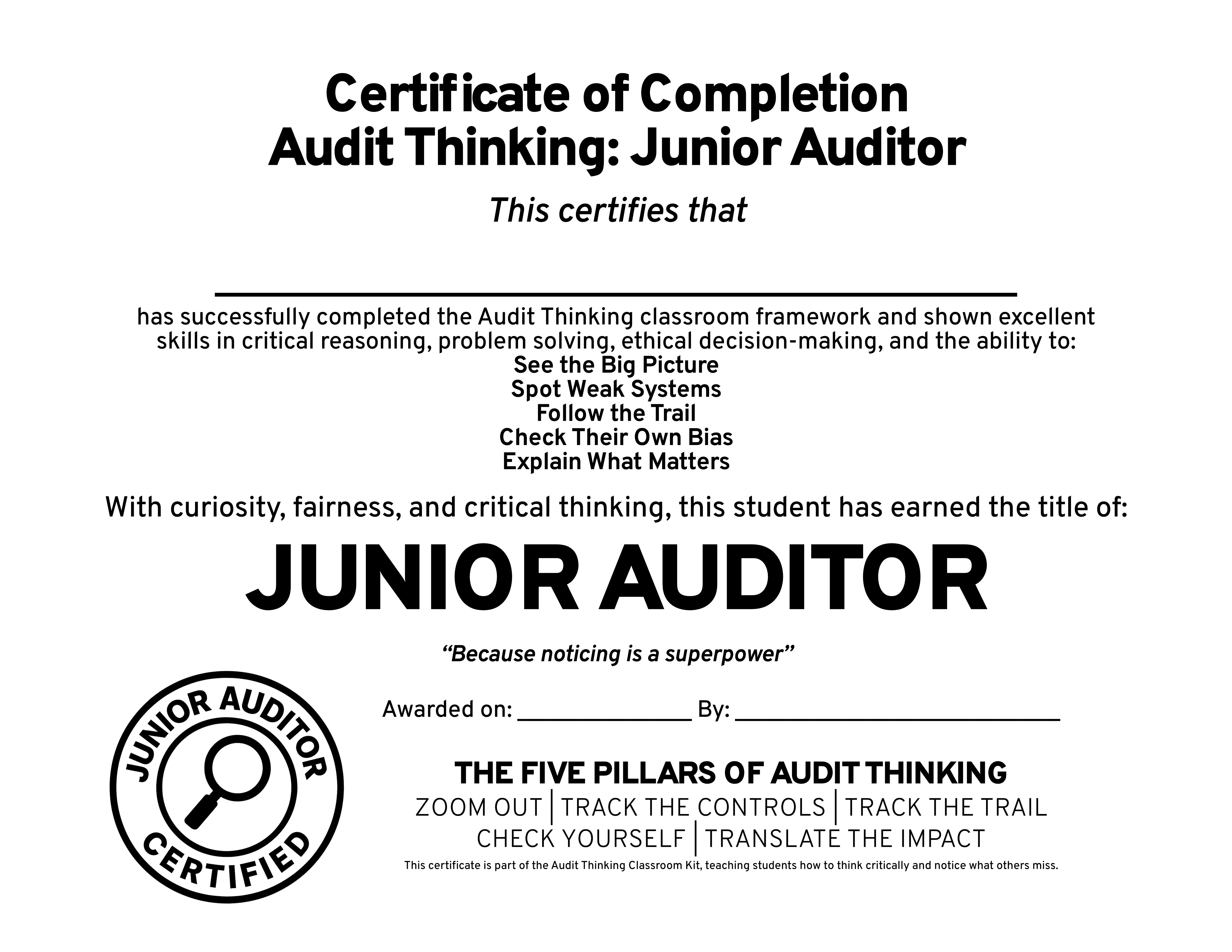
Bonus: The kit comes with a printable certificate so your students can proudly earn the title of Junior Auditor.
To unlock the kit, what’s the full name of the final pillar that turns thinking into fixing? (All lowercase. No spaces.)

No posts
Comments
Nothing yet. Say the first thing.
Sign in to join the conversation.